Language Disorders
 Call Kai
 Learn
Learn Practice Test
 Spaced Repetition
 Match
Match Flashcards
 Knowt Play
1/31

There's no tags or description
Looks like no tags are added yet.
Name | Mastery | Learn | Test | Matching | Spaced | Call with Kai | Chat |
|---|
No analytics yet
Send a link to your students to track their progress
32 Terms
Definition for Speech
HOW we use our voice to communicate our thoughts.
It consists of:
Articulation: ability to produce specific sounds
Voice: quality of sound produced, consists of pitch, loudness, and resonance
fluency: aka stuttering, smoothness and rhythm of speech
Speech → articulation, voice, fluency
Language → content, form, use
Definiton for Language
consists of socially shared roles (grammar, semantics, etc) for how we use words to communicate our thoughts.
consists of:
receptive: understanding language, including following directions and pointing to pictures
expressive: how we use and combine words to share thoughts, ideas, and communicate wants and needs → through speech, writing, gesture, nonverbal communication
pragmatic: social use of language consisting of knowing what to say, how to say it, and when to say it.
Literacy
ability to read and write → also ability to locate, evaluate, use, and communicate using text, visual, audio, and video sources.
5 Domains of Language
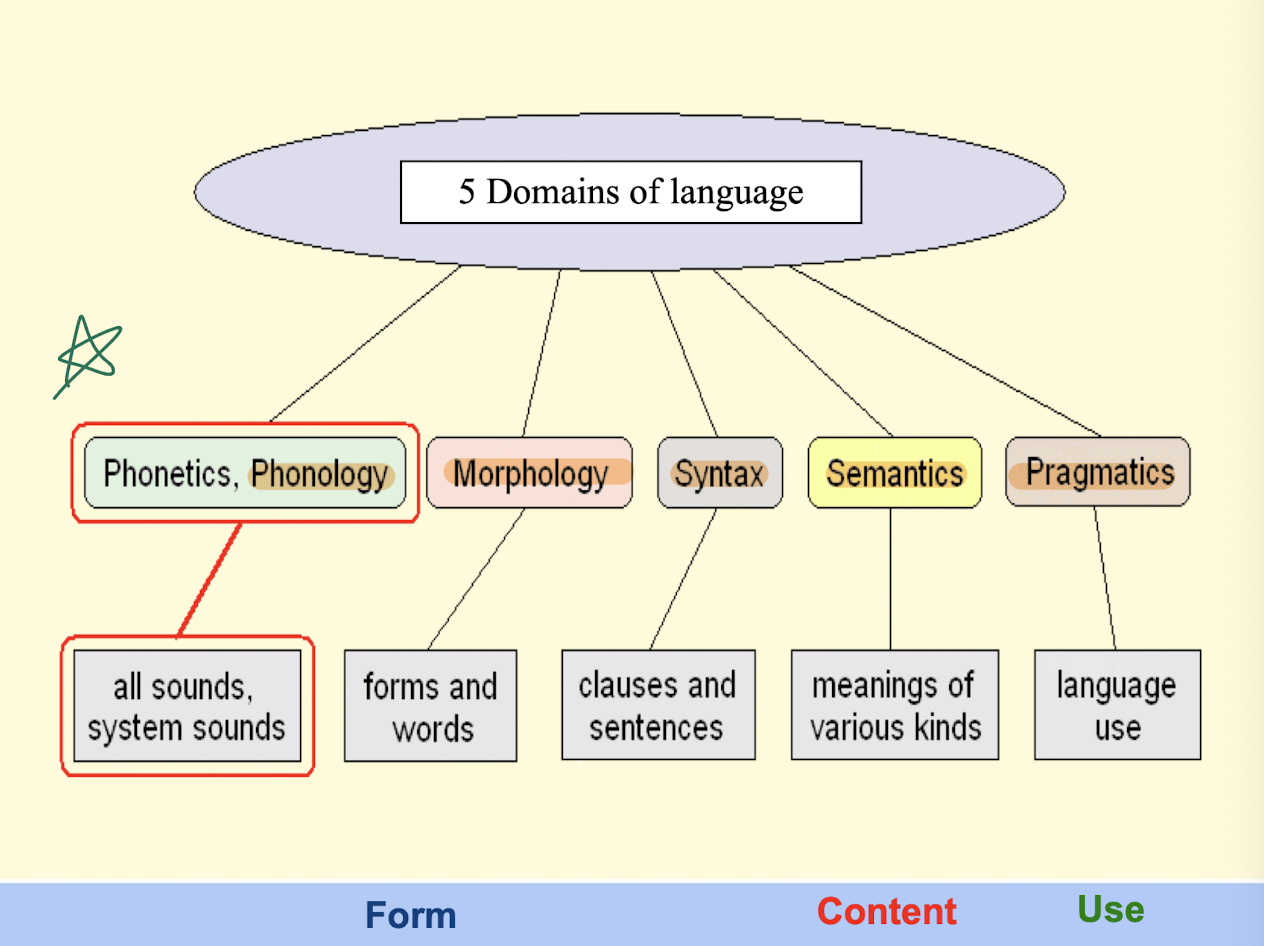
Semantics
the meaning of words → often determined from figurative language and inferential meaning
lexicon → the complete vocabulary of a language
individual words
utterance
word relationships (i.e., antonyms, synonyms)
Syntax
rules for words are sequenced into phrases and sentences → aka grammar
Increased sentence elaboration:
simple: subject-verb-object (Sam ate oranges.)
more complex: subject-verb-object-adverb (The boy ate an apple in the kitchen.) and subject-auxiliary-verb-adverb (He always eats neatly.)
compound and complex sentence structures
Morphology
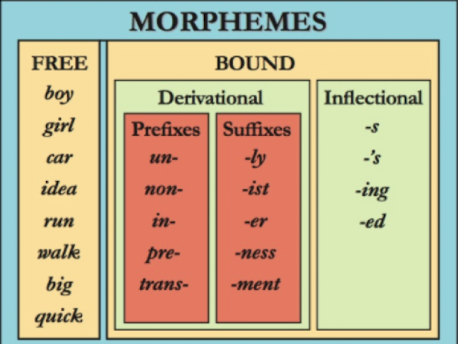
Morphemes are the smallest linguistic unit with meaning.
bound morphemes: (-s, -ed, -est)
cannot stand alone and still convey meaning → usually prefixes, suffixes or inflections
free morphemes or unbound morphemes: (boy)
base words that can stand alone
Exp:
“Unlikely” (3 morphemes) → un- (bound), -like- (free), -ly (bound)
“I need to go now” (5 morphemes) → I (f) need (f) to (f) go (f) now (f)
Phonology
Rules that govern the combination of speech sounds in a language. The rules of sound organization and sequence.
phonemes in a lang; indicates meaning change (pat vs. bat)
order of sounds that can go together “ntat”
refined and mastered by 5 years of age
Pragmatics
Rules for governing the use of language in context.
Elements included:
communicative intents or functions
turn taking
topic maintenance
presupposition (implicit assumption about the world or background relaying to an utterance whose truth is taken for granted)
identification and repaire of communication breakdown
non-verbal signals
appropriate code: style of communication for context/partner
Relationship between comprehension (receptive) and production (expressive)…
Children comprehend before they produce language.
Most adults can comprehend more than they can produce.
e.g., reading the NYT but not repeat it over to someone else
Receptive Language
Decoding the words and sentences → taking the string of auditory information and deriving meaning.
must apply rules to the signals meaning
understanding what someone else says
Modalities include:
listening
reading
seeing
Expressive Language
aka production → encoding: taking abstract ideas and mapping them into words
Modalities:
speaking
writing
writing based on spoken language
signing
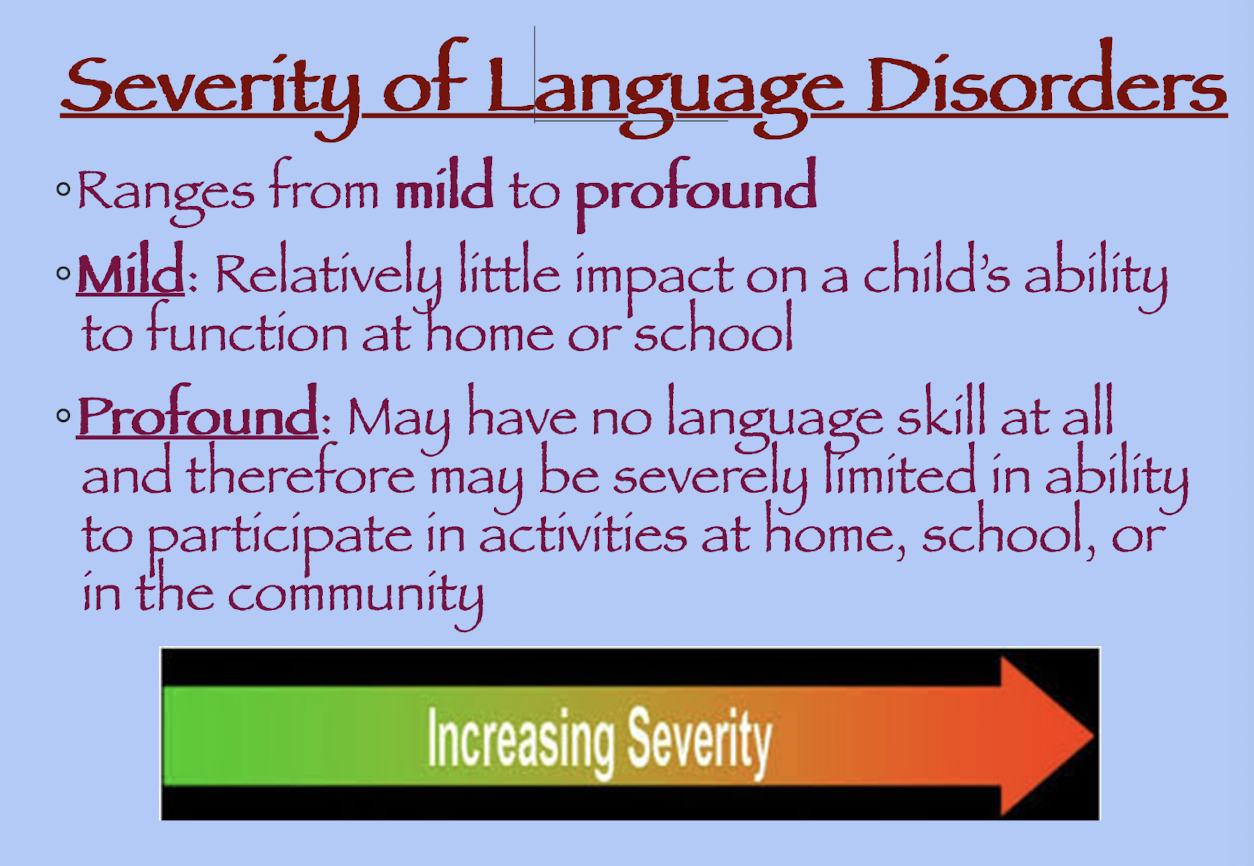
Language Disorders for toddlers and preschoolers typically have difficulty:
achieving important language milestones
Language Disorders for school-age typically have difficulty:
academic skills that rely on language proficiency
Developmental Causes of Language Disorders:
Developmental Language Disorder (DLD): Condition where children have significant difficulties with language development from a young age, despite having typical hearing and cognitive ability.
Intellectual Disability: Cognitive delays can impact language development
ASD: language difficulties are a core feature of autism
Genetic conditions: conditions like down syndrome or Fragile X syndrome can affect language development
Hearing Loss: difficulty hearing can impact a child’s ability to learn and use language.
Acquired Causes After Birth:
Brain Injury:
TBI: cause LD like aphasia → affecting lang expression and comprehension
Stroke → lack of blood flow to brain causes language impairments
Environmental Causes:
lack of language exposure
neglect or abuse → childhood trauma can impact language development
poor nutrition → malnutrition can affect overall development including language
NOTE: IN MANY CASES, THE EXCT CAUSE OF LANGUAGE IMPAORMENT MAY NOT BE IDENTIFIED
Prelinguistic Stage: (Birth-12 months)