photosynthesis
 Call Kai
 Learn
Learn Practice Test
 Spaced Repetition
 Match
Match Flashcards
 Knowt Play
1/40

There's no tags or description
Looks like no tags are added yet.
Name | Mastery | Learn | Test | Matching | Spaced | Call with Kai | Chat |
|---|
No analytics yet
Send a link to your students to track their progress
41 Terms
chloroplast
chloroplasts are organelles that contain photosynthetic pigments, enzymes, and other intermediates to carry out photosynthesis
contain circular DNA & 70S ribosomes
vary greatly in numbers and shapes from one type of plant to another
typically found in palisade mesophyll cells and spongy mesophyll cells in leaves
root hair cells do not have chloroplasts, as these cells do not carry out photosynthesis
structure of chloroplast
disc-shaped
bounded by a double membrane → envelope
both outer and inner membrane form smooth continuous boundaries
inner membrane is impermeable to ions
during chloroplast development, the inner membrane project inwards to give rise to fluid filled sacs called thylakoids but it becomes disconnected from thylakoids in mature chloroplasts
thylakoids → third membrane system
thylakoid membrane forms a network of flattened discs known as thylakoids
thylakoids are usually stacked to form grana (singular: granum)
grana can be joined by intergranal lamella (plural: lamellae)
thylakoid membrane contains the following which are embedded or attached on its surface
photosystems containing various light-absorbing photosynthetic pigments (e.g. chlorophyll, carotenoids) for absorption of light energy during light reaction of photosynthesis
electron carriers
enzymes (e.g., NADP+ reductase)
stalked particles containing ATP synthase
extensive thylakoid membrane increases surface area for absorption of light energy
inside the thylakoid is the thylakoid space → important to create a steep proton gradient for chemiosmosis
stroma (fluid-filled space) contains:
circular DNA with genes which code for its own proteins (electron carriers and enzymes) (10%) + can also self-replicate as chloroplast has its own DNA polymerase
RNA polymerase and 70S ribosomes which allow chloroplasts to synthesise their own proteins
enzymes required for Calvin cycle/dark reaction of photosynthesis (e.g., Rubisco) to synthesise organic compounds (e.g., carbohydrates)
starch grains to store excess glucose
function of chloroplast
carry out photosynthesis
absorb light energy to synthesise ATP and NADPH (light reaction) which are used to synthesise organic compounds (e.g. sugars such as glucose)
store food reserves (e.g. as starch grains)
chloroplast envelope
structure: bounded by double membrane → both outer and inner membrane form smooth continuous boundaries, and the inner membrane is impermeable to ions
function: separates organelle from the cell and allows for
compartmentalisation
thylakoids (third membrane system) → structure and function
thylakoid membrane forms a network of flattened discs known as
thylakoids, and are usually stacked to form grana (singular: granum), and can be joined by intergranal lamella (plural: lamellae)a site where light reactions occur
extensive thylakoid membrane provides a large surface area for attachment of:
photosystems containing photosynthetic pigments (e.g. chlorophyll, carotenoids) for absorption of light energy during light reaction of photosynthesis
electron carriers
enzymes (NADP+ reductase)
ATP synthase (also known as stalked particles)
photosystems and electron carriers are closely located and arranged in a sequential order for electrons to be passed down the chain of electron carriers of decreasing energy levels
releases energy to pump protons (H+) into the thylakoid space (active transport) → increases efficiency of photophosphorylation
the phospholipid bilayer is impermeable to H+, thus
allowing accumulation of H+ in the thylakoid space to create a steep proton gradient
inside the thylakoid is the thylakoid space
important for creating a steep proton gradient for
chemiosmosis
stroma → structure and function
contains many copies of circular chloroplast DNA
genes code for its own proteins such as electron carriers and enzymes needed for dark reactions
as chloroplast has its own DNA polymerase, the circular DNA can self-replicate
contains 70S ribosomes
allow chloroplast to carry out protein synthesis independently of the cell
gel-like medium containing soluble enzymes, organic acids,
lipids, sugars + contain varying concentrations of ATP/ADP, NADPH/NADPsite where dark reaction / Calvin Cycle occurs
requires enzymes (e.g. Rubisco) to synthesise organic compounds (e.g. carbohydrates)
starch grains to store excess glucose as starch
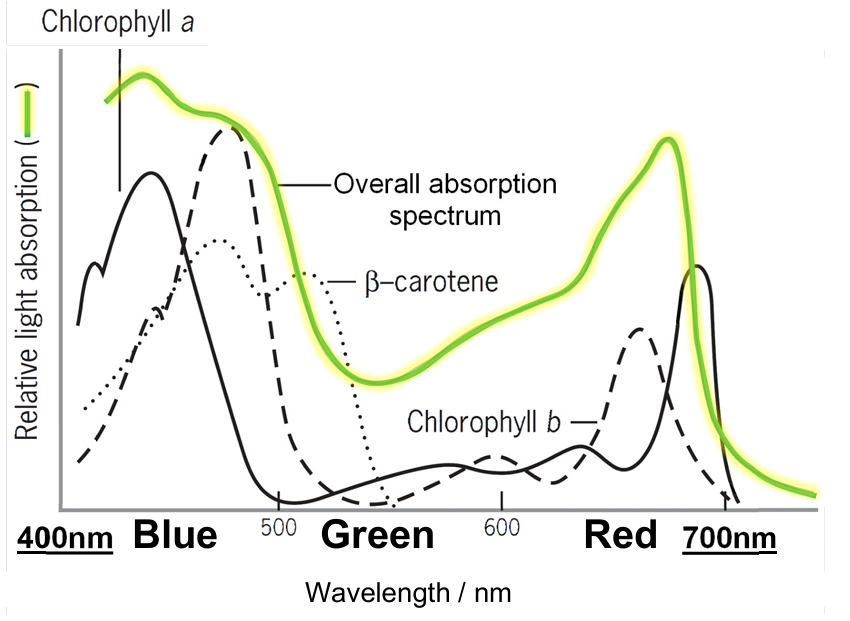
absorption spectrum
absorption spectrum: graph of amount of light energy absorbed for each pigment at each wavelength (λ)
various pigments (e.g. chlorophyll a, chlorophyll b, β-carotenes) absorb light energy from a range of 400 to 700nm
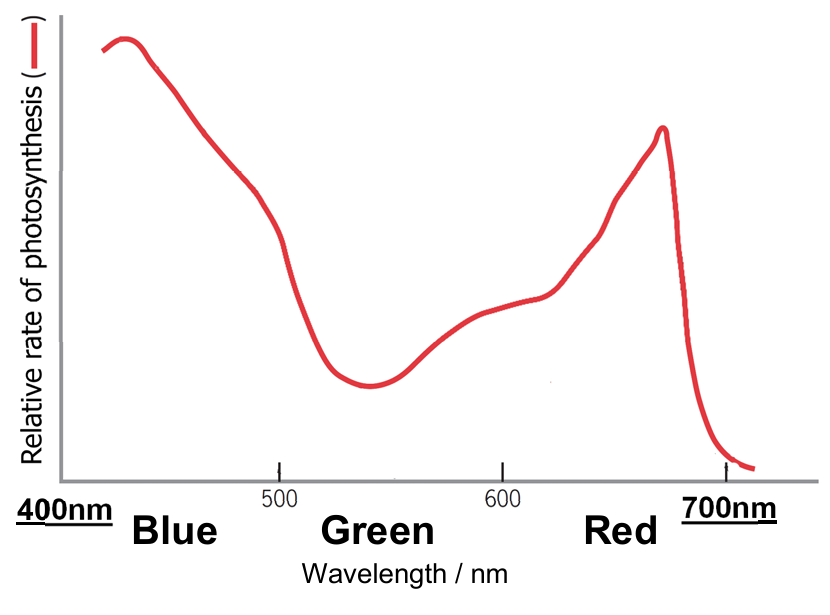
blue and red light brings about high rate of photosynthesis
single chloroplast contains thousands of photosystems → each is a cluster of photosynthetic pigments embedded in thylakoid membranes of chloroplasts
all wavelengths of visible white light, except green, are absorbed
chlorophylls a and b absorb light energy from both blue (400-500nm) and red (600-700nm) regions
β-carotene and xanthophyll absorb light energy from blue (400-500nm)
action spectrum
action spectrum: graph of rate of photosynthesis occurring at each wavelength (λ)
there is a close similarity between absorption and action spectra ⇒ photosynthetic pigments are responsible for absorption of light energy
the relationship between both spectra is not directly proportional
roles of pigment
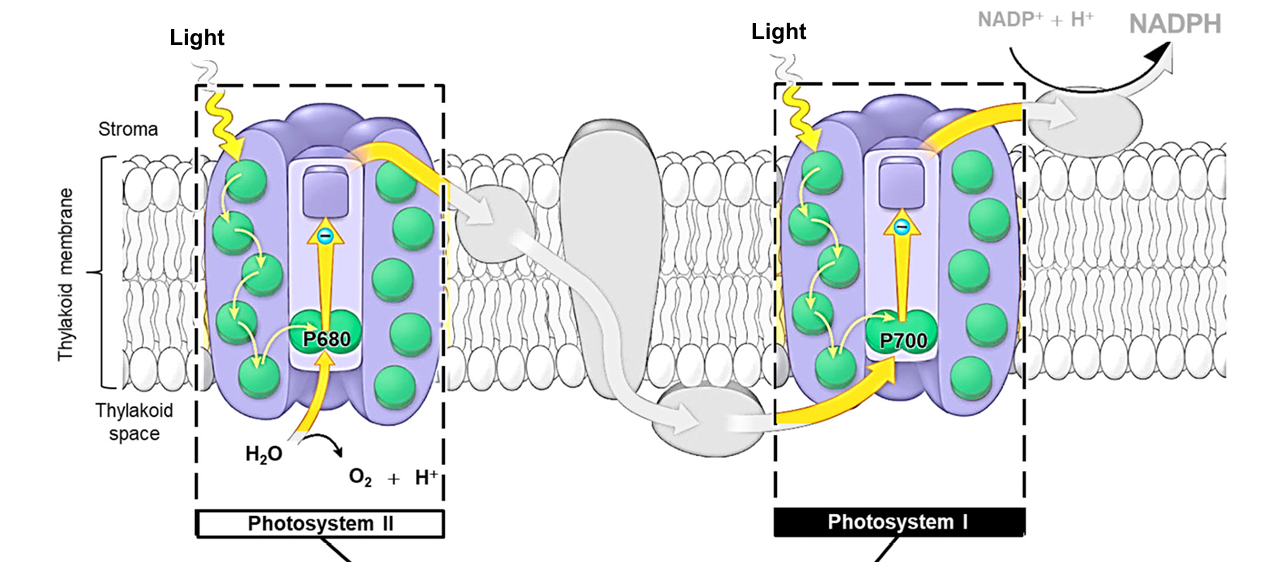
photosynthetic pigments are found in photosystems embedded in thylakoid membrane
two types of photosystems (PS):
PS I: P700 reaction centre (special chlorophyll a absorbs light energy best at 700nm)
PS II: P680 reaction centre (special chlorophyll a absorbs light energy best at 680nm)
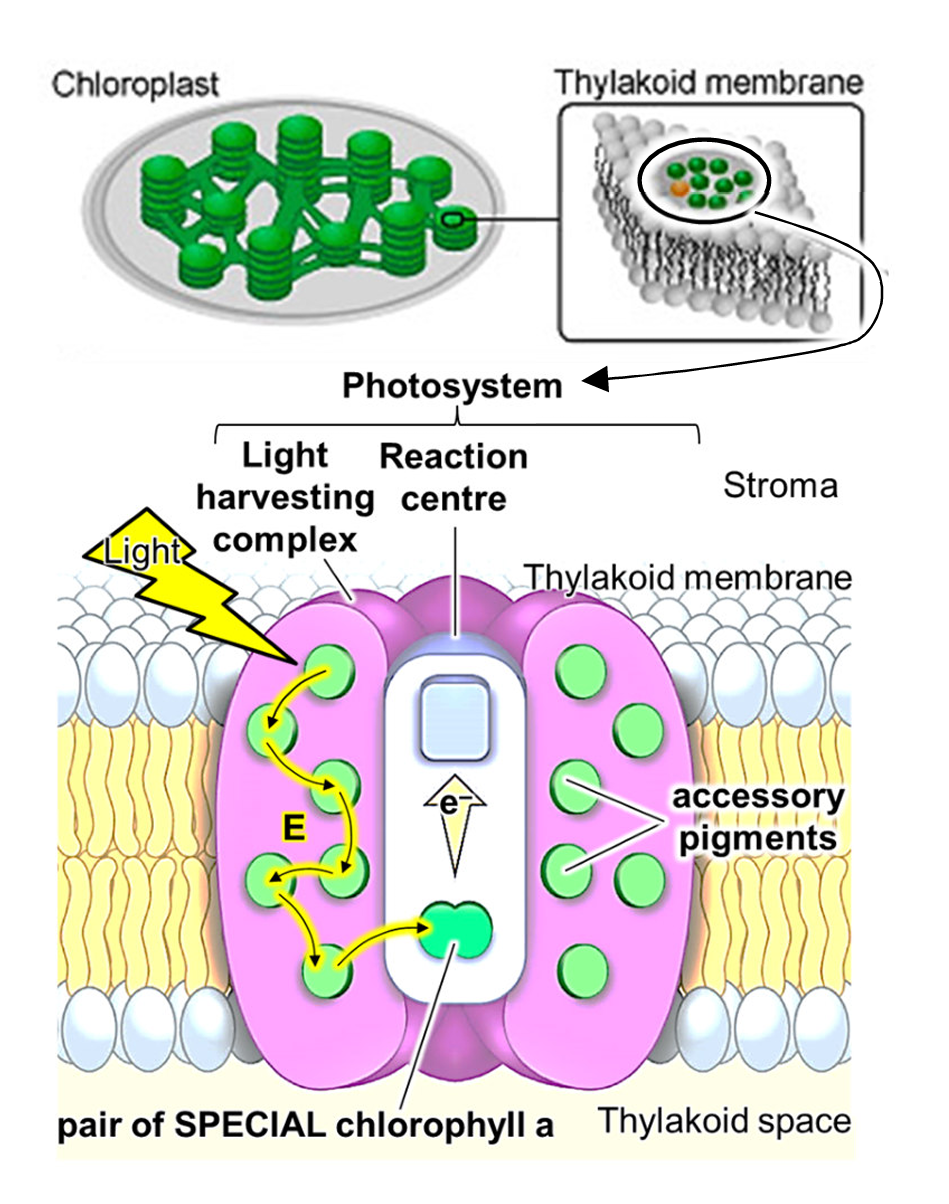
structure of photosystems → each consists of:
a light harvesting complex (LHC)
consists of accessory pigments (e.g. chlorophyll a, chlorophyll b, carotenoids)
which absorb light energy from 400nm to 700nm and transfer energy to the reaction centre
a reaction centre (RC) surrounded by LHC
consists of primary pigments (special chlorophyll a) whose electrons are displaced during photoactivation (activated by light)
when sufficient energy is absorbed, an electron of
special chlorophyll a is boosted to very high energy
level and is displacedthe displaced electron is accepted by electron acceptor and pass down electron carriers of decreasing energy levels in the Electron Transport Chain (ETC)
overview of photosynthesis
photosynthesis is a two-stage process
light reaction (light dependent reaction) / photophosphorylation
dependent on light intensity
dark reaction (light independent reaction) / calvin cycle
independent on light intensity
dependent on temperature, substrate concentration, enzyme concentration, pH (enzyme-controlled)
6CO2 + 6H2O → C6H12O6 + 6O2
light reaction → photophosphorylation
occurs at thylakoid membrane (including grana and intergranal lamellae)
light energy is required (hence light dependent reaction) for photoactivation of special chlorophyll a and photolysis of water
light energy is converted to chemical energy stored in products NADPH and ATP, which are required for dark reaction
O2 is a by-product released during photolysis of water
requirements for light reaction
for non-cyclic photophosphorylation
light energy
NADP+
H2O
for cyclic photophosphorylation
light energy
products for light reaction
for non-cyclic photophosphorylation
ATP for dark reaction (Calvin Cycle)
NADPH for dark reaction (Calvin Cycle)
O2 (by-product)
for cyclic photophosphorylation
ATP for dark reaction (Calvin Cycle)
non-cyclic photophosphorylation
occurs all the time when light energy is present ⇒ makes products used in Calvin Cycle
synthesise of ATP and NADPH via photophosphorylation
at photosystem II (PSII), light energy is absorbed by photosynthetic (accessory) pigments of light harvesting complex (LHC)
energy is passed to neighbouring pigments until it reaches the pair of special chlorophyll a in the reaction centre (RC)
photoactivation of special chlorophyll a at reaction centre results in electron displaced from the pair of special chlorophyll a (oxidised)
photolysis of water occurs (only in PSII) (in thylakoid space) to replenish displaced electrons from PSII
enzyme for photolysis is located at PSII
H+ / protons accumulates in the thylakoid space ⇒ steep proton gradient
oxygen is released as a by-product [2H2O → 4H+ + 4e- + O2] ⇒ diffuse out
electrons (from special chlorophyll a at reaction centre) are passed down electron carriers of decreasing energy levels in the electron transport chain (ETC) from PS II to PS I → unidirectional path
[further explanation] electron carriers (involved in a series of redox reactions) are found in thylakoid membrane arranged in order of decreasing energy levels
electron displaced from PS II is first accepted by primary electron acceptor, and the electron is then passed down electron carriers of the first Electron Transport Chain (ETC) between PS II and PS I, until it reaches the pair of special chlorophyll a in the Reaction Centre of PS I
energy released from flow of electrons is used to pump H+ from stroma (across thylakoid membrane) into thylakoid space, and this creates a steep proton gradient
[further explanation] concentration of H+ in thylakoid space (pH 4) is greater than that in stroma (pH 8)
thylakoid membrane is impermeable to H+ due to hydrophobic core of phospholipid bilayer
photoactivation occurs simultaneously in PS I (i.e., same processes 1 to 3; 5 and 6)
electron displaced from PS I is passed down electron carriers of second ETC
electron is accepted by final electron acceptor NADP+ to form NADPH (reduced NADP), catalysed by enzyme NADP+ reductase [NADP+ + 2H+ + 2e- → NADPH + 2H+]
diffusion of H+ from thylakoid space into stroma through hydrophilic channel of ATP synthase (stalked particle) down concentration gradient releases energy, which is coupled to ATP synthesis, catalysed by ATP synthase via chemiosmosis
[further explanation of chemiosmosis] chemiosmosis refers to the diffusion of H+ from thylakoid space into stroma
through hydrophilic channel of ATP synthase (stalk particle) down concentration gradient releases energy which is coupled to ATP synthesis, catalysed by ATP synthasethe proton gradient is created using energy released when electrons are passed down electron carriers of decreasing energy level and photolysis of water in the thylakoid space
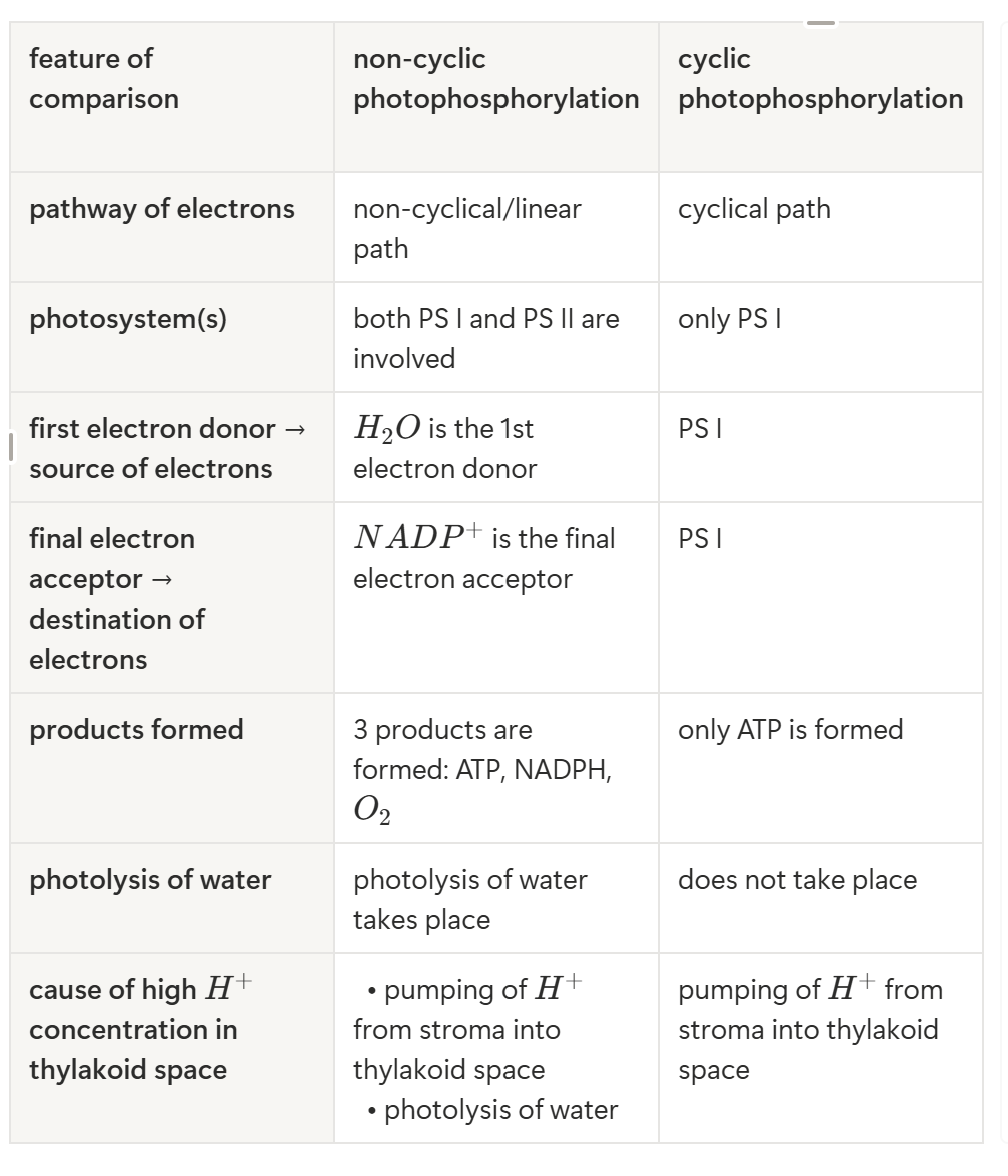
cyclic photophosphorylation → only at PS1
occurs when more ATP is needed ⇒ only ATP is synthesised (no NADPH is produced)
PS I is both the electron donor and acceptor
PS II is not involved
no photolysis of water
at PSI, light energy is absorbed by photosynthetic (accessory) pigments of light harvesting complex (LHC)
energy is passed to neighbouring pigments until it reaches the pair of special chlorophyll a in reaction centre (RC)
photoactivation of special chlorophyll a at RC results in electron displaced from the pair of special chlorophyll a
electron is passed down electron carriers of decreasing energy levels from PS I to the ETC between PS II and PS I, and back to PS I, hence, NADPH is not formed [no water is needed ⇒ no photolysis]
energy released from flow of electrons is used to pump H+ from stroma (across thylakoid membrane) into thylakoid space, and this creates a steep proton gradient
diffusion of H+ from thylakoid space into stroma through hydrophilic channel of ATP synthase (stalked particle) down concentration gradient releases energy, which is coupled to ATP synthesis, catalysed by ATP synthase via chemiosmosis
non-cyclic photophosphorylation VS cyclic photophosphorylation
calvin cycle
occurs in stroma
light energy is not directly involved in the reaction ⇒ light independent
occurs all the time (even in absence of light) if there are products of light reaction (ATP and NADPH) available to fix CO2 and synthesise carbohydrates & other organic molecules [incorporates CO2 into organic molecules, converted to sugar]
requirements for calvin cycle
from light reaction: 2 high energy chemical molecules which drive
Calvin cycleATP for carbon reduction and RuBP regeneration
NADPH for carbon reduction
from air:
CO2 for carbon fixation
within stroma of chloroplast:
Ribulose-1,5-bisphosphate (RuBP)
compounds exiting the calvin cycle
ADP
NADP+
Glyceraldehyde-3-phosphate 3 also known as triose phosphate (TP)/GALP/G3P
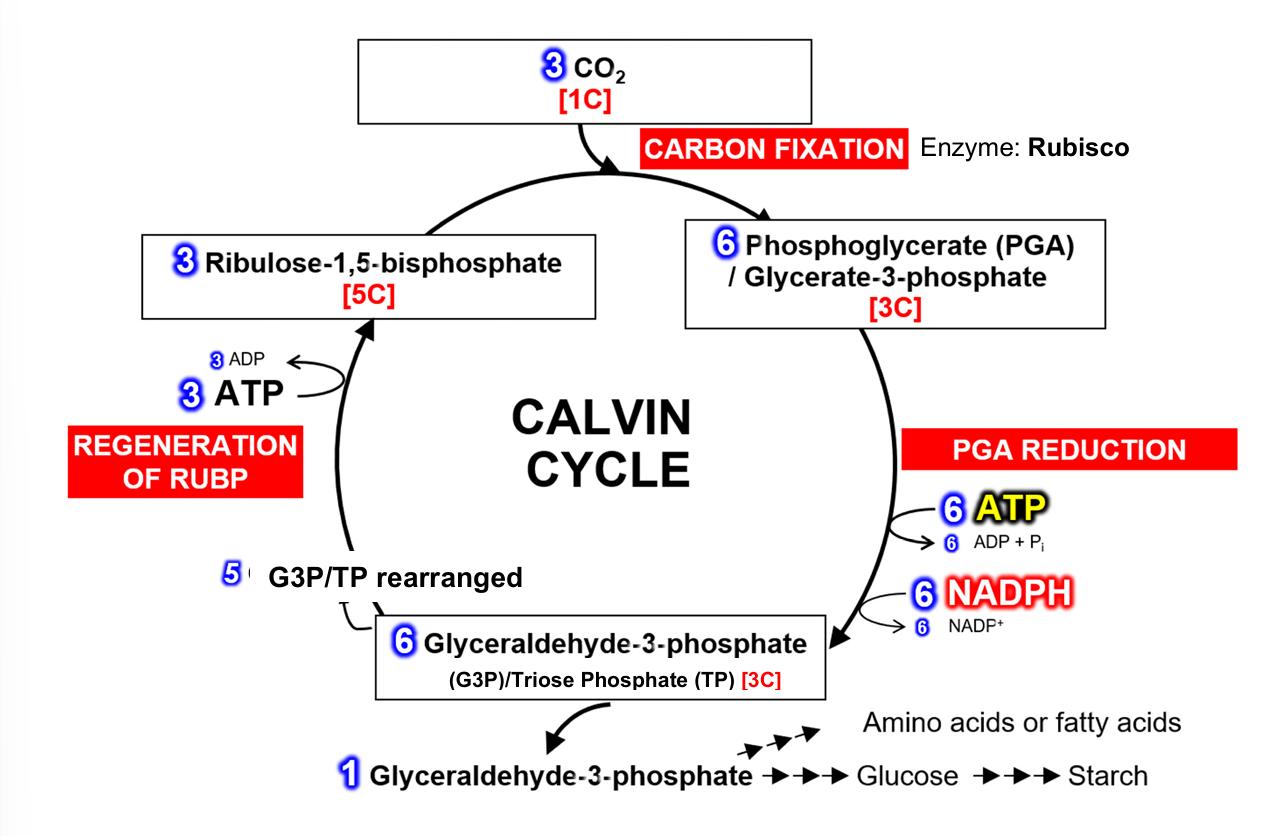
processes in calvin cycle
carbon (CO2) fixation
Rubisco (Ribulose-1,5-bisphosphate carboxylase-oxygenase) catalyses CO2 fixation
CO2 combines with RuBP (5C) to form an unstable 6C compound, which breaks down into 2 molecules of phosphoglycerate4 (PGA / GP) (3C)
PGA reduction
Phosphoglyceric acid (PGA) (also known as glycerate-3-phosphate) is phosphorylated and then reduced to glyceraldehyde-3-phosphate (or triose phosphate [TP] or GALP or G3P or PGAL) using ATP (provides energy) and NADPH (oxidised) from light reaction
regeneration of RuBP
Glyceraldehyde-3-phosphate (TP) is phosphorylated using ATP from light reaction and rearranged to regenerate ribulose-1,5-bisphosphate (RuBP) for Calvin Cycle to continue to occur
5 TP (3C) molecules rearrange to form 3 RuBP (5C), which require total of 3 ATP
one glyceraldehyde-3-phosphate (TP) exits the cycle to form organic compounds (e.g. carbohydrates, amino acids, fatty acids)
[further explanation] 2 TP (3C) molecules combine to form glucose (6C), which is used to form starch for storage
important pointers for photosynthesis experiments
rate of photosynthesis can be measured by:
volume of carbon dioxide taken in per unit time → rate of substrate being used up
volume of oxygen evolved per unit time → rate of product being formed
increase in dry mass per unit time → rate of product being formed – carbon fixation
when the effect of different experimental conditions (e.g., light intensity) on the rate of photosynthesis is investigated, it is best to use the same individual plant
when the rates of photosynthesis of different plants are compared, calculate the rate of photosynthesis per unit time and per unit mass of plant (or per unit surface area of leaf) before
comparisonremember to take into consideration the rate of respiration before calculation of the rate of photosynthesis
products of photosynthesis (carbohydrates, oxygen) are used in respiration
product of respiration (carbon dioxide) is used for photosynthesis
limiting factor
limiting factor: a factor that is nearest to its minimum value and directly increases the rate of reaction when its quantity is changed
typical graph of the effect of a factor affecting rate of photosynthesis
all factors (e.g., light intensity) affecting the rate of photosynthesis will have their effects presented
in the form of a graph
light intensity
light energy is required for photoactivation of special chlorophyll a and photolysis of water in light reaction/photophosphorylation in order to synthesise NADPH and ATP for Calvin Cycle
light intensity is usually not a major limiting factor for most plants (except for shade plants) unless it is during sunrise and sunset
light intensity on a clear summer day → about 100 000 lux
light saturation for C3 plants → about 10 000 lux (10% of full sunlight
very high light intensity may damage chlorophyll (photobleaching) which reduces the rate of photosynthesis
plants exposed to such conditions (e.g., desert plants) usually have thick cuticles and hairy leaves
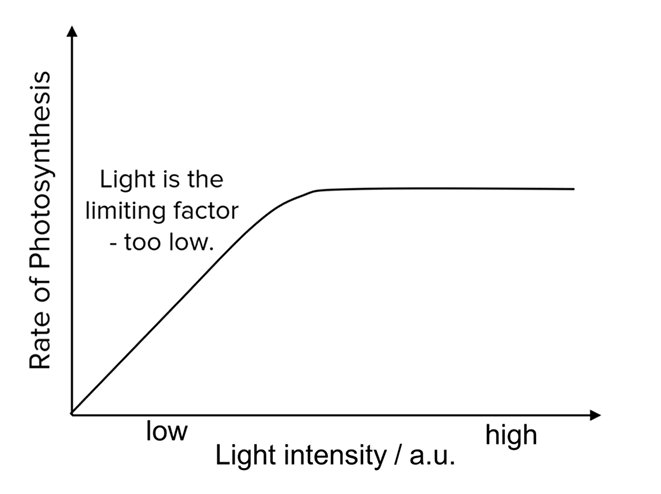
to describe light intensity graph
A: rate of photosynthesis increases steeply (and linearly)
light intensity is the limiting factor
as light intensity increases, more light energy is absorbed by photosynthetic pigments
rate of photoactivation of special chlorophyll a increases, and the rate of light reaction and photosynthesis increases
B: rate of photosynthesis increases gradually → slows down
another factor is becoming the limiting factor
C: rate of photosynthesis remains constant / is at its maximum
light saturation point is reached
light intensity is no longer the limiting factor; another factor is the limiting factor [it could be CO2 or
temperature]
![<ul><li><p>A: rate of photosynthesis increases steeply (and linearly)</p><ul><li><p>light intensity is the limiting factor</p></li><li><p>as light intensity increases, more light energy is absorbed by photosynthetic pigments</p></li><li><p>rate of photoactivation of special chlorophyll a increases, and the rate of light reaction and photosynthesis increases</p></li></ul></li><li><p>B: rate of photosynthesis increases gradually → slows down</p><ul><li><p>another factor is becoming the limiting factor</p></li></ul></li><li><p>C: rate of photosynthesis remains constant / is at its maximum</p><ul><li><p>light saturation point is reached</p></li><li><p>light intensity is no longer the limiting factor; another factor is the limiting factor [it could be CO2 or<br>temperature]</p></li></ul></li></ul><p></p>](https://assets.knowt.com/user-attachments/72fa79f7-29e1-4cde-9d87-ad5d266a7b4a.png)
compensation point → light intensity
compensation point: light intensity whereby rate of photosynthesis equals rate of respiration
there is no net gaseous exchange between the plant and its environment
all CO2 released during respiration are used in photosynthesis
O2 produced during photosynthesis are used for respiration
no net increase in dry mass and no growth of plants
compensation point is reached at low light intensity, usually during sunrise and sunset
carbon dioxide concentration
CO2 is required for carbon fixation during dark reaction
CO2 concentration is a major limiting factor in photosynthesis since its concentration in the atmosphere is about 0.04%
as carbon dioxide concentration increases, the rate of synthesis of carbohydrates via dark reaction / Calvin Cycle increases until limited by other factors
[FYI] however, increased atmospheric CO2 may result in fewer stomata formed
![<ul><li><p>CO<sub>2</sub> is required for carbon fixation during dark reaction</p></li><li><p>CO<sub>2</sub> concentration is a major limiting factor in photosynthesis since its concentration in the atmosphere is about 0.04%</p><ul><li><p>as carbon dioxide concentration increases, the rate of synthesis of carbohydrates via dark reaction / Calvin Cycle increases until limited by other factors</p></li><li><p>[FYI] however, increased atmospheric CO<sub>2 </sub>may result in fewer stomata formed</p></li></ul></li></ul><p></p>](https://assets.knowt.com/user-attachments/037408fa-a3be-4127-a9ed-80a6270c319d.png)
temperature
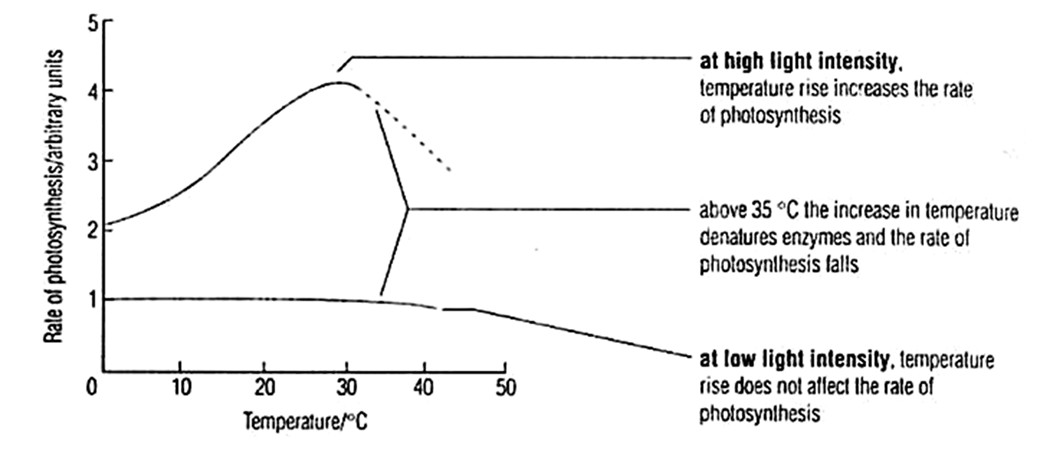
temperature affects the rate of enzymatic reaction
especially for enzymes involved in Calvin Cycle (dark reaction)
enzymes (e.g., NADP+ reductase, ATP synthase) in light reaction are also affected
for every 10°C increase in temperature, up till its optimum temperature, the rate of photosynthesis doubles
beyond the optimum temperature, the enzymes denature
other factors affecting rate of photosynthesis
effect of light quality (wavelength)
rate of photosynthesis is higher when blue or red wavelengths are absorbed
effect of oxygen concentration
Rubisco has a binding affinity for both CO2 and O2→ both can bind to Rubisco
at high CO2 concentration, CO2 binds at the active site of rubisco for carbon fixation
at low CO2 concentration, O2 successfully competes with CO2 for the active site of Rubisco ⇒ rate of carbon fixation is reduced
effect of availability of water
only less than 1% of water absorbed by roots are used in photosynthesis, hence availability of water in the soil is unlikely to affect the rate of photosynthesis
however, when there is very high rate of transpiration (greater than uptake of water), it results in the closure of stomata, in order to reduce water loss
the rate of gaseous exchange decreases, resulting in decrease in the rate of carbon fixation
effect of chlorophyll concentration
chlorophyll concentration is usually not a limiting factor
decrease in chlorophyll concentrations causes leaves to turn yellow ⇒ rate of photosynthesis decreases
reasons:
magnesium and nitrogen deficiency → both are part of structure of chlorophyll
lack of light → light is required for final stage of chlorophyll synthesis
disease or ageing
orientation of ATP synthase in mitochondrion and chloroplast:
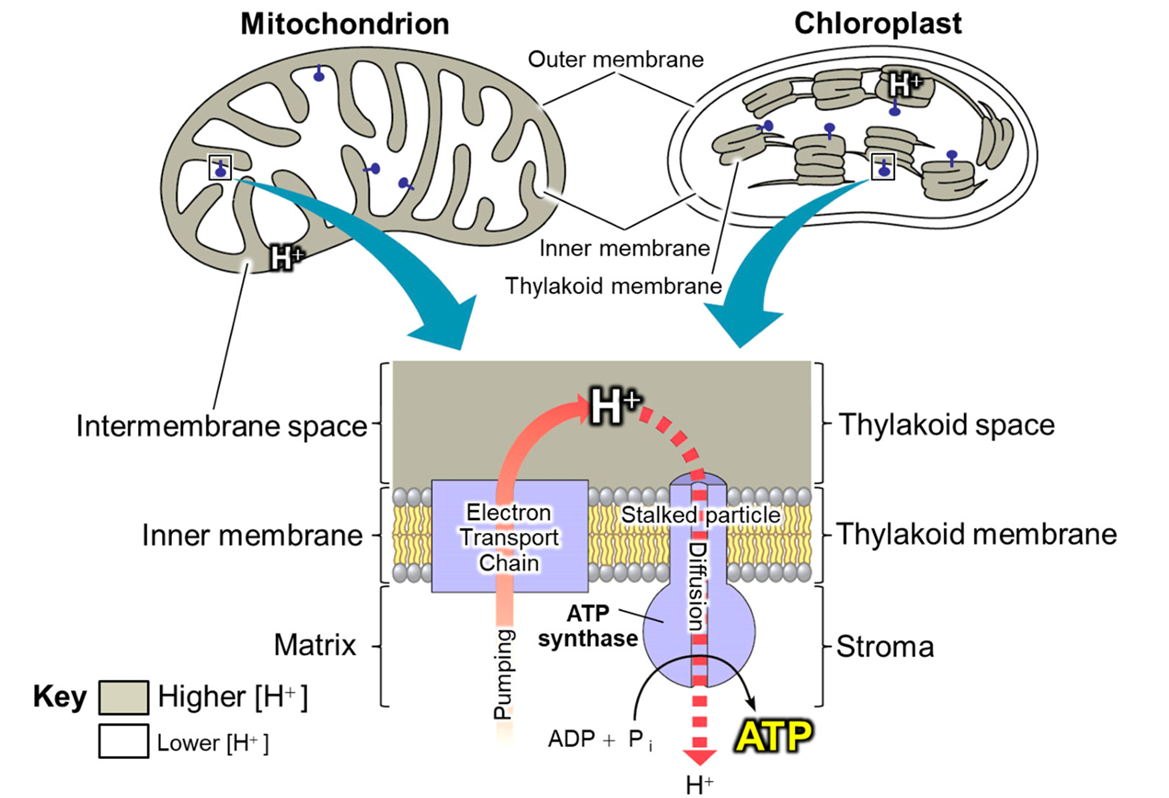
similarities between photophosphorylation VS oxidative phosphorylation
electrons passed down electron carriers of decreasing energy level in electron transport chain
pumping of H+ across membrane to create steep proton gradient
diffusion of H+ via hydrophilic channel of ATP synthase (stalked particle) to synthesise ATP
differences between photophosphorylation VS oxidative phosphorylation
feature of comparison | photophosphorylation | oxidative photophosphorylation |
|---|---|---|
location | takes place in the thylakoid of chloroplasts | takes place in the inner mitochondrial membrane |
source of electrons |
|
|
final electron acceptor |
| O2 |
products formed | 3 products are formed: ATP, NADPH, O2 | 2 products are formed: ATP, H2O |
requirement of light energy | required for photolysis of water | not required |
source of energy | light energy | oxidation of glucose provides source of energy |
direction of H+ pumped to generate steep proton gradient | H+ pumped from stroma to thylakoid space | H+ pumped from matrix to intermembrane space |
direction of H+ diffusion to synthesise ATP | diffusion from thylakoid space to stroma | diffusion from intermembrane space to matrix |
similarities between Calvin Cycle VS Krebs Cycle
involve cyclic pathways / regeneration of intermediates
differences between Calvin Cycle VS Krebs Cycle
features of comparison | Calvin Cycle | Krebs Cycle |
|---|---|---|
location | stroma of chloroplast | matrix of mitochondrion |
(starting) intermediate regenerated | RuBP is regenerated | oxaloacetate is regenerated |
compounds exiting cycle | TP/GALP/G3P, NADP+, ADP | NADH, FADH2, ATP |
involvement of CO2 | CO2 is fixed by rubisco | CO2 is released during oxidative decarboxylation |
role of electron/hydrogen carrier | NADPH provides reducing power for carbon reduction | NADH is a product formed during oxidation of acetyl-CoA |
role of ATP |
| synthesise ATP by substrate level phosphorylation |
type of metabolic process/enzyme reaction | anabolic reaction → carbon is fixed to | catabolic reaction→ carbon is removed as CO2 from organic compound |
similarities between chloroplast VS mitochondrion
both chloroplasts and mitochondria have an outer and inner membrane
both organelles, outer membranes form a smooth and continuous boundary
both organelles have circular DNA
both organelles have 70S ribosomes
both have electron carriers embedded in the internal membrane system → inner membrane of mitochondria and thylakoid membrane of chloroplast
both have ATP synthase embedded in the internal membrane system → inner membrane of mitochondria and thylakoid membrane of chloroplast
both have an extensive system of membrane inside
differences between chloroplast VS mitochondrion
feature of comparison | chloroplast | mitochondrion |
|---|---|---|
folding of inner membrane to form cristae | no | yes |
presence of thylakoid/grana | yes | no |
presence of photosystems/ chlorophyll embedded in thylakoid membrane | yes | no |
presence of starch grains | yes | no |
direction of projection of ATP synthase → stalked particle | project outwards into the stroma | project inwards into matrix |
similarities between photosynthesis VS respiration
require organelles
chloroplasts for photosynthesis
mitochondria for respiration
energy-converting process
cyclic pathway involved
Calvin Cycle for photosynthesis
Krebs Cycle for respiration
require Electron Transport Chain for chemiosmosis to occur, and the ETC is found on:
thylakoid membrane for photosynthesis
inner mitochondrial membrane for respiration
ATP synthesis via ATP synthase/phosphorylation occurs
differences between photosynthesis VS respiration
feature of comparison | photosynthesis | respiration |
|---|---|---|
organelle where process occurs | chloroplast | mitochondrion |
type of cells | cells containing | all cells (all the time) |
involvement of light | yes for light reaction | no |
use of energy | energy is accumulated and used to synthesise carbohydrates and stored in carbohydrates | energy is used to synthesise ATP |
dry mass of cell | increase | decrease |
involvement of oxygen | released as by-product of light reaction | used as final electron acceptor in oxidative phosphorylation |
involvement of carbon dioxide | fixed during carbon fixation in Calvin Cycle to synthesise carbohydrates | released during oxidative decarboxylation in link reaction and Krebs Cycle |
involvement of water | used for photolysis of water in light reaction | released after final |
type of metabolic process/enzyme reaction | anabolic → carbon is fixed to synthesise organic compounds | catabolic → carbon is removed as CO2CO_2CO2 from organic compound) |