P4.2.1 Electrical charge
 Call Kai
 Learn
Learn Practice Test
 Spaced Repetition
 Match
Match Flashcards
 Knowt Play
1/6

There's no tags or description
Looks like no tags are added yet.
Name | Mastery | Learn | Test | Matching | Spaced | Call with Kai | Chat |
|---|
No analytics yet
Send a link to your students to track their progress
7 Terms
Characteristics of charge
Electric charge (Q) can be positive or negative
Opposite charges attract, like charges repel
Measured in Coulombs (C) or millicoulombs (mC)
mC to C → divide by 1000
C to mC → multiply by 1000
What is a conductor? Provide examples
Conductors:
Materials that allow electrical charge to move freely
Examples:
Metals (have delocalised electrons that can move to conduct electricity)
Silver
Gold
Copper
Steel
Sea water (NaCl dissolves and acts as an electrolyte)
What is a semiconductor? Provide examples
Semiconductors:
Materials that are poor conductors when cold, but better when warm
Examples:
Silicon
Germanium
What is an insulator? Provide examples
Insulators:
Materials that do not allow electrical charge to move freely
Examples:
Wood
Rubber
Glass
Oil
Diamond
Describe how electrostatic charge occurs
Electrostatic charge can be produced by friction
When 2 insulating materials rub against each other, electrons may be transferred
The material that gains electrons will become negatively charged
The material that loses electrons will become positively charged
Describe methods for detecting electrostatic charge
Putting charged object near paper scraps and watch paper scraps be attracted to object
Putting charged object near water stream and watch stream bend
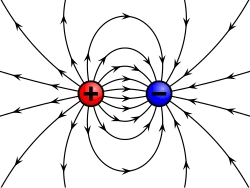
What is an electric field?
A region in which an electric charge experiences a force
An electric field always points in the direction in which a positive charge experiences a force
If the positive charge is pulled to the right, field lines point to the right, and vice versa