Prelim Revision : SHORT ANSWER QUESTIONS
 Call Kai
 Learn
Learn Practice Test
 Spaced Repetition
 Match
Match Flashcards
 Knowt Play
1/33

There's no tags or description
Looks like no tags are added yet.
Name | Mastery | Learn | Test | Matching | Spaced | Call with Kai | Chat |
|---|
No analytics yet
Send a link to your students to track their progress
34 Terms
Q21. Landscape product
Function and quality of different types of Lawn Mowers
John Ferrabee (1830)
Follows and Bate (1900)
Royal (1936)
Victa 2 Stroke (1950)
Victa 2 stroke (1960)
Sunbeam 2 stroke (1974)
Honda 4 stroke (2011)
John Ferrabee ( materials and Quality + Function of mower)
The first push mower invested by Edward Budding in 1830
Roller for regulating the height to prevent the machine from dropping into ground
Front Mounted Catcher
Wrought Iron
- Ductile, tough and strong, so it can withstand bending and impacts without easily cracking.
Cast Iron
Hard, strong in compression and wear-resistant, making it suitable for parts exposed to vibration
Follows and Bate
Catcher behind the main body of the mower
Gear driven
Timber Handles
Lightweight and easy to shape with the tools available in 1900.
Steel frame and gears
High strength and toughness, allowing the mower to handle mechanical loads.
Royal
Petrol engined domestic mower
Chain drive and front mounted catcher
- Fabricated steel frame, engine uses cast iron
- Steel reel → tough + sharp
Victa 2 stroke (1950)
Cast iron base plate with no provision for catcher
Handles painted tube steel
FUNCTION
Started by using a rope wrapped around a pulley at the top of the motor
Tiresome, took many pulls
Victa 2 Stroke (1960)
Self propelled model
Fuel tank and impulse starter
Polyethelene catcher
Sunbeam Mower
160 cc two stroke motor
Fuel tank, recoil starter
Pipes exhaust fumes to reduce airbone pollution
Mulch and catch mower (HONDA 4 STROKE)
Offer choice between mulching and catching
More versatile
Base plate is cast aliminium
Catcher is Poleyethelyne Terephtalte
Safety Features of Lawn Mowers (2 AND EXPLANATION)
Operator presence control: Stops the engine or blades when the operator releases the handle.
Blade guard: Covers the blade to prevent contact with the operator and reduce objects being thrown
Quality of materials used on Landscape product
Cast Iron
Wrought Iron
Mild Steel- Deck
Die cast Aliminium Deck
Poleyehtylne terephtlate (PET) fabric
Cast Iron
High strength, hardness and wear resistance are important.
Wrought Iron
Ductile, tough and strong, so it can withstand bending and impacts without easily cracking.
Mild Steel DECK (Advantages and Disadvantages)
Advantage
Strong and durable – can withstand impacts from rocks and other object
Disadvantage
Can rust/corrode when exposed to moisture and grass
Die cast Aliminum Alloy Deck (Advantages and Disadvantages)
Advantages
Lightweight – much lighter than steel
Disadvantages
Less tough than mild steel and can crack under severe impact
Poleyehtylne terephtlate (PET) fabric
High strength
Fabric is durable and resistant to tearing
Lightweight
Forming methods of Lawn mower components
What forming process are used to make lawm mower components
Aliminium Deck (Die- casti…)
defintion of die casting
2 types of die casting
how does it help w lawn mower deck
Die casting is the forming process
Diecasting involves when molten metal is forced under high pressure into a reusable metal mould . The metal cools and solidifies, then the finished component is removed.
Gravity die casting and Pressure die casting
Helps with lawn mower deck by..
Produces denser, stronger castings with excellent surface finish.
The process allows a complex, rigid deck to be produced accurately while keeping it lighter and corrosion-resistant
Lawn mower wheels ( Plastic process) - injec… m
define forming process
how does it help w lawn mower wheels ( 2 advanatges , fast prod.. , consisten..)
Forming process= Injection Moulding
Injection moudling: .Molten plastic is injected under pressure into a mould, where it cools and solidifies into the required wheel shape.
How does it help
Fast production – ideal for producing large quantities of wheels.
Consistent dimensions – every wheel can be produced to the same size.
Blade
forming process (forg…) meaning
how does it help “blade” ( 3 advantages), high stren, high toug, better grai..
Forming Process
- Forging: Proccess of shaping a metal with forceful blows usually by hammering or pressing
- Produces high strength to withstand the forces from cutting.
- Improves toughness, helping the blade resist impact from small objects.
- Creates a strong grain structure in the steel.
Punching Shear FORMULA
PUNCHING SHEAR = FORCE/ CIRCUMFERENCE X THICKNESS
Q22.
Pascals Principle Calculation
Pressure 1= Pressure 2

Quality and and microstructure of materials used in Braking System
refer to other slides
BRAKING SYSTEM: From flashcard 33-72
Stress and Strain Graph
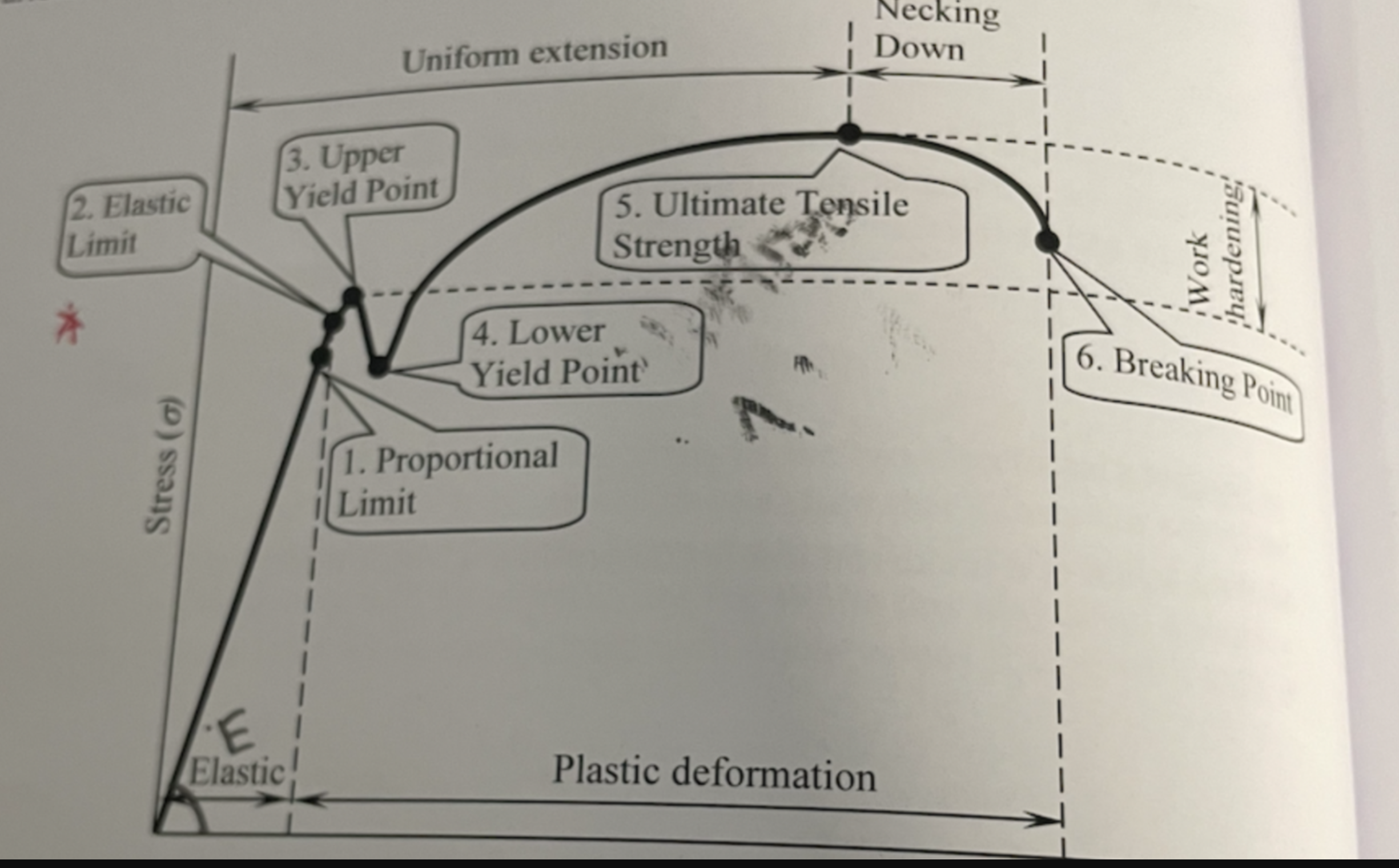
Features of Stress and Strain
Proportional Limit (Hookes Law) - SHOWS STIF..
- Straight line relationship between stress and strain
- E= STRESS/ STRAIN ( E = Young’s Modulus (Pa))]
SHOWS STIFNESS
Elastic Limit, what happens beyond this point
Beyond this point plastic deformation will occur
Ultimate Tensile Strength
Maximum stress a material can withstand
Necking:
Undergo localised deformation
Toughness
Toughness: The area under the whole curve, resistance to shock loading
Resilience:
The area under the curve ONLY in Elastic Deformation region, It is also the amount of strain energy stored
Components method
Calculationn- practise in book
Q23