N160 FINAL SLAYER 😈
 Studied by 0 people
 Call with Kai
 Learn
Learn Practice Test
 Spaced Repetition
 Match
Match Flashcards
 Knowt Play
1/229

There's no tags or description
Looks like no tags are added yet.
Name | Mastery | Learn | Test | Matching | Spaced | Call with Kai |
|---|
No study sessions yet.
230 Terms
What supports functioning of the group?
group interaction style
commonality of purpose
group process
group cohesiveness
group dynamics
What does PEACE stand for?
PRAXIS
EMPOWERMENT
AWARENESS
COOPERATION
EVOLVEMENT

What is praxis? (P.E.A.C.E.)
ability to plan and perform purposeful movement
thoughtful reflection and action that occur in synchrony
values made visible through deliberate action
What is one example of Praxis? (P.E.A.C.E.)
You become aware that you have been avoiding talking with and interacting with a person in your group who is new, who does not seem to be someone you would ordinarily get to know.
You begin to reflect on what is keeping you at a distance from this person and come to terms with some stereotypes and prejudices that you want to overcome.
Asyou begin to interact with the person, you realize that doing so it not easy; your old attitudes keep getting in the way. You continue to take every opportunity to interact, and as you do, you observe what you feel and how your actions are coming across.
Gradually, you become more and more comfortable, and eventually are able to claim this person as a valued friend.
What is Empowerment? (P.E.A.C.E.)
Growth of personal strength, power, and ability to enact one's own will and love for self in the context of love and respect for others.
A form of strength that comes with real solidarity with and among those who seek Peace.
Example of empowerment (P.E.A.C.E.)
Consider the process of ending slavery in the US, and the end of apartheid in South Africa. People who were enslaved or disadvantaged had to act on their own behalf and claim their own personal power in order to be free.
Some leaders in their governments and other allies were sympathetic to their plight and realized that the situation was wrong, and took bold actions to change laws and policies.
Freedom from those enslaved and people of color certainly benefits those who were formerly oppressed and enslaved, but the fundamental benefit is the empowerment for all that can come from the social and political shift that assures human rights for all.
What is awareness? (P.E.A.C.E.)
An active, growing knowledge of Self and others and the world in which you live. Turning into the moment and valuing your own experience.
Example of Awareness (P.E.A.C.E.)
There are immense social, cultural, and structural barriers that make it hard or impossible for people with disabilities to do things in many communities. But as people with disabilities and their families begin to expore these barriers, others become more aware of the barriers and take action to make changes on behalf of people with disabilities.
What is Cooperation? (P.E.A.C.E.)
An active commitment to group solidarity and group integrity. A group's commitment to cooperation grows out of mutually defines values, where each individual's viewpoint and abilites are honored equally.
Moves away from actions that gives individuals power over others.
What is Evolvement? (P.E.A.C.E.)
A commitment to growth where change and transformation are conscious and deliberate. Evolvement can be likened to the cycles of the moon where new and old, life and death, and all phases are ultimately one.
Example of Evolvement (P.E.A.C.E.)
Families evolve and change as the years go by. Some of the changes are welcome, otehrs are not. But over time, the family remains identifiable as a family with a shared history and heritage. How families adjust as changes happen is important to the health and well-being of every individual in the family.
3 main benefits of group work (categories)
academic (deeper critical thinking)
social (relationship building)
practical (disperse workload)
group process
the events that occur while the group is working on the task
"what is happening" in the group
group maintenance functions
facilitate the building of group-centred attitudes, behaviours, and processes
Peace is defined as "freedom from disturbance; tranquility."
Peace is NOT.... (Chinn article)
- letting things slide for the sake of friendship
- doing whatever is required to keep on good terms
- criticizing people behind their backs
- being silent at a meeting only to rant and rave afterward
- letting things drift if they do not affect your personally
- playing it safe in order to avoid confrontation
- manipulating someone to avoid open conflict
- coercing someone to do what you want
- hearing distortions of truth without refuting them
- indulging another's behavior when the behavior is destructive
- withholding information to protect someone else
What creates effective groups
Understanding group skills and dynamics.
Small groups favoured but large groups can still be effective.
Encouraging member-to-member interaction.
formal group roles
the leader and the members
informal group roles
positions in the group with rights and duties that are directed toward one or more members
task functions
involve business of the group or "keeping things focused"
information seeker (asks for clarification)
coordinator (spells out relationships between ideas)
recorder (keeper of the minutes)
deviant roles (groups)
member roles that detract from group functioning (aggressor, blocker, recognition seeker, dominator)
groupthink
the tendency of group members to conform, resulting in a narrow view of some issue
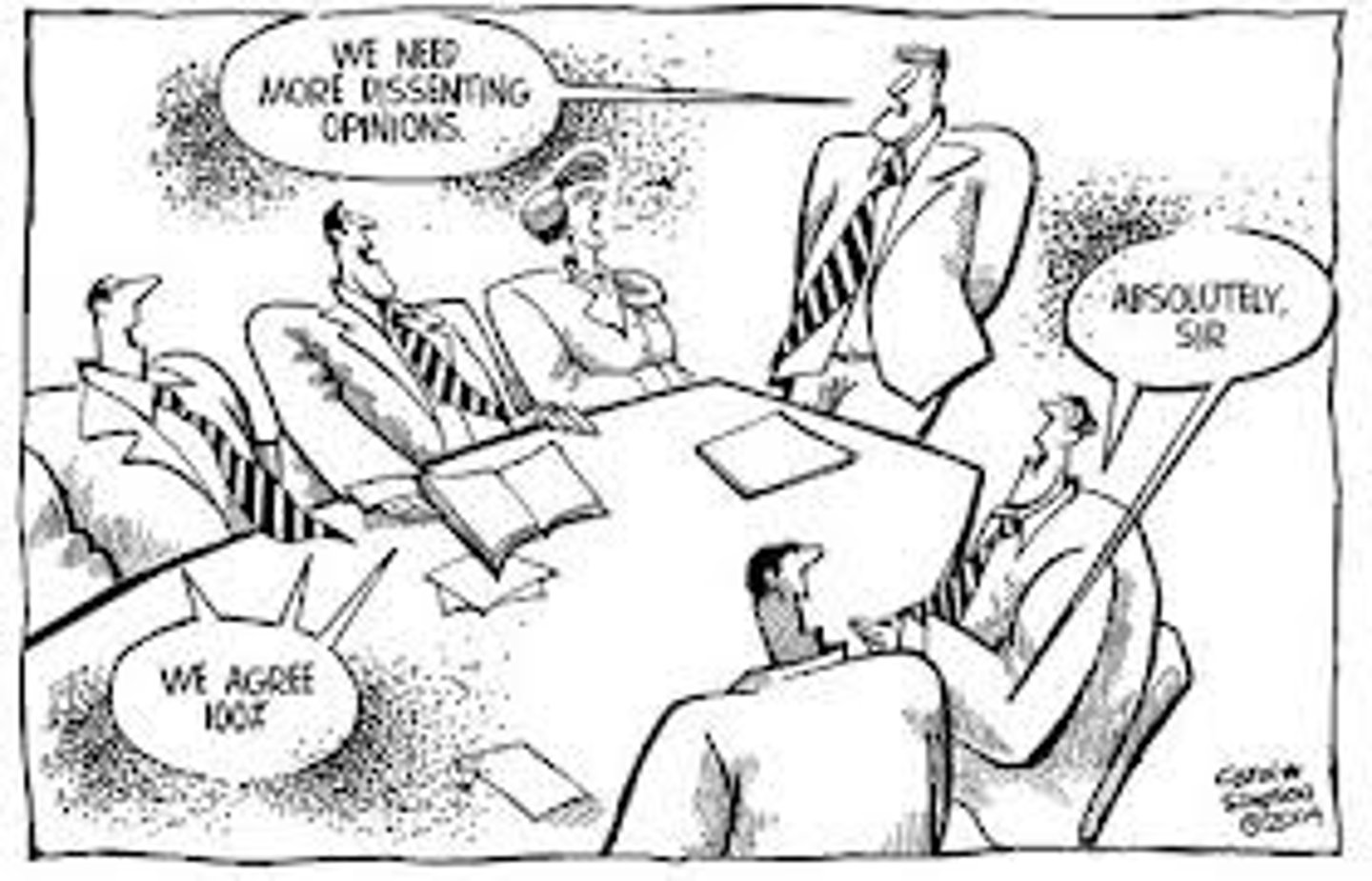
group dynamics
the ways in which individuals affect groups and the ways in which groups influence individuals
What task roles exist within successful groups?
information seeker (asks for clarification)
coordinator (spells out relationships between ideas)
recorder (keeper of the minutes)
What creates ineffective groups?
Poor leadership, or leadership that's too strong (results in groupthink)
Poor group cohesion
Role confusion
What is group process? What impacts it?
Group process is "what is happening" in the group. It is
how each member and the whole group interacts and
relates with each other as a whole group, which involves:
nonverbal communications, group mood, and group atmosphere, including successes and tensions.
closed group
all members begin at the same time, no new members are admitted.
open group
members are welcomed and provided time to learn group norms and expectations
referent (communication)
Motivates one to communicate with another.
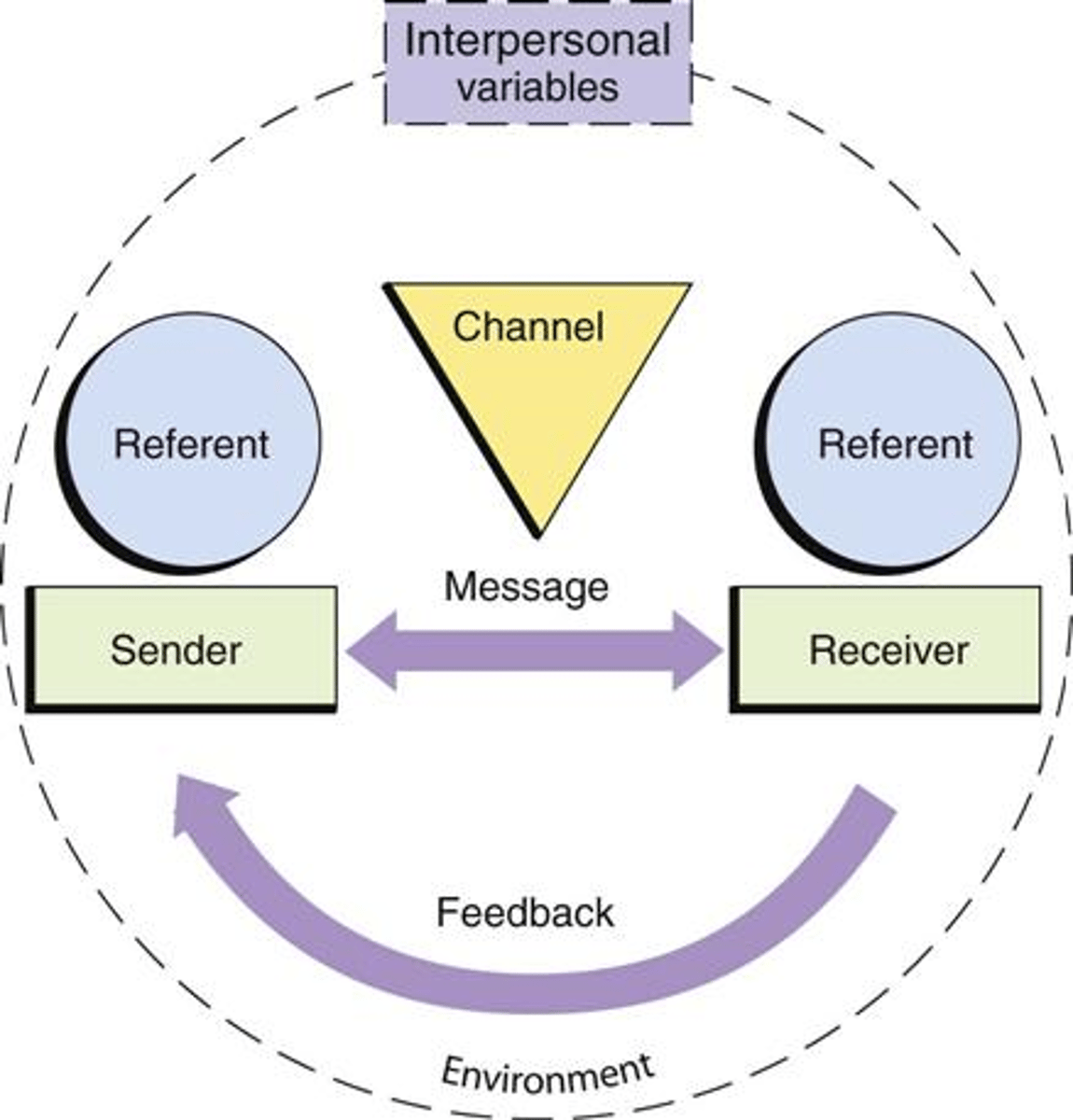
channels (communication)
means of conveying and receiving messages through visual, auditory, and tactile senses
interpersonal variables
factors within both the sender and receiver that influence communication
4 phases of nurse-patient relationship
1. pre-interaction
2. orientation
3. working
4. termination
relational practice
"Is guided by conscious participation with clients using a number of relational skills including listening, questioning, empathy, mutuality, reciprocity, self-observation, reflection and sensitivity to emotional contexts"
relational communication
the will and active intention of nurses to join people where they are
relational inquiry
An approach to nursing practice that has 2 essential components:
relational consciousness & inquiry as a form of action.
Involves highly-reasoned, skilled action, observational and analytical skills, strong clinical skills including competence, judgment, and decision making.
interprofessional communication
Communicate with patients, families, communities, and other health professionals in a responsive and responsible manner that supports a team approach to the maintenance of health and the treatment of disease
Qualities, behaviours, and approaches that affect interprofessional communication
- role clarification
- team functioning
- conflict resolution
- collaborative leadership
role clarification
Learners/practitioners understand their own role and the roles of those in other professions, and use this knowledge appropriately to establish and achieve patient/client/family and community goals.
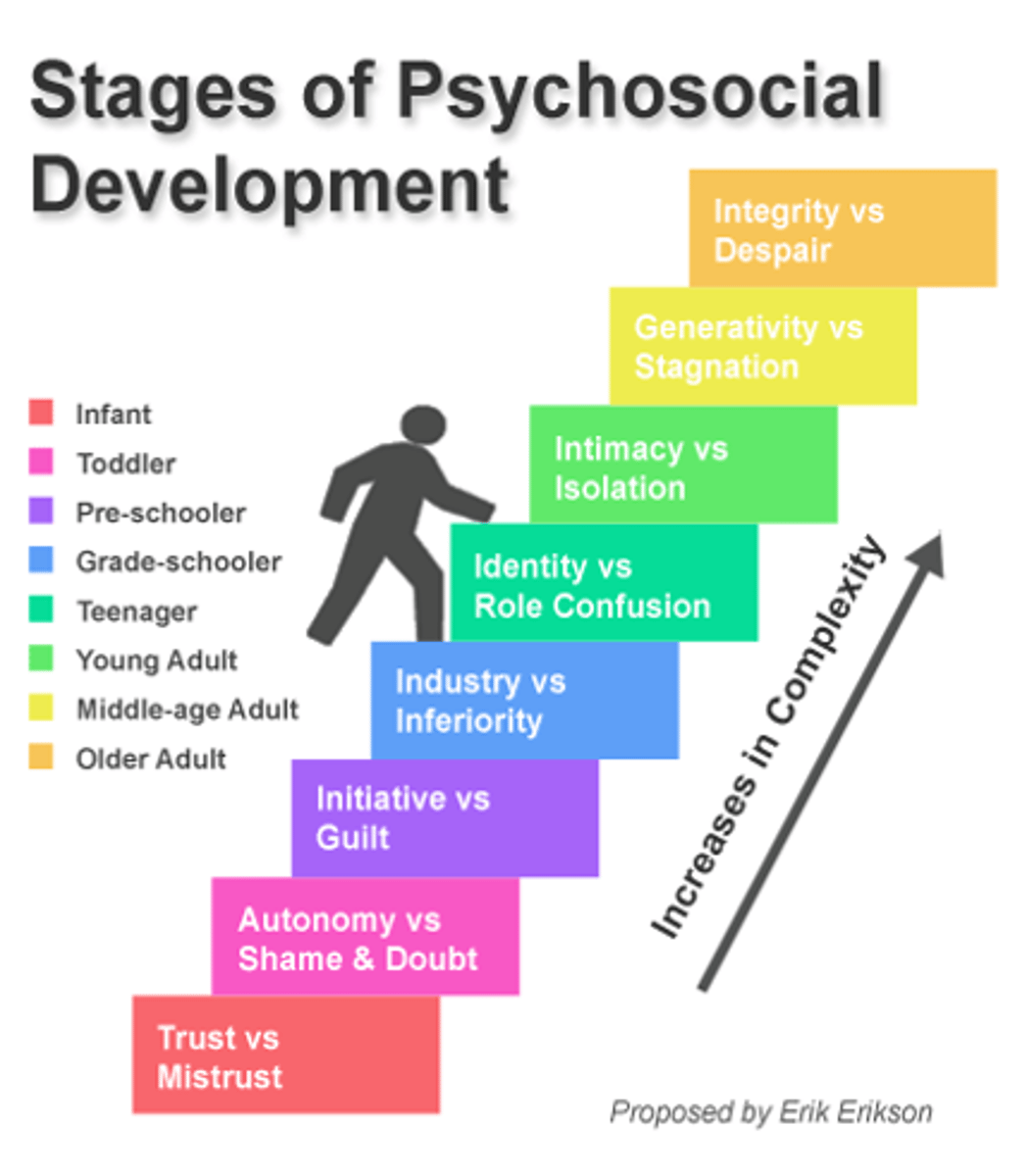
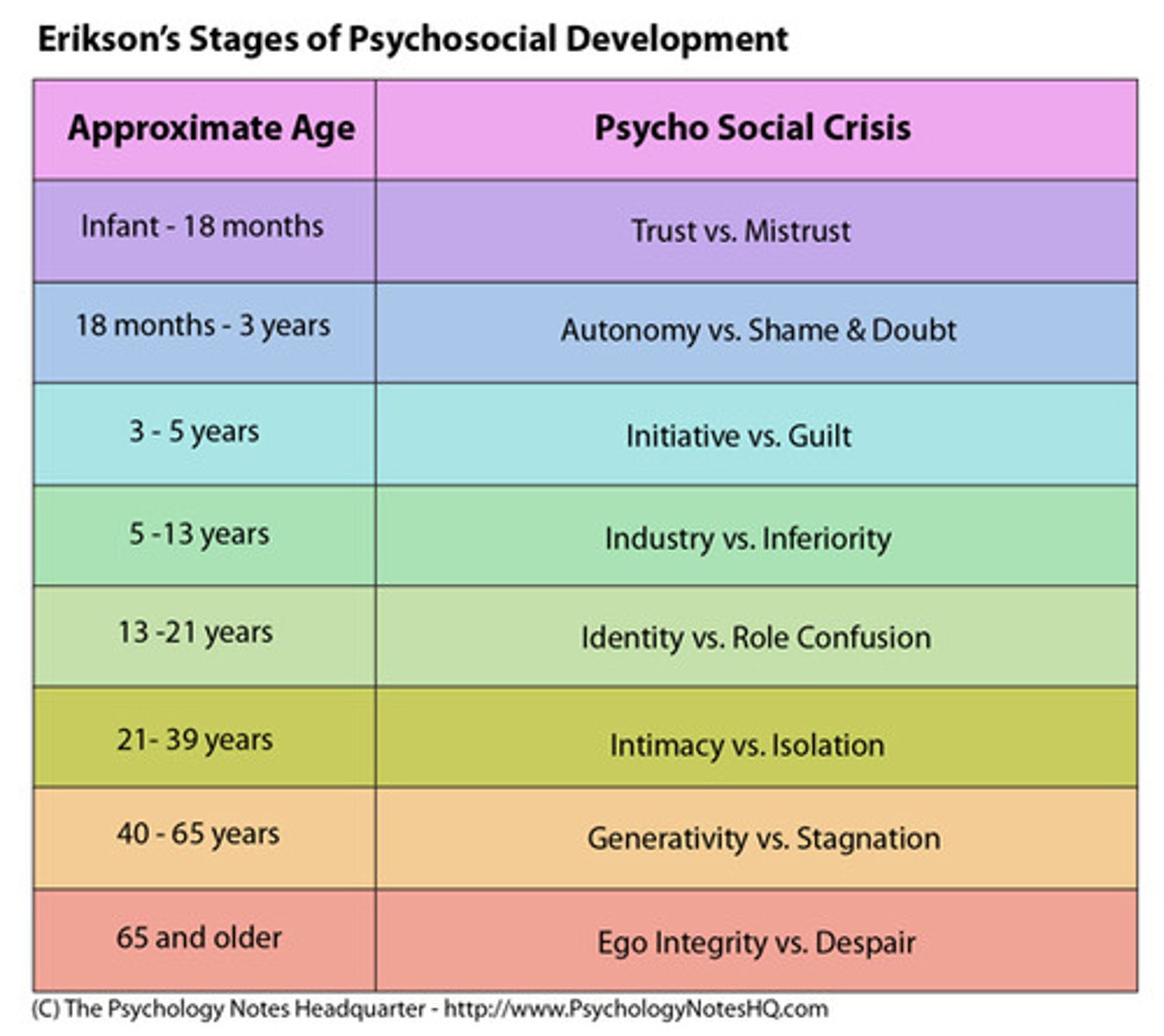
Erikson's Theory of Eight Stages of Life
Psychosocial model that covers the lifespan. In each stage the person needs to accomplish a partiicular task before moving on to the next stage. Each task is framed with opposing conflicts that the person must balance.
Stage 1: Trust versus mistrust (infancy: birth to one year)
Stage 2: Autonomy versus sense of shame and doubt (toddler years: 1-3 years)
Stage 3: Initiative versus guilt (preschool years: 3-6 years)
Stage 4: Industry versus inferiority (middle childhood: 6-11 years)
Stage 5: Identity versus role confusion (adolescence: 12-18 years)
Stage 6: Intimacy versus isolation (young adulthood: ages 18-35 years)
Stage 7: Generativity versus self-absorption and stagnation (middle adulthood: 35-65 years)
Stage 8: Integrity versus despair (old age: 65+)
receptive aphasia (Wernicke's)
inability to understand spoken or written words
types of aphasia
Global (Speech is absent or severely reduced)
Expressive (Broca's) (Person can understand language, but cannot use language themselves),
Receptive (Wernicke's) (Can speak, but cannot understand)
Expresssive = Cannot express
Receptive = Cannot receive
factors that contribute to impaired communication
Language barriers
Hearing/Vision
Conditions like aphasia
4 types of feedback
informal, formal, summative, formative
Why is feedback important?
Assists developing learner's competence and confidence.
Helps them think about the gap between them and actual and desired performance, and identify ways to narrow the gap and improve
Enhances safety and opportunities for accountability, relationship building.
summative feedback
Measures performance, often against a standard, and
comes with a mark/grade and feedback to
explain your mark. It can be used to rank or
judge individuals
What demonstrates being receptive to learning from feedback?
Be a good listener
When in doubt, ask for clarification
Embrace the feedback session as a learning opportunity
Remember to pause and think before responding
Avoid jumping to conclusions, and show that you are invested in the learning
process and keen to improve
Think positively and be open to helpful hints
Learn from your mistakes and be motivated
Be a good sport and show appreciation
Be proactive
How to give feedback in a constructive way
Feedback should be constructive by focusing on behaviours that can be improved.
Developing robust professional relationships is a prerequisite for giving/receiving constructive feedback that will act as a powerful motivator.
formative feedback
learner’s progress at a particular time through
a course or during the acquisition of a new
skill. It provides opportunities to gain feedback,
reflect and redirect effort (where appropriate)
before completing a final assessment
timed negative feedback
formal vs informal feedback
formal: part of a structured assessment
informal: provided on a day-to-day basis, usually in verbal form
What is the purpose of feedback?
Aims to develop performance to a higher level by dealing with underperformance in a constructive way.
5 Ways of Knowing in Nursing (PEASE)
Personal Knowledge in Nursing
Empiric - The Science of Nursing
Aesthetics - The Art of Nursing
Social political knowing: The Context of Nursing
Ethics - "what ought to be done"
What is meant by "Personal Knowledge in Nursing"
(1 of the 5 ways of knowing in nursing)
Reflection and response are the processes of personal knowing that contribute to an understanding.
What is meant by "Empiric - The Science of Nursing"
(1 of the 5 ways of knowing in nursing)
It is factual, descriptive and ultimately aimed at developing abstract theoretical explanation. Empirical knowing is
the science of nursing. As a pattern of knowing
it draws on traditional ideas of science in which
reality is viewed as something that can be
verified by other observers
What is meant by "Aesthetics - The Art of Nursing"
(1 of the 5 ways of knowing in nursing)
Aesthetic practice is making "visible through actions" of
the nurse's perception of what the patient
needs. In other words, aesthetic knowing is the
comprehension of meaning in a singular,
particular, subjective expression that we call the
art of nursing.
What is meant by "Social political knowing: The Context of Nursing"
(1 of the 5 ways of knowing in nursing)
environment of care - the policies and institutional practices that influence nursing practice.
the understanding that society has of nursing and the understanding that nursing has of society and of societal policies
What is meant by "Ethics - "what ought to be done"
(1 of the 5 ways of knowing in nursing)
Knowing in ethics is to explore the
norms or ethical codes of discipline in making
moral choices and being responsible for the
choices made. Ethical knowing leads one to
seek an answer to the question: is this right!
and is it just?
self-concept
a person's subjective description of who he or she is (not born with)
- continues to develop throughout lifespan
always changing and based on the following:
- sense of competency and mastery of prior and new experiences
- perceived reactions of others people to one's body
- ongoing perceptions and interpretations of other people's thoughts and feelings
- personal and professional relationships
- collective beliefs and images one holds about oneself- academic and employment
-related identity
- ability to cope with and resolve problems
- racial and ethnic identity
- gender and sexual dientity
- personality structure
- perceptions of events that have an impact on the self- personal appearance and physical attractivenesss
- current feelings about the physical, emotional, and social self- self-expectations
How can you demonstrate receptivity to feedback?
- be open-minded, set ego aside
- listen attentively
- ask clarifying questions
- thank person
- take action to improve based on feedback
- regularly seek feedback
self-concept stressor
any real or perceived change that threatens identity, body image, or role performance
•The mental image that one has of oneself
•Comprises social, emotional, physical, academic domains
•Affects how a person adapts to challenges, difficult situations, and relationships
•The cognitive aspect of self
Nurse's Effect on the Patient's Self-Concept
Nurses need to remain aware of their own feelings, ideas, values, expectations, and judgments:
Use a positive and matter of fact approach.
Build a trusting relationship.
Be aware of facial and body expressions.
Some patients with a change in body appearance or function are very sensitive to health care providers' verbal and nonverbal responses.
Family's Effect on the Development of Self-Concept
Children who experience sensitive and supportive caring will develop expectations that they are worthy of other peoples love and that other people are supportive.
Parents who respond in a firm, consistent and warm manner promote positive self-esteem in their children.
Parents who are harsh, behave inconsistently, or have low self esteem themselves may foster negative self concepts in their children.
How do psychosocial and cognitive developmental stages shape self-concept? (Erikson)
Each stage must conform to a social norm that is associated with a cognitively acceptable behaviour. You need to meet those norms to be accepted.
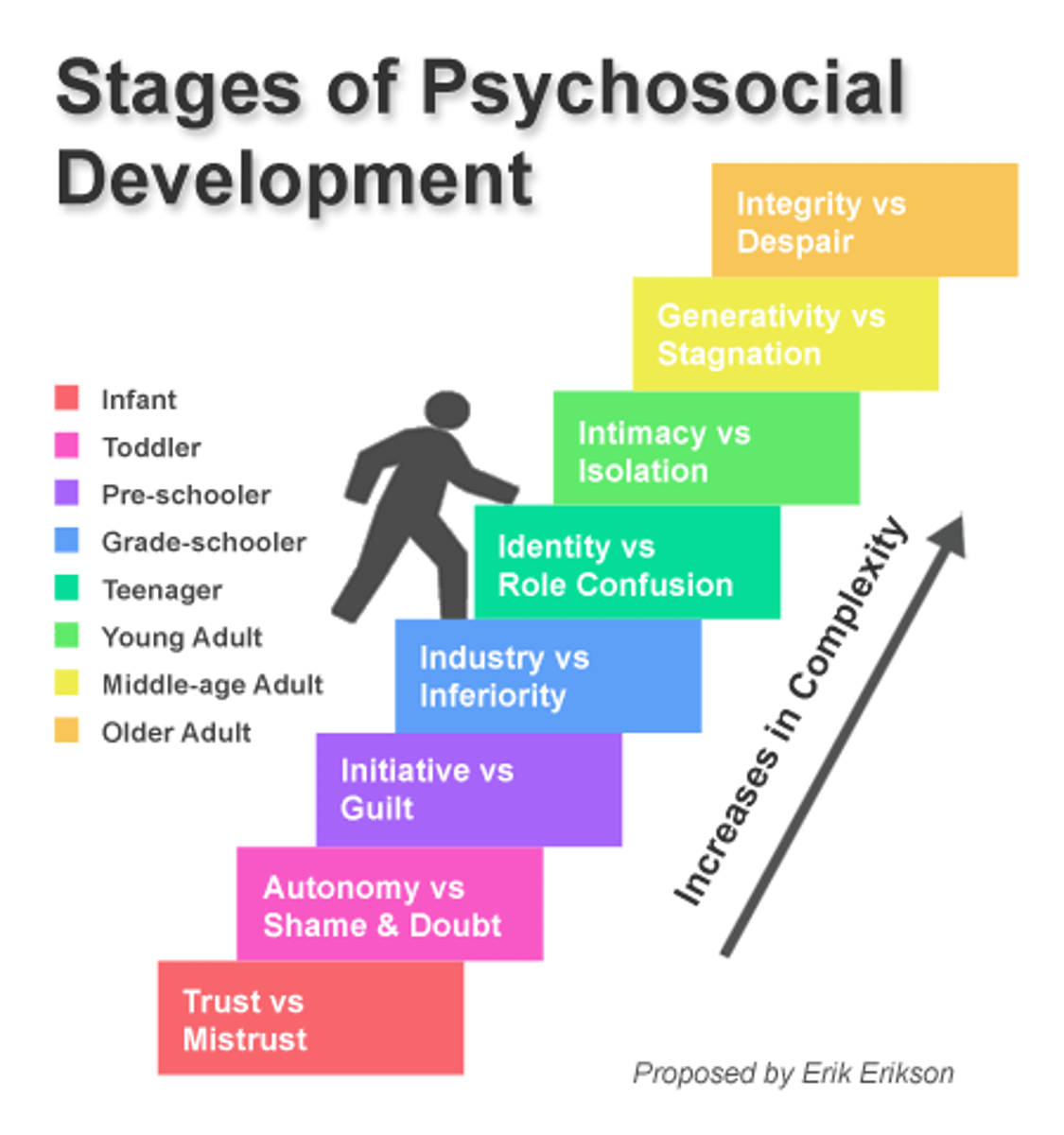
Erikson's Psychosocial Stages
1. Trust vs. Mistrust (birth-1 year)
2. Autonomy vs. Shame and Doubt (2-3 years)
3. Initiative vs. Guilt (3-6 years)
4. Industry vs. Inferiority (6-11 years)
5. Identity vs. Identity Diffusion (12-18 years)
6. Intimacy vs. Isolation (early adulthood: 19-mid 20s)
7. Generativity vs. Stagnation/Self-Absorbtion (middle age: late 30s-50s)
8. Integrity vs. Dispair (old age: 60s and beyond)
material self
your concept of self as reflected in a total of all the tangible things you own
social self
your concept of self as developed through your personal, social interactions with others
spiritual self
concept of self based on your thoughts and introspections about your values and moral standards
example of material, social, and spiritual self
material: I collect antiques
social: I play in the chess club
spiritual: I believe in a higher spiritual being
self-reflexiveness
abillity to think about what we are doing while we are doing it
(self-label)
3 conditions of feedback that affects our sense of who we think we are
frequent
credible
consistent (with other comments and our own experience)
self-esteem (self-worth)
your evaluation of your worth or value based on your perception of such things as your skills, abilities, talents, and appearance
self-efficacy
the belief in one's capabilities to organize and execute the courses of action required to manage prospective situations
a persons belief in their ability to succeed
factors that affect self-esteem
social comparison, self-expectations, self-fulfilling prophecy
how can spirituality affect self-esteem
Signifies a positive approach, an accepting, embracing, loving attitude toward life, suffering, and death.
How can you improve a client's self-esteem?
- help them identify feelings
- being present as a "sounding board"
- providing possibilty of hope
- focus on client's strengths
- they take active role in their own care
environmental factors that affect self-esteem
Environmental factors that will affect your self esteem are family, friends, school, and media.
Family can affect you positively and negatively.
Positive: Compliments, encouragement, and positive nature
Negative: being overly critical, constantly arguing, and constantly correcting
self-esteem stressors
Low self-worth, inability to meet expectations, failure in work or relationships
individuals with high self-esteem are generally more resilient and are better able to cope with demands and stressors
What kinds of actions, behaviours, ideas demonstrate high self-efficacy?
- strong self-concept
- high self-esteem
- Form a stronger sense of commitment to their interests and activities
- Develop a deeper interest in the activities in which they participate.
How can you support healthy self-efficacy?
- include problem solving skills and processes patients need to cope
- break difficult tasks down into achievable steps
- identify patient strengths
- work with patients to use solutions and resources within their means
- self-help and support groups can be useful
What does positive or "high" self-efficacy look like?
Individuals with high self-efficacy look at difficulties as challenges rather than threats, they tend to be more intrinsically interested in the tasks they pursue
How can spirituality support self-efficacy
- positive outlook
- confidence in abillity to succeed
- possibly higher self-confidence
7 guidelines for improving accuracy of perceptions
1) realize that all perceptions are subjective and partial
2) we should avoid mind reading or assuming that we know what others perceive
3) good idea to check perceptions, stating how you perceive something and asking others how they perceive
4) distinguish facts from inferences
5) avoid self-serving bias (perceive ourselves too charitably and others too harshly)
6) guard against fundamental attribution error
7) monitor the labels we use
perception
The act of becoming aware through the senses
personal construct
A "mental yardstick" that we use to measure a person or situation.
•Similar to prototype but more detailed attributes i.e. intelligent vs unintelligent, attractive vs ugly, successful vs failure. The personal constructs we use shape our perception because we only measure things against constructs that we actually use. Therefore, we might not recognize other peoples qualities if they don't fit into our own database of personal constructs.
3 Steps to Perception Checking (VALIDATION)
1) Describe the behaviour you noticed (state what you observed)
2) Check to see whether the other perceives the same thing.
3) If so (correct perception), request clarification of the behaviour.
Factors that influence our perceptions
Physiology
Age
Culture
Roles
Cognitive Abilities
Self
cultural considerations that affect self-concept
religion, ancestry, skin color, language, class, education, profession, skill, family and political attitudes
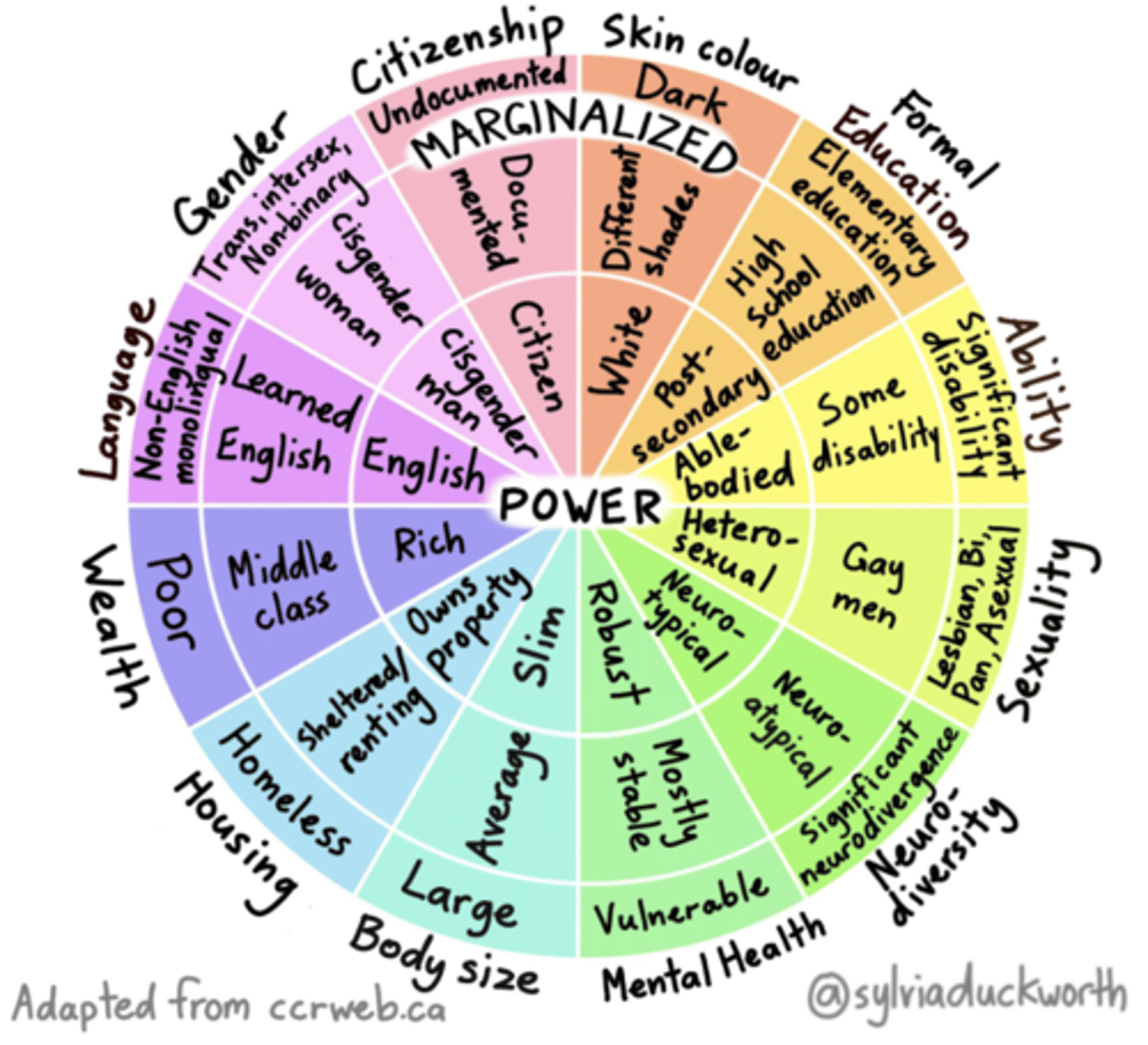
wheel of privilege and power
the closer you are to the centre, the more privilege you have
mindfulness
Being alert, mentally present, and cognitively flexible while going through life's everyday activities and tasks.
- research shows beneficial for stress reduction and improves quality of life
Benefits of Mindfulness
•Helps us better understand interplay between mind, body and emotions
•Helps us become more deeply aware of self in the midst of the moment to moment experiences
•Cultivates more compassion
•Helps us to respond rather than react from habitual ways of thinking, moving, feeling, doing
•Can support our physical, emotional, psychosocial and spiritual well being
•Helps us to self regulate
•Helps us tap into our intuition (learn to recognize it)
Mindfulness fosters a sense of....
wellbeing
Barriers of mindfulness in nursing
- lack of time
- showing compassion may make nurses vulnerable to exploitation or harm
- work politics
- many struggle with being kind and compassionate to themselves
What can perception checking help avoid?
Tense, heated situations. In conflict, we often become frustrated because we feel as though the other person doesn't understand us.
Perception checking allows for individuals to feel as though their voice is heard and their opinion is valued
self-compassion
Being kind to ourselves when we suffer, fail, or feel inadequate, recognizing that imperfection is part of the human condition, and accepting rather than denying negative feelings about ourselves.
"Shame is the intensely painful feeling or experience of believing that we are flawed and therefore unworthy of love, belonging, and connection." - Brene Brown (Atlas of the Heart)
What is the value of practising self-compassion?
Self-compassion has been shown to be
closely linked to wellbeing; after following a
mindfulness course, people tend to be:
» Less self-judging – they are
understanding towards themselves in
situations of pain or failure rather than
being harshly self-critical;
» Kinder to themselves;
» Less isolated – they are more likely to see their difficulties as part of the larger human experience rather than things
that separate them from other people;
» Less likely to be overwhelmed by painful
thoughts and feelings
Compassion Fatigue
a state of exhaustion experienced by medical and psychological professionals, as well as caregivers, which leaves the individual feeling stressed, numb, or indifferent
Compassion fatigue (CF) is "debilitating weariness brought about by repetitive, empathic responses to the pain and suffering of others
Causes of compassion fatigue
- lack of support
- lack of knowledge about CF
- lack of time/ability to provide quality care
Factors that lessen compassion fatigue
- colleague support
- work-life balance
- connecting with others
- acknowledgement
- maturity and experience
Factors that worsen compassion fatigue
- being unable to ease suffering
- coexisting stresses
- excessive attachment/involvement
Outcomes/effects of compassion fatigue
- profound fatigue (even with lots of sleep)
- negative effects on relationships
- considering leaving the profession (burnout)
4 Possible interventions to mitigate compassion fatigue
- increase education about CF
- promotion of teamwork and collegial support
- develop a philosophy of "there is always something more they can do" : this helps combat feelings of hopelessness and "failing the patient"
- discuss appropriate emotional attachment (boundaries)
What does Andrea Turner equate black humor to? (Youtube video)
A symptom of compassion fatigue