quiz #2: carbonic anhydrase
 Call Kai
 Learn
Learn Practice Test
 Spaced Repetition
 Match
Match Flashcards
 Knowt Play
1/22

There's no tags or description
Looks like no tags are added yet.
Name | Mastery | Learn | Test | Matching | Spaced | Call with Kai | Chat |
|---|
No analytics yet
Send a link to your students to track their progress
23 Terms
how can you change the ∆G of a reaction?
changing the concentrations
do enzymes change the ∆G?
no, but they can change the rate of the reaction
what are osteoclasts?
they break down and remove bone tissue by dissolving the fibers and the matrix of bone
when is a reaction spontaneous?
when the ∆G is negative
what does it mean to be at equilibrium?
the ∆G is = 0
concentrations are consistent, but the rate of reaction has not stopped its just balanced on both sides
what does ∆G tell you about the rate of reaction?
it provides no information on the rate of reaction—∆G is independent of path or molecular mechanism, only energy difference between substrate and product
what is ∆G°?
the free energy under standard conditions and at equilibrium
conditions:
pH = 7
298 K
1M reactants
what is Keq?
the equilibrium constant at standard conditions
[products]/[reactants]
Keq = 1 → ∆G° = 0 (at equilibrium)
Keq > 1 → - ∆G° (more products than reactants- spontaneous)
Keq < 1 → + ∆G° (more reactants than products - nonspontaneous)
what are the 2 different models of substrate binding and how do they differ?
the lock and key model suggests that the enzyme and substrate fit together perfectly, like a key in a lock
in contrast, the induced fit model proposes that the enzyme's shape changes slightly to accommodate the substrate, creating a better fit
do enzymes change the thermodynamics of a reaction?
no, enzymes do not change the thermodynamics of a reaction; they only change the rate at which the reaction reaches equilibrium
what is Q?
the reaction quotient
[products] / [reactants]
how can the active site lower an activation energy barrier?
orientating substrates correctly
straining substrate bonds
providing a favorable microenvironment
non-covalently bonding to the substrate
where does the energy to lower the activation energy come from?
weak interactions between the enzyme and substrate, energy released when bonds form
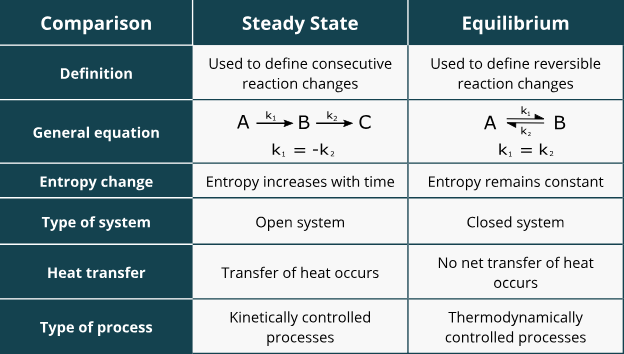
what is a steady state?
the homeostatic condition in which net concentrations remain constant over time, thus requiring the constant input of energy from the environment (can be forward OR reversed)
Use Le Chatelier’s Principle to explain what affect hyperventilation would have on blood pH.
Equilibrium shifts to the left, pH increases (hyperventilation means CO2 is lost faster than cellular respiration replaces it, resulting in a decrease in CO2 concentration in the blood).
A genetic analysis of one of the sister’s CA II genes indicates that a Glycine to Arginine mutation (G149R) is responsible for the CA deficiency. Compare glycine and arginine based on the following characteristics. (side chain = R group).
Classification of amino acid side chain (polar or nonpolar)
Ionization of the side chain at pH 7
Side-chain non-covalent interactions at pH 7
Side chain size
At pH 7, glycine is neutral and nopolar, while arginine's side chain is protonated, positively charged.
Arginine is also larger. Glycine's side chain can participate in van der Waals interactions whereas the side chain of arginine can participate in ion-ion and ion-dipole interactions.
Focus on the following components of the figure: osteoclast, bone, resorptive pit, anion exchanger, H2O + CO2, CA, H+, ATPase. Write a short description explaining how these components fit together to facilitate osteoclast function. Be sure to explain why the resorptive pit is acidic, including the role of CA and ATPase.
CO2 is produced by the osteoclast. CA converts CO2 + H20 to H2CO3 which readily dissociates to HCO3- and H+. The HCO3- is removed from the osteoclast by an anion exchanger, in exchange for a Cl- ion. H+ is moved actively, by a channel that uses ATP, to the resorptive pit. By pumping H+ into the resorptive pit, the low pH of 4 of the resorptive pit is achieved. Cl- is transported into the pit to keep it electrically neutral.
Explain how a deficiency in carbonic anhydrase would impact osteoclast function.
H+ would not be produced (or pumped into the resorptive pit).
Thus, the resorptive pit could not be acidified and bone could not be broken down.
Do you think reactions occurring in cells will always match the conditions for ΔG°’? What determines the spontaneity of a reaction in a cell, ΔG°’ or ΔG? Briefly explain your answer.
No, reactions will not always match the conditions, especially concentration of reactants and products. DG ultimately determines the spontaneity of a reaction.
The K'eq for CO2 + H2O ---> H2CO3 is 1 × 10⁻³. Is the ΔG°’ for this reaction zero, negative, or positive? What does that mean about the direction of the reaction under standard biochemical conditions?
positive ; production of CO2 + H2O is favored
Explain how enzymes like carbonic anhydrase is affecting the free energy of the reaction. Be specific and include a discussion of the free energy of reactants, products, and the transition state.
The overall free energy of a reaction is unaffected by an enzyme. Enzymes accelerate the attainment of equilibria, but they don't shift its position. The equilibrium position is a function only of the free energy difference between reactants and products. Enzymes decrease the amount of free energy that must be invested to reach the transition state. As a result, enzymes increase the rate of reactions relative to uncatalyzed reactions.
What is the ΔG of the reaction occurring in the osteoclast, that is catalyzed by carbonic anhydrase?
negative
To help you synthesize all you’ve learned to this point, hypothesize why the reaction proceeds towards the formation of H2CO3 in the osteoclast. In your reasoning, use Le Chatelier's Principle as well as a discussion of ΔG vs ΔG°' (is the osteoclast at standard conditions?).
The reaction proceeds toward H2CO3 because of the continuous production of CO2 by cellular processes, bicarbonate ion is being transported out of the osteoclast, and H+ is being pumped into the resorptive pit.
These conditions push the reaction toward H2CO3. Thus, the osteoclast is not at standard conditions of DG°'