Ch. 4 The Parts of a Microscope for Lab
 Call Kai
 Learn
Learn Practice Test
 Spaced Repetition
 Match
Match Flashcards
 Knowt Play
1/16

There's no tags or description
Looks like no tags are added yet.
Name | Mastery | Learn | Test | Matching | Spaced | Call with Kai | Chat |
|---|
No analytics yet
Send a link to your students to track their progress
17 Terms
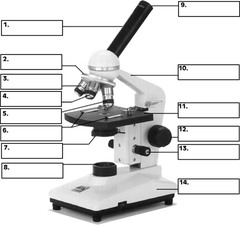
ocular lens
Magnification lens located at the top of the microscope
what is structure number 9?

body tube
what is structure number 1?
The part of the microscope that connects the ocular lenses and the rotating nosepiece with the objective lenses; contains lens that helps to focus but not magnify
arm
The part of the microscope that support the lenses, body tube, and nose piece; is used to carry the microscope.

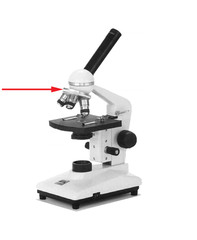
rotating nosepiece
contains the three to four objective lenses of the microscope, and is used to rotate the desired lens into place
scanning objective lens
The lowest power lens that has a magnification of 5x; the lens that is used to start with

low power objective lens (LP)
the lens with the third highest power and a magnification of 10x
what is structure number 3?

high power objective lens (HP)
the lens with the second highest power and a magnification of 40x - 45x

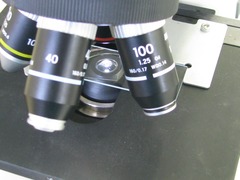
oil immersion lens
the highest power lens with a magnification of 100x; this lens cannot be used without oil
course focus
Moves the nose piece up and down to focus the specimen; can only be used with scanning and low power objective lenses
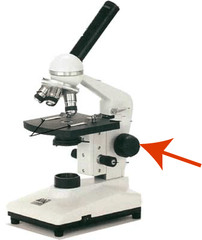
fine focus
focuses the specimen without moving the nosepiece up and down; used to focus all lenses
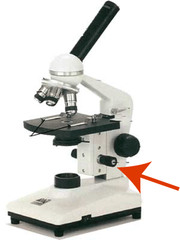
slide manipulator
Moves the slide around on the stage so that different parts of the slide can be viewed
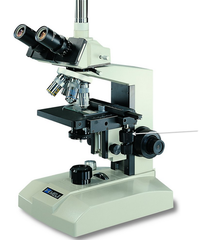
stage clips
Holds the slide in place; are connected to the slide manipulator
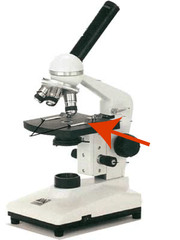
stage
The platform of the microscope that holds the slides
what is the structure pointed out by the red arrow?

iris diaphragm
The switch that moves the condenser to adjust the amount of light that shines through the specimen slide

condenser
Can be opened or closed to adjust the amount of light that shines through the specimen slide for better contrast and sharpness
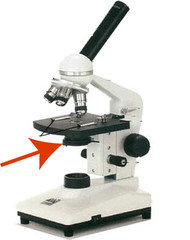
illuminator
Provides the light that shines through the specimen slide so that the specimen is visible

base
The bottom part of the microscope; is used to carry the microscope
