CMMA Unit 4
 Call Kai
 Learn
Learn Practice Test
 Spaced Repetition
 Match
Match Flashcards
 Knowt Play
1/65

There's no tags or description
Looks like no tags are added yet.
Name | Mastery | Learn | Test | Matching | Spaced | Call with Kai | Chat |
|---|
No analytics yet
Send a link to your students to track their progress
66 Terms
What do MA’s need prepare before each examination?
Assemble all supplies. Understand procedures including physical ones. Understand use of tools such as electronic tools like telehealth.
If a patient has anaphylactic shock, what should you do?
First be prepared with epi pens and have plenty of supply for it. Second be ready to call for help. Third use CPR if the epi pen has not been used. Epi pen can only be used if ordered. Inject the epi pen through the patient’s clothing. Hold for 10 seconds and do it hard. Check drug and allergy status at the beginning of each visit.
What equipment should be ready each time an examination takes place?
Thermometer: Used to measure body temperature
Stethoscope: Used to amplify sounds in the body, such as the beating of the heart, respirations in the lungs, and bowel sounds in the abdomen
Sphygmomanometer: Used to measure blood pressure
Pulse oximeter: Used to measure oxygen saturation in the blood
Reflex hammer: Used for testing reflexes
Otoscope: Used to examine the ears
Ophthalmoscope: Used to examine the interior of the eye, especially the retina
How do medical assistants assist different specialities?
Dermatology : Minor surgical procedures to help obtain skin biopsies or in the debridement of wounds and collect specimens from wound cultures.
Cardiology : perform electrocardiograms (EKGs) and Holter monitoring on patients with cardiac symptoms or diseases.
Endocrinology: should be familiar with venipuncture and capillary punctures (fingersticks). Medical assistants will perform glucose monitoring and patient education related to the latter.
Obstetrics and gynecology : A common procedure is a Pap test
Pulmonology : Pulmonary function test (PFT). The most common tests and procedures performed are spirometry, peak flow meters, and pulse oximetry.
What are common patient preparation procedures?
Colonoscopy or a fasting glucose test both require fasting.
How do you explain the necessity of a procedure?
Before entering an examination room that is occupied by a patient, always knock, announce yourself, and ask for permission to enter.
Explain the procedure and the importance of the procedure in an empathetic, simple, and direct manner.
Ask patients to empty their bladder before undressing. If a urine sample is required, give complete and detailed instructions.
Assist patients with disrobing and with stepping up onto the examination table as needed.
Once the patient is ready, notify the health care provider.
Provide the patient information about any follow-up appointments, additional exams, aftercare instructions, and referrals. Let the patient know when to expect results. Ask if the patient has any questions.
Report any discomfort afterwards. It could be life threatening.
How should you treat older patients?
Be patient. Explain things clearly. Do not use pet names. Be calm and respectful.
How should you treat patients with physical dissabilities?
Provide additional support if needed. Ask before touching patient or wheel chair. Allow them to do as much things independently as possible. If physically unstable or confused, always have someone attend them.
How should you treat children?
Smile and speak to the child at eye level. Speak gently and calmly with an even tone and avoid using “baby talk,”. Depending on the child, role playing can be helpful.
During procedures, plan extra time to explain to the child what is being done and to provide a sense of calmness. Explain in simple, age-appropriate terms exactly what you want them to do.
Holding or entertaining an uncooperative child may be necessary. Never leave children alone. Safety is a priority.
What should be a priority when positioning patients?
Only position patients when its examination time. Note some positions may be uncomfortable. Explain calmly and clearly to patients. A patient’s comfort should be of utmost importance.
What is the supine position?
In the supine position, also known as the horizontal recumbent position, patients lie flat on their back with hands at the sides. Be sure that the patient’s feet are supported by extending the examination table. This position is used to examine anything on the anterior or ventral (front) surface of the body (head, chest, stomach) and for certain types of x-rays. Use a pillow if need be to help with pain.
What is the Prone position?
The prone position requires the patient to lie face down, flat on the stomach, with the head turned to one side, and arms either alongside the body or crossed under the head. This position is the opposite of the supine position.
What is the Dorsal Recumbent?
In the dorsal recumbent position, the patient is lying flat on the back with knees bent and feet flat on the examination table. This position relieves strain on the lower back and relaxes abdominal muscles. Used to inspect the head, neck, chest, vaginal, rectal, and perineal areas.
To drape the patient, place the drape at the patient’s neck or underarms and cover the body down to the feet.

What is Lithotomy position?
The lithotomy position is similar to the dorsal recumbent position, except the patient’s feet are placed in stirrups attached to the end and sides of the table. The stirrups must be locked in place to ensure patient safety.
. After the feet are in place in the stirrups, the patient is instructed to slide down until the buttocks are positioned at the edge of the table. The patient is draped from under the arms to the ankles. This position is used for vaginal examinations.
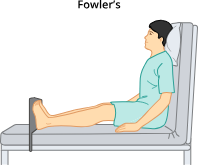
What is Fowler’s position?
In the Fowler’s position, the patient sits on the examination table with the head of the table raised to a 90-degree angle. If able, the patient may be seated on the edge of the table with feet over the edge in an upright position.
What is Semi-Fowler’s?
The semi-Fowler’s position is a modified Fowler’s position with the head of the table at a 45-degree angle instead of a 90-degree angle.
What is the left lateral position?
The left lateral position (also known as lateral semi-prone recumbent position and formerly known as Sims' position) requires the patient to be placed on the left side with the right leg sharply bent upward and the left leg slightly bent. The right arm is flexed next to the head for support. The patient is draped from under the arm or shoulders to below the knees at an angle.
This position is used for rectal exams, taking rectal temperatures, enemas, and perineal and pelvic exams.
What is Knee–Chest?
In the knee–chest position, the patient is placed in the prone position and then asked to pull the knees up to a kneeling position with thighs at a 90-degree angle to the table and buttocks in the air.
The head is turned to one side, and the arms may be placed under the head or on either side of the head for comfort and support. This position is used for proctologic exams, sigmoidoscopy procedures, and rectal and vaginal exams.
How do you calculate the amount of dosage required?
X = D/H * Q
Where D is the desired dose. H is the strength or supply on hand. Q is quantity.

How do you calculate desired dosage when theres weight involved?
X = D/H * Q
Where D is the desired dose. H is the strength or supply on hand. Q is quantity which is typically a unit.
X mg/kg of a medication. The patient weighs X lb. The medication is supplied as 100 mg/mL.
X mg / kg 1 ml /100 mg * 1 ml
What is paranetal?
Medication administration is generally injected directly into the body, bypassing the gastrointestinal tract.
Examples include :
Subcutaneous | Injection administered below the skin layer into the adipose (fat) layer |
Intradermal | Injection administered into the dermis |
Intramuscular | Injection administered into the muscle |
Intravenous | Injection administered directly into the vein |
What is non-paranetal?
Given by mouth, delivered to the gastrointestinal tract.
What is a generic name?
generic name is the standard or official name and assigned by the United States Adopted Names (USAN) Council and the World Health Organization (WHO).Generic names are not capitalized and are also listed with brand names.
How do you check the medication order?
The name of the medication, dosage, time, and route of administration direct the MA in preparing medication for administration. Consent for administration of a medication should be obtained from the patient or guardian prior to preparing the medication. Tell the patient what the medication is, what it is given for, the dosage, and the route that will be used.
How many checks should be done before giving medication? And when?
3 times. When first receiving it, when preparing for administration and when putting it away.
What are the correct checks for giving medication?
Right patient : Check with DOB and address.
Right medication : Check the label three times to verify the medication, strength, and dose. First time is when obtaining it, second time is when preparing to admin., and the third is when putting it away.
Right form : Liquid, pill, etc.
Right dose and route : Compare with patient info.
Right time : MAs give medications right after the provider writes the order.
Right Technique : MAs must know the correct techniques for administering every medication they give by every route.
Right Education : Prior to administration of a medication, explain to the patient the name of the medication, the ordering provider, and the reason and intended effect of the medication; disclose any side effects; and confirm any allergies.
Right Documentation : document administering a medication after the patient receives it, not before. If you do not administer a medication as prescribed, the documentation must include this and why the patient did not receive it. Proper documentation includes date, time, quantity, medication, strength, lot number, manufacturer, expiration date, consent obtained, and patient outcome.
How do you do ophthalmic administration?
Use only in the eyes. Take your non dominant hand and pull down lower eyelid. Take dominant hand, rest on top of forehead, and drop the drops ½ above the conjunctival sac. If its a cream or ointment, evenly apply a thin ribbon of the ointment along the inside edge of the lower eyelid on the conjunctiva, moving from the medial to lateral side. Release eyeball and instruct patient to blink / close their eyes.
How do you do otic administration?
Have the patient lie on their side with the infected ear facing up.
With your non dominant hand, pull the pinna of the auricle (outer ear) outward and upward for adults and outward and downward for infants and children to ensure good medical distribution.
Hold the applicator ½ an inch above their ear and administer the drop. Have the patient remain still for 5 minutes. Ask if there’s any discomfort or pain.
What should be kept in mind regarding allergies?
Always update allergy information. Ask the patient as well. Ask details about the allergy, including what the reaction was and what the offending agent or allergen was.
For medication allergies, ask and document the following.
Name of the suspected medication, prescribed (brand or generic) and non-prescribed (over-the-counter) medications
Timeframe of the reaction from initiation of the medication
Strength and formulation
Description of the reaction
Indication for the medication being taken (if there is no clinical diagnosis, describe the illness)
Date and time of the reaction
Number of doses taken or number of days on the medication before onset of the reaction
Route of administration
What should you have the patient do after they take some medication?
Have the patient stay for 30 minutes to check for allergies.
What are the three classifications of risk of infection?
Critical devices, such as surgical forceps, come in contact with blood or normally sterile tissue
Semi-critical devices, such as endoscopes, come in contact with mucus membranes
Non-critical devices, such as stethoscopes, come in contact with unbroken skin
What are common single use items?
includes needles, syringes, sterile gloves, gowns, face masks, and suction catheters.
What are common sterility mistakes when using syringes?
Using the same one to administer or access medication to more than one patient
Using medications packaged as single-dose or single-use for more than one patient
Failing to use aseptic technique when preparing and administering injections.
Make sure needles aren’t expired. Use alcohol wipes to clean skin and needle. Don’t let medication run down the needle.
Used needles should be disposed of in which of the following ways?
These should not be recapped to prevent injuries. They should immediately be disposed of in the sharps waste container.
What are the two parts of a syringe?
A syringe has two parts: a barrel and a plunger.
What does a needle consist of? How should the needle be angled when used?
A hub, shaft, and bevel. Make sure the bevel is facing up?

What should be kept in mind when selecting a needle?
When selecting a needle, the gauge and the length need to be considered. A needle’s gauge (G) refers to the size of the opening of the needle, or lumen. The higher the gauge, the smaller or narrower the lumen is. For example, a 25 G has a smaller lumen than an 18 G needle. If a patient is obese use a larger needle.
What are subcutaneous injections? How should they be done?
SC injections are administered beneath the skin and into the adipose (fat) tissue. Used in small doses that dissolve slowly. Common medications that are injected SC are insulin, heparin, immunizations, and allergy medications. When performing a SC injection, ensure that you can pinch at least 1 inch of skin in order to inject below it and also use 45 degree angle.
What are intradermal injections? How should these be done?
ID injections are administered between the upper layers of the skin, between the epidermis and dermis. The most common site for ID injections is the mid forearm. When doing forearm ones, measure one hands width from the elbow and wrist. The upper chest and scapula (upper back) regions may also be used. Since the medication is administered between the skin, the angle of the needle is almost parallel to the skin, or 5 to 15 degrees.
What are intramuscular injections?
Common sites are the deltoid (shoulder), ventrogluteal (outer hip), and vastus lateralis (upper, outer thigh) muscles. The needle should be at a 90-degree angle to the skin to ensure penetration past the skin and adipose tissue to reach the muscle.

How do you do ventrogluteal shots?
Give the injection where the V is made between your index finger and middle finger (position the thumb pointing towards the groin). This injection site can hold up to 3 mL of medication.
How do you do deltoid shots?
The deltoid muscle is the most common injection site since it is the easiest to access, with patients only having to lift their sleeve. avoided for infants or children younger than 3 years of age. The site of injection on the deltoid should be 1 to 2 inches below the acromion process. The deltoid muscle can only hold up to 1mL of medication.
How do you thigh shots?
The vastus lateralis muscle is located on the lateral side of the thigh. The injection site is halfway down the muscle, between the greater trochanter and the lateral femoral condyle. This site is recommended for children younger than 3 years of age.
What are the appropriate sizes and needle gauges for subcutaneus, intramuscular and intradermal.
Type | Common Sites of Injections | Angle of Injection | Needle Size | Needle Length |
Subcutaneous (SC) | upper, outer arm; abdominal region; and the upper thigh | 45 degrees | 23 -25 G | 5/8 inch |
Intradermal (ID) | forearm | 5 to 15 degrees | 25-27 G | ¼ to ½ inch |
Intramuscular (IM) | deltoid, ventrogluteal, vastus lateralis | 90 degrees | 22-25 G | 1 to 1 ½ inch |
How should you do an SC shot?
Gently grasp and pinch the area selected as an injection site using your nondominant hand. Hold the syringe in the dominant hand between the thumb and forefinger like a dart and insert the needle quickly at a 45-degree angle. After the needle is in place, release the tissue with your nondominant hand. With your dominant hand, inject the medication. Avoid moving the syringe. Withdraw the needle quickly at the same angle at which it was inserted. Using gauze, apply gentle pressure at the site after the needle is withdrawn. Do not massage the site.
How should you do an ID shot?
Use your nondominant hand, spread the skin taut over the injection site. Taut skin provides easy entrance for the needle and is also important to do for older adults, whose skin is less elastic. with the bevel of the needle up at a 5- to 15-degree angle at the selected site, place the needle almost flat against the patient’s skin, bevel side up, and insert the needle into the skin. Keeping the bevel side up allows for smooth piercing of the skin and induction of the medication into the dermis. Advance the needle no more than an eighth of an inch to cover the bevel. Once the syringe is in place, use the thumb of the nondominant hand to push on the plunger to slowly inject the medication. Carefully withdraw the needle out of the insertion site using the same angle it was placed.
How do you do an IM shot?
Stabilize the skin around the injection site by pulling the skin taut with the forefinger and thumb of your nondominant hand. With your dominant hand, hold the syringe like a dart and insert the needle quickly into the muscle at a 90-degree angle using a steady and smooth motion. After the needle pierces the skin, use the thumb and forefinger of the nondominant hand to hold the syringe and inject the medication. Remove the needle at the same angle at which it was inserted. Cover the injection site with sterile gauze using gentle pressure and apply a bandage if needed.
What is a vial?
Parenteral medications come packaged in these, ampules, and premeasured syringes and cartridges. These are the most common packaging for medication that is administered parenterally. Typically a plastic or glass container that has a rubber stopper (diaphragm) on the top. The rubber stopper is covered with a metal lid or plastic cover to maintain sterility until the vial is used for the first time. Most expire after 28 days, write the date of application in your notes.
What is an ampule?
A sealed glass container designed to hold a single dose of medication. may have a particular shape with a constricted neck. They are designed to snap open. The neck may be scored or have a darkened line or ring around it to indicate where it should be broken to withdraw medication. When withdrawing medication from this, snap the neck off by grasping it with an alcohol wipe, sterile gauze, or ampule protector. When the needle is inserted into the item, take care to prevent the shaft and tip of the needle from touching the rim of it.
What are Premeasured Syringes?
Single dosed and packaged with the needle that is provided by the manufacturer. Disposable and supplied already loaded with the substance to be injected. Often used for immunizations and for emergency administration, such as naloxone for overdoses and sodium bicarbonate for shock and cardiac arrests.
What are Hypodermic Syringe?
Come in a variety of sizes from 0.5 to 60 mL and even larger. Calibrated or marked in milliliters but hold varying capacities. Of the small-capacity syringes, the 3 mL syringe is used most often for the administration of medication. Although many syringes are labeled in milliliters, a few syringes are still labeled with cubic centimeters (cc). Milliliter (mL) is the correct unit.
What is a Tuberculin Syringe?
A narrow syringe that has a capacity of 0.5 mL or 1 mL. The 1-mL size is used most often. The volume of this syringe can be measured on the milliliter scale. On the milliliter side of the syringe, the syringe is calibrated in hundredths (0.01 mL) and tenths (0.1 mL) of a milliliter. Used to accurately measure medications given in very small volumes (e.g., heparin). This syringe is also often used in pediatrics and for diagnostic purposes (e.g., skin testing for tuberculosis).
What are Insulin Syringe?
They are marked U-100 and are designed to be used with insulin that is marked U-100. The substance inside should be measured only in a U-100 syringe. It is important to note that for U-100 substance, 100 units = 1 mL. These syringes do not have detachable needles. The needle, hub, and barrel are inseparable.
What are controlled substances?
any medication, whether prescription or illegal, that has the potential for abuse or addiction. prescribing and dispensing must be protected from misuse by storing them under double lock, such as a combination of two keys.
Refrigerated medications must be stored at which of the following temperature ranges?
between 35˚ and 46˚ F (2˚ and 8˚ C). Frozen ones must be stored between –58˚ and 5˚ F (–50˚ and –15˚ C). The temperatures of the refrigerators and freezers need to be checked daily.
What is required of all medical procedures done? What is a MAR?
Administered medications, including injections, are to be documented by law.
A report that serves as a legal record of the medications administered to a patient at a facility by a health care provider or professional. include key information about the patient’s medication, the medication name, dose taken, date and time, route given, special instructions, and any reaction to the medication. must be filled out each time a patient is administered a medication.
What should be noted when storing medications?
Clearly separate topical, such as creams and ointments, from other kinds of this. They must be clearly labeled as topical and stored separately from those that are administered orally.
Other products must be kept away from these medications.
What is eye irrigation? How is it done?
the process of using a sterile solution to flush the eyes of any foreign bodies or any toxic chemicals. requires sterile technique and equipment.
Assemble the equipment and two sets of the supplies and equipment if both eyes are to be done .
Perform a triple check of the medication and provider’s order and the rights of administration and check for expiration dates on the medication and all supplies.
Warm the water to body temperature and place the patient in a supine or sitting position and place a waterproof drape on the patient’s shoulder.
Wipe the eyelid with gauze twice. Hold the bottom and top eye lid open. Start squeezing the bottle so that the solution flows from the inner canthus to the outer canthus in a steady stream directed toward the lower conjunctiva.
What is ear irrigation? How is it done?
Supplies you will need are an ear syringe, sterile basin, return basin, warmed irrigation solution, a waterproof drape, towel, and gauze or cotton balls.
have the patient sitting or lying on the side with the affected ear facing up. Place a waterproof drape over the shoulder on the side that is being irrigated.
Using an otoscope, examine the affected ear, taking note of any cerumen or foreign bodies (if allowed).
Cleanse the outer ear with a gauze pad moistened with the irrigating solution.
Have the patient to tilt their head toward the side that is being irrigated. Hold the ear wash basin tightly below the affected ear. Gently insert the disposable tip into the ear so that it is positioned toward the top of the ear canal.
Start spraying the solution, checking to be sure the tubing remains straight. Continue to spray until you have used up the solution, the maximum time has been reached, or you have obtained the desired results
What are the legal requirements for prescribing meds?
Orders, or prescriptions, may be written, electronic, or verbal. These orders may be transmitted electronically, faxed, or delivered by hand to the pharmacy by the patient.
The e-prescribing tool can auto send the prescription to the pharmacy via a fax server / secure electronic transmission of prescriptions. In addition, pharmacies can request refills electronically or to pose questions to the health care provider via the e-prescribing system.
Written orders may be created and transmitted in different ways as well. Instead of manually being created on a paper form (such as a prescription pad), they may be computer-generated paper prescriptions.
What must electronically generated prescriptions must have?
A DEA number of the prescribing health care provider if the prescription is for a controlled substance
The telephone number of the health care provider
The time and date of the transmission
The name of the pharmacy to which the prescription is sent.
What is unique about specialty pharmacies and medications?
Specialty pharmacies prescribe unique medications for complex cases and they will almost always have training on to use certain medications.
Specialty medications require intensive patient management and, in some cases, special handling. Some medications need to be compounded.
What demographic data is needed?
Demographic Data
Name
Address
Birthdate
Sex
Gender
Social Security number
Phone number
Employment information
Administrative Data
Notice of privacy practices form
Advance directives
Consent forms
Medical records release form
Correspondence
Any correspondence related to the patient (e.g., from patient’s insurance company, attorney, or the patient themselves)
Schedule, Financial, and Billing Information
What is the difference between EMR and EHRS?
The former is only connected to hospitals. The latter is connected to a multitude of hospitals and organizations.
What is required to be reported to EHRS?
Sexually transmitted diseases, information of interest such as vehicle injuries related to helmets, TB, births, deaths, etc.
What should be done before telehealth visits?
Request the patient to send information or forms to fill out online and return them. The patient should also make sure to update or install any software or applications needed. All parties find a comfortable, quiet, private spot to sit during the visit.