Chemistry - 3.1.1 Atomic Structure
 Call Kai
 Learn
Learn Practice Test
 Spaced Repetition
 Match
Match Flashcards
 Knowt Play
1/39

There's no tags or description
Looks like no tags are added yet.
Name | Mastery | Learn | Test | Matching | Spaced | Call with Kai | Chat |
|---|
No analytics yet
Send a link to your students to track their progress
40 Terms
What does a nucleus consist of?
it consists of protons, and neutrons and is surrounded by electrons in energy levels
State the position, relative charge and relative mass of the following:
proton
neutron
electron

Define atomic and mass number and state their symbols
atomic number, Z, is the number of protons in the nucleus
The mass number, A, is the total number of protons and neutrons in the atom.
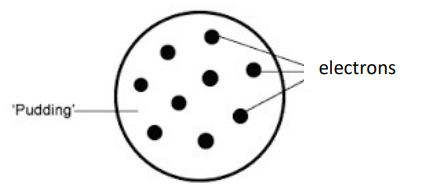
What did the plum-pudding model suggest the atom was like, and who suggested it?
J.J Thompson: a ball of positive charge with negatively charged electrons embedded throughout and thus the mass is evenly ditributed throughout the atom
Who conducted the alpha particle scattering experiment and what did it suggest about the atom?
Ernest Rutherford
most of the alpha particles went through: shows that the atom is mostly empty space
some of the alpha particles were deflected at large angles: shows that only the nucleus was positively charged (the centre of the atom)
some of the alpha particles were deflected straight back: shows that the mass of the atom is concentrated in the centre
NO NEUTRONS PRESENT

What did the bohr model suggest?
electrons orbit the nucleus at specific distances and that the electrons are in energy levels

Compare the plum pudding model with the nuclear model
both models show the presence of electrons
both models do not show neutrons (has not been discovered yet)
plum pudding model shows that the mass is distributed evenly throughout the atom, whilst the nuclear model shows that the mass in concentrated in the centre (the nucleus)
plum pudding model shows that the atom is a ball of positive charge, whilst the nuclear model suggests that only the nucleus is positively charged
Define the term ‘isotopes’ and explain the existence of isotopes
Isotopes exist due to instability caused in an atom.
Isotopes have the same number of protons but a different number of neutrons than other atoms of that element.
How do isotopes of the same element vary in terms of chemical properties and physical propertes?
Isotopes of an element are chemically identical since their electron configuration is the same. The same number of electrons are present/ same electronic configuration.
Isotopes of an element are physically different. Isotopes with more neutrons have a higher mass / higher density / higher melting point / slower rates of diffusion.
State three isotopes of hydrogen and their mass number
Protium (1), Deuterium (2), Tritium (3)
State two reasons why mass spectrometry is used
to determine the relative molecular mass
to determine all the isotopes present in a sample of an element and to therefore identify elements.
State the five stages of Time of Flight Mass Spectrometry.
ionisation
acceleration
ions drift
detection of ions
data analysis
Give two conditions that must be used in mass spectrometry and why
must be kept under a high vaccum - to stop the ions produced from colliding with molecules in the air, making the test less accurate and reliable since it may affect the time it takes for an ion to travel through the tube.
the sample must be ionised
Give two reasons in TOF mass spectrometry why the sample must be ionised
ions, not molecules, will interact and thus be attracted to the negative plate
only ions will hit the detector and create a current
In TOF mass spectrometry what are the two types of ionisation and when are they used?
electrospray - used preferably for larger organic molecules (high formula mass) The softer conditions of this technique mean fragmentation does not occur
electron impact - used for elements and substances with low formula mass. Electron impact can cause larger organic molecules to fragment.
What is meant by fragementation?
The process in mass spectrometry that causes a positive ion to split into smaller ions and neutral ones, one of which is a positive fragment ion
Describe how ions are formed in a time of flight (TOF) mass spectrometer.

Explain what happens in Electrospray Ionisation.
The sample is dissolved in a volatile, polar solvent
injected through a fine needle giving a fine mist
the tip of needle has high voltage
at the tip of the needle the sample molecule, M, gains a proton, H+ , from the solvent forming MH+
M(g) + H+ —→ MH+ (g)
The solvent evaporates away while the MH+ ions move towards a negative plate
Explain what happens in electron impact ionisation
A vaporised sample is injected at low pressure
An electron gun fires high energy electrons at the sample
This knocks out an outer electron
Forming positive ions with different charges
E.g. Ti (g) —→ Ti+ (g)+ e–
Explain what happens in Acceleration of Ions
Positive ions are accelerated by an electric field to a constant kinetic energy
Why does a heavier ion arrive later?
for equal kinetic energy, a greater mass means a lower velocity so the ion takes longer to travel through the fixed flight tube distance
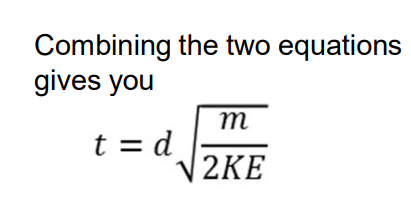
Which two equations are needed to calculate the time of flight? Show the rearranged format
KE = ½ mv²
KE = kinetic energy of particle (J)
m = mass of the particle (kg)
𝑣 = velocity of the particle (ms–1)
t = d / v
t = time of flight (s)
d = length of flight tube (m)
𝑣 = velocity of the particle (m s–1
Explain what happens in ion drift
the positive ions with a smaller mass/charge ratio values will have the same kinetic energy as those with a larger mass/charge ratio yet will travel faster
The ions are therefore separated based on their different velocities
the heavier particles take longer to drift through the area
the ions are distinguished by different flight times
Explain what happens in detection
The ions reach the detector and generate a small current, which is fed to a computer for analysis.
The current is produced by electrons transferring from the detector to the positive ions.
The size of the current is proportional to the abundance of the species


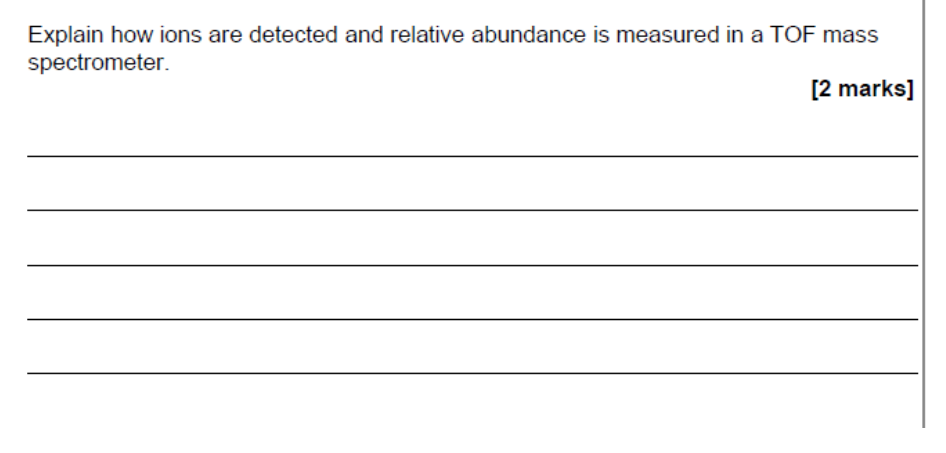

Explain how current is generated in a mass spectrometer. [2]
electrons are transferred at the detector
from the detector to the positive ion
State the name of the sub-orbitals and the maximum number of electrons each can occupy
s-orbital: 2 electrons
p-orbital: 6 electrons
d-orbital: 10 electrons
f-orbital: 14 electrons
Label the following sections in the periodic table based on their block:
group 1 and 2 metals (inculding hydrogen)
transition metals
non-metals
bottom of the periodic table
group 1 and 2 (incluidng hydrogen): s-block
transition metals: d-block
non-metals: p-block
bottom of the periodic table: f-block
How many sub-orbitals are there in:
the 1st shell
the 2nd shell
the 3rd shell
the 4th shell
the 1st shell: only s shell
the 2nd shell: only s and p shell
the 3rd shell: only s, p , and d shells
the 4th shell: s,p,d and f shells
Write the elctronic configuration of the following:
lithium
calcium
silver
nitogen
chlorine
lithium: 1s22s1
calcium: 1s22s22p63s23p64s2
silver: 1s22s22p63s23p64s23d104p65s24d9
nitrogen: 1s22s22p3
cholrine: 1s22s22p63s23p5
Write the electronic configuration of the following:
chloride ion
magnesium ion
zinc ion
sulfide ion
stronium ion
chloride ion (Cl-): 1s22s22p23s23p6
magnesium ion (Mg2+): 1s22s22p6
zinc ion (Zn2+): 1s22s22p63s23p64s03d10
sulfide ion (S2-): 1s22s22p63s23p6
stronium ion (Sr2-): 1s22s22p63s23p64s23d104p6
What are the exceptions for 3d and 4s?
4s always comes before 3d when writing electronic configuration
in ions 4s loses it’s electrons before 3d
Write the short hand electronic configuration for the following elements:
potassium
zircronium
iodine
sulfur
potassium: [Ar] 4s1
zircronium: [Kr] 5s24d2
iodine: [Kr] 5s24d104p5
sulfur: [Ne]3s23p4
Define what is meant by ‘first ionisation energy’ and write the equation for the first ionisation energy
The first ionisation energy is the enthalpy change when one mole of gaseous atoms forms one mole of gaseous ions with a single positive charge
H(g) —→ H+ (g) + e
Define what is meant by the ‘second ionisation energy’
the enthalpy change when one mole of gaseous ions with a single positive charge forms one mole of gaseous ions with a double positive charge
State and explain the three factors that effect ionisation energy
nuclear charge (n.o of protons): the greater the n.o of protons the greater the nuclear charge —→ thus the greater the force of electrostatic attraction between the outer electron and nucelus = greater ionisation energy
distance from the nucleus: the greater the distance from the nucleus, the lower the ionisation energy due to a weaker force of attraction between the outer electron and the nucleus
shielding: the greater the number of electron shells, the weaker the force of attraction between the outer electron and the nucleus —→ thus the lower the ionisation energy
State and explain the trends of ionisation energy as you:
go down a group
go across a period
go down a group: ionisation energy decreases, this is because the shielding increases (there are more electron shells), and thus a greater distance between the outer electron and the nucelus —→ hence a weaker force of electrostatic attraction between the nucleus and outer electron
go across a period: ionisation energy increases, this is because the nuclear charge increases (n.o of protons) —→ therefore a stronger force of electrostatic attraction between the outer electron and the nucleus
Why does helium have a large first ionisation energy?
this is because helium’s first electron is in the first shell closest to the nucleus and has no shielding effects from inner shells.
Helium has a bigger first ionisation energy than hydrogen as it has one more proton.