A&P Lab Test 1
 Call Kai
 Learn
Learn Practice Test
 Spaced Repetition
 Match
Match Flashcards
 Knowt Play
1/232

There's no tags or description
Looks like no tags are added yet.
Name | Mastery | Learn | Test | Matching | Spaced | Call with Kai | Chat |
|---|
No analytics yet
Send a link to your students to track their progress
233 Terms
superior
toward the head or upper part of the body
inferior
toward the feet or lower part of the body
cranial
toward the skull or head
caudal
toward the tail end of the body (coccyx)
anterior
toward the front of the body
posterior
toward the back of the body
dorsal
toward the back of the body; synonymous with posterior
ventral
toward the front of the body; synonymous with anterior
medial
towards the body’s midline
lateral
away from the body’s midline
intermediate
between a more medial structure and a more lateral structure
proximal
closer to the trunk or to the point where a limb attaches/begins
distal
farther from the trunk or point of origin/attachment
superficial
closer to or at the body surface
deep
farther from the body surface
external
toward or on the outside of an organ, cavity, or body structure
internal
toward or on the inside of an organ, cavity, or body structure
ipsilateral
located on the same side of the body
contralateral
located on opposite sides of the body
Sutural Bones
small, flat, irregularly shaped bones found within the sutures
Sutural bones examples
small accessory bones in the lambed suture between the occipital and parietal bones of the skull

Flat Bones
thin, flattened bones that are often slightly curved rather than completely flat
Flat bones examples
cranial bones of the skull, ribs, sternum, and scapulae

Long bones
longer in length than they are wide
Long bones examples
femur, humerus, tibia, fibula, radius, ulna, metacarpals, metatarsals, and phalanges

Short bones
roughly cube shaped with length, width, and thickness that are approximately equal
Short bones examples
carpals of the wrist and tarsals of the ankle

Irregular bones
have complex shapes, often have projections, ridges, openings, or unusual contours
Irregular bone examples
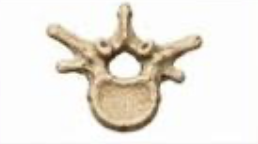
vertebrae, sacrum, coccyx, sphenoid bone, ethmoid bone, many facial bones
Sesamoid bones
small, rounded or oval bones, protecting tendons from pressure, compression, and wear
Sesamoid bones examples
the patella, pisiform in the wrist, and small sesamoid bones in the hands and feet

Axial Skeleton (80 bones)
Skull, Auditory ossicles, hyoid bone in neck, vertebrae, sacrum, coccyx, ribs and sternum

Appendicular skeleton (126 bones)
Pectoral girdle, upper limbs, pelvic girdle, lower limbs

Meatus
A tube like passageway or canal through a bone
The external auditory _____ is the ear canal in the temporal bone of the skull

Sinus
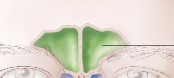
An air-filled hollow space within a bone
The frontal _____ is inside the frontal bone, above the eyes
Foramen
A hole or opening in a bone, usually for nerves or blood vessels
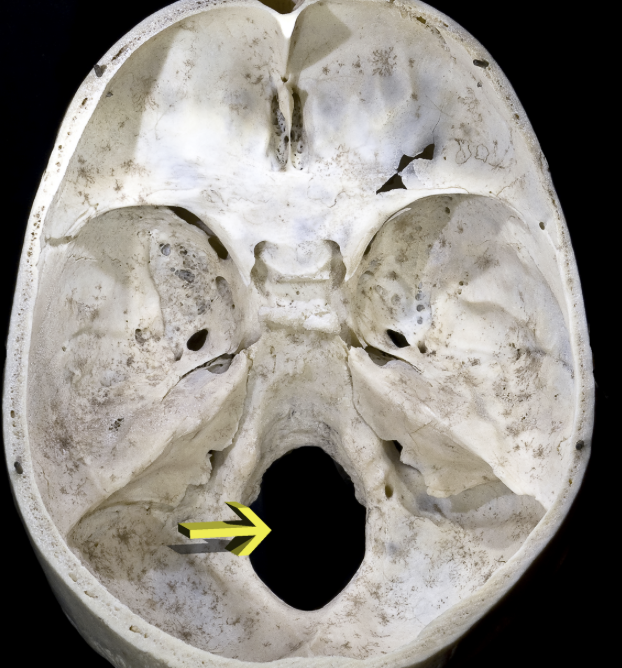
The _____ magnum is the large opening in the occipital bone at the base of the skull where the spinal cord passes.
Fissure
A narrow, slit like opening in or between bones
The Superior Orbital ______ is located in the sphenoid bone, at the back of the eye socket

Groove
A narrow furrow or channel in a bone
The intertubercular _____ is on the upper humerus, between the greater and lesser tubercles

Fossa
A shallow depression, hollow, or basin-like area in a bone
The mandibular _____ is in the temporal bone of the skull and helps form the jaw joint

Facet
A smooth, flat, or slightly curved surface where two bones meet
Superior articular ______ are on vertebrae in the vertebral column

Condyle
A smooth, rounded knob at the end of a bone that forms part of a joint
The occipital _____ are on the bottom of the skull and articulate with the first cervical vertebra

Head
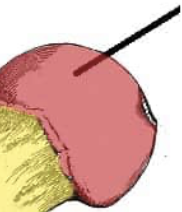
A large, rounded end of a bone that helps form a joint
The _____ of the femur is the ball-like upper end of the thigh bone that fits into the hip socket
Neck
A narrowed region that connects a head to the main part (shaft) of a bone
The _____ of the femur lies just below the head of the femur

Trochlea
A smooth, pulley-shaped joint surface
The _____ of the humerus is at the elbow end of the upper-arm bone and articulates with the ulna

Process
Any noticeable bony projection or outgrowth
The mastoid _____ is a projection of the temporal bone located behind the ear

Tuberosity
A large, roughened bump where muscles or ligaments attach
The tibial _____ is the tough bump on the front of the tibia just below the knee

Tubercle
A small rounded bump, commonly used for attachment
The greater _____ is a projection on the upper humerus near the shoulder

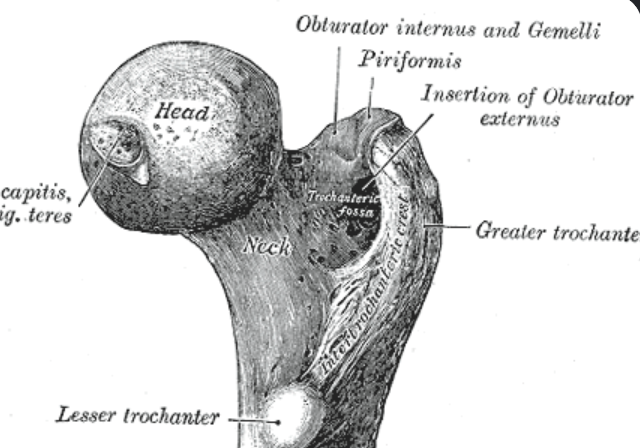
Trochanter
A very large, blunt projection found only on the femur
The greater _____ is on the upper outer side of the femur near the hip
Crest
A prominent, narrow ridge of bone
The iliac _____ is the upper curved ridge of the hip bone

Line
A low, narrow ridge that is less prominent than a crest
The _____ aspera is a long ridge on the posterior surface of the femur

Spine
A sharp, pointed or slender projection
The ischial _____ is a pointed projection on the ischium, part of the hip bone

Ramus
An arm-like or branch-like extension of a bone
The _____ of the mandible is the upright near portion of the lower jaw

Frontal Bone (1)
Anterior side of the skull

Parietal Bones (2)
On the upper & Lateral walls of the skull

Temporal Bones (2)
symmetrical bones on the sides and base of the cranium

occipital bone (1)
forms the lower and back part of the human skull

sphenoid bone (1)
wedged between the frontal, temporal, and occipital bones

ethmoid bone (1)
center of the skull that divides the nasal cavity from the brain and helps form the eye sockets
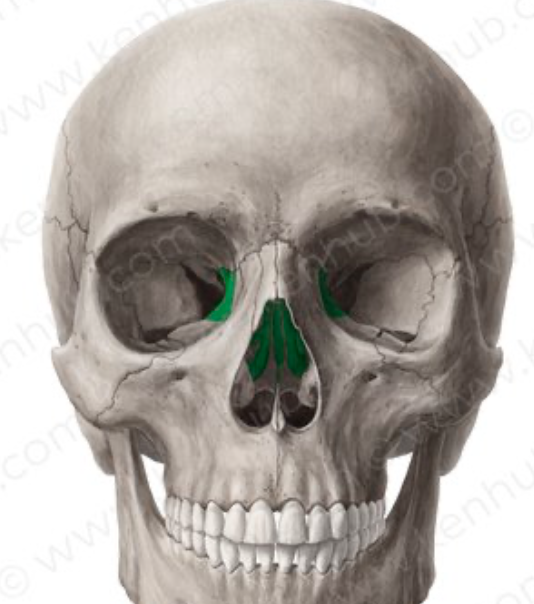
nasal bones (2)
two oblong bone located side by side at the upper middle part of the face that form the hard bridge of the nose

maxilla bones (2)
two paired, pyramidal-shaped bones fused at the midline of the mid face to form the upper jaw

zygomatic bones (1)
a paired irregular bone situated at the upper and lateral part of the face

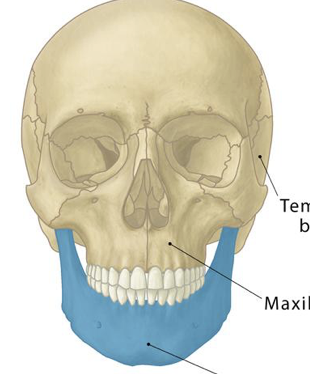
mandible (1)
the largest, strongest, and only movable bone in the human skull
palatine bones (2)
two paired L-shaped facial bones located at the back of the nasal cavity that help form the hard palate, the nasal cavity, and the floor of the eye sockets

lacrimal bones (1)
the smallest most fragile bone of the face, located at the front part of the medial (inner) wall of each eye socket

vomer (1)
a small, thin plow-shaped facial bone that forms the lower and back part of the nasal septum, separating the left and right nasal cavities

nasal conchae (2)
long, curled shelves of bone that project into breathing passages of the nasal cavity
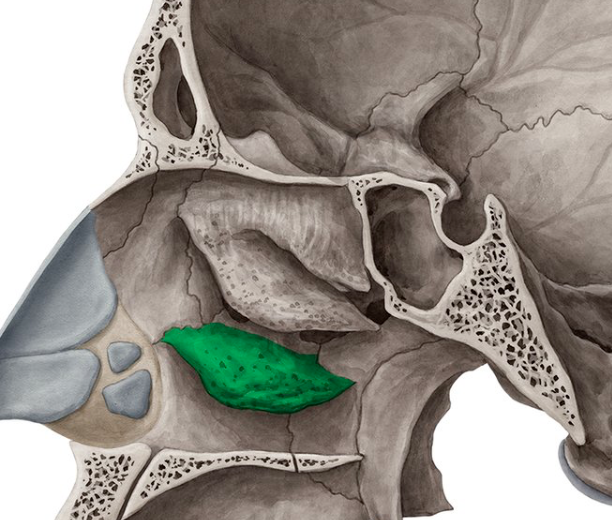
nasal septum (1)
the perpendicular plate of the ethmoid bone and the vomer bone, along with smaller contributions from the maxilla and palatine bones

supraorbital foramen
a small opening or notch in the frontal bone of the skull, located along the superior margin of the eye socket directly under the eyebrow

infraorbital foramen
a small opening in the maxillary bone of the skull, located just below the lower margin of the eye socket and slightly to the side of the nose

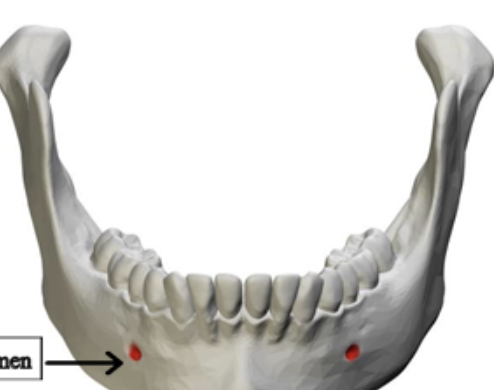
mental foramen
one of two small openings on the front and side of the mandible that allows nerves and blood vessels to reach the chin and lower lip
superior orbital fissure
a narrow, triangular cleft in the skull that connects the eye socket to the middle cranial fossa of the brain
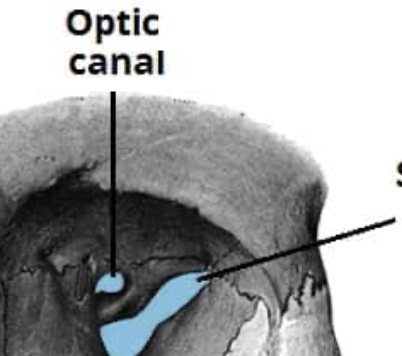
optic canal
a short, funnel-shaped bony passage in the skull that connects the eye socket to the middle cranial fossa inside the brain cavity

external auditory meatus
the tube-like passage that connects the outer ear to the eardrum

mastoid process
a conical, bony prominence located at the base of the skull directly behind and below the ear canal

styloid process
a slender, pointed piece of bone that extends downward and forward from the base of the skull near the ear

occipital condyles
two oval shaped bony bumps on the bottom of the skull’s occipital bone that connect your head to your neck

carotid canal
a bony passage in the skull’s temporal bone that allows the main blood supply to the brain to pass safely from the neck into the head
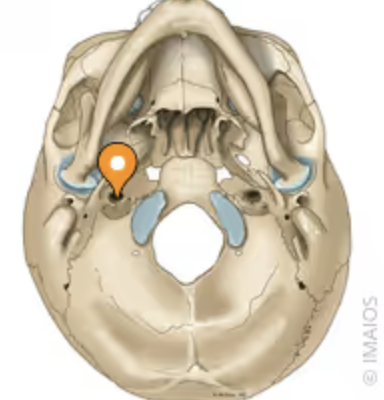
jugular foramen
a large opening at the base of the skull formed by the temporal and occipital bones that allows major blood vessels and cranial nerves to pass through

foramen magnum
the largest opening at the base of the skull through which the spinal cord and brainstem connect

coronoid process of the mandible
a thin triangular bony projection extending upward from the front part of the upper jawbone’s ramus
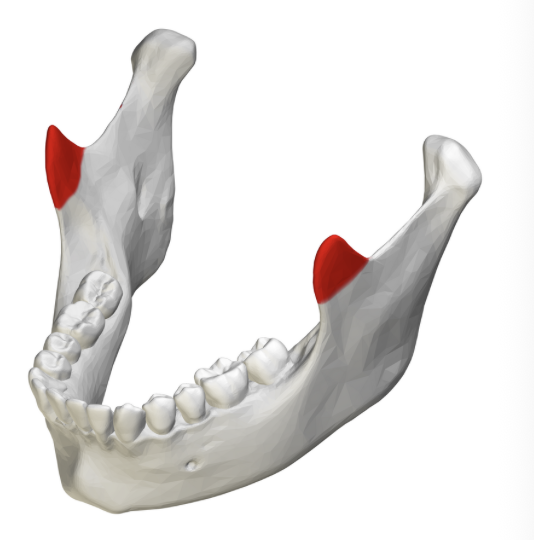
condylar process of the mandible
an upward and backward bony projection on the lower jaw that forms the temporomandibular joint(TMJ) with the skull

mandibular notch
a U-shaped dip on the upper edge of the lower jawbone’s vertical part

mandibular fossa
a deep, oval shaped depression on the temporal bone of the skull that helps form the temporomandibular joint (TMJ)
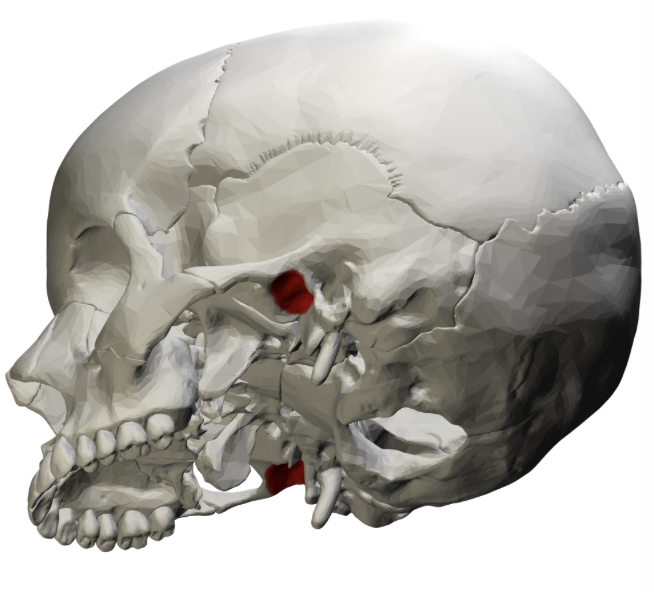
alveolar process
the thickened ridge of bone on the upper and lower jaw that contains the sockets holding the roots of the teeth
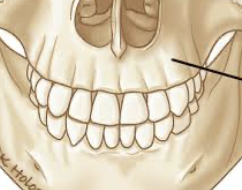
zygomatic arch
a bony bridge on the side of the skull that forms the prominent contour of the cheek

pterion
a fragile, h-shaped junction on the side of the skull where four cranial bones meet (frontal, parietal, temporal, and sphenoid bones)

crista galli
a small, triangular bony ridge that projects upward from the middle of the ethmoid bone inside the skull

cribriform plate
a sieve-like, horizontal bony structure belonging to the ethmoid bone that forms the roof of the nasal cavity
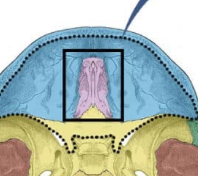
sella turcica
a saddle-shaped depression in the sphenoid bone at the base of the skull that holds and protects the pituitary gland

lesser wing
a paired, thin, triangular bony plate that projects laterally from the anterosuperior aspect of the sphenoid body at the base of the skull
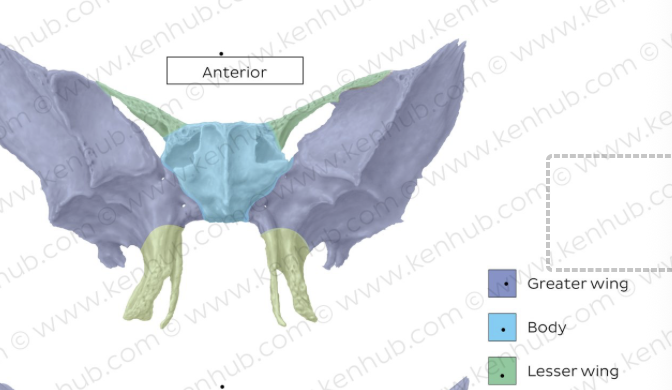
greater wing
a large, curved bony process of the sphenoid bone that spreads out on both sides of the skull base

coronal suture
a dense, fibrous joint that connects the frontal bone to the two parietal bones across the top of the skull

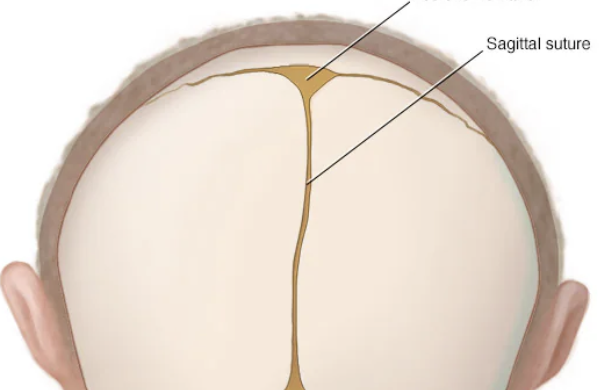
sagittal suture
a dense, fibrous joint running along the top center of the skull that connects the two parietal bones

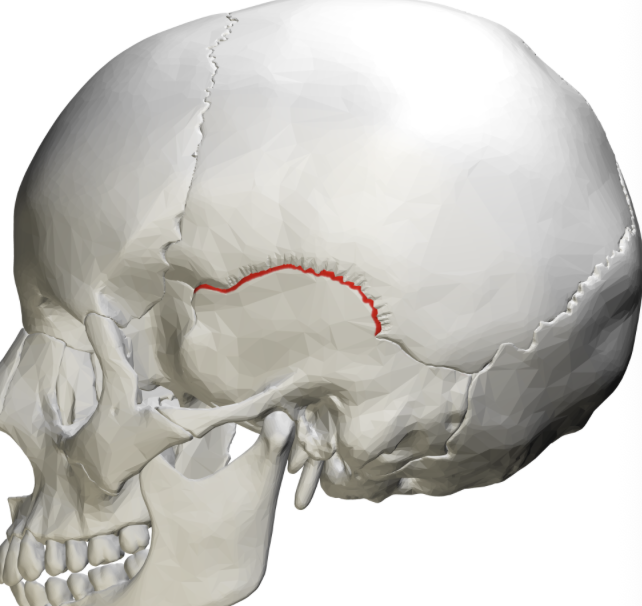
squamous suture
a paired, arched cranial joint on the side of the skull that connects the temporal bone to the parietal bone
lambdoid suture
a dense, fibrous joint located at the back of the skull that connects the two parietal bones to the occipital bine

frontal suture
a vertical fibrous joint that runs down the middle of the forehead, connecting the two halves of the frontal bone from the bridge of the nose to the top of the head

anterior fontanelle
the largest diamond-shaped “soft spot” on the top front of an infant’s head where the cranial bones meet but have not yet fused

posterior fontanelle
a small, triangle-shaped soft spot located at the back of a newborn’s head where the parietal and occipital skull bones meet
mastoid fontanelle
a paired soft spot on an infant’s skull located just behind the ear, where the temporal, parietal, and occipital bones meet

sphenoidal fontanelle
a paired soft spot on each side of an infant’s skull
