Ch 6: Fluid, Electrolyte, Acid-Base Homeostasis Pt 2
 Call Kai
 Learn
Learn Practice Test
 Spaced Repetition
 Match
Match Flashcards
 Knowt Play
1/47

There's no tags or description
Looks like no tags are added yet.
Name | Mastery | Learn | Test | Matching | Spaced | Call with Kai | Chat |
|---|
No analytics yet
Send a link to your students to track their progress
48 Terms
Chloride Function
Assists in fluid distribution by attaching to water or sodium
Found in gastric secretions, pancreatic juices, bile, and cerebrospinal fluid
Excreted through the kidneys
Chloride
Mineral electrolyte and major extracellular anion
Normal range: 98-108 mEq/L
Phosphorus
Mostly found in the bones; small amounts are in the bloodstream
Plays a role in bone and tooth mineralization, cellular metabolism, acid-base balance, and cell membrane formation
Main source is dietary intake
Excreted through the kidneys
Normal range: 2.5-4.5 mg/dL
pH
⚬balance is vital in keeping the body optimally functioning
Our bodies have compensatory mechanisms to keep
homeostasis
⚬you will be able to identify acid-base imbalances and implement nursing interventions to improve the imbalance
Acid-Base Balance
Measured by pH
Normal serum pH: 7.35-7.45)
Body fluids, kidneys, and lungs help maintain balance
Subtle changes can cause serious effects
pH regulation
reflects hydrogen concentrations
■Hydrogen is an acid
■The more hydrogen, the lower the pH
PH Acid
by-products of metabolism
■Volatile acids (example- carbonic acid)
■Volatile gases (example- carbon dioxide)
■Nonvolatile acids
Buffers
Chemicals that combine with an acid or base to change pH
Immediate reaction to counteract pH variations until compensation is initiated
Four Buffer Mechanisms
The bicarbonate-carbonic acid system, phosphate system, hemoglobin system, and protein system
Potassium Hydrogen Buffers
Potassium and hydrogen move interchangeably into and out of the cell to balance pH
With extracellular excess, hydrogen moves inside the cell for buffering; in exchange, potassium moves out
Potassium imbalances can lead to pH imbalances
Respiratory Regulation
Manages pH by altering carbon dioxide excretion
Uses chemoreceptors
Responds quickly, but is short lived
Speeding up respirations
excrete more carbon dioxide, decreasing acidity
Slowing down Respirations
excrete less carbon dioxide, increasing acidity
Renal Regulation
Alters the excretion or retention of hydrogen or bicarbonate
More effective because it is permanently removing hydrogen
Responds the slowest, but lasts the longest
Acid-Base Imbalances Respiratory System
compensates by increasing or decreasing ventilation
PaCO₂ is acidic
Normal arterial PaCO2 35-45 mmHg
Acid-Base Imbalances Renal System
compensates by producing acidic or alkaline urine
HCO₃- (bicarbonate) is basic
Normal HCO3 22-26 mEq/L
Acidosis cause
Ketones are produced too quickly and build up in the blood
Respiratory Opposite, Metabolic Equal
ROME (acronym)
Normal Values
pH: 7.35-7.45
PCO2: 35-45 mm Hg
HCO3: 22-26 mEq/L
Metabolic Acidosis
Low pH
Normal PCO2
Low HCO3
Metabolic Alkalosis
High pH
Normal PCO2
High HCO3
Respiratory Acidosis
Low pH
High PCO2
Normal HCO3
Respiratory Alkalosis
High pH
Low PCO2
Normal HCO3
Acid Base Balance Compensation
■If the problem causing the pH imbalance originates in the lungs, the kidneys initiate efforts to correct it
■If the problem causing the pH imbalance originates outside the lungs, the lungs initiate efforts to correct it
Metabolic Acidosis Causes
■Bicarbonate deficit: intestinal and renal losses
■Acid excess: tissue hypoxia resulting in lactic acid accumulation, ketoacidosis, drugs, toxins, and renal retention
Metabolic Acidosis Manifestations
■Appear as regulatory systems fail to maintain pH within normal range
■Include headache, malaise, weakness, fatigue, lethargy, coma, warm and flushed skin, nausea, vomiting, anorexia, hypotension, dysrhythmias, shock, Kussmaul's respirations, and hyperkalemia

Metabolic Alkalosis Causes
■Excess bicarbonate: excessive antacid use, use of bicarbonate-containing fluids, hypochloremia
■Deficient acid: gastrointestinal loss, hypokalemia, renal loss, hypovolemia, hyperaldosteronism
Metabolic Alkalosis Manifestations
■Appear as regulatory systems fail to maintain pH within normal range
■Include mental confusion, hyperactive reflexes, paresthesia, tetany, seizures, respiratory depression, dysrhythmias, and coma

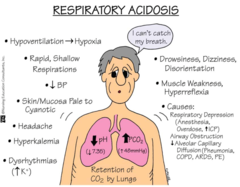
Respiratory Acidosis Causes
Results from carbon dioxide retention, which increases carbonic acid
Caused by conditions that result in hypoventilation or decreased gas exchange
Include acute asthma exacerbations, chronic obstructive pulmonary disease, airway obstructions, pulmonary edema, pneumonia, drug overdose, respiratory failure, and central nervous system depression
Respiratory Acidosis Manifestations
■Appear as regulatory systems fail to maintain pH within normal range
■Include headache, blurred vision, tremors, muscle twitching, vertigo, irritability, disorientation, lethargy, coma, tachycardia leading to bradycardia, blood pressure fluctuations, diaphoresis
Respiratory Alkalosis Causes
Results from excess exhalation of carbon dioxide, which leads to carbonic acid deficits
Caused by conditions that result in hyperventilation
■Include acute anxiety, pain, fever, hypoxia, gram-negative septicemia, aspirin overdose, excessive mechanical ventilation, and hypermetabolic states
Respiratory Alkalosis Manifestations
■Appear as regulatory systems fail to maintain pH within normal range
■Include paresthesia, dizziness, vertigo, syncope, muscle irritability and twitching, tetany, inability to concentrate, seizures, tachycardia, dysrhythmias, dry mouth, anxiety, excessive diaphoresis, and coma

ARTERIAL BLOOD GAS (ABG) INTERPRETATION
⚬Uncompensated
⚬Partially compensated
Fully compensated
⚬pH ABG
serum hydrogen concentration
■Indicates acid-base status
⚬PaCO₂ ABG
partial pressure of carbon dioxide
■Indicates the adequacy of pulmonary ventilation
⚬HCO₃ ABG
bicarbonate
■Indicates the activity in the kidneys to retain or excrete bicarbonate
⚬PaO₂ ABG
partial pressure of oxygen
■Indicates serum oxygen concentration
ABG Base Excess/Deficit
■Indicates serum buffer concentration, particularly bicarbonate
■Positive values indicate an excess of base or a deficit of acid
■Negative values indicate a deficit of base or an excess of acid
First step ABG
Is the pH basic (>7.4), acidic (
Second step ABG
Is the PaCO₂ basic (
Third step ABG
Is the HCO₃ basic (>26 mEq/L), acidic (
Fourth step in ABG (Look for Patterns)
■Two As mean acidosis, two Bs mean alkalosis
■If one of the As or Bs is CO₂, it suggests respiratory disorder
■If one of the As or Bs is HCO₃, it suggests metabolic disorder
■Three As or Bs indicate a mixed disorder; 3 As indicate acidosis and 3 Bs indicate alkalosis
ABG Steps
For each step, note "B" if basic, "A" if acidic, or normal if within normal limits
Fifth step ABG Determine compensation
■Uncompensated if the unpaired result is within normal range
■Partially compensated if the unpaired result is the opposite letter of the pairs, but pH is still abnormal
■Fully compensated if the unpaired result is the opposite letter and the pH has returned to normal range
Uncompensated
if the unpaired result is within normal range
Partially compensated
if the unpaired result is the opposite letter of the pairs, but pH is still abnormal
Fully compensated
if the unpaired result is the opposite letter and the pH has returned to normal range
Acid Base Balance (ABG)
⚬If all three are normal, the ABGs are normal
⚬If CO2 and HCO3 are abnormal, ABGs are fully compensated when pH has returned to normal and uncompensated when two values are abnormal
⚬If three are abnormal, ABGs are partially compensated, or combined disorder is happening
⚬Lungs (regulates CO2) and kidneys (retains or excretes HCO3) are the main players in acid-base balance/ imbalance