2 - Carbohydrates
 Call Kai
 Learn
Learn Practice Test
 Spaced Repetition
 Match
Match Flashcards
 Knowt Play
1/131

Earn XP
Description and Tags
Proverbs 16:3
Name | Mastery | Learn | Test | Matching | Spaced | Call with Kai | Chat |
|---|
No analytics yet
Send a link to your students to track their progress
132 Terms
c. Carbohydrates
Polyhydroxy aldehydes or ketones
a. Lipids
b. Proteins
c. Carbohydrates
d. Nucleic acids
b. "Hydrates of carbon"
In a literal sense, the name carbohydrate can be literally taken as ________
a. "Sugars of life"
b. "Hydrates of carbon"
c. "Carbon of hydrates"
d. "Polyhydroxy ketones"
c. CₙH₂ₙOₙ
[CARBOHYDRATES]
Empirical formula of monosaccharides
a. CₙH₂ₙO₂ₙ
b. C₂ₙHₙOₙ
c. CₙH₂ₙOₙ
d. CₙHₙO₂ₙ
a. True
[CARBOHYDRATES]
Not all carbohydrates are sugars. Sugars should be sweet and includes mono/disaccharides . Polysaccharides like starch are not sweet and cannot be called sugars
a. True
b. False
a. True
[CARBOHYDRATES]
Just like amino acids and proteins, carbohydrates have significance whether they are single units (monosaccharides) or more than that (disaccharides to polysaccharides)
a. True
b. False
Monosaccharides
Disaccharides
Oligosaccharides
Polysaccharides
Classification of Carbohydrate [4]
Functional group
Number of carbons
[CLASSIFICATION OF CARBOHYDRATES]
Monosaccharides can be classified based on _____ [2]
Aldose
Ketose
[CLASSIFICATION OF CARBOHYDRATES]
Classification of monosaccharides based on functional group:
a. Triose or tetrose
b. Aldose or ketose
c. Pentose or hexose
d. Furanose or pyranose
Triose
Tetrose
Pentose
Hexose
[CLASSIFICATION OF CARBOHYDRATES]
Classification of monosaccharides based on number of carbons:
a. Aldose or ketose
b. Triose, tetrose, pentose, hexose
c. D or L configuration
d. Alpha or beta anomer
Dihydroxyacetone
Glyceraldehyde
[CLASSIFICATION OF CARBOHYDRATES]
Examples of triose
a. Erythrose, threose
b. Ribose, arabinose
c. Dihydroxyacetone, glyceraldehyde
d. Glucose, galactose, fructose, mannose
Erythrose
Threose
[CLASSIFICATION OF CARBOHYDRATES]
Examples of tetrose
a. Dihydroxyacetone, glyceraldehyde
b. Ribose, arabinose
c. Glucose, galactose, fructose, mannose
d. Erythrose, threose
Ribose
Arabinose
[CLASSIFICATION OF CARBOHYDRATES]
Examples of pentose
a. Erythrose, threose
b. Ribose, arabinose
c. Dihydroxyacetone, glyceraldehyde
d. Glucose, galactose, fructose, mannose
Glucose
Galactose
Fructose
Mannose
[CLASSIFICATION OF CARBOHYDRATES]
Examples of hexose
a. Ribose, arabinose
b. Erythrose, threose
c. Dihydroxyacetone, glyceraldehyde
d. Glucose, galactose, fructose, mannose
b. Disaccharides
[CLASSIFICATION OF CARBOHYDRATES]
2 units of carbohydrate
a. Monosaccharides
b. Disaccharides
c. Oligosaccharides
d. Polysaccharides
Sucrose
Maltose
Lactose
📌Mnemonic: “Share Mo Lang”
[CLASSIFICATION OF CARBOHYDRATES]
Examples of disaccharides
a. Raffinose, melezitose, stachyose
b. Cellulose, pectin, chitin
c. Sucrose, Maltose, and Lactose
d. Starch and glycogen
c. Maltose
[CLASSIFICATION OF CARBOHYDRATES]
Disaccharide composed of glucose + glucose
a. Sucrose
b. Lactose
c. Maltose
d. Cellobiose
b. Sucrose
[CLASSIFICATION OF CARBOHYDRATES]
Disaccharide composed of glucose + fructose
a. Maltose
b. Sucrose
c. Lactose
d. Trehalose
c. Lactose
[CLASSIFICATION OF CARBOHYDRATES]
Disaccharide composed of glucose + galactose
a. Sucrose
b. Maltose
c. Lactose
d. Cellobiose
d. Oligosaccharides
[CLASSIFICATION OF CARBOHYDRATES]
3 to 10 units of carbohydrate
a. Polysaccharides
b. Disaccharides
c. Monosaccharides
d. Oligosaccharides
Raffinose
Melezitose
Stachyose
[CLASSIFICATION OF CARBOHYDRATES]
Examples of oligosaccharides
a. Cellulose, pectin, chitin
b. Starch, glycogen
c. Raffinose, melezitose, stachyose
d. Maltose, sucrose, lactose
c. Polysaccharides
[CLASSIFICATION OF CARBOHYDRATES]
More than 10 units of carbohydrate
a. Oligosaccharides
b. Monosaccharides
c. Polysaccharides
d. Disaccharides
►Include most structural carbohydrates
Cellulose
Pectin
Chitin
►Includes stored energy forms for plants and animals
Starch
Glycogen
[CLASSIFICATION OF CARBOHYDRATES]
Example of Polysaccharides [2]
d. Starch
[CLASSIFICATION OF CARBOHYDRATES]
Stored energy form of carbohydrates for plants
a. Glycogen
b. Cellulose
c. Chitin
d. Starch
b. Glycogen
[CLASSIFICATION OF CARBOHYDRATES]
Stored energy form of carbohydrates for animals
a. Starch
b. Glycogen
c. Pectin
d. Cellulose
b. Linear
[STRUCTURE & iSOMERISM]
Monosaccharides drawn using Fischer projections
a. Cyclic
b. Linear
c. Branched
d. Pyranose
c. Cyclic
[STRUCTURE & iSOMERISM]
Monosaccharides drawn using Haworth projections
a. Linear
b. Branched
c. Cyclic
d. Open-chain
c. Penultimate OH
[STRUCTURE & iSOMERISM]
The D/L-isomerism is based on this OH
a. Anomeric OH
b. First OH
c. Penultimate OH
d. Glycosidic OH
c. The 2nd to the last carbon
[STRUCTURE & iSOMERISM]
The penultimate carbon refers to _____
a. The first carbon
b. The anomeric carbon
c. The 2nd to the last carbon
d. The carbonyl carbon
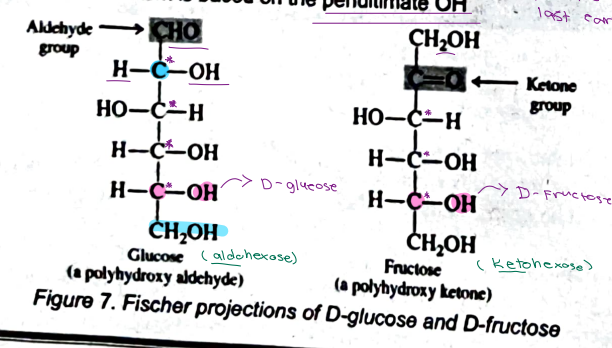
c. Aldohexose
[STRUCTURE & iSOMERISM]
Glucose is a polyhydroxy aldehyde, also called this
a. Ketohexose
b. Aldopentose
c. Aldohexose
d. Ketopentose
b. Ketohexose
[STRUCTURE & iSOMERISM]
Fructose is a polyhydroxy ketone, also called this
a. Aldohexose
b. Ketohexose
c. Aldopentose
d. Ketopentose
c. Aldehyde group (CHO)
[STRUCTURE & iSOMERISM]
Functional group at the top of glucose's Fischer projection
a. Hydroxyl group
b. Ketone group
c. Aldehyde group (CHO)
d. Carboxyl group
![<p>[STRUCTURE & iSOMERISM]</p><p class="font-claude-response-body break-words whitespace-normal">Functional group at the top of glucose's Fischer projection</p><p class="font-claude-response-body break-words whitespace-normal">a. Hydroxyl group<br>b. Ketone group<br>c. Aldehyde group (CHO)<br>d. Carboxyl group</p>](https://assets.knowt.com/user-attachments/32c1ea39-3303-40df-b9a5-5caf5bedb5ab.png)
c. Ketone group (C=O)
[STRUCTURE & iSOMERISM]
Functional group at the top of fructose's Fischer projection
a. Aldehyde group
b. Carboxyl group
c. Ketone group (C=O)
d. Hydroxyl group
c. Hemiacetals
[STRUCTURE & iSOMERISM]
In the process of cyclization, OH⁻ binds with carbonyl, technically making all cyclic monosaccharides
a. Acetals
b. Ketals
c. Hemiacetals
d. Glycosides
b. Furanoses
[STRUCTURE & iSOMERISM]
5-membered rings of cyclic monosaccharides
a. Pyranoses
b. Furanoses
c. Hemiacetals
d. Anomers
c. Pyranoses
[STRUCTURE & iSOMERISM]
6-membered rings of cyclic monosaccharides
a. Furanoses
b. Hemiacetals
c. Pyranoses
d. Anomers
A. True
[STRUCTURE & iSOMERISM]
In order to yield either furanoses or pyranoses, books often use pentoses/hexoses and then use their Penultimate OH
A. True
b. False
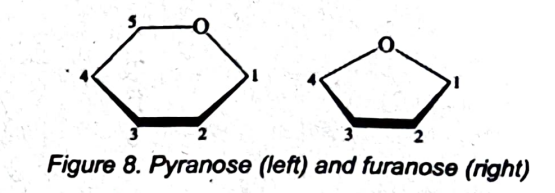
[STRUCTURE & iSOMERISM]
Figure 8: Pyranose (left) and furanose (right)
c. Anomeric carbon
[STRUCTURE & iSOMERISM]
What used to be the carbonyl carbon while linear will become _____ while cyclic
a. Penultimate carbon
b. Glycosidic carbon
c. Anomeric carbon
d. Hemiacetal carbon
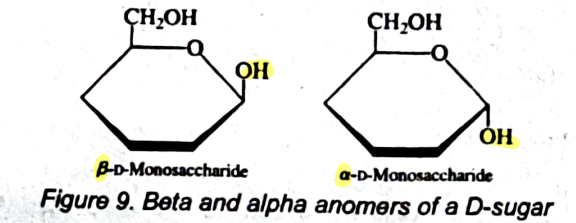
[STRUCTURE & iSOMERISM]
Figure 9: Beta and alpha anomers of a D-sugar
c. Racemic
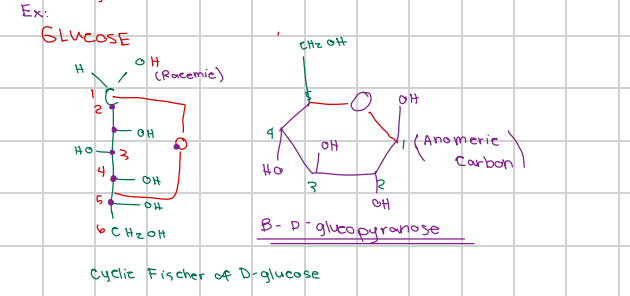
[CYCLIZATION]
During cyclization, the OH formed at carbon 1 of glucose is described as
a. Anomeric
b. Penultimate
c. Racemic
d. Hemiacetal
b. B-D-glucopyranose
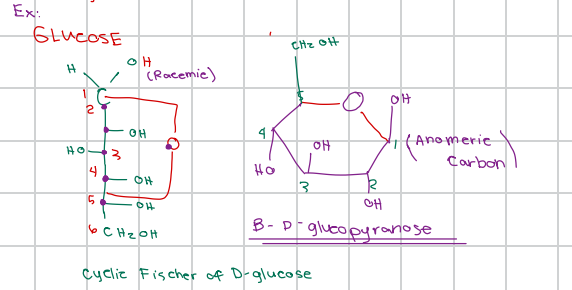
[CYCLIZATION]
Cyclic Fischer of D-glucose
a. α-D-fructofuranose
b. B-D-glucopyranose
c. D-fructose
d. α-D-glucofuranose
c. Anomeric carbon
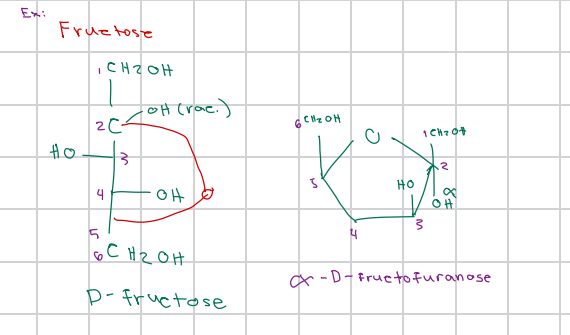
[CYCLIZATION]
What used to be the carbonyl carbon (C1) of glucose while linear becomes this while cyclic
a. Penultimate carbon
b. Glycosidic carbon
c. Anomeric carbon
d. Hemiacetal carbon
d. α-D-fructofuranose
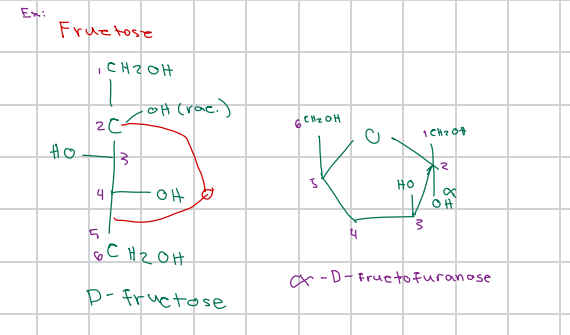
[CYCLIZATION]
Cyclization of D-fructose results in this product
a. B-D-glucopyranose
b. D-fructose (linear)
c. Cyclic Fischer of D-glucose
d. α-D-fructofuranose
b. Functional isomerism
[ISOMERISM]
Aldose and ketose is an example of ________
a. Optical isomerism
b. Functional isomerism
c. Diastereomerism
d. Epimerism
b. Optical isomerism
[ISOMERISM]
Changes within the chiral carbons
a. Functional isomerism
b. Optical isomerism
c. Structural isomerism
d. Geometric isomerism
c. Enantiomerism
[ISOMERISM]
All chiral carbons inverted
a. Epimerism
b. Diastereomerism
c. Enantiomerism
d. Functional isomerism
c. Diastereomerism
[ISOMERISM]
Not all chiral carbons inverted
a. Enantiomerism
b. Epimerism
c. Diastereomerism
d. Functional isomerism
c. Epimerism
[ISOMERISM]
Only 1 chiral carbon inverted
a. Diastereomerism
b. Enantiomerism
c. Epimerism
d. Functional isomerism
c. D-Mannose
[ISOMERISM]
✨BEQ: Epimer of D-Glucose at C-2
a. D-Galactose
b. D-Fructose
c. D-Mannose
d. D-Ribose
b. D-Galactose
[ISOMERISM]
Epimer of D-Glucose at C-4
a. D-Mannose
b. D-Galactose
c. D-Fructose
d. D-Ribose
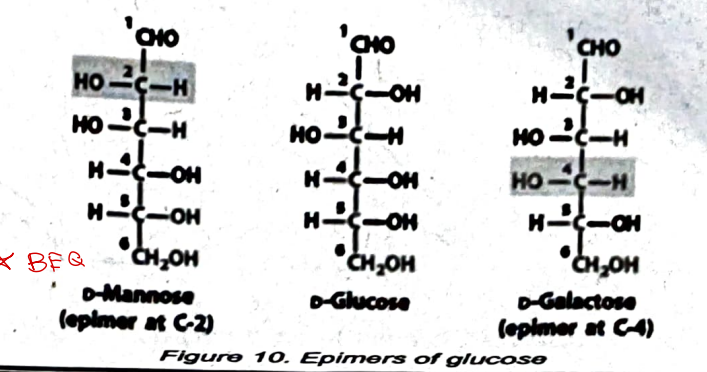
[ISOMERISM]
Figure 10: Epimers of glucose
c. Redox
[REACTIONS & DERIVATIVES]
Generates simple sugar derivatives
a. Hydrolysis
b. Condensation
c. Redox
d. Isomerization
Oxidation
Reduction
[REACTIONS & DERIVATIVES]
Redox reaction involves ___ [2]
b. Oxidation
[REACTIONS & DERIVATIVES]
Gives rise to different sugar acids
a. Reduction
b. Oxidation
c. Hydrolysis
d. Condensation
Uronic acids
Aldonic acids
Aldaric acids
[REACTIONS & DERIVATIVES]
Oxidation gives rise to different sugar acids such as _____ [3]
c. Aldonic acids
[REACTIONS & DERIVATIVES]
Oxidation at C1 gives rise to this acid
a. Uronic acids
b. Aldaric acids
c. Aldonic acids
d. Glycosidic acids
c. Aldaric acids
[REACTIONS & DERIVATIVES]
Oxidation at C1 & C6 gives rise to this acid
a. Aldonic acids
b. Uronic acids
c. Aldaric acids
d. Sugar alcohols
d. Uronic acids
[REACTIONS & DERIVATIVES]
Oxidation at C6 gives rise to this acid
a. Aldaric acids
b. Sugar alcohols
c. Aldonic acids
d. Uronic acids
b. Reduction
[REACTIONS & DERIVATIVES]
Gives rise to sugar alcohols
a. Oxidation
b. Reduction
c. Condensation
d. Hydrolysis
c. Hexoses
[REACTIONS & DERIVATIVES]
C6 just means the last carbon, and has always been called C6 because most sugar acids originate from _______
a. Pentoses
b. Trioses
c. Hexoses
d. Tetroses
c. Condensation
[REACTIONS & DERIVATIVES]
This process combines a cyclic sugar to another thing (technically meaning an acetal)
If the "other thing" is another sugar = Disaccharide
If the "other thing" is not a sugar = Glycoside
a. Hydrolysis
b. Oxidation
c. Condensation
d. Reduction
b. Disaccharide
[REACTIONS & DERIVATIVES]
Combines a cyclic sugar to another thing (technically meaning an acetal)
If the "other thing" is another sugar =________
a. Glycoside
b. Disaccharide
c. Polysaccharide
d. Acetal
a. Glycoside
[REACTIONS & DERIVATIVES]
Combines a cyclic sugar to another thing (technically meaning an acetal)
If the "other thing" is not a sugar = _______
a. Glycoside
b. Disaccharide
c. Polysaccharide
d. Acetal
b. Glycosidic bond
[REACTIONS & DERIVATIVES]
In either case (disaccharide or glycoside), this bond is formed
a. Hydrogen bond
b. Glycosidic bond
c. Peptide bond
d. Ester bond
c. Alpha or beta
[REACTIONS & DERIVATIVES]
In a disaccharide, the glycosidic bond is labelled after the locants of the two carbons connected. If the carbon is anomeric, indicate if __________
a. Cis or trans
b. D or L
c. Alpha or beta
d. R or S
d. Polysaccharide
[REACTIONS & DERIVATIVES]
Condensing more and more sugars together can convert a di- to a tri-, tetra-, and eventually a ________
a. Monosaccharide
b. Oligosaccharide
c. Disaccharide
d. Polysaccharide
c. D-gluconic acid
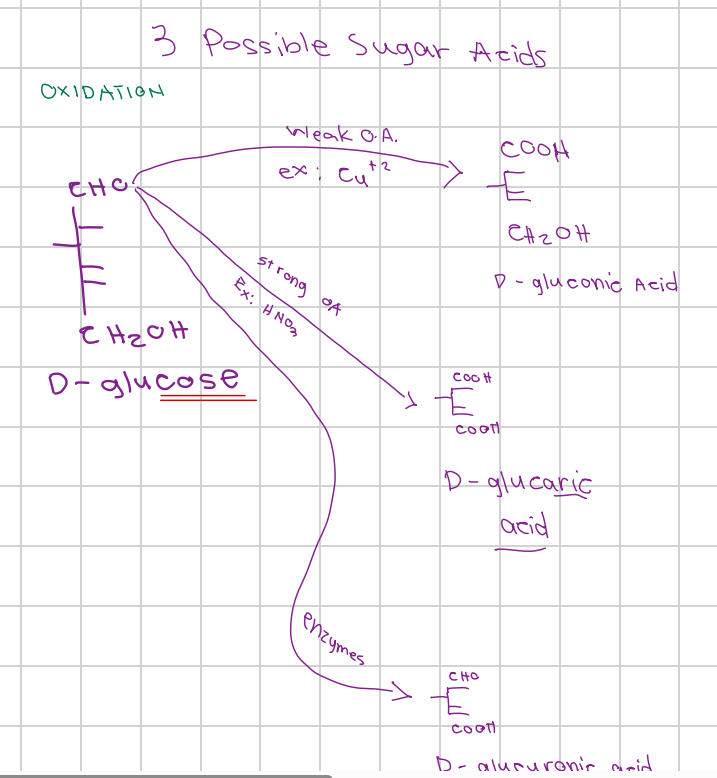
[REACTION & DERIVATIVES - OXIDATION]
Product of oxidation of D-glucose using weak OA (Cu²⁺) at C1
a. D-glucitol
b. D-glucaric acid
c. D-gluconic acid
d. D-glucuronic acid
c. Cu²⁺
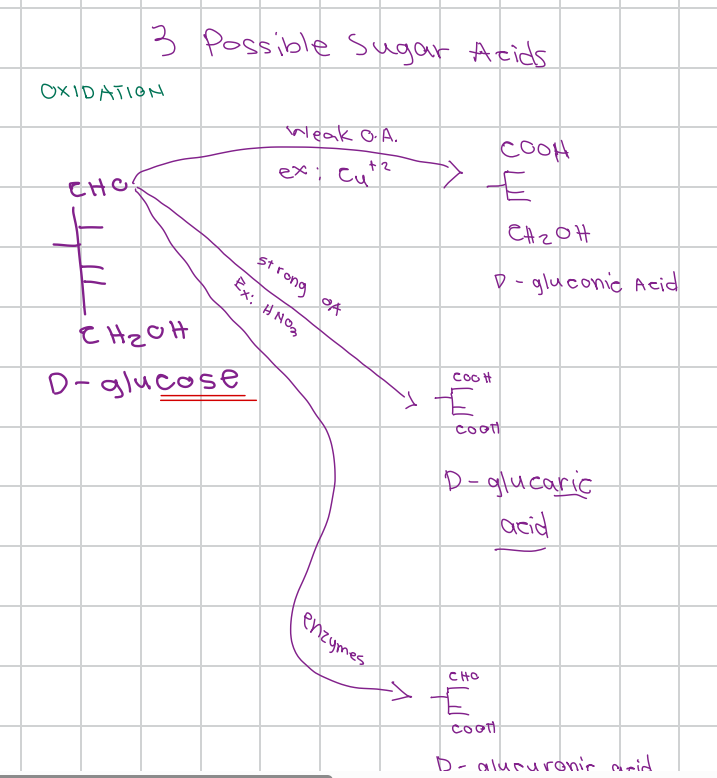
[REACTION & DERIVATIVES - OXIDATION]
Weak OA (oxidizing agent) used in the oxidation of D-glucose at C1
a. HNO₃
b. KMnO₄
c. Cu²⁺
d. H₂O₂
b. D-glucaric acid
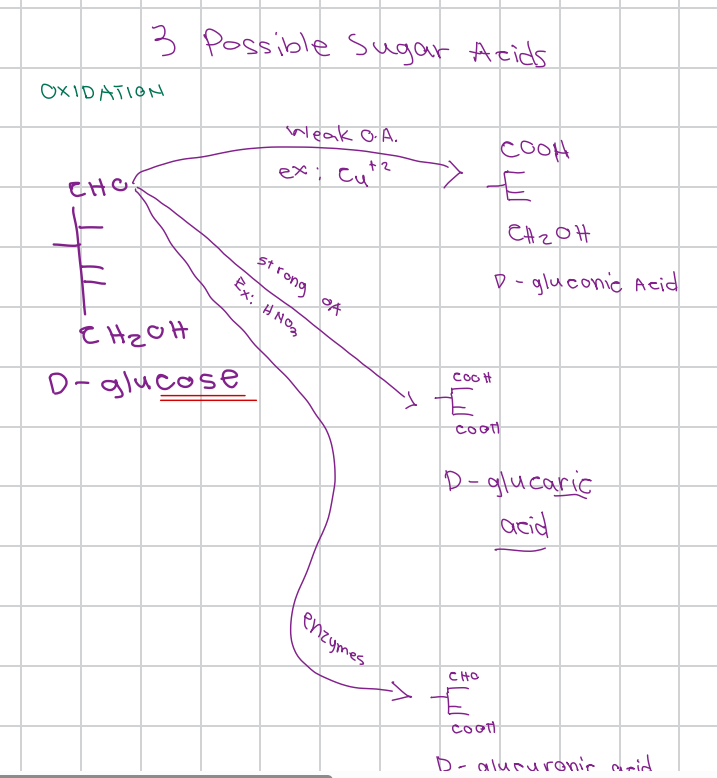
[REACTION & DERIVATIVES - OXIDATION]
Product of oxidation of D-glucose using strong OA (HNO₃) at C1 & C6
a. D-gluconic acid
b. D-glucaric acid
c. D-glucuronic acid
d. D-mannitol
d. HNO₃
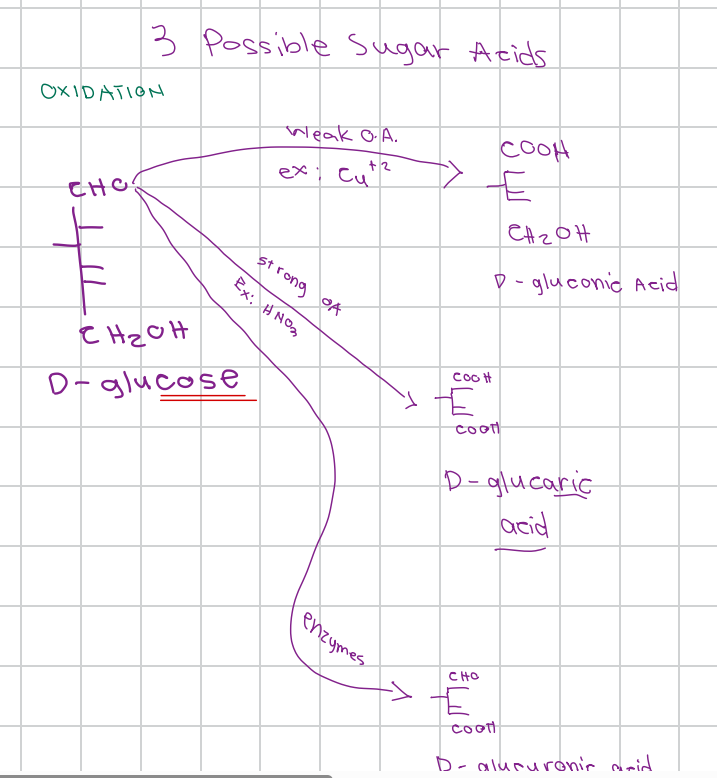
[REACTION & DERIVATIVES - OXIDATION]
Strong OA (oxidizing agent) used in the oxidation of D-glucose at C1 & C6
a. Cu²⁺
b. O₂
c. H₂O₂
d. HNO₃
c. D-glucuronic acid
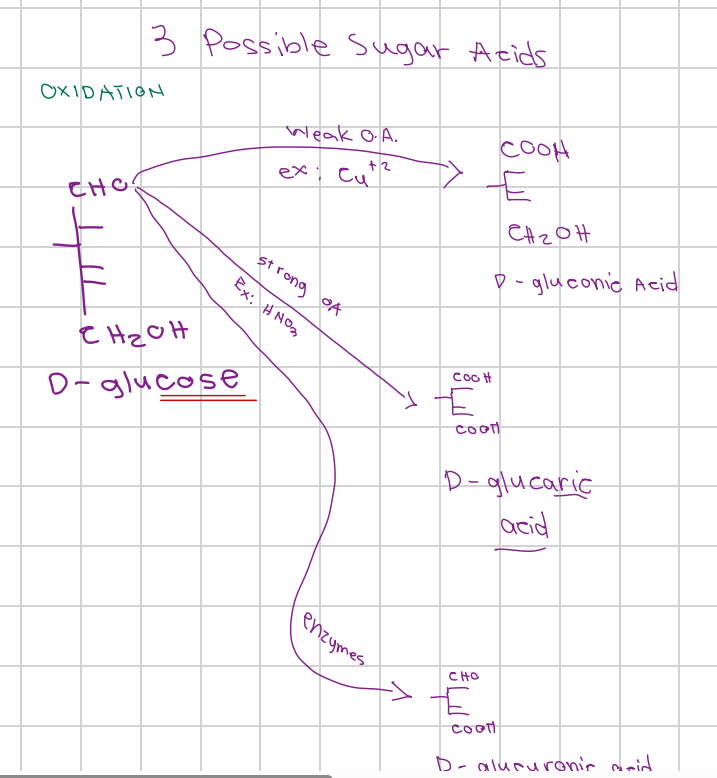
[REACTION & DERIVATIVES - OXIDATION]
Product of oxidation of D-glucose using enzymes at C6
a. D-gluconic acid
b. D-glucaric acid
c. D-glucuronic acid
d. D-glucitol
c. [H]
[REACTION & DERIVATIVES - REDUCTION]
Reagent/symbol used to represent reduction
a. [O]
b. OA
c. [H]
d. NAD⁺
![<p>[REACTION & DERIVATIVES - REDUCTION]</p><p>Reagent/symbol used to represent reduction</p><p class="font-claude-response-body break-words whitespace-normal">a. [O]<br>b. OA<br>c. [H]<br>d. NAD⁺</p>](https://assets.knowt.com/user-attachments/98dbfb91-12d2-4149-83bc-f80730914dde.png)
c. Mannitol
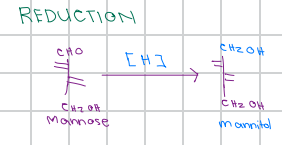
[REACTION & DERIVATIVES - REDUCTION]
Reduction product of mannose
a. D-glucaric acid
b. Sorbitol
c. Mannitol
d. D-gluconic acid
d. Condensation
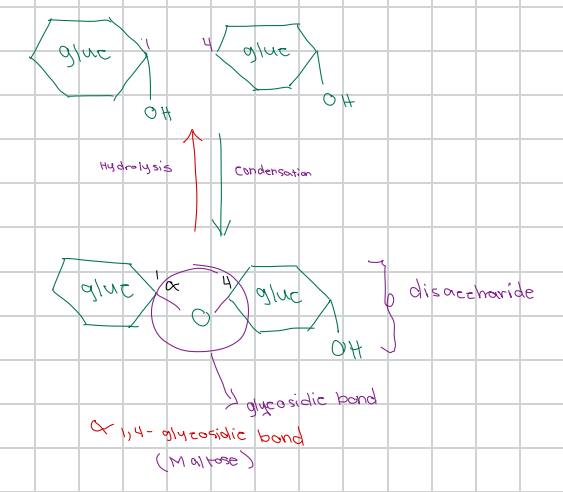
[REACTION & DERIVATIVES - CONDENSATION]
Reaction that combines two cyclic sugars with removal of OH and H
a. Hydrolysis
b. Oxidation
c. Reduction
d. Condensation
c. Hydrolysis
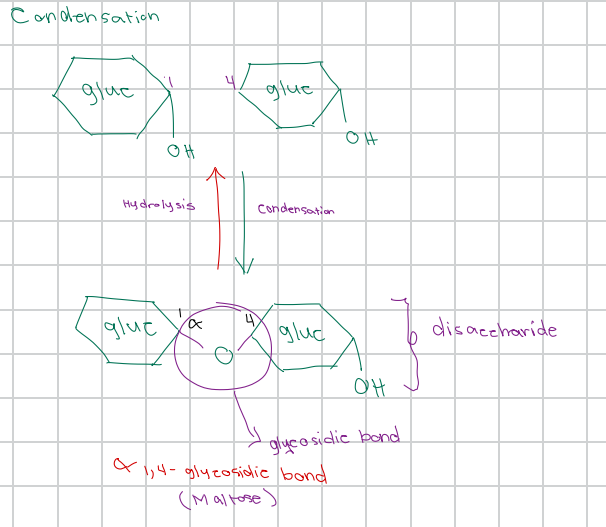
[REACTION & DERIVATIVES - CONDENSATION]
Reaction that breaks down a disaccharide using H₂O
a. Condensation
b. Oxidation
c. Hydrolysis
d. Reduction
c. Glycosidic bond
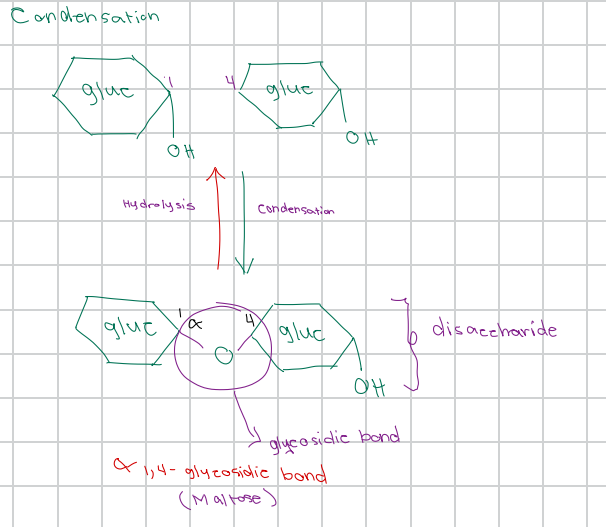
[REACTION & DERIVATIVES - CONDENSATION]
Bond formed when two cyclic sugars undergo condensation
a. Peptide bond
b. Ester bond
c. Glycosidic bond
d. Hydrogen bond
c. Maltose
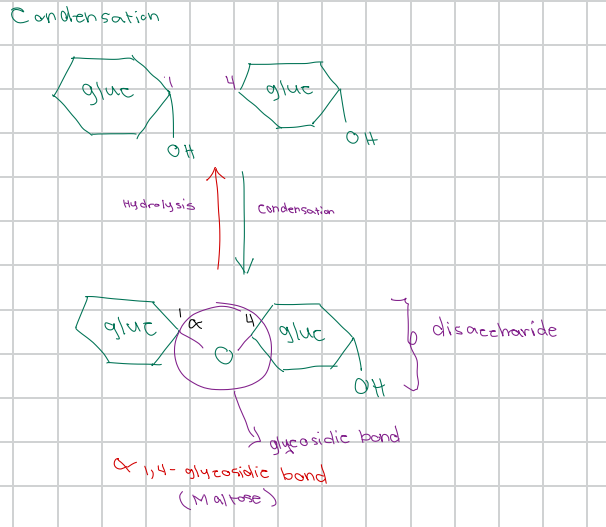
[REACTION & DERIVATIVES - CONDENSATION]
Disaccharide formed by α 1,4-glycosidic bond between two glucose units
a. Lactose
b. Sucrose
c. Maltose
d. Cellobiose
d. Disaccharide
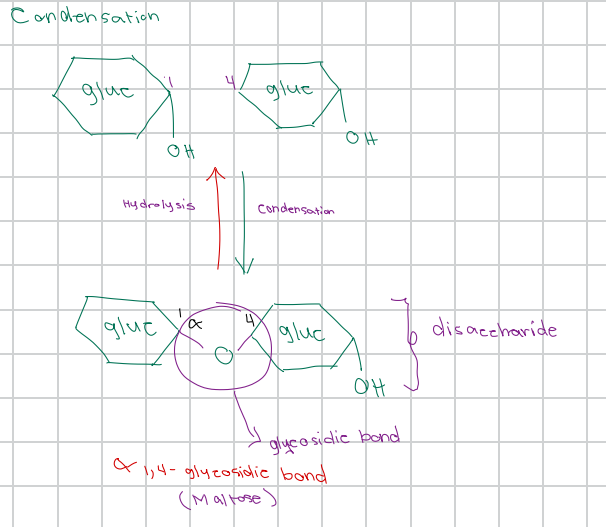
[REACTION & DERIVATIVES - CONDENSATION]
Two units of a sugar joined together by a glycosidic bond
a. Monosaccharide
b. Polysaccharide
c. Oligosaccharide
d. Disaccharide
a. True
[BEYOND MONOSACCHARIDE - DISACCHARIDE]
Knowing the glycosidic bonds can explain their differences in behavior as well as enzymes that hydrolyze them
a. True
b. False
a. True
[BEYOND MONOSACCHARIDE - DISACCHARIDE]
Glucose is abbreviated as “glc” and not “glu” ( to avaoid confusion with glutamic acid )
a. True
b. False
Sucrose
Maltose
Lactose
Cellobiose
Trehalose
📌Mnemonic: “SML” “CT”
[BEYOND MONOSACCHARIDE - DISACCHARIDE]
Table 10: Some common disaccharides include ___ [5]
Maltose
Cellobiose
Lactose
📌Mnemonic: “MCL”
[BEYOND MONOSACCHARIDE - DISACCHARIDE]
Disaccharides that have a free reducing end
a. Sucrose and Trehalose
b. Maltose, Cellobiose, and Lactose
c. Maltose and Sucrose
d. Lactose and Trehalose
Sucrose
Trehalose
📌Mnemonic: “ST”
[BEYOND MONOSACCHARIDE - DISACCHARIDE]
Disaccharides that have no free reducing end
a. Maltose and Cellobiose
b. Lactose and Maltose
c. Sucrose and Trehalose
d. Cellobiose and Lactose
d. Glc-α1,4-Glc
[BEYOND MONOSACCHARIDE - DISACCHARIDE]
Glycosidic bond of Maltose
a. Glc-β1,4-Glc
b. Gal-β1,4-Glc
c. Glc-α1,β2-Fru
d. Glc-α1,4-Glc
b. Glc-β1,4-Glc
[BEYOND MONOSACCHARIDE - DISACCHARIDE]
Glycosidic bond of Cellobiose
a. Glc-α1,4-Glc
b. Glc-β1,4-Glc
c. Gal-β1,4-Glc
d. Glc-α1,β2-Fru
c. Gal-β1,4-Glc
[BEYOND MONOSACCHARIDE - DISACCHARIDE]
Glycosidic bond of Lactose
a. Glc-α1,4-Glc
b. Glc-α1,β2-Fru
c. Gal-β1,4-Glc
d. Glc-α1,α1-Glc
b. Glc-α1,β2-Fru
[BEYOND MONOSACCHARIDE - DISACCHARIDE]
Glycosidic bond of Sucrose
a. Glc-β1,4-Glc
b. Glc-α1,β2-Fru
c. Gal-β1,4-Glc
d. Glc-α1,α1-Glc
d. Glc-α1,α1-Glc
[BEYOND MONOSACCHARIDE - DISACCHARIDE]
Glycosidic bond of Trehalose
a. Glc-α1,4-Glc
b. Glc-β1,4-Glc
c. Glc-α1,β2-Fru
d. Glc-α1,α1-Glc
Homoglycan
Heteroglycan
[BEYOND MONOSACCHARIDE - POLYSACCHARIDE]
Type of Polysaccharide include ____ [2]
Starch
Glycogen
Cellulose
📌Mnemonic: “SGC”
[BEYOND MONOSACCHARIDE - POLYSACCHARIDE]
Examples of Homoglycan [3]
c. Starch
[BEYOND MONOSACCHARIDE - POLYSACCHARIDE]
Glucan with α1,4 and α1,6 bonds
a. Glycogen
b. Cellulose
c. Starch
d. Chitin
b. Glycogen
[BEYOND MONOSACCHARIDE - POLYSACCHARIDE]
Similar to starch, but with more branches
a. Cellulose
b. Glycogen
c. Chitin
d. Starch
d. Chitin
[BEYOND MONOSACCHARIDE - POLYSACCHARIDE]
Glucan with β1,4 bonds
a. Starch
b. Glycogen
c. Cellulose
d. Chitin
d. Alpha-glucosidase
📌Rationale: Amylase for the initial starch digestion, and Alpha-glucosidase for the final brush border digestion
[BEYOND MONOSACCHARIDE - POLYSACCHARIDE]
GIT enzyme humans have that digests starch
a. Beta-glucosidase
b. Cellulase
c. Amylase
d. Alpha-glucosidase
b. Beta-glucosidase
[BEYOND MONOSACCHARIDE - POLYSACCHARIDE]
Enzyme humans lack, making cellulose (fiber) indigestible
a. Alpha-glucosidase
b. Beta-glucosidase
c. Amylase
d. Cellulase
Glycosaminoglycans (GAG) / Mucopolysaccharides (MPS)
Plant -specific ones like pectin and gums
[BEYOND MONOSACCHARIDE - POLYSACCHARIDE]
Examples of Heteroglycans [2]
c. Glycosaminoglycans (GAG)/Mucopolysaccharides (MPS)
[BEYOND MONOSACCHARIDE - POLYSACCHARIDE]
Contains amino sugars, and are major components of tissues and extracellular matrix
a. Homoglycans
b. Pectin and gums
c. Glycosaminoglycans (GAG)/Mucopolysaccharides (MPS)
d. Starch and glycogen
Chondroitin
Hyaluronic acid
Heparin
📌Mnemonic: “CHH”
[BEYOND MONOSACCHARIDE - POLYSACCHARIDE]
Examples of Glycosaminoglycans (GAG)/Mucopolysaccharides (MPS)
a. Pectin and gums
b. Starch, glycogen, cellulose
c. Maltose, sucrose, lactose
d. Chondroitin, hyaluronic acid, heparin
Pectin
Gums
[BEYOND MONOSACCHARIDE - POLYSACCHARIDE]
Plant-specific heteroglycans
a. Chondroitin and heparin
b. Starch and glycogen
c. Pectin and gums
d. Cellulose and chitin
Energy - either immediate (glucose) or stored (starch in plants, glycogen in animals)
Structure - cellulose and chitin (cell walls), pectin, etc.
Pharmaceutical - both carbohydrates and derivatives (e.g. glucose,sucrose, cellulose, starch , etc.)
Pharmacologic - both carbohydrates and their derivatives (e.g. heparin, lactulose, mannitol, sucralose)
Nonclinical - especially for cooking or baking
[USES]
Uses of Carbohydrates [5]