SAS 4: ORAL & DENTAL CARE OF LOCAL & SYSTEMIC DX
 Call Kai
 Learn
Learn Practice Test
 Spaced Repetition
 Match
Match Flashcards
 Knowt Play
1/45

There's no tags or description
Looks like no tags are added yet.
Name | Mastery | Learn | Test | Matching | Spaced | Call with Kai | Chat |
|---|
No analytics yet
Send a link to your students to track their progress
46 Terms
Sickle Cell Disease(SCD)
amino acid is effected: thymine = adenine / glutamic acid = valine
Considered as the most common genetic disorder of the blood.
It is caused by a variant of the B-globin gene called sickle hemoglobin
Red Blood Cells
Normally, the flexible, round red blood cell move easily through blood vessels.
In sickle cell disease, the red blood cell are shaped like sickles or crescent moons.
These rigid, sticky cells can get stuck in small blood vessels.
This can slow or block blood flow and oxygen to parts of the body.
hallmark of Sickle Cell Disease(SCD)
Anemia and vasculopathy – hallmarks of SCD.
Mean life span of a sickled RBC is 12–17 days (normal: 120 days).
Hemoglobin levels: 6–9 g/dL (normal: 12–18 g/dL).
Splenic Sequestration Crisis
Caused by a large number of RBCs becoming trapped in the spleen.
Can induce:
Sudden and severe anemia
Thrombocytopenia
Reticulocytosis
Splenectomy
Recommended because in patients with SCD spleen shrivel up and stop functioning.
Post-Splenectomy Sepsis → Caused by Streptococcus pnemoniae.
Leading cause of mortality among infants affected by SCD.
Intervention of Sickle Cell Disease(SCD)
Administration of Penicillin V potassium 125mg orally twice daily starting 2 months of age to prevent pneumococcal infection. Age 3- dosage is doubled and should be continued until age 5.
Oral and dental manifestations of Sickle Cell Disease(SCD)
Nonspecific to the disease
Jaundice and glossitis of mucous membranes
Delayed tooth eruption
Radiographic Findings of Sickle Cell Disease(SCD)
decreased radiodensity in the bones, coarse trabecular pattern, thin inferior border of the mandible, pronounced lamina dura, dentin hypomineralization, calcifications in the pulp chamber, hypercementosis.
Craniofacial abnormalities of SCA radiographically:
bimaxillary protrusion with flared incisors
Prominent parietal and zygomatic bones(“Tower skull”)
Thinning of the outer table of the calvarium (“Hair-on-end appearance”)
“doughnut lesions”
biphosphonate-related osteonecrosis of the jaws(BRONJ)
must be ruled out from a detailed medical history
Bleeding Disorders
hemophila
Von Willebrand Disease
hallmarks of hemophila
-Hemarthroses, muscle and joint hemorrhages -Easy bruising -prolonged hemorrhage after surgery
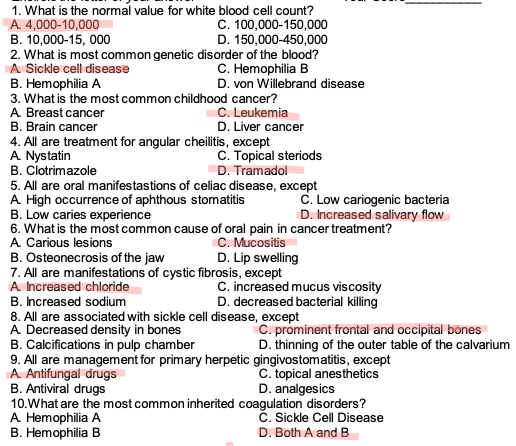
hemophila A & B -are the MOST common inherited coagulation disorders
hemophila A
deficiency of plasma factor VIII coagulant activity
hemophila B
deficiency of plasma factor IX coagulant activity
hemophila C
factor XI
Von Willebrand Disease
characterized by abnormal quantity or quality of von Willebrand factor(vWF) -pretreatment should be discussed with a hematologist
most common inherited bleeding disorder
Oral and Dental Treatment Concerns
Review of medical records and consultation with the hematologist before invasive procedures to avoid bleeding complications.
No pretreatment is required for supragingival scaling in mild and moderate cases of hemophilia.
Block anesthesia and certain infiltration anesthesia in severe hemophiliacs should not be performed until hemostatic problem is corrected because they can cause deep tissue bleeding and potential airway obstruction.
Pediatric Osteoporosis
Bone fractures are the main reason for hospitalization in children between 10 and 14 y.o.
Characterized by:
Low bone mass
Microarchitectural deterioration of bone structure
Increased bone fragility
Pediatric Cancer
2nd most common cause of fatalities in children between 5 and 14 years of age in the US.
Acute Lymphoid Leukemia
80% of childhood leukemias.
Peak incidence at 4 y.o.
90% overall cure rate.
most common blood cancer
greater than 40,000/mm³.
dental procedures can be done when platelet count is __
Neutrophils
Body's first line of defense.
Absolute Neutrophil Count (ANC) <1,000/mm³
Defer treatment because the risk for development of infections and bacteremia increases greatly.
Hematopoietic Stem Cell Transplantation (HSCT)
Used to replace the marrow of patients with:
Hematologic disorders
Congenital immunodeficiencies
Lipidoses
Inborn errors of metabolism
Mucositis
Most common cause of oral pain in cancer treatments.
Most common complication in HSCT.
normal Blood component values
4,000-10,000 /mL
normal Platelet Count values
150,000- 450,000/mm3
Primary Herpetic Gingivostomatitis
Caused by Herpes Simplex Virus type 1 (HSV-1).
Acquired through direct skin contact or body fluids.
Children may present with severe local pain.
Difficulties with fluid and food intake.
At risk for dehydration.
is contagious. HSV-1 can be trasmitted through saliva.Avoid sharing drinking glasses or eating utensils . Also avoid sharing toys with other children because most young children put toys in their mouth
Nonspecific symptoms of primary herpetic gingivostomatitis
Cervical lymphadenopathy
Malaise
Irritability
Upper respiratory tract infection
Low-grade fever
Oral lesions of primary herpetic gingivostomatitis
Start as vesicles on the tongue, buccal mucosa, and gingiva.
Rapidly rupture to become ulcers.
Infection lasts for 10–14 days.
Management of Primary Herpetic Gingivostomatitis
Promote lesion healing, palliation, adequate hydration, and nutrition.
Prevent further spread of infection.
Cold items such as ice cream, popsicles, and ice chips can soothe affected tissues and help with hydration.
Analgesics, topical anesthetics, and coating agents help relieve pain and facilitate food intake.
Acyclovir.
Candidiasis / Moniliasis / Thrush
Fungal infection caused by Candida albicans.
Occurs in infants 5–7 days after birth.
Appears as multiple, small, white curd-like patch lesions.
Lesions may be easily removed from the mucosa, exposing areas of erythema and ulceration, which readily bleed.
usually considered not to be contagious, one instance where the fungus can be passed back and forth is between infant and mother. An infant may develop thrush and transfer it to the mother’s nipples, which become painful with reddish, cracking skin. Conversely, mothers develop a Candida albicans yeast infection on their nipples while taking antibiotics or steroids and trasnfer the infection to their babies while breastfeeding.
Opportunistic infection caused by overgrowth of Candida species due to:
Antibiotic and/or corticosteroid use
Xerostomia
Diabetes mellitus
Appliances covering the palate
Smoking
Immature or compromised immune system
2 most common forms of Candidiasis in children
Pseudomembranous candidiasis
Erythematous candidiasis
Treatment of Candidiasis
Antifungal agents such as:
Nystatin
Clotrimazole
treatment of Angular Cheilitis
Nystatin
Triamcinolone acetonide cream (Mycolog-II)
Applied to the corners of the mouth 3–5 times a day for 5 days
Cystic Fibrosis Transmembrane Conductance Regulator (CFTR)
Most common genetic disease.
causes:
Decreased chloride absorption
Increased sodium absorption
pseudomonas aeruginosa
tx: tobramycin
these are inhaled to prevent infection for Cystic Fibrosis
Tobramycin
Colomycin
hallmark of Cystic Fibrosis
Salty skin
Pseudomonas aeruginosa
most common pathogen in Cystic Fibrosis
Inflammatory Bowel Disease (IBD)
A disorder of intestinal inflammation caused by chronic conditions.
affects the proximal part of intestine
Encompasses:
Ulcerative colitis
Crohn disease
Diarrhea and abdominal pain are common features of the disorder.
hallmark of Inflammatory Bowel Disease (IBD)
cobble stoning
Ulcerative colitis
(inflammation of the colon and rectum)
Crohn disease
(inflammation of the large intestine, small intestine)
Oral Manifestations of Crohn Disease
Aphthous ulcers
Lip swelling
Buccal mucosa swelling (cobblestoning)
Mucogingivitis
Deep linear ulceration
Mucosal tags
The oral manifestations of Crohn disease are usually self-resolving and do not require specific treatment.
Patients whose oral cavity is symptomatic should use a cinnamon- and benzoate-free diet.
Celiac Disease
Gluten-related disorder.
Gluten – main protein in wheat
Oral Manifestations of Celiac Disease
Low caries experience
Low levels of cariogenic microflora
High occurrence of recurrent aphthous stomatitis
Reduced salivary flow
practice question in sas