Ch. 11-12
 Call Kai
 Learn
Learn Practice Test
 Spaced Repetition
 Match
Match Flashcards
 Knowt Play
1/18

There's no tags or description
Looks like no tags are added yet.
Name | Mastery | Learn | Test | Matching | Spaced | Call with Kai | Chat |
|---|
No analytics yet
Send a link to your students to track their progress
19 Terms
Long Run
The time it takes for substantial new investment and entry to occur.
Short Run
The period before entry occurs.
Sunk Cost
A cost that once incurred cannot be recovered.
Explicit Cost
A cost that requires a money outlay.
Implicit Cost
A cost that does not require an outlay of money.
Accounting Profits
Total revenue minus explicit costs.
Economic Profits
Total revenue minus total costs including implicit opportunity costs.

Profit
Total Revenues (TR)
Price times quantity sold: TR= P * Q
Total Cost
The costs of producing a given quantity of output.

Variable Costs
Costs that vary with output.
Marginal Revenue
The change in total revenue from selling an additional unit; for a firm in a competitive industry, MR=Price.
Average Cost
The cost per unit; the total cost of producing a given quantity divided by the quantity, AC = TC/Q
Profit
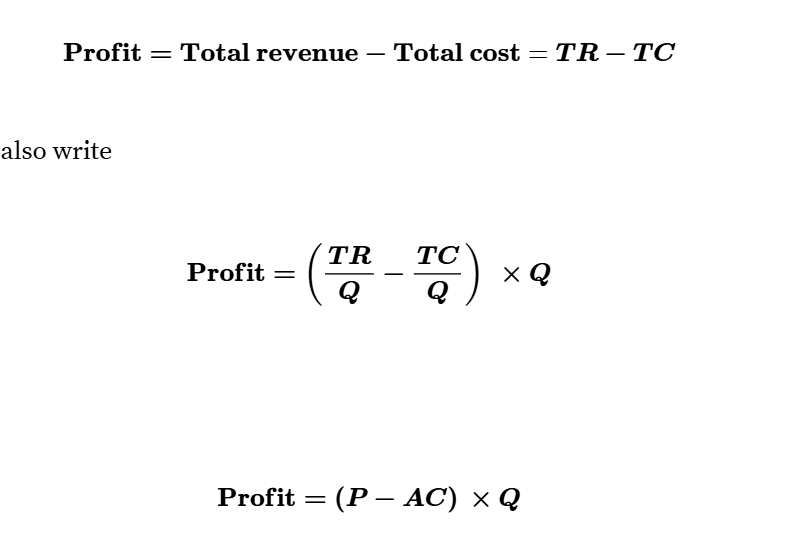
Zero Profits
The condition when P=AC; at this price the firm is covering all of its costs including enough to pay labor and capital their ordinary opportunity costs.
Increasing Cost Industry
An industry in which the costs of production increase with greater output; shown with an upward-sloped supply curve.
Constant Cost Industry
An industry in which cost of production do not change with greater industry output; shown with a flat supply curve.
Decreasing Cost Industry
An industry in which the costs of production decrease with an increase in industry output; shown with a downward-sloped supply curve.
Elimination Principle
The principle that in a competitive market, above normal profits are eliminated by entry and below normal profits are eliminated by exit.