Ch. 5 - Cell Signaling
 Call Kai
 Learn
Learn Practice Test
 Spaced Repetition
 Match
Match Flashcards
 Knowt Play
1/43

There's no tags or description
Looks like no tags are added yet.
Name | Mastery | Learn | Test | Matching | Spaced | Call with Kai | Chat |
|---|
No analytics yet
Send a link to your students to track their progress
44 Terms
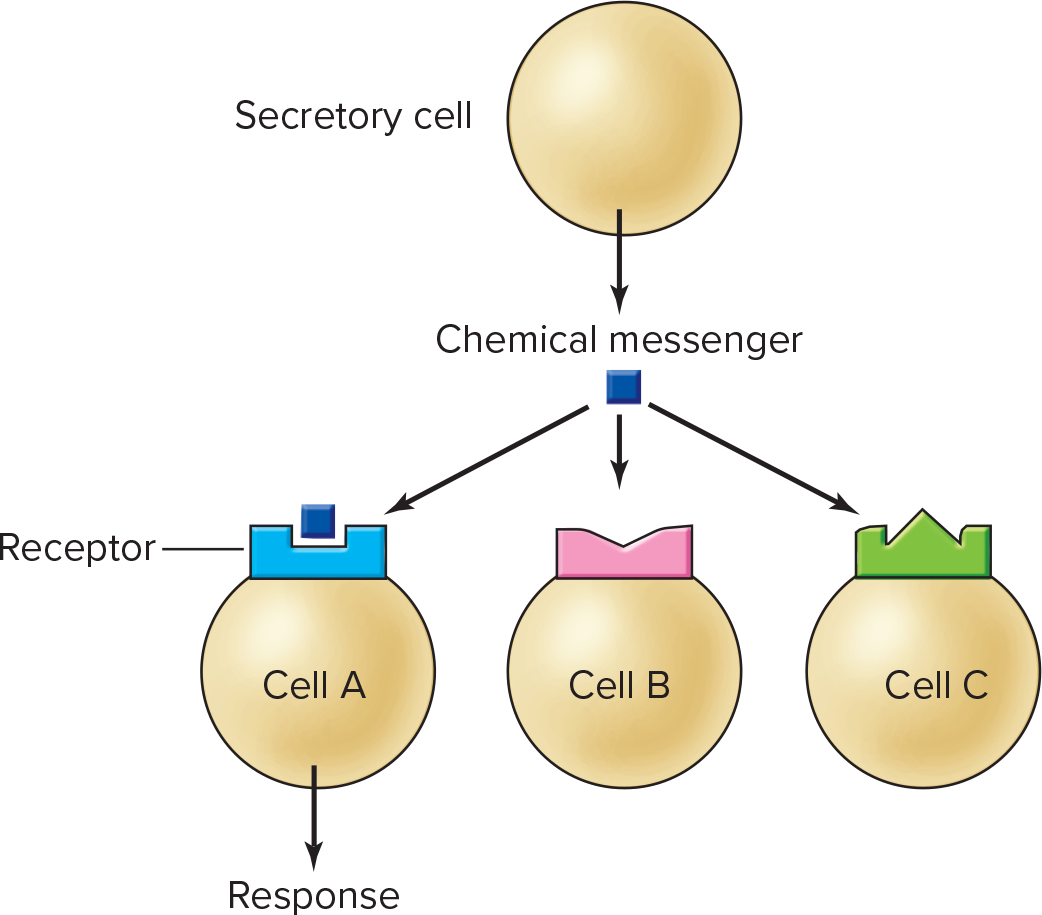
Receptor
(for messengers) protein either on cell surface, in the cytosol, or in the nucleus that binds a chemical messenger such as a hormone or neurotransmitter and mediates its actions
(in sensory system) specialized peripheral ending of afferent neuron, or separate cell intimately associated with it, that detects changes in some aspect of environment
Signal transduction
The process by which a messenger molecule initiates a sequence of intracellular events that leads to a cell’s
Specificity
Selectivity; ability of binding site to react with only one, or a limited number of, types of molecules
Affinity
The strength with which a chemical messenger binds to its receptor
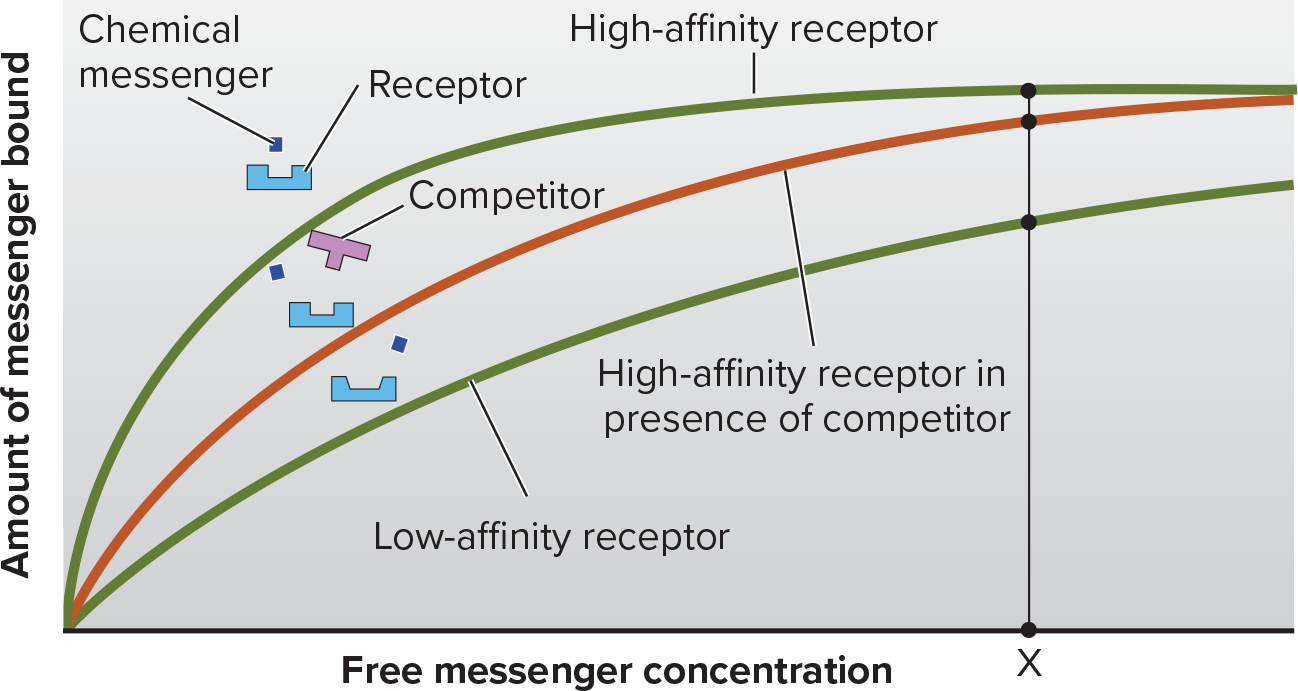
Saturation
The degree to which receptors are occupied by messengers (ex. if all are occupied, the receptors are FULLY saturated)
Competition
The ability of different molecules to compete with a ligand for binding to its receptor; competitors are generally similar in structure to the natural ligand
Antagonist
A molecule that competes with a ligand for binding to its receptor but does NOT activate signaling normally; prevents the action of the natural ligand (ex. certain types of antihistamines)
Agonist
A chemical messenger that binds to a receptor and triggers the cell’s response; mimics a normal messenger’s action (ex. decongestants)
Down-regulation
A decrease in total number of target-cell receptors for a given messenger; may occur in response to chronically high extracellular concentration of the messenger
Up-regulation
An increase in total number of target-cell receptors for a given messenger; may occur in response to chronically low extracellular concentration of the messenger
Increased sensitivity
Increased responsiveness of a target cell to a given messenger; may result from up-regulation of receptors
Internalization
Down-regulation of plasma membrane receptors by receptor-mediated endocytosis
Receptor activation
Change in receptor conformation caused by combination of messenger with receptor
Signal transduction pathways
Sequences of mechanisms that relay information from plasma membrane receptor to cell’s response mechanism
Nuclear receptors
Members of a family of receptor proteins that are localized in cell nuclei, or which are transported to the nucleus upon activation; include the steroid and thyroid hormone receptors
First messengers
Extracellular chemical messengers such as hormones
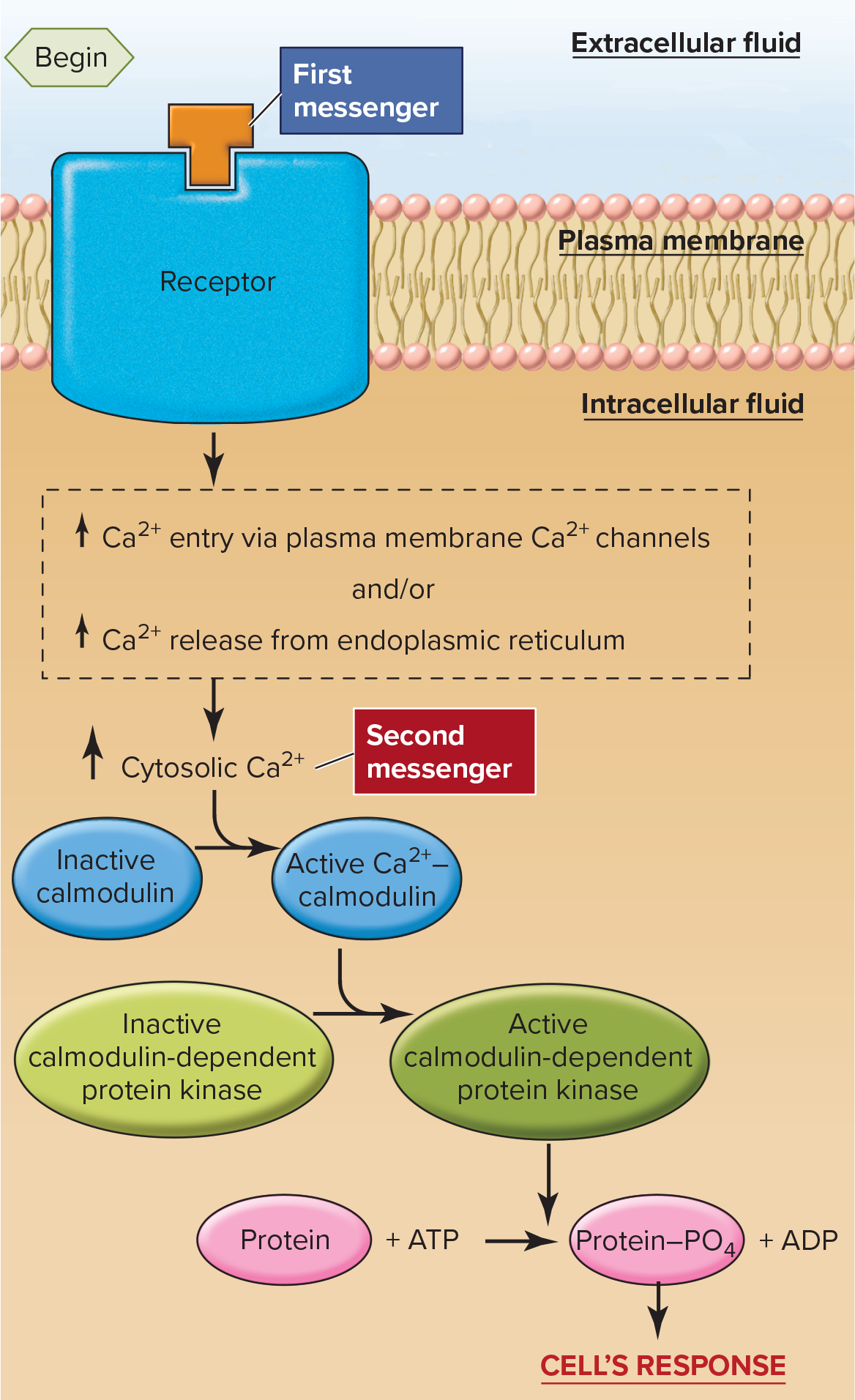
Second messengers
Intracellular substances that serve as relays from plasma membrane to intracellular biochemical machinery, where they alter some aspect of cell’s function
Protein kinase
Any enzyme that phosphorylates other proteins by transferring to them a phosphate group from ATP
Receptor tyrosine kinases
The major types of receptor proteins that are themselves enzymes; these receptors are on plasma membranes and respond to many different water-soluble chemical messengers
Cyclic GMP (cGMP)
Cyclic 3′,5′-guanosine monophosphate; cyclic nucleotide that acts as second messenger in some cells
Guanylyl cyclase
Enzyme that catalyzes transformation of GTP to cyclic GMP
cGMP-dependent protein kinase
Enzyme that is activated by cyclic GMP and then phosphorylates specific proteins, thereby altering their activity
janus kinases (JAKs)
Cytoplasmic kinases bound to a receptor but not intrinsic to it
G proteins
Proteins from a family of regulatory proteins that reversibly binds guanosine nucleotides; plasma membrane G proteins interact with membrane ion channels or enzymes
G-protein-coupled receptors
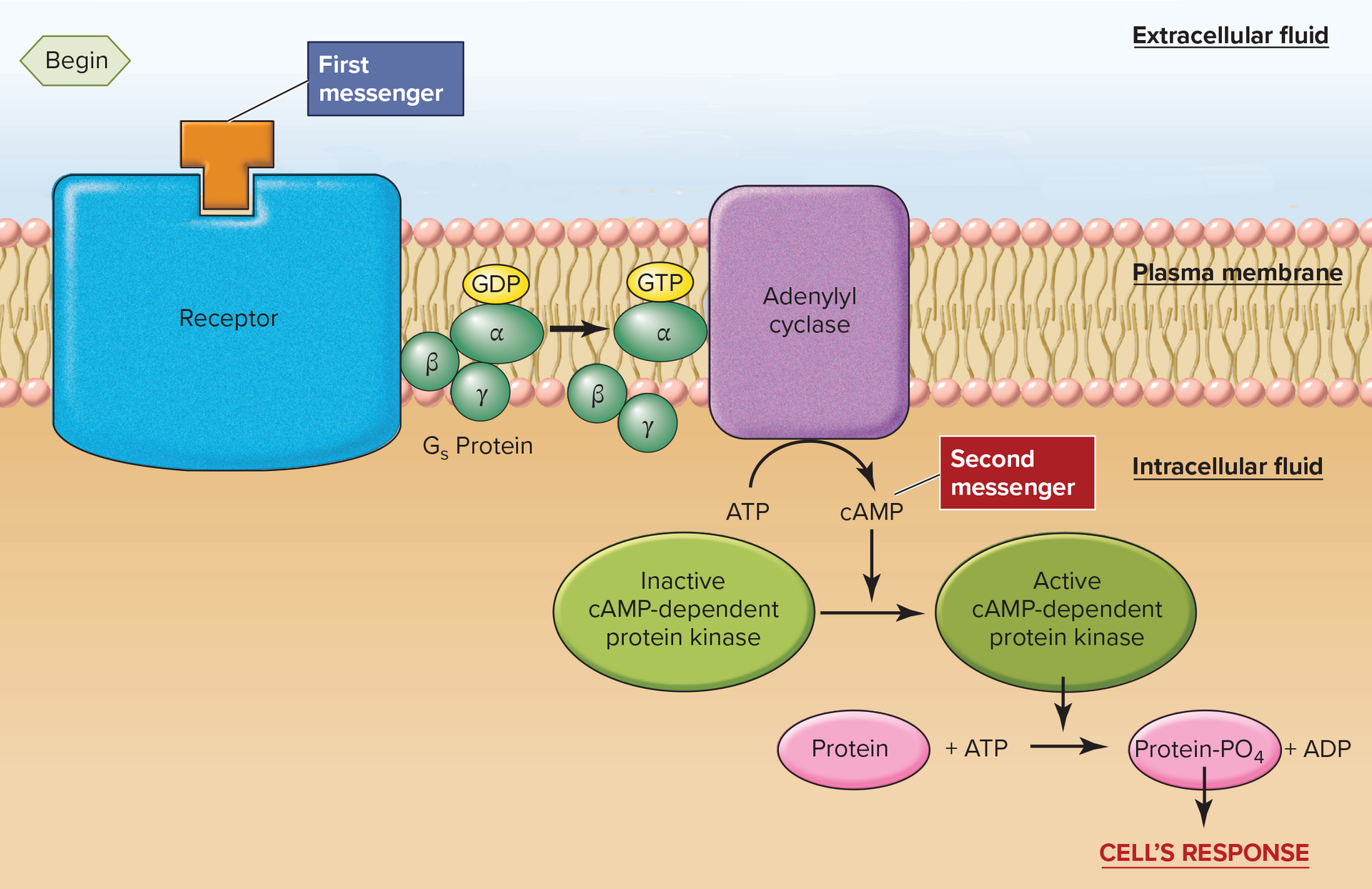
Cell membrane proteins that bind an extracellular signal and then activate an associated G protein, leading to activation of another protein such as adenylyl cyclase
Adenylyl cyclase
Enzyme that catalyzes transformation of ATP to cyclic AMP
Cyclic AMP (cAMP)
Cyclic 3′,5′-adenosine monophosphate; cyclic nucleotide that serves as a second messenger for many “first” chemical messengers
cAMP phosphodiesterase
An enzyme in all cells that converts cAMP into an inactive molecule of AMP
cAMP-dependent protein kinase
Enzyme that is activated by cyclic AMP and then phosphorylates specific proteins, thereby altering their activity; also called protein kinase A
phospholipase C
Receptor-controlled plasma membrane enzyme that catalyzes phosphatidylinositol bisphosphate breakdown to inositol trisphosphate and diacylglycerol
diacylglycerol (DAG)
Second messenger that activates protein kinase C, which then phosphorylates a large number of other proteins.
inositol trisphosphate (IP3)
Second messenger that causes release of calcium from endoplasmic reticulum into cytosol
protein kinase C
Enzyme that phosphorylates certain intracellular proteins when activated by diacylglycerol
calmodulin-dependent protein kinases
Intracellular enzymes that, when activated by calcium and the protein calmodulin, phosphorylate many protein substrates within cells; they are components of many intracellular signaling mechanism
eicosanoids
General term for modified fatty acids that are products of arachidonic acid metabolism (cyclic endoperoxides, prostaglandins, thromboxanes, and leukotrienes); function as paracrine or autocrine substances
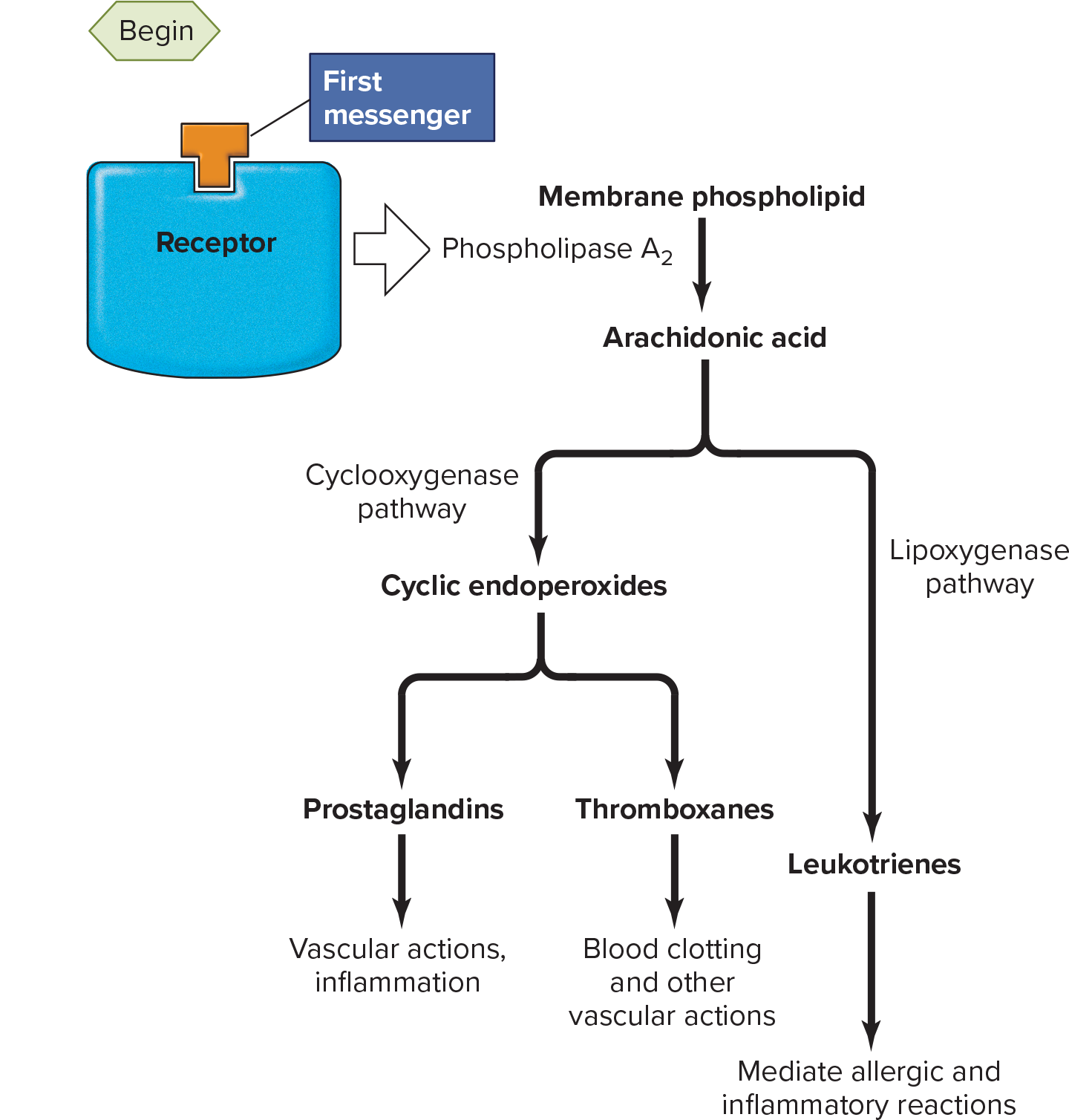
cyclic endoperoxides
Eicosanoids formed from arachidonic acid by cyclooxygenase.
prostaglandins
Members of one class of a group of modified unsaturated fatty acids (eicosanoids) that function mainly as paracrine or autocrine factors
thromboxanes
Eicosanoids derived from arachidonic acid by the action of cyclooxygenase; among other functions, involved in platelet aggregation
leukotrienes
Type of eicosanoid that is generated by lipoxygenase pathway and functions as inflammatory mediator
phospholipase A2
Enzyme that splits arachidonic acid from plasma membrane phospholipid
cyclooxygenase (COX)
Enzyme that acts on arachidonic acid and initiates production of cyclic endoperoxides, prostaglandins, and thromboxanes
lipoxygenase
Enzyme that acts on arachidonic acid and leads to leukotriene formation