L4 MEIOSIS I & MEIOSIS II
 Call Kai
 Learn
Learn Practice Test
 Spaced Repetition
 Match
Match Flashcards
 Knowt Play
1/20

There's no tags or description
Looks like no tags are added yet.
Name | Mastery | Learn | Test | Matching | Spaced | Call with Kai | Chat |
|---|
No analytics yet
Send a link to your students to track their progress
21 Terms
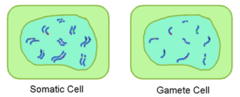
Somatic cells vs Sex cells
Somatic cells are also known as diploid or 2n (chromosomes from mom (n) chromosomes from dad);
sex cells are haploid or 1n (one copy of each chromosome); when sperm and egg combine, they produce a 2n zygote)
Meiosis vs. Mitosis
- meiosis has 2 cell divisions, mitosis only has one
- in meiosis homologous chromosomes pair up on cell's equator, in mitosis homologous chromosomes never pair up
- in anaphase 1 of meiosis sister chromatids are still paired, in anaphase in mitosis, sister chromatids are separated
- meiosis results in a haploid cell, mitosis results in a diploid
Meiosis creates 4 daighter cells, Mitosis only 2

Meiosis I Stages
Prophase I
Metaphase I
Anaphase I
Telophase I and cytokinesis

thre events of meiosis l:
1- Synapsis and crossing over in prophase I
2- At the metaphase plate, there are
paired homologous chromosomes (tetrads) (::-:: ::-::) ::-::)
3- At anaphase I, it is homologous chromosomes, instead of sister chromatids, that separate (:: :: ::) (:: :: :: )
Prophase I stages
1. Leptotene
2. Zygotene
3. Pachytene
4. Diplotene
5. Diakinesis
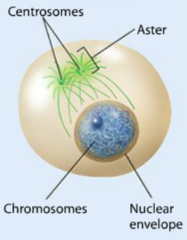
Prophase I: Leptotene
-chromosomes thicken and become visible, but the chromatids remain invisible.
- Centrosomes begin to move toward opposite poles
Prophase I: Zygotene
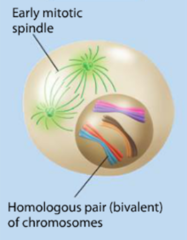
1. Homologous chromosomes enter synapsis.
2. The synaptonemal complex forms (Each pair of chromosomes forms a tetrad, a group of four chromatids)
Prophase I: Pachytene
synapsis is complete, crossing over occurs

Prophase I: Diplotene
Crossing over is completed. Synaptonemal complex dissolves. Nuclear envelope continues to break down.
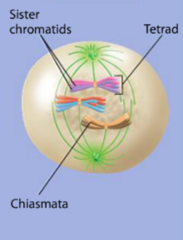
Prophase I: Diakinesis
chromatids thicken and shorten, at the end of prophase I, the nuclear membrane breaks down and the spindle begins to form

Metaphase I
Pairs of homologous chromosomes move to the equator of the cell. (::-:: ::-:: ::-::)

Anaphase I
Homologous chromosomes separate (:: :: :: ) (:: :: :: )

Telophase I and Cytokinesis
Chromosomes gather at the poles of the cells. the cytoplasm divides.

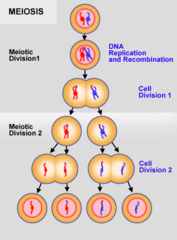
Meiosis II
the second phase of meiosis consisting of chromatids separating, along with the two diploid cells splitting in two
Metaphase II
Chromosomes line up at the equator. (:: :: ::) (:: :: :: )
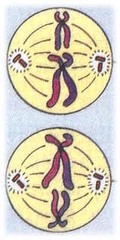
Anaphase II
sister chromatids separate (: : :) (: : :) ( : : :) (: : :)

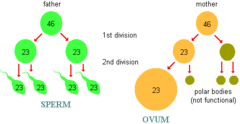
Spermatogenesis
4 sperm cells are
produced from each
primary spermatocyte.

Oogenesis
the production, growth, and maturation of an egg, or ovum. one Egg and three polar bodies

spermatogenesis vs oogenesis
Spermatogenesis: 4 gametes made, no polar bodies; Oogenesis: 1 gamete and three polar bodies
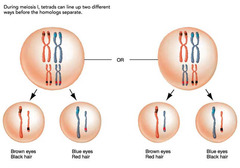
genetic variation
• Independent assortment of chromosomes
• Crossing over
• Random fertilization
independent assortment
the random distribution of the pairs of genes on different chromosomes to the gametes.
2^n