ANT203 (The Nature of Humans) - Lecture 2 Content
 Call Kai
 Learn
Learn Practice Test
 Spaced Repetition
 Match
Match Flashcards
 Knowt Play
1/43

There's no tags or description
Looks like no tags are added yet.
Name | Mastery | Learn | Test | Matching | Spaced | Call with Kai | Chat |
|---|
No analytics yet
Send a link to your students to track their progress
44 Terms
Definition of the biological species concept
Interbreeding populations that are reproductively isolated from other popluations
Definition of reproductive isolation
Members of a population do not produce successful (i.e., viable or fertile) progeny with members outside the population
Definition of the mate recognition species concept
Members within a population sharing a common, distinct fertilization system
Definition of the phylogenetic species concept
Smallest, distinct population of individuals that have a common ancestry
Definition of the phonetic fossil species concept
Morphological variation present in extinct population should approximately be equivalent to the metrical variation present in extant populations
Definition of hominid
Homo sapiens, extant relatives, extinct relatives, and extinct ancestors
Definition of hominin
Homo sapiens, extinct ancestors, and extinct relatives
Definition of cladistics
Reconstruction on species phylogeny based on synapomorphic (i.e., shared, derived homologous) characteristics
Definition of homologous trait
Characteristic inherited through a common ancestor
Definition of analogous trait
Characteristic arisen independently
Definition of plesiomorphic trait
Primitive characteristic
Definition of apomorphic trait
Derived characteristic
What are the two principles of phylogenetic classification?
Monophyly, and holophyly
Definition of monophyly (i.e., monophyletic phylogenetic group)
All species in a taxon is derived from a common ancestor
Definition of holophyly
All descendants of a common ancestor must be included in a taxon
Definition of paraphyly (i.e., paraphyletic phylogenetic group)
Not all descendents derived from a common ancestor are present
Definition of polyphyly (i.e., polyphyletic phylogenetic group)
Descendants are not derived from a common ancestor (i.e., common ancestor is distant)
How are evolutionary relationships examined using the molecular clock?
The accumulation of distinct molecular markers (i.e., molecular distance) indicate a divergence from a more distant common ancestor
When did the common ancestor of all mammalian species live?
Approximately 80 million years ago
What mammalian order is most closely related to the primate order?
Dermoptera (i.e., flying lemur)
What distinct dental characteristic is present on Galioptreus variegatus? What is the adaptive function of this characteristic?
Comb-shaped incisors use to extract juice from fruit (i.e., specialized frugivorous dentition)
What mammalian order serves as the prime model organisms for extinct primitive primates (i.e., Paleocene primate)
Scandentia (i.e., tree shrew)
What are the six common characteristics shared with the members of the Primate order?
1. Dexterity
2. Characteristic of phalanges
3. Vision, characteristic of skeletal morphology
4. Characteristic of dental morphology
Brain
Reproduction
1. Opposable hallux, prehensile hands
2. Fingernails, fingerprints
3. Stereoscopic vision, partial closure of orbital bone
4. Unspecialized moral morphology
5. Large brain relative to body
6. Long gestational and juvenile periods
Function of fingerprints
Increased sensitivity (i.e., number of mechanoreceptors for dexterity and sensation), and increased friction (i.e., grip)
Definition of stereoscopic vision
Compilation of sensory information derived independently from each eye to produce a single three-dimensional image (i.e., height, width, depth)
Function of stereoscopic vision
Arboreal life (i.e., mobility and predation)
Primitive mammalian dental formula
3.1.4.3./3.1.4.3 (i.e., 3 incisors, 1 canine, 4 premolars, and 3 molars)
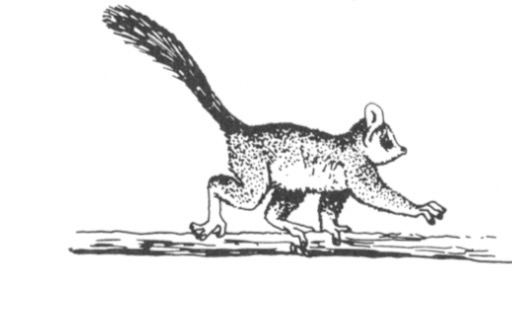
What is the term is used to describe this form of locomotion?
Arboreal quadrupedalism
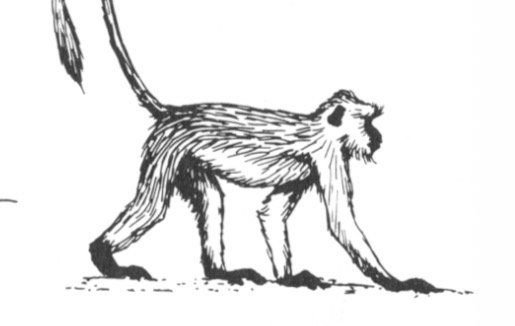
What is the term is used to describe this form of locomotion?
Terrestrial quadrupedalism
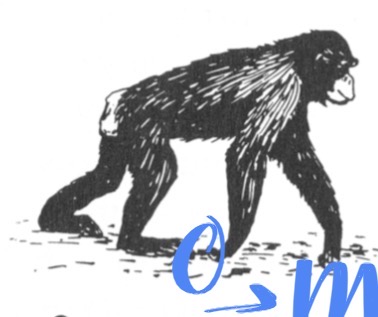
What is the term is used to describe this form of locomotion?
Knuckle-walking quadrupedalism
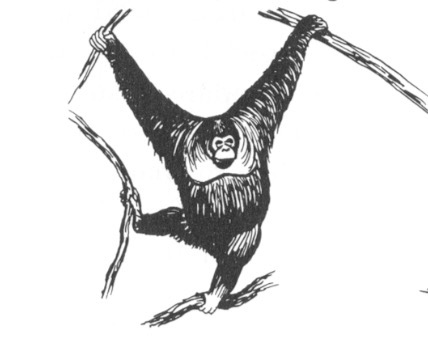
What is term is used to describe this form of locomotion?
Suspensory climbing
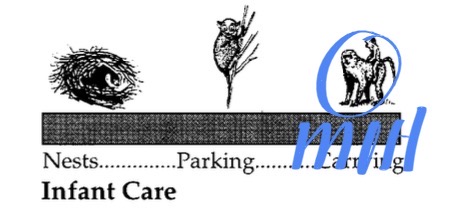
What are the three predominant way infant care is performed by members within the Primate order? Which one is the most common?
Nesting, parking, and carrying
Predominant characteristic that distinguishes strepsirhines from haplorhines
Strepsirhines (wet-nosed) have an exposed rhinarium, while this characteristic is absent in haplorhines (dry-nosed_
What are the common characteristics shared with the members of the Strepsirhini suborder?
1. Characteristic of dental morphology
2. Distinct structure on phalange
3. Characteristic of dental morphology
1. Reduced upper incisors
Grooming claw
Tooth comb (i.e., incisors and canines protrude)
Strepsirhine dental formula
2.1.3.3/2.1.3.3 (i.e., absence of 1 incisors and 1 premolar relative to the primitive mammalian dental formula
What are the common characteristics shared with the members of the cheriogaleids (i.e., dwarf lemur) family?
1. Derived or ancestral lineage relative to other hominid species?
2. Dental formula
3.
4. Temporal activity pattern
Dietary behaviour
1. Primitive
2. 2.1.3.3/2.1.3.3 dental formula
3. Arboreal
4. Nocturnal
5. Frugivorous and insectivorous
What are the common characteristics shared with the members of the lemurids (i.e., lemur) family?
1. Dental formula
2. Temporal activity pattern
3.
Dietary behaviour
1. 2.1.3.3/2.1.3.3 dental formula
2. Diurnal or cathemeral
3. Arboreal and terrestial
3. Frugivorous and foliovorous
What are the common characteristics shared with the members of the lepilemurids (i.e., sportive lemur) family?
1. Dental formula
2.
3. Temporal activity pattern
Dietary behaviour
1. 0.1.3.3/2.1.3.3 (i.e., absence of superior incisors)
2. Arboreal
3. Nocturnal
4. Folivorous
What are the common characteristics shared with the members of the indriidae (i.e., indris and sifakas) family?
1. Dental formula
Temporal activity pattern (lemur), temporal activity pattern (indris and sifakas)
3.
4. Dietary behaviour
1. 2.1.2.3/1.1.2.3 (absence of lower incisor)
2. Nocturnal (lemur), diurnal (indris and sifakas)
3. Arboreal
4. Foliovorous
What are the common characteristics shared with members of the daubetoniidae (aye-aye) family?
1. Dental formula
2. Temporal activity pattern
3.
4. Dietary behaviour
1. 1.0.1.3/1.0.1.3 (absence of position 1 incisor, canine, position 2 premolar, and position 3 premolar)
2. Nocturnal
3. Arboreal
4. Insectivore
What are the common characteristics shared with members of the galagidae (galagos) family?
1. Dental formula
2. Temporal activity pattern
3.
4. Three primary dietary behaviours observed
1. 2.1.3.3/2.1.3.3
2. Nocturnal
3. Arboreal
4. Insectivorous, frugivorous, and gummivorous
What are the common characteristics shared with members of the lorisidae (loris) family?
1. Dental formula
2. Temporal activity pattern
3.
4. Dietary behaviour
1. 2.1.3.3/2.1.3.3
2. Nocturnal
3. Arboreal
4. Insectivorous, frugivorous, and gummivorous
Three predominant characteristic that distinguishes skeletal morphology strepsirhines (prosimians) from skeletal morphology haplorhines (anthropoids)
Fused frontal cranial bone, fused mandibular symphysis, and postorbital closure are characteristic in members of the order haplorhines. Unfused frontal cranial bone, unfused mandibular symphysis, and the absence of a postorbital closure (i.e., postorbital bar or postorbital plate) are characteristic in members of the strepsirhines order.
What are the common characteristics shared with members of the tarsiidae (tarsiers) family?
1. Distinct morphological characteristic
2. Dental formula
3. Dental morphology
4.
5. Temporal activity pattern
6. Dietary behaviour
1. Presence of derived (i.e., haplorhine) and primitive (i.e., strepsirhine) morphology
2. 2.1.3.3/1.1.3.3
3. High cusp on teeth
4. Arboreal
5. Nocturnal
6. Insectivorous