Exam 3- A/P 2
 Call Kai
 Learn
Learn Practice Test
 Spaced Repetition
 Match
Match Flashcards
 Knowt Play
1/79

Earn XP
Description and Tags
Chapter 17 Digestive system and Chapter 19 Respiratory system
Name | Mastery | Learn | Test | Matching | Spaced | Call with Kai | Chat |
|---|
No analytics yet
Send a link to your students to track their progress
80 Terms
Define Respiration
how an organism acquires energy through the process of exchange gases between the atmosphere and body cells, requires O2 and expels CO2 as byproduct.
What are the 3 events/types of Respiration?
External respiration(ventilation/breathing, allows gas exchange in lungs), internal respiration(gas transport in blood and exchange with body cells), cellular respiration(process of ATP production in mitochondria, uses O2 to harness energy and gives off CO2).
List the Upper respiratory organs and lower respiratory organs?
Upper respiratory organs include the nose, nasal cavity, sinuses, pharynx, and Larynx; lower respiratory organs consist of the trachea, bronchial tree, and lungs.
What is Sinusitis?
Inflammation of the sinus cavities, often caused by infection/allergy, leading to symptoms like facial pain, congestion, and headaches.
What is the function of the Nose in the respiratory system?
provide entrance to nasal cavity where internal hairs begin to filter incoming air
What is the function of the Nasal cavity in the respiratory system?
conducts air to pharynx where mucus lining filters, warms, and moistens incoming air.
What is the function of the Sinuses(paranasal sinuses) in the respiratory system?
hollow spaces in various bones of skull that reduce weight of skull and serve as resonant chambers.
What is the location and function of the Pharynx in the respiratory system?
located behind(posterior) to nasal cavity, oral cavity, and larynx, serving as a passageway for air to the larynx and food to the esophagus. It plays a crucial role in both respiration and digestion.
What is the location and function of the Larynx in the respiratory system?
enlargement at the top of trachea, that serves as a passageway for air preventing foreign objects from entering trachea, house vocal cords.
What is the location and function of the Trachea(windpipe) in the respiratory system?
flexible tube that connects larynx with bronchial tree splits into left and right primary bronchi, passageway for air with mucous lining to filter air
What is the function of the Bronchial tree in the respiratory system?
branching tubes from trachea that conduct air to alveoli with mucous lining contiues to filter incoming air.
What is the function of the Lungs in the respiratory system?
site of gas exchange between the air in alveoli and blood in pulmonary circuit
List the Inspiratory respiratory structure in order
Air enters nasal cavity, nasopharynx, oropharynx, Laryngopharynx, Larynx, Trachea, main brochi, Lobar bronchi, Segmental bronchi, bronchioles, terminal bronchioles, respiratory bronchioles, alveolar ducts, end at alveoli
What are 3 parts of Pharynx?
Nasopharynx(top), Oropharynx(middle), Laryngopharynx(lower)
What are the 3 large single cartilages of Larynx?
Thyroid(Adam’s Apple)= largest cartilage with shield like structure. Cricoid= ring-shaped cartilage that forms the base of the larynx. Epiglottis= flap-like elastic cartilage that covers the trachea during swallowing.
What are the 3 pairs of small cartilages of Larynx?
Arytenoid= pyramid-shaped, help in vocal cord movement. Corniculate= small horn-shaped, assist in opening and closing the larynx. Cuneiform= elongated, provide support and structure to the laryngeal walls.
What are the 2 types of vocal folds described?
True vocal cords= lower fold, involved in sound production. False vocal cords= upper(vestibular) fold, do not produce sound, protect the airway.
What makes up the glottis?
true vocal cords + openings between them
Blank has wall of 20 c-shaped rings of hyaline cartilage to prevent collapse?
trachea
What is the structure of the main bronchi?
similar to trachea but they contain cartilaginous plates instead of C-shaped rings.
Bronchodilation vs Bronchoconstriction
Bronchodilation refers to the sympathetic response of widening of the air passages in the respiratory system, allowing increased airflow, while bronchoconstriction refers to the narrowing of these passages, which decreases airflow.
What is Hilum?
region on medial surface of each lung through which bronchus and large blood vessels enter
Parietal pleura vs Visceral pleura
Parietal pleura refers to the outer serous membrane that lines the thoracic cavity, while visceral pleura is the inner serous membrane that covers the lungs directly. Pleural cavity= potwntial space between the two pleurae that contains pleural fluid.
What makes up a respiratory cycle?
one complete inhalation and one complete exhalation
Define Atmospheric pressure?
force that moves air into lungs at sea level=760 MM Hg (of mercury)
at rest atomspheric pressure=alveolar pressure
What is Boyle’s Law?
Boyle's Law states that the pressure of a gas is inversely proportional to its volume when temperature is constant. As volume decreases, pressure increases, and vice versa. (Phrenic nerves setimulates diagphram in inspiration)
Phrenic nerve come from what spinal nerve?
arises from the cervical spinal nerves C3, C4, and C5. Think C 3,4,5 keep the diaphram alive.
Alveolar cells synthesize blank to decrease surface tension in alveoli and help lungs expand.
surfactant
Attraction of water molecules create blank making it hard to inflate alveoli.
surface tension
In blank the diaphragm moves down, volume increases in lungs, and pressure decreaes in lungs.
inspiration
In blank diaphragm moves up(recoil), volume decrease in lungs, and pressure increases in lungs.
expiration
Define respiratory volumes and what measurement is this called?
different volumes of air that can be moved into and out of the lungs, spirometry using spirometer
What is the volume and description of Tidal Volume(TV)?
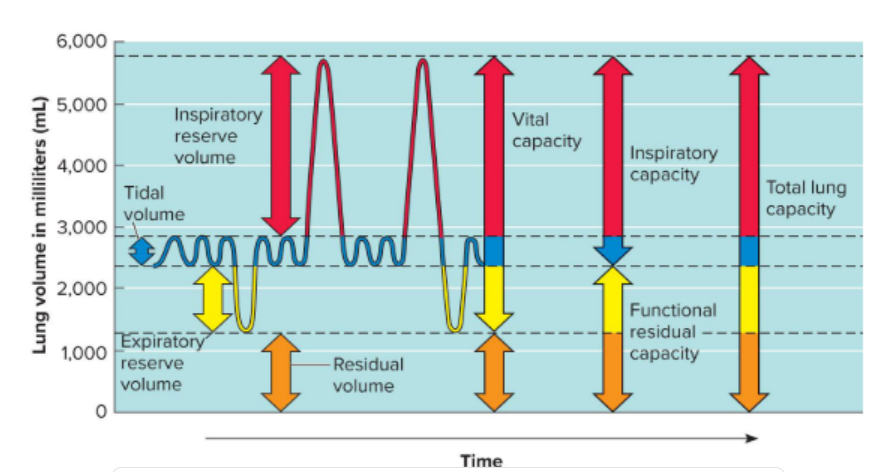
Volume of air moved in or out of lungs during a respiratory volume, around 500 mL.
What is the volume and description of Inspiratory Reserve Volume(IRV)?
The amount of air that can be forcibly inhaled after the normal tidal volume inhalation, around 3000 mL.
What is the volume and description of Expiratory Reserve Volume(ERV)?
The amount of air that can be forcibly exhaled after a normal tidal volume exhalation, around 1100 mL.
What is the volume and description of Residual Volume(RV)?
The amount of air remaining in the lungs after a forced exhalation, around 1200 mL.
What is the volume and description of Vital Capacity(VC)?
The total amount of air that can be exhaled after a maximum inhalation, around 4600 mL, VC=TV+IRV+ERV.
What is the volume and description of Inspiratory Capacity(IC)?
The maximum amount of air that can be inhaled after a normal tidal volume exhalation, approximately 3500 mL, IC=TV+IRV
What is the volume and description of Functional Residual Capacity(FRC)?
The volume of air remaining in lungs after a normal tidal volume exhalation, approximately 2300 mL. FRC=ERV+RV
What is the volume and description of Total Lung Capacity(TLC)?
The maximum amount of air the lungs can hold, around 5800 mL, TLC=VC+RV.
What muscle are used in tidal volume?
diaphragm only, external intercostals, elastic intercostals, elastic recoil of lungs
What muscle are used in Expiratory reserve volume?
internal intercostals, rectus abdominis, internal and external obliques
What muscle is used in Inspiratory Reserve volume?
sternocleiodmastoid
What is anatomical vs alveolar dead space vs physiological dead space?
Anatomical dead space= air the respiratory tract that remains in conduction structures and doesn’t reach alveoli. Alveolar dead space- air in the respiratory tract that reaches nonfunctional alveoli. Physiological dead space= total of anatomical and alveolar dead space(about 150Ml/breath in normal circumstances).
Equation for calculating Minute ventilation(MV)?
MV= tidal Volume(TV) x Respiratory/breathing rate(RR)
Equation for calculating Alveolar Ventilation Rate(AVR)?
AVR = (TV - Physiolgical Dead Space) x RR
What are two respiratory disorders that decrease ventilation described?
Chronic Bronchial asthma= causes increase mucus production and # of Bronchial mucosa cells. Decrease in # of respiratory cilia and mobility of cilia. Emphysema= increase in thoracic volume and size of alveoli. Decrease in lung elasticity and Number of alveoli.
Define respiratory area?
group of neurons in the brainstem that control breathing and adjust rate and depth.
What are the two main respiratory areas and their respective function?
Medullary respiratory center(Ventral respiratory group sets breathing rhythm and Dorsal respiratory group sets breathing rate/depth) and pontine respiratory groups(sets rhythm of breathing by limiting inspiration duration)
Define Partial pressure? What is the partial pressure of O2 in the atomsphere air?
amount of pressure each gas contributes to the total pressure, 25% O2
5 Steps to O2 diffusion across the respiratory membrane?
O2 enters the alveoli 2. O2 diffuses across the alveolar epithelium 3. O2 passes through the fused basement membranes 4. O2 crosses the capillary endothelium 5. O2 binds to hemoglobin in red blood cells
What are the 2 main factors controlling breathing?
PCO2 and H+ concentration to maintain internal pH
What are the stimulated receptors, response, and effect of strech of tissues through Hering-Breuer reflex?
The Hering-Breuer reflex involves stretch receptors in the lungs(visceral pleura, bronchioles, and alveoli) that are stimulated by excessive lung inflation. This triggers a response to inhibit further inhalation, thereby preventing over-inflation during forceful breathing.
What are the stimulated receptors, response, and effect of Low plasma PO2 through Peripheral chemoreceptors?
The peripheral chemoreceptors, located in the carotid and aortic bodies, are stimulated by low plasma PO2 levels. This response leads to increased (alveolar ventilation) respiratory rate and depth, helping to increase plasma PO2.
What are the stimulated receptors, response, and effect of High plasma PCO2 through Central chemoreceptors?
The central chemoreceptors, located in the medulla oblongata(chemosensitive areas of respiratory center), are stimulated by high plasma PCO2 levels. This response leads to increased(alveolar ventilation) respiratory rate and depth, helping to decrease plasma PCO2 and restore acid-base balance.
What are the stimulated receptors, response, and effect of High cerebrospinal fluid H+ concentration through Central chemoreceptors?
The central chemoreceptors, located in the medulla oblongata(chemosensitive areas of respiratory center), are stimulated by high cerebrospinal fluid H+ concentrations. This response triggers increased(alveolar ventilation) respiratory rate and depth, aiding in the reduction of H+ levels to restore normal pH balance(Decreases plasma PCO2)
Blank helps regulate depth of breathing when stretch receptors are stimulated during inspiration sensory impulses travel over vagus nerve(10) to respiratory area preventing overinflation of lungs during forced breathing?
Inflation(Hering-Breuer) Reflex
Increased breathing rate during exercise is a result of what 2 things?
Cerebral cortex signaling.
Joint reflex(propriorecptors stimulate muscular movements to increase RR)
What are Alveolar pores?
tiny openings that may permit air to pass from one alveolus to another by providing alternate air pathway.
What are Alveolar Macrophages?
Specialized immune cells found in the alveoli that engulf(phagocytize) and digest pathogens and debris to help maintain lung health.
Difference between Type 1 and Type 2 cells in alveolus walls?
Type 1 cells, or alveolar epithelial cells, are responsible for gas exchange due to their thin structure, while Type 2 cells secrete surfactant to reduce surface tension in the alveoli and help prevent collapse.
What is the respiratory membrane function and 3 structures?
The respiratory membrane facilitates gas exchange between the alveoli and blood. It comprises the alveolar walls (simple squamous epithelium), the blood capillary walls(simple squamous epithelium), and the fused basement membrane(epithelial layers join walls of alveoli and capillaries).
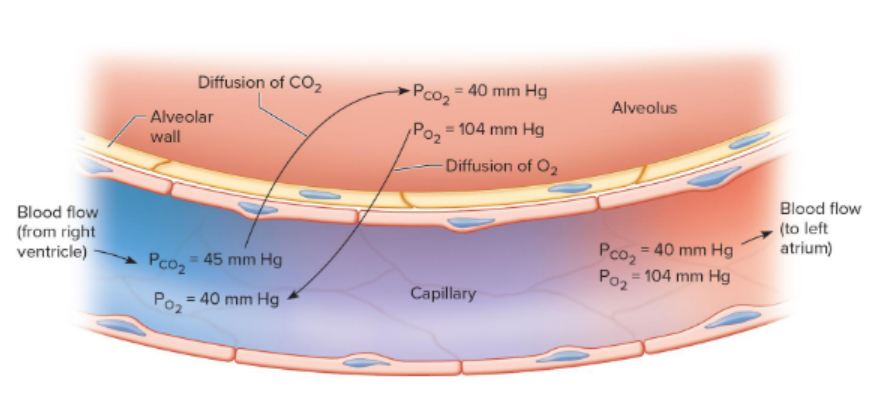
O2 diffuses from
CO2 diffuses from
O2 diffuses from alveoli to the blood
CO2 diffuses from blood to the alveoli
To much CO2 in blood causes blood pH to blank
decrease, leading to acidosis.
What are the 2 reactions and substances transported of O2 entering the blood?
is dissolved in plasma(1-2%) and it binds to heme portion of hemoglobin(98-99%). This transport is essential for Oxygen and Oxyhemoglobin delivery to tissues and organs.
What are the 3 reactions and substances transported of CO2 entering the blood?
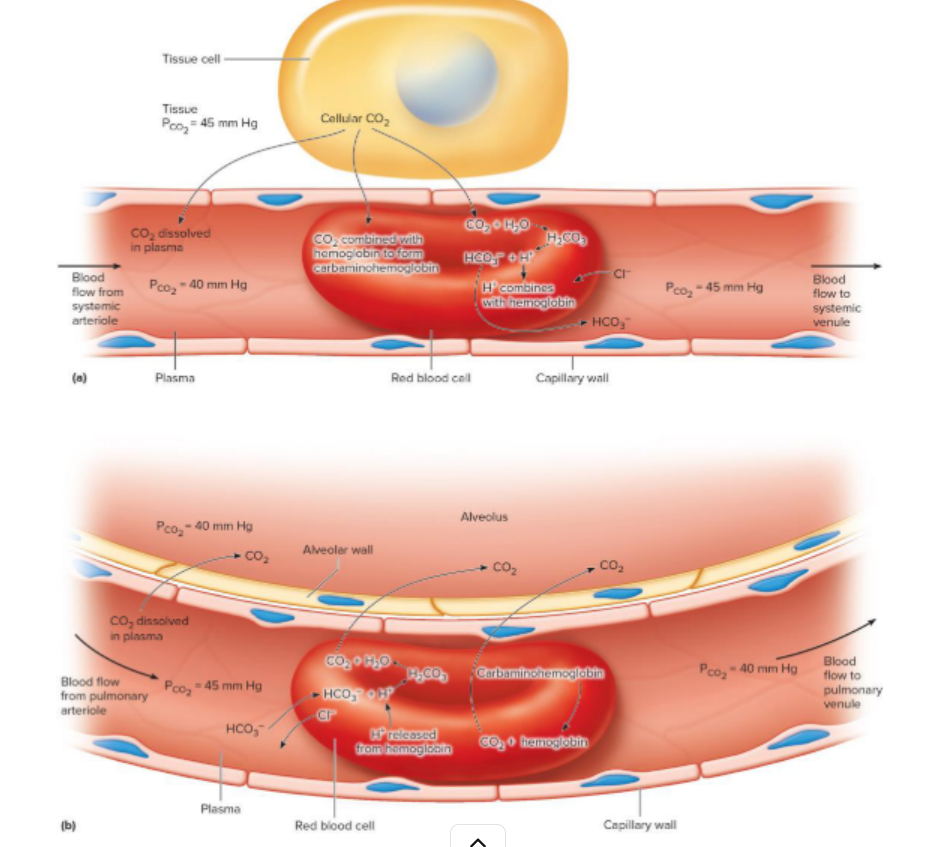
CO2 is transported as dissolved bicarbonate ions (70%), bound to hemoglobin(carbaminohemoglobin) (23%), and as CO2 dissolved in plasma (7%). This process is crucial for maintaining acid-base balance and facilitating respiration.
What are the effects of high altitude and HAPE on gas exchange?
High altitude can lead to decreased oxygen availability, causing hypoxia. High Altitude Pulmonary Edema (HAPE) results from fluid accumulation in the lungs, impairing gas exchange and reducing oxygen efficiency.
What enzyme in RBC that speed up reaction between CO2 and H2O?
The enzyme carbonic anhydrase facilitates the conversion of CO2 and H2O into bicarbonate and protons, playing a vital role in CO2 transport and acid-base balance.
What is hemoglobin made of?
Heme(surrounds an atom of iron) + Globin(a protein of 4 Polypeptide chains) + iron atom
What 3 factors increase the amount of O2 begin releases/dissociating from oxyhemoglobin?
PCO2 increase
Decrease of Blood pH(increase acidity)
Increase blood Temperature
About blank remains bound to hemoglobin in venous blood to ensure adjustment CO2 levels/Ph and have a temporary reserve supply of O2 if inspiratory O2 isn’t avaliable.
75% of O2
blank acts as a buffer and binds to H+ in carbon dioxide transport
deoxyhemoglobin
In blank transport, upon reaching the lungs bicarbonate ions diffuse back into RBCs and the reaction runs in reverse CO2 diffuses from blood into alveoli and exhaled from lungs
carbon dioxide
6 major events of Inspiration
1. Impulses are conducted on phrenic nerves to muscle fibers in the diaphragm, contracting them.
2. As the dome-shaped diaphragm moves downward, the thoracic cavity expands.
3. At the same time, the external intercostal muscles may contract, raising the ribs and expanding the thoracic cavity further.
4. The intra-alveolar pressure decreases.
5. Atmospheric pressure, greater than intra-alveolar pressure, forces air into the respiratory tract through the air passages.
6. The lungs fill with air
4 Major events of exhalation
1. The diaphragm and external intercostal muscles relax.
2. Elastic tissues of the lungs, stretched during inspiration, suddenly recoil, and surface tension pulls in on alveolar walls.
3. Tissues recoiling around the lungs increase the intra-alveolar pressure.
4. Air is forced out of the lungs.
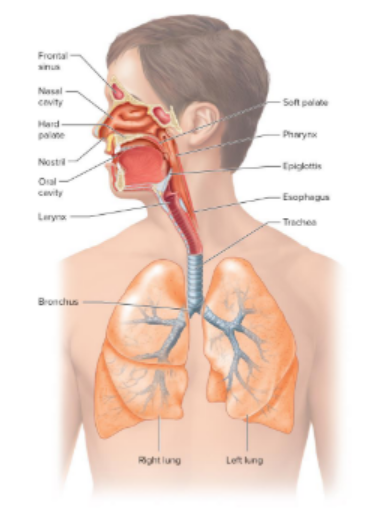
Label
Respiratory volumes and capacity
Partial pressure gradient across the resting membrane
CO2 transport