Praxis 5440: Atoms and Radioactivity
 Call Kai
 Learn
Learn Practice Test
 Spaced Repetition
 Match
Match Flashcards
 Knowt Play
1/44

There's no tags or description
Looks like no tags are added yet.
Name | Mastery | Learn | Test | Matching | Spaced | Call with Kai | Chat |
|---|
No analytics yet
Send a link to your students to track their progress
45 Terms
Atomic Theory
field of info that has to do with the properties of atoms
Atoms can neither be ________ nor ___________. (Discovered by John __________)
Atoms can neither be CREATED nor DESTROYED. (Discovered by John DALTON)
What is in the nucleus (the center) of an atom?
protons and neutrons
nuclei
the plural form of the word "nucleus"
What are their charges?
1. protons
2. electrons
3. neutrons
1. positively charged
2. negatively charged
3. neutral (no charge)
Where are electrons located on an atom?
orbiting around the nucleus, in what we call the 7 shells, energy layers, or clouds

Describe the 7 shells of an atom.
Starting with the closest to the nucleus, they are known by number (1-7) or letter (K-Q), and each can hold a maximum number of electrons.

K-shell
1st shell; closest shell to the nucleus; holds max 2 electrons

L-shell
2nd shell; holds max 8 electrons
M-shell
3rd shell; holds max 18 electrons
neutral atoms
same number of protons and electrons (so the positive and negative charges balance out). Most atoms are like this.
negative ion
when an atom GAINS ELECTRONS, resulting in a negative charge, it is called this
positive ion
when an atom LOSES ELECTRONS, resulting in a positive charge, it is called this
ionization
when a neutral atom becomes charged (when it becomes a negative or positive ion)
molecules
when atoms of the SAME ELEMENT bond together
compound
when atoms of 2 or more DIFFERENT ELEMENTS bind together
mass number
a characteristic of an element: the number of protons and neutrons added together

atomic number
a characteristic of an element: the number of protons

valence shell
outermost shell of electrons (Q-shell)
valence electrons
electrons located on the outermost (or valence) shell of an atom
Why is the valence shell of electrons on an atom important?
They are gained or lost in a reaction with another atom. How many valence electrons there are in an atom is what determines that atom's bonding behavior.
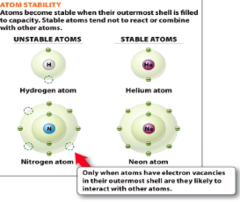
stable atom
an atom whose outer shell is filled with electrons (an atom whose outer shell isn't filled wants to become stable by filling the outer shell, by bonding with another atom)
atomic bonds
created when atoms transfer or share electrons (the electrons furthest from the nucleus, in the valence shell)
ionic bond
a type of atomic bond where electrons are TRANSFERRED from one atom to another (balancing out two charged atoms -- a positive ion and a negative ion), creating a neutral charge
covalent bond (hint, hint: Check out the name here, "co-valent"...Think "co-" meaning "share," and then "valence shell")
a type of atomic bond where electrons are SHARED between atoms
isotope
a variation of an element that has a different number of neutrons (but the same numbers of protons and electrons)

Why don't chemical reactions ever result in gains or losses of matter? (i.e. why isn't there ever more or less matter left after a chemical reaction has taken place?)
Because atoms can neither be created nor destroyed (exception: large amounts of energy, like in nuclear reactions)
nuclear fission
the SPLITTING of a large nucleus into smaller pieces (can release lots of energy and can result in the formation of different elements)
nuclear fusion
the JOINING of two nuclei with the same charges, which occurs under extreme temperatures and pressure (occurs naturally in stars) (can release or absorb lots of energy and can result in the formation of different elements)
What did Democritus do in 400 B.C.?
came up with the first conceptualization of an atom (the first idea of how to picture/model it)
List notable models of the atom.
-Democritus in 400 B.C. (first)
-solid sphere/billiard ball model (John Dalton)
-plum pudding/raisin bun model (J.J. Thomson)
-planetary/nuclear model (Ernest Rutherford)
-Bohr/orbit model (Niels Bohr)
-electron cloud/quantum mechanical model (Louis de Broglie and Erwin Schrodinger)
What was wrong the Bohr/orbit model of the atom?
the belief that electrons orbited in fixed (instead of changing) orbits
John Dalton's atom model
solid sphere/billiard ball model

J.J. Thomson's atom model
plum pudding/raisin bun model

Ernest Rutherford's atom model
planetary/nuclear model

Niels Bohr's atom model
Bohr/orbit model

Louis de Broglie & Erwin Schrodinger's atom model
electron cloud/quantum mechanical model

Radioisotopes (a.k.a. radionuclides or radioactive isotopes)
atoms that have an unstable nucleus (have excess energy, and potential to undergo radioactive decay and emit gamma rays, or in other words, they have the potential to be radioactive)
radioactive decay
when an unstable atomic nucleus spontaneously loses energy ("radioactivity" refers to the particles that are emitted)
energy transfer
when atoms lose or gain energy (for example, radioactive decay)
radioactive half-life
the time it takes for half of the radioactive nuclei in a sample to go through radioactive decay
radiation
when energy is emitted by one thing and absorbed by another
stable (or non-radioactive) isotopes
isotopes that have not been observed to decay (maybe they're not radioactive, or maybe their decay time is just so long that no one can observe it)
radioactive isotopes
have unstable nuclei and can undergo spontaneous nuclear reactions at an time (resulting in radiation)
3 types of ionizing radiation
- alpha (a) rays, which are positive
- beta (B) rays, which are negative
- gamma (Y) rays, which are neutral