Insulin Dosing and Calculations

0.0(0)
Studied by 0 people
call kaiCall Kai
Locked
learnLearn
examPractice Test
spaced repetitionSpaced Repetition
heart puzzleMatch
flashcardsFlashcards
GameKnowt Play
Card Sorting

1/62

encourage image

There's no tags or description

Looks like no tags are added yet.

Last updated 12:19 AM on 8/26/26
Name
Mastery
Learn
Test
Matching
Spaced
Call with Kai
Chat

No analytics yet

Send a link to your students to track their progress

63 Terms

1
New cards
When may insulin be started initially instead of a GLP-1 agonist in T2DM?
Severe hyperglycemia, symptoms of catabolism, or suspected insulin deficiency
2
New cards

What BG and A1C levels indicate severe hyperglycemia where insulin is started initially in T2DM?

BG ≥300 mg/dL or A1C >10%

3
New cards
If insulin is still required after glucose toxicity resolves in T2DM, what combination is recommended for greater efficacy?
Insulin + GLP-1 agonist
4
New cards

What is the general stepwise approach to starting insulin in T2DM?

Start basal (fasting) insulin first → if fasting glucose is not at goal or A1C is not at goal → add prandial insulin → if the patient is still not at A1C goals → full basal/bolus regimen OR mixed insulin regimen
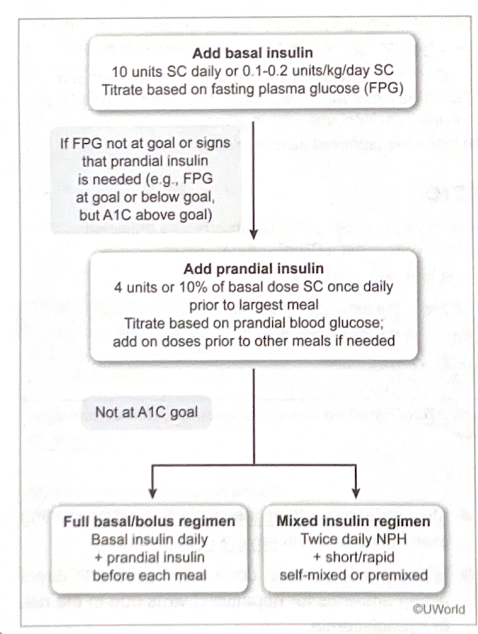
<p>Start basal (fasting) insulin first → if fasting glucose is not at goal or A1C is  not at goal → add prandial insulin →  if the patient is still not at A1C goals → full basal/bolus regimen OR mixed insulin regimen</p>
5
New cards
What determines when insulin doses should be increased in T2DM?
BG and A1C trends
6
New cards

What is the initial basal insulin dose for T2DM? and how is it titrated?

10 units SC once daily OR 0.1–0.2 units/kg/day SC; based on fasting plasma glucose

7
New cards

When should prandial insulin be added to basal insulin in T2DM?

If FPG is at/below goal but A1C remains above goal

8
New cards

What is the initial prandial insulin dose when adding it to basal insulin in T2DM and how should it be taken?

4 units OR 10% of the basal insulin dose SC once daily prior to the largest meal

9
New cards

How is prandial insulin titrated in T2DM?

based on prandial blood glucose, add on doses prior to other meals if needed

10
New cards
What are 2 insulin regimen options if a patient remains above A1C goal after basal and prandial insulin intensification?
Full basal-bolus regimen OR mixed insulin regimen
11
New cards

What does a full basal-bolus regimen consist of for T2DM?

Basal insulin daily + prandial insulin before each meal

12
New cards

What does a twice-daily mixed insulin regimen consist of for T2DM?

NPH + short/rapid-acting insulin, either self-mixed or premixed

13
New cards

Which insulin types are recommended for a physiologic insulin regimen in T1DM and why?

Rapid-acting prandial insulin + long-acting basal insulin;

They provide a physiologic insulin pattern similar to normal endogenous insulin secretion

14
New cards

What is the usual insulin starting dose for a patient with T1DM?

0.4–0.5 units/kg/day using total body weight

15
New cards

How is the TDD generally divided when starting basal-bolus insulin in T1DM?

50% basal + 50% prandial (divided equally among 3 meals)

16
New cards

How to start a basal bolus insulin regimen in T1D

  1. calculate TDD (0.4-0.5 u/kg/day)

  2. divide TDD into 50% basal and 50% bolus

  3. divide the bolus insulin among 3 meals


17
New cards
Can prandial insulin be distributed unequally among meals in T1DM?
Yes; give more for larger meals and less for smaller meals
18
New cards
Why are NPH + regular insulin regimens not preferred?
Their pharmacokinetic profiles do not mimic physiologic pancreatic insulin release as well as long-acting + rapid-acting basal-bolus regimens
19
New cards
What are advantages of an NPH + regular insulin regimen?
Lower cost and fewer injections because the insulins can be mixed
20
New cards

How is the starting TDD calculated for an NPH + regular insulin regimen?

Same TDD calculation as a basal-bolus regimen

(0.4–0.5 units/kg/day using total body weight)

21
New cards

How is the TDD divided in a NPH + regular insulin regimen?

2/3 TDD given in the morning and 1/3 TDD given at night

morning dose is 2/3 NPH and 1/3 regular

evening dose is ½ NPH and ½ regular

22
New cards
What are benefits of insulin pumps?
Excellent BG control and fewer insulin injections
23
New cards

Where is insulin stored in a traditional insulin pump?

In a reservoir

24
New cards
How does insulin travel from a traditional pump into the patient?
Reservoir → tubing → infusion set → cannula → SC tissue
25
New cards

Which insulin pump components require regular replacement?

Insulin reservoir, tubing, and infusion set

26
New cards

Which type of insulin is preferred in insulin pumps?

Rapid-acting insulin

27
New cards
What are the 2 methods by which insulin pumps deliver insulin?
Continuous basal dosing and bolus dosing
28
New cards

How does an insulin pump provide basal insulin?

continuous doses of small amounts of rapid-acting insulin every few minutes

29
New cards

What is the purpose of a bolus dose from an insulin pump and how is the bolus dose calculated?

Cover carbohydrates consumed in a meal;

Using the patient's insulin-to-carbohydrate ratio (ICR)

30
New cards

What is an automated insulin delivery (AID) system and name an example?

A system that integrates CGM data with an insulin pump to automatically adjust insulin doses;

Medtronic MiniMed 780G

31
New cards
How do AID systems respond to changing BG levels?
Detect BG changes in real time and automatically adjust insulin doses
32
New cards

What is the preferred method of insulin delivery when appropriate? When is initiation of an AID system recommended?

Automated insulin delivery (AID); Early initiation is recommended

33
New cards
What is an advantage of an insulin patch pump compared with a traditional pump?
Smaller and more discreet
34
New cards
What is a potential limitation of insulin patch pumps?
Less flexibility with insulin dosing
35
New cards
What type of insulin do patch pumps deliver at mealtimes?
Rapid-acting insulin
36
New cards
How can basal insulin delivery vary among patch pumps?
They may provide continuous basal insulin or no continuous basal insulin, depending on the product
37
New cards

How is an insulin patch pump filled? How is insulin delivered from a patch pump into the body?

Its reservoir is filled with rapid-acting insulin before the patch is applied;

Through a cannula inserted into the skin

38
New cards
How are on-demand doses delivered with a patch pump?
By pressing buttons on the device
39
New cards
Should insulin doses be adjusted based on a single abnormal BG reading?
No; adjustments should generally be based on BG trends
40
New cards
At what times should BG ideally be checked to evaluate insulin trends?
Before breakfast (FPG), lunch, dinner, and at bedtime
41
New cards
Which insulin dose is primarily evaluated when fasting BG is consistently abnormal?
Basal insulin
42
New cards

What should be done when fasting BG trends are

  1. low

  2. high


  1. Decrease the basal insulin dose

  2. Increase the basal insulin dose


43
New cards
What are the 2 main approaches to mealtime insulin dosing?
Use the same dose with each meal OR calculate each dose based on carbohydrate intake
44
New cards
When is using the same mealtime insulin dose each day most appropriate?
When carbohydrate intake for that meal is approximately the same each day
45
New cards
What is a disadvantage of using a fixed mealtime insulin dose?
Variable carbohydrate intake can cause high or low BG
46
New cards
When is carbohydrate-based mealtime insulin dosing useful?
When carbohydrate intake varies from day to day
47
New cards
What is the insulin-to-carbohydrate ratio (ICR)?
The grams of carbohydrates covered by 1 unit of insulin
48
New cards

Which rule is used to calculate the ICR for regular insulin?

Rule of 450: ICR = 450 ÷ total daily dose (TDD)

(ICR = g of carbs covered by 1 u of regular insulin)

49
New cards

Which rule is used to calculate the ICR for rapid-acting insulin?

Rule of 500: ICR = 500 ÷ total daily dose (TDD)

(ICR = g of carbs covered by 1 u of regular insulin)

50
New cards
What insulin doses must be included when determining the TDD for an ICR calculation?
Both basal and short- or rapid-acting insulin
51
New cards
How do you calculate a mealtime insulin dose using an ICR?
Grams of carbohydrates in the meal ÷ ICR
52
New cards
What is a correction dose of insulin?
A bolus dose used to lower BG that is above the target range
53
New cards
What is the correction factor (insulin sensitivity factor)?
The amount that 1 unit of insulin is expected to lower BG in mg/dL
54
New cards

Which rule calculates the correction factor for regular insulin?

1,500 Rule: Correction factor = 1,500 ÷ TDD

55
New cards

Which rule calculates the correction factor for rapid-acting insulin?

1,800 Rule: Correction factor = 1,800 ÷ TDD

56
New cards
What insulin doses are included in TDD when calculating a correction factor?
Both basal and short- or rapid-acting insulin
57
New cards

What is the formula for calculating a correction dose for elevated blood glucose?

(Current BG − target BG) ÷ correction factor

58
New cards

Which types of insulin is the correction dose formula for?

both rapid and regular insulin

59
New cards
How are most insulin conversions performed?
1:1 using the same dose
60
New cards
How do you convert twice-daily NPH to once-daily insulin glargine?
Use 80% of the total daily NPH dose
61
New cards

How do you convert Toujeo to another insulin glargine?

Use 80% of the Toujeo dose

62
New cards
Why is the dose reduced when converting twice-daily NPH to glargine?
To reduce the risk of hypoglycemia
63
New cards
Does an insulin conversion dose sometimes require further adjustment?
Yes; adjust based on BG control, such as increasing the dose for hyperglycemia



