Part 10.1- ENDOCRINE SYSTEM
 Call Kai
 Learn
Learn Practice Test
 Spaced Repetition
 Match
Match Flashcards
 Knowt Play
1/112

Earn XP
Description and Tags
Proverbs 16:3
Name | Mastery | Learn | Test | Matching | Spaced | Call with Kai | Chat |
|---|
No analytics yet
Send a link to your students to track their progress
113 Terms
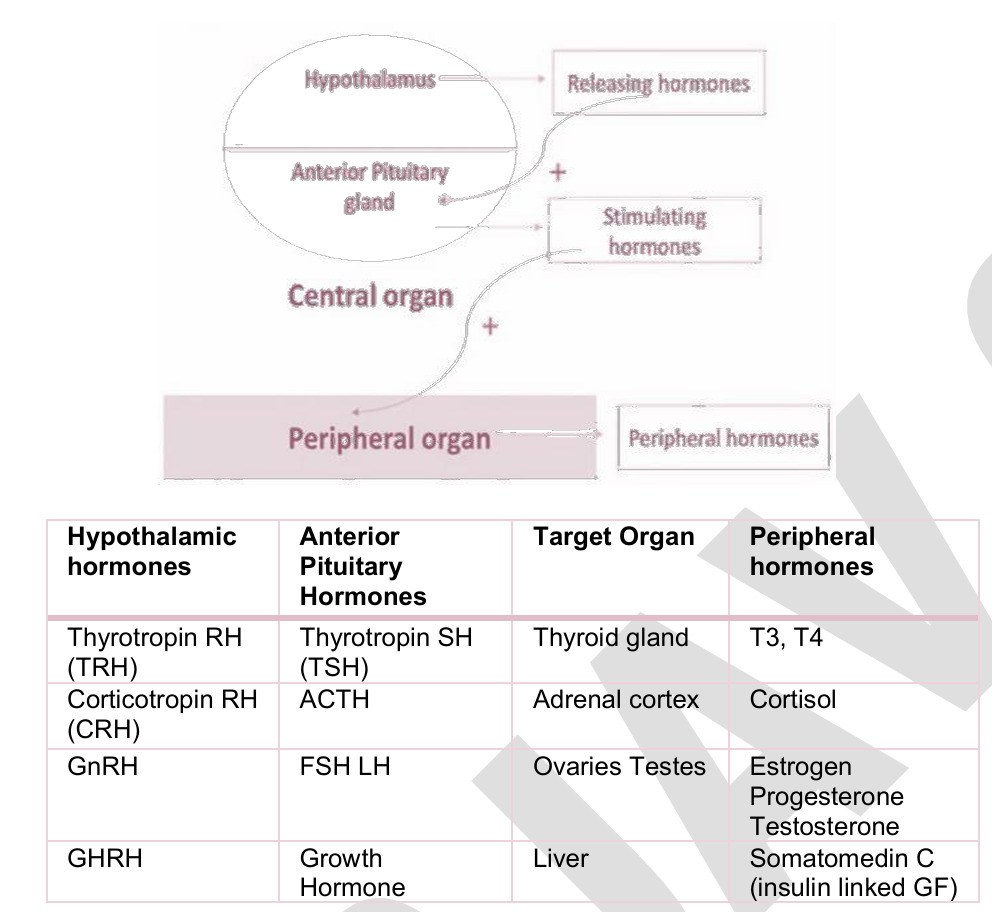
PHYSIOLOGY OF ENDOCRINE SYSTEM
b. 24 hours
Circadian rhythm refers to patterns that are repeated approximately every:
a. 12 hours
b. 24 hours
c. 48 hours
d. 7 days
c. Sleep and the sleep–wake cycle
Pituitary hormone rhythms are primarily entrained to:
a. Food intake
b. Exercise
c. Sleep and the sleep–wake cycle
d. Blood pressure changes
a. Circadian pattern of hormone secretion
Susceptibility to feedback regulation may be related to:
a. Circadian pattern of hormone secretion
b. Blood type
c. Height and weight
d. Eye color
c. Growth hormone (GH)
Which hormone secretion peaks at sleep onset?
a. Cortisol
b. ACTH
c. Growth hormone (GH)
d. Thyroxine
c. Early in the morning
The secretion of ACTH and cortisol typically peaks:
a. At bedtime
b. During lunch
c. Early in the morning
d. At midnight only
b. At bedtime
ACTH and cortisol levels are usually lowest:
a. At sleep onset
b. At bedtime
c. In the afternoon
d. During exercise
b. ACTH and cortisol
Which hormone pair demonstrates an early morning peak and bedtime trough?
a. GH and insulin
b. ACTH and cortisol
c. Prolactin and oxytocin
d. Thyroxine and glucagon
c. At sleep onset
Growth hormone (GH) secretion is highest:
a. Early morning
b. During intense exercise
c. At sleep onset
d. At bedtime awakening
b. Wolff-Chaikoff effect
An example of local regulation in thyroid physiology is the:
a. Frank-Starling mechanism
b. Wolff-Chaikoff effect
c. Renin-angiotensin system
d. Vaughan Williams classification
b. Excess iodide inhibits further organification of iodine
The Wolff-Chaikoff effect occurs when:
a. Low iodide increases thyroid hormone synthesis
b. Excess iodide inhibits further organification of iodine
c. Excess calcium stimulates T3 production
d. Thyroid hormone secretion becomes independent of iodine
b. Decreased T3 and T4 synthesis
The immediate effect of the Wolff-Chaikoff effect is:
a. Increased T3 and T4 synthesis
b. Decreased T3 and T4 synthesis
c. Increased ACTH secretion
d. Increased cortisol production
d. Hypothyroidism
Decreased thyroid hormone synthesis during the Wolff-Chaikoff effect may result in:
a. Hyperthyroidism
b. Hyperparathyroidism
c. Diabetes mellitus
d. Hypothyroidism
c. 10–14 days
The duration of effect (DOE) of the Wolff-Chaikoff effect is approximately:
a. 1–2 hours
b. 10–14 hours
c. 10–14 days
d. 1 month
b. Increased T3 and T4 synthesis leading to hyperthyroidism
Beyond 10–14 days of excess iodide exposure, the thyroid may respond with:
a. Reduced T3 and T4 synthesis only
b. Increased T3 and T4 synthesis leading to hyperthyroidism
c. Complete cessation of hormone production
d. Decreased cortisol secretion
b. Starting material for thyroid hormone (T3 and T4) synthesis
Iodine serves as the:
a. End product of thyroid hormone synthesis
b. Starting material for thyroid hormone (T3 and T4) synthesis
c. Enzyme that activates thyroid hormone
d. Storage protein for thyroid hormones
c. A step in thyroid hormone biosynthesis
Organification of iodine refers to:
a. Storage of iodine in bone
b. Renal excretion of iodine
c. A step in thyroid hormone biosynthesis
d. Breakdown of thyroid hormones
b. Organification of iodine
Excess iodide initially decreases thyroid hormone production by inhibiting:
a. TSH secretion
b. Organification of iodine
c. Cortisol release
d. Growth hormone secretion
b. Negative feedback
The dominant type of hormonal feedback regulation is:
a. Positive feedback
b. Negative feedback
d. LH surge in response to increased estrogen levels
A classic example of positive feedback regulation is:
a. Decrease in cortisol suppressing ACTH
b. Thyroid hormone inhibition of TSH
c. Low glucose decreasing insulin secretion
d. LH surge in response to increased estrogen levels
a. Estrogen causing LH surge
Positive feedback in the reproductive system involves an increase in:
a. Estrogen causing LH surge
b. Cortisol causing ACTH suppression
c. T3 causing TSH suppression
d. Insulin causing glucagon suppression
b. Pituitary dwarfism
[GROWTH HORMONE]
Childhood growth hormone deficiency commonly presents as:
a. Acromegaly
b. Pituitary dwarfism
c. Hyperthyroidism
d. Diabetes insipidus
a. Increased cardiovascular morbidity
[GROWTH HORMONE]
Adult growth hormone deficiency is associated with:
a. Increased cardiovascular morbidity
b. Hyperactivity only
c. Hypercalcemia
d. Increased thyroid hormone production
a. Fatigue, weakness, and hypoglycemic effects
[GROWTH HORMONE]
Which symptoms may occur in adult growth hormone deficiency?
a. Fatigue, weakness, and hypoglycemic effects
b. Hypertension and tachycardia
c. Polyuria and polydipsia only
d. Fever and rash
b. Growth hormone therapy
[GROWTH HORMONE]
The first-line management for growth hormone deficiency is:
a. Dopamine agonists
b. Growth hormone therapy
c. Beta blockers
d. Calcium channel blockers
c. Somatotropin (cadaveric hormone preparation)
[GROWTH HORMONE]
Which growth hormone preparation is considered obsolete?
a. Somatropin
b. Somatrem
c. Somatotropin
d. Desmopressin
d. Risk of Creutzfeldt-Jakob disease (spongiform encephalitis)
[GROWTH HORMONE]
Why was cadaveric somatotropin made obsolete?
a. Severe hepatotoxicity
b. Severe nephrotoxicity
c. Risk of pulmonary fibrosis
d. Risk of Creutzfeldt-Jakob disease
a. Somatropin
[GROWTH HORMONE]
Which of the following is a recombinant growth hormone preparation?
a. Somatropin
b. Quinidine
c. Oxytocin
d. Propranolol
b. Somatotropin with methionine
[GROWTH HORMONE]
Somatrem differs because it contains:
a. Added iodine
b. Somatotropin with methionine
c. Calcium with cortisol
d. Extra prolactin
a. Somatropin
[GROWTH HORMONE]
A clinically useful recombinant growth hormone preparation is:
a. Somatropin
b. Somatotropin (cadaveric only)
c. Verapamil
d. Furosemide
c. Hyperglycemia and increased risk of diabetes mellitus
[GROWTH HORMONE]
An adverse effect of recombinant growth hormone therapy is:
a. Hypoglycemia only
b. Pulmonary fibrosis
c. Hyperglycemia and increased risk of diabetes mellitus
d. Cinchonism
Pituitary gigantism
[GROWTH HORMONE]
Childhood growth hormone excess commonly results in:
a. Acromegaly
b. Pituitary gigantism
c. Pituitary dwarfism
d. Diabetes insipidus
a. Acromegaly
[GROWTH HORMONE]
Adult growth hormone excess commonly presents as:
a. Acromegaly
b. Pituitary gigantism
c. Pituitary dwarfism
d. Diabetes insipidus
a. Somatostatin and analogues
[GROWTH HORMONE]
A major treatment approach for growth hormone excess includes:
a. Somatostatin and analogues
b. Beta blockers only
c. Diuretics only
d. Calcium channel blockers only
b. Octreotide and Lanreotide
[GROWTH HORMONE]
Which of the following are somatostatin analogues?
a. Quinidine and Lidocaine
b. Octreotide and Lanreotide
c. Bromocriptine and Cabergoline
d. Verapamil and Diltiazem
c. Inhibiting growth hormone release
[GROWTH HORMONE]
Somatostatin analogues reduce growth hormone excess by:
a. Stimulating GH release
b. Increasing prolactin release
c. Inhibiting growth hormone release
d. Blocking insulin receptors
a. Gastrin, insulin, glucagon, and TSH
[GROWTH HORMONE]
Somatostatin analogues also inhibit release of:
a. Gastrin, insulin, glucagon, and TSH
b. Cortisol and aldosterone
c. Estrogen and progesterone
d. Histamine and serotonin
a. Neuroendocrine tumors (carcinoid syndrome)
[GROWTH HORMONE]
Octreotide and lanreotide are useful in the management of:
a. Neuroendocrine tumors
b. Hypertension
c. Bronchial asthma
d. Myocardial infarction
a. Refractory watery diarrhea
[GROWTH HORMONE]
Somatostatin analogues are also used for:
a. Refractory watery diarrhea
b. Osteoporosis
c. Migraine only
d. Hyperlipidemia
a. Somatostatin analogues
[GROWTH HORMONE]
Acute control of bleeding in esophageal varices and peptic ulcer disease may involve:
a. Somatostatin analogues
b. Beta blockers
c. Insulin therapy
d. Calcium supplementation
b. Bromocriptine
[GROWTH HORMONE]
Which dopamine agonist inhibits prolactin and growth hormone release?
a. Propranolol
b. Bromocriptine
c. Furosemide
d. Quinidine
b. D2 agonists
[GROWTH HORMONE]
Bromocriptine and cabergoline primarily act as:
a. D1 agonists
b. D2 agonists
b. Pegvisomant
[GROWTH HORMONE]
Which drug is a growth hormone receptor antagonist?
a. Octreotide
b. Pegvisomant
c. Cabergoline
d. Somatropin
c. A pegylated somatropin antagonist
[GROWTH HORMONE]
Pegvisomant is best described as:
a. A dopamine antagonist
b. A thyroid hormone analogue
c. A pegylated somatropin antagonist
d. A calcium channel blocker
b. Reducing drug clearance and improving effectiveness
[GROWTH HORMONE]
Pegylation improves drug effectiveness mainly by:
a. Increasing drug clearance
b. Reducing drug clearance and improving effectiveness
c. Preventing receptor binding completely
d. Increasing toxicity
a. Growth hormone excess/acromegaly
[GROWTH HORMONE]
Pegvisomant is primarily used for:
a. Growth hormone excess/acromegaly
b. Pituitary dwarfism
c. Diabetes insipidus
d. Hyperthyroidism
c. Gonadotropin-releasing hormone
[GROWTH HORMONE]
GnRH stands for:
a. Growth hormone–releasing hormone
b. Glucagon-releasing hormone
c. Gonadotropin-releasing hormone
d. Gastrin-releasing hormone
a. Luteinizing hormone–releasing hormone
[GROWTH HORMONE]
LHRH stands for:
a. Luteinizing hormone–releasing hormone
b. Long hormone regulatory hormone
c. Liver hormone releasing hormone
d. Lymphocyte hormone regulatory hormone
b. Intermittent or pulsatile
[GROWTH HORMONE]
A physiological effect of GnRH occurs when serum GnRH levels are:
a. Sustained and continuous
b. Intermittent or pulsatile
c. Completely absent
d. Excessively suppressed
d. Stimulatory effect on FSH/LH
[GROWTH HORMONE]
Pulsatile GnRH secretion produces what effect on FSH and LH?
a. Inhibitory effect on FSH/LH
b. Permanent suppression of gonadotropins
c. No effect on gonadotropins
d. Stimulatory effect on FSH/LH
a. Increased estrogen, progesterone, and testosterone
[GROWTH HORMONE]
The physiological effect of pulsatile GnRH results in:
a. Increased estrogen, progesterone, and testosterone
b. Decreased estrogen, progesterone, and testosterone
b. Sustained and continuous
[GROWTH HORMONE]
The pharmacologic effect of GnRH occurs when serum GnRH levels are:
a. Intermittent or pulsatile
b. Sustained and continuous
c. Low and absent
d. Variable every hour
d. Inhibitory effect on FSH/LH
[GROWTH HORMONE]
Sustained GnRH exposure causes what effect on FSH and LH?
a. Increased stimulation of FSH/LH
b. No effect on gonadotropins
c. Permanent increase in LH
d. Inhibitory effect on FSH/LH
b. Decreased estrogen, progesterone, and testosterone
[GROWTH HORMONE]
The pharmacologic effect of sustained GnRH results in:
a. Increased estrogen, progesterone, and testosterone
b. Decreased estrogen, progesterone, and testosterone
b. Hypothalamic hypogonadism
[GROWTH HORMONE]
Intermittent or pulsatile administration of GnRH is primarily used for:
a. Hormone excess states
b. Hypothalamic hypogonadism
c. Hyperthyroidism
d. Heart failure
d. Intermittent or pulsatile
[GROWTH HORMONE]
Management of hypothalamic hypogonadism requires GnRH administration that is:
a. Continuous and sustained
b. Weekly depot injection
c. Single-dose therapy
d. Intermittent or pulsatile
b. Hormone excess states
[GROWTH HORMONE]
Continuous or sustained GnRH administration is used for:
a. Hormone deficiency states
b. Hormone excess states
c. Acute myocardial infarction
d. Diabetes insipidus
c. IM depot or continuous dosing
[GROWTH HORMONE]
Sustained GnRH administration is commonly given as:
a. Oral immediate-release tablets
b. Topical cream
c. IM depot or continuous dosing
d. Sublingual tablets
a. Severe endometriosis with dysmenorrhea
[GROWTH HORMONE]
Which condition is treated using inhibitory dosing of GnRH analogues?
a. Severe endometriosis with dysmenorrhea
b. Pituitary dwarfism
c. Hyperprolactinemia
d. Diabetes mellitus
a. Endometrial cancer
[GROWTH HORMONE]
GnRH analogues may be used in the management of:
a. Endometrial cancer
b. Asthma
c. Peptic ulcer disease
d. Hypertension
a. Breast cancer
[GROWTH HORMONE]
Which malignancy may be managed using sustained GnRH administration?
a. Breast cancer
b. Cataract
c. Pneumonia
d. Cirrhosis
a. Prostate cancer
[GROWTH HORMONE]
GnRH analogues are commonly used in the management of:
a. Prostate cancer
b. Renal stones
c. Migraine
d. Hyperthyroidism
b. Feminizing effect
[GROWTH HORMONE]
A possible adverse effect of inhibitory GnRH dosing in males is:
a. Masculinizing effect
b. Feminizing effect
c. Hyperthyroidism
d. Polycythemia
b. Masculinizing effect
[GROWTH HORMONE]
A possible adverse effect of inhibitory GnRH dosing in females is:
a. Feminizing effect
b. Masculinizing effect
c. Hypoglycemia only
d. Hypercalcemia
c. Oxytocin and vasopressin
[POSTERIOR PITUITARY HORMONE]
classified as posterior pituitary hormones
a. Growth hormone and prolactin
b. ACTH and TSH
c. Oxytocin and vasopressin
d. LH and FSH
c. Posterior pituitary gland
[POSTERIOR PITUITARY HORMONE]
Oxytocin and vasopressin are stored and released from the:
a. Adrenal medulla
b. Anterior pituitary gland
c. Posterior pituitary gland
d. Pancreas
b. Posterior hypothalamus
[POSTERIOR PITUITARY HORMONE]
Posterior pituitary hormones are produced or synthesized in the:
a. Anterior pituitary gland
b. Posterior hypothalamus
c. Adrenal cortex
d. Thyroid gland
b. Initial milk release and uterine contraction
[POSTERIOR PITUITARY HORMONE]
A major physiologic effect of oxytocin is:
a. Decreased uterine contraction
b. Initial milk release and uterine contraction
c. Increased thyroid hormone release
d. Suppression of prolactin secretion
a. Let-down (release)
[POSTERIOR PITUITARY HORMONE]
Oxytocin promotes milk:
a. Let-down (release)
b. Production
c. Storage
d. Digestion
c. Nasal spray
[POSTERIOR PITUITARY HORMONE]
Which route of administration of oxytocin is used to stimulate milk let-down?
a. Oral tablet
b. Intramuscular injection
c. Nasal spray
d. Subcutaneous injection
b. Prevention or treatment of postpartum hemorrhage
[POSTERIOR PITUITARY HORMONE]
IV infusion of oxytocin may be used for:
a. Hyperthyroidism treatment
b. Prevention or treatment of postpartum hemorrhage
c. Diabetes mellitus management
d. Asthma treatment
a. Labor induction
[POSTERIOR PITUITARY HORMONE]
Oxytocin IV infusion is commonly used for:
a. Labor induction
b. Hypertension treatment
c. Chronic kidney disease
d. Migraine prevention
d. 1-hour IV infusion
[POSTERIOR PITUITARY HORMONE]
The typical administration for oxytocin during labor induction is:
a. Rapid IV push
b. Weekly depot injection
c. Oral capsule once daily
d. 1-hour IV infusion
b. Uterine rupture due to uterine tetany
[POSTERIOR PITUITARY HORMONE]
A serious adverse effect of oxytocin is:
a. Pulmonary fibrosis
b. Uterine rupture
c. Hyperglycemia
d. Bronchospasm
b. Oxytocin receptor antagonist
[POSTERIOR PITUITARY HORMONE]
Atosiban is classified as a:
a. Oxytocin receptor agonist
b. Oxytocin receptor antagonist
c. Beta blocker
d. Dopamine agonist
b. Decrease uterine contraction
[POSTERIOR PITUITARY HORMONE]
The primary effect of Atosiban is to:
a. Increase uterine contraction
b. Decrease uterine contraction
c. Increase prolactin secretion
d. Cause vasoconstriction
d. Prevent pre-term labor
[POSTERIOR PITUITARY HORMONE]
Atosiban is mainly used to:
a. Induce labor
b. Stimulate milk let-down
c. Treat postpartum hemorrhage
d. Prevent pre-term labor
c. Tocolytic agent
[POSTERIOR PITUITARY HORMONE]
Atosiban is considered a:
a. Vasodilator
b. Diuretic agent
c. Tocolytic agent
d. Anticoagulant
b. Antidiuretic hormone (ADH)
[POSTERIOR PITUITARY HORMONE]
Vasopressin is also known as:
a. Oxytocin
b. Antidiuretic hormone (ADH)
c. Growth hormone
d. Prolactin
a. Prevent diuresis
[POSTERIOR PITUITARY HORMONE]
The primary physiologic action of vasopressin is to:
a. Prevent diuresis
b. Promote diuresis
c. Stimulate uterine contraction
d. Increase thyroid hormone release
c. Vasoconstriction in blood vessels
[POSTERIOR PITUITARY HORMONE]
Activation of V1 receptors by vasopressin primarily causes:
a. Water reabsorption
b. Bronchodilation
c. Vasoconstriction in blood vessels
d. Increased insulin secretion
a. Blood vessels
[POSTERIOR PITUITARY HORMONE]
V1 receptors are mainly located in:
a. Blood vessels
b. Thyroid gland
c. Liver only
d. Pancreas
c. Distal tubule
[POSTERIOR PITUITARY HORMONE]
The V2 receptor of vasopressin is primarily located in the:
a. Proximal tubule
b. Coronary artery
c. Distal tubule
d. Myocardium
b. Translocation of aquaporins into the cell membrane
[POSTERIOR PITUITARY HORMONE]
Activation of V2 receptors results in:
a. Vasoconstriction only
b. Translocation of aquaporins into the cell membrane
c. Increased calcium excretion into the cytoplasm
d. Decreased water permeability
b. Water reabsorption
[POSTERIOR PITUITARY HORMONE]
Insertion of aquaporins into the cell membrane leads to:
a. Increased diuresis
b. Water reabsorption
c. Reduced blood volume
d. Sodium wasting
b. Diabetes insipidus
[POSTERIOR PITUITARY HORMONE]
Vasopressin deficiency commonly results in:
a. Diabetes mellitus
b. Diabetes insipidus
c. Hyperthyroidism
d. Acromegaly
d. Vasopressin (ADH)
[POSTERIOR PITUITARY HORMONE]
Diabetes insipidus is primarily caused by deficiency of:
a. Oxytocin
b. Prolactin
c. Growth hormone
d. Vasopressin (ADH)
a. Polyuria
b. Polydipsia
[POSTERIOR PITUITARY HORMONE]
Symptoms of diabetes insipidus (2)
a. Polyuria
b. Polydipsia
c. Polyphagia
d. Dysuria
c. Hypernatremia
d. Hypoosmolar -Diluted urine
[POSTERIOR PITUITARY HORMONE]
Symptoms of diabetes insipidus (2)
a. Polyphagia
b. Dysuria
c. Hypernatremia
d. Hypoosmolar
c. Pituitary diabetes insipidus
[POSTERIOR PITUITARY HORMONE]
Central diabetes insipidus is also known as:
a. Nephrogenic diabetes insipidus
b. Diabetes mellitus
c. Pituitary diabetes insipidus
d. Syndrome of inappropriate ADH secretion
b. Central organ problems causing true ADH deficiency
[POSTERIOR PITUITARY HORMONE]
Central diabetes insipidus is caused primarily by:
a. Kidney resistance to ADH
b. Central organ problems causing true ADH deficiency
c. Excess aldosterone secretion causing true ADH deficiency
d. Hyperinsulinemia causing excess in true ADH
c. Vasopressin (ADH)
[POSTERIOR PITUITARY HORMONE]
The major hormone deficiency in central diabetes insipidus is:
a. Growth hormone
b. Oxytocin
c. Vasopressin (ADH)
d. Prolactin
a. Vasopressin or desmopressin
[POSTERIOR PITUITARY HORMONE]
First-line management of central diabetes insipidus may include:
a. Vasopressin or desmopressin
b. Beta blockers
c. Calcium channel blockers
d. Insulin therapy
d. Nonselective V1 and V2 receptor agonist
[POSTERIOR PITUITARY HORMONE]
Vasopressin acts as a:
a. Selective V2 receptor antagonist
b. Beta blocker
c. Dopamine agonist
d. Nonselective V1 and V2 receptor agonist
c. Selective V2 receptor agonist
[POSTERIOR PITUITARY HORMONE]
Desmopressin primarily acts as a:
a. Nonselective V1/V2 agonist
b. Selective V1 receptor agonist
c. Selective V2 receptor agonist
d. Alpha blocker
b. Decrease water excretion
[POSTERIOR PITUITARY HORMONE]
The renal effect of desmopressin is to:
a. Increase water excretion
b. Decrease water excretion
c. Increase sodium wasting
d. Promote diuresis
d. Hemophilia A and von Willebrand disease
[POSTERIOR PITUITARY HORMONE]
In addition to diabetes insipidus, desmopressin is used for:
a. Heart failure and von Willebrand disease
b. Hyperthyroidism and Hemophilia A
c. Atrial fibrillation and Heart failure
d. Hemophilia A and von Willebrand disease
a. Vasopressin excess
[POSTERIOR PITUITARY HORMONE]
Results in Syndrome of inappropriate antidiuretic hormone secretion (SIADH)
a. Vasopressin excess
b. Vasopressin deficiency
b. Syndrome of inappropriate antidiuretic hormone secretion
[POSTERIOR PITUITARY HORMONE]
SIADH stands for:
a. Syndrome of increased aldosterone hormone
b. Syndrome of inappropriate antidiuretic hormone secretion
c. Severe insulin-associated hormone deficiency
d. Selective inhibition of antidiuretic hormone
a. Hypovolemia
b. Hypertension
[POSTERIOR PITUITARY HORMONE]
A common signs of excess vasopressin (2)
a. Hypovolemia
b. Hypertension
c. Polyuria
d. Hypernatremia