BIOL 207 Lecture 2 - DNA as Genetic Material (Questions)
 Call Kai
 Learn
Learn Practice Test
 Spaced Repetition
 Match
Match Flashcards
 Knowt Play
1/18

There's no tags or description
Looks like no tags are added yet.
Name | Mastery | Learn | Test | Matching | Spaced | Call with Kai | Chat |
|---|
No analytics yet
Send a link to your students to track their progress
19 Terms
Why are s-strain pneumonia able to remain virulent and kill mice, while r-strain pneumonia cannot?
S-strain protected by glycocalyx: unable to be spotted by immune cells
R-strain lacks glycocalyx: no protection from immune cells are and phagocytosized
Explain the different treatment groups and results of Griffith’s transformation experiment, including strains used, treatment of strain, and results on mice.
S-strain injected = dead mice
R-strain injected = mice alive
Heat treated s-strain injected = mice alive, no s-strain found
R strain + heat treated s-strain = mice dead, s-strain found

Explain the “transforming principle” that allowed killed s-strain bacteria to transform r-strain bacteria. How is this used presently?
Bacteria with single stranded binding proteins (competence factors) that help digest the existing genome and incorporate the free DNA from dead bacteria into the living bacterial genome
Bacteria can be treated to increase competence, followed by transformation of desired DNA to easily amplify and manipulate DNA in the lab

Describe Avery, MacLeod, & McCarty’s experiment using the s-strain pneumonia. What did they determine based on the transforming principle?
Tested different aspects of the virus’ integral function:
Destroyed polysaccharides (glycocalyx) → transforming activity still intact
Lipids destroyed → transforming activity still intact
Treatment with ribonuclease (RNA destroyed) → transforming activity still intact
Treatment with protease (proteins destroyed) → transforming activity still intact
Treatment with deoxyribonuclease (DNA destroyed) → transforming activity lost
Conclusion: transforming principle is the DNA

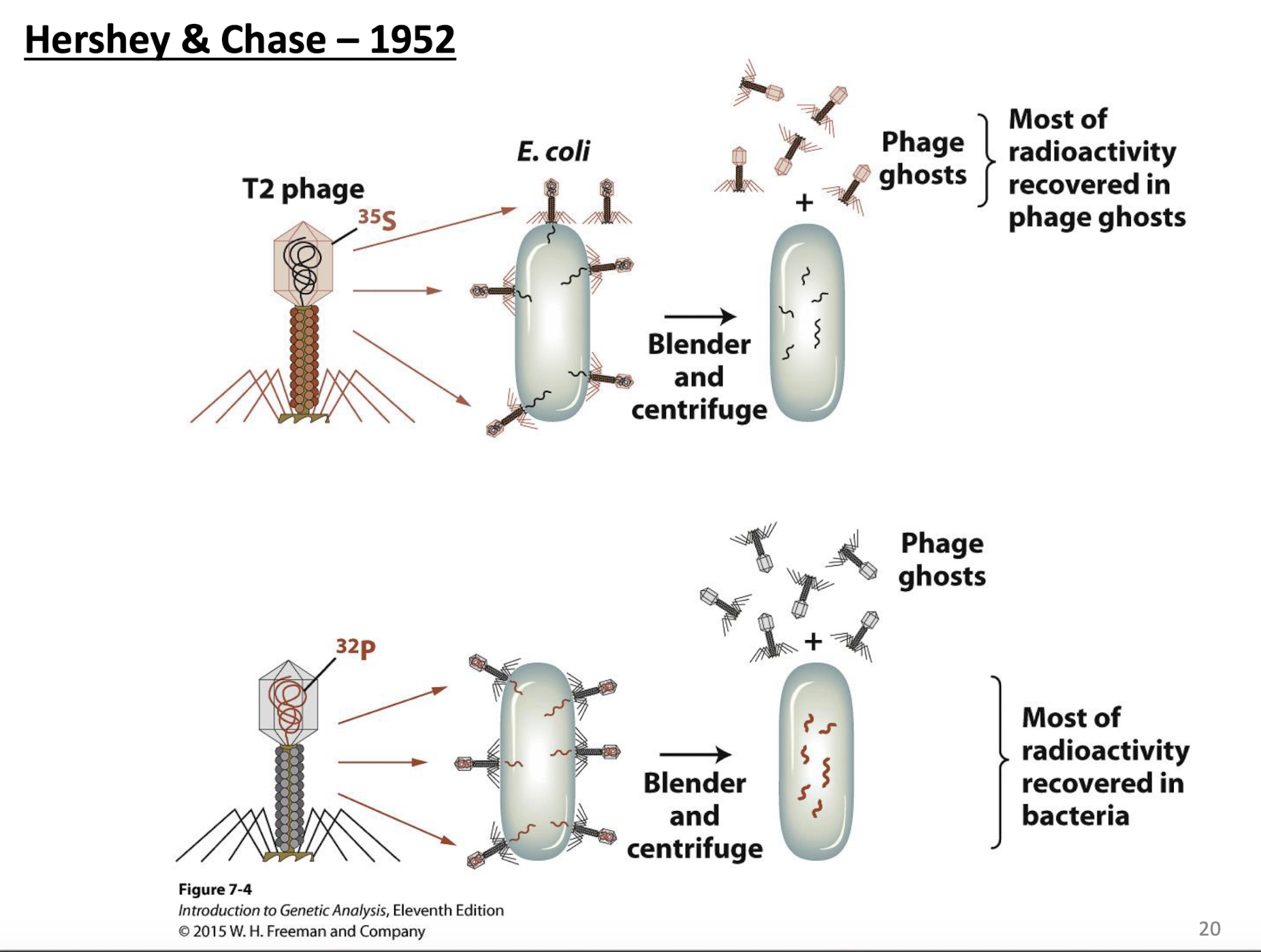
Describe Hershey and Chase’s experimental design regarding bacteriophages. How did they differentiate groups?
T2 phages contain only DNA and protein and attack via injection → DNA or protein must be the carrier of genetic material
Phosphorus found in DNA but not protein: radioactive P will track the DNA in the phage. DNA is rich in phosphorus (backbone)
Sulfur found in protein not DNA: radioactive S will track protein in the phage. Amino acids (cysteine and methionine) that make up proteins contain sulfur
Describe the results of the Hershey Chase experiment. What conclusion did this lead to?
Sulfur marked proteins made up the “ghost” of the phage: outside that was not injected. Phosphorus marked DNA entered the cell being attacked, and was able to be recovered from progeny (offspring)
Conclusion: DNA is the hereditary material for T2 phages, not protein
What are the 4 principles that DNA must have due to being the hereditary and genetic material?
Cells must be able to replicate DNA → exact copies need to be made
Carry hereditary information that can be expressed into cell structures
Transfer information to control a cell’s activity → control of how a gene is expressed
Must be able to change (mutate)
How are nucleotides linked via phosphodiester bonds? Name the process.
5’ phosphate group of one nucleotide loses its H, 3’ sugar group of another loses an OH, condensating an H2O molecule. A covalent bond is formed between the phosphate and the sugar to make a phosphodiester bond.
Condensation reaction → water is released
What determines the directionality of a nucleic acid strand?
Phosphate backbone orientation: 3’ end/5’ end
What did Chargaff’s experimentation about DNA determine about its properties?
Determined nucleotide distribution across species:
Each species has a specific quantity of DNA
The same ratio of bases is found in different species
Conclusion: A = T, C = G
(Often AT is more prominent than GC)
How was the structure of DNA eludicated? Who contributed?
Rosalind Franklin: produced an X-ray diffraction image of DNA
Watson and Crick: interpreted data and built a structural model based on the image
Describe the shape and structure of DNA, including orientation, bonds, and base pairs per turn.
2 nm wide, helical molecule made up of two antiparallel nucleotide polymer strands
Connected by phosphodiester bonds between 3’ sugar and 5’ phosphate
Sugar and phosphate groups face outside, while nitrogenous bases are faced in
~10 base pairs per helical turn
Explain how complimentary bases are paired, including which go with which and how they bond.
A pairs with T, G pairs with C
Hydrogen bonds connect the base pairs
If the conservative replication model is true, how much of the newly formed DNA duplexes would be new and old DNA? Explain.
New DNA duplexes would have exactly 100% new DNA: each replicated daughter strand reanneals with one another so that both halves are new DNA

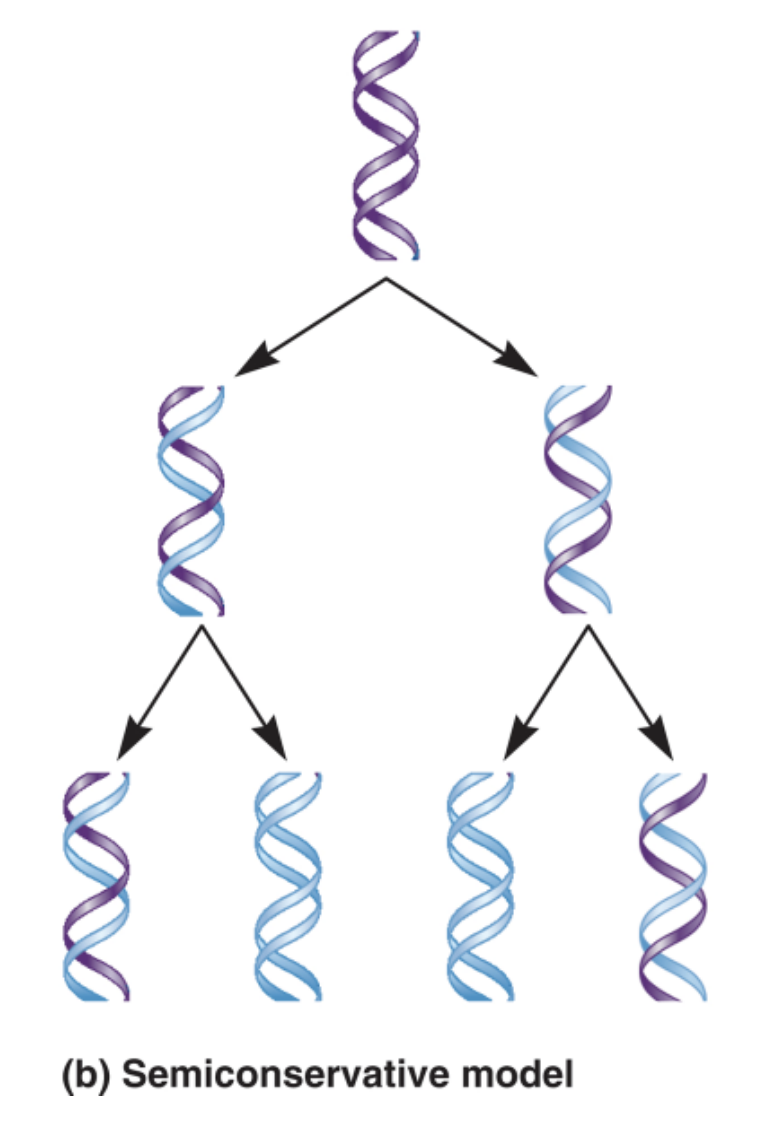
If the semi-conservative replication model is true, how much of the newly formed DNA duplexes would be new and old DNA? Explain.
New DNA duplexes would have exactly 50% new DNA: each replicated daughter strand anneals with its complimentary template parent strand, such that only half is new DNA
If the dispersive replication model is true, how much of the newly formed DNA duplexes would be new and old DNA? Explain.
New DNA duplexes would have roughly 50% new DNA: each new daughter strand and old parent strand are made up of half daughter half old DNA, each strand has slightly varying but roughly half and half composition

Describe Meselson-Stahl’s experimental design regarding light and heavy DNA. How were they able to track DNA for replication?
N15 labelled DNA is heavy, while N14 labelled DNA is light. The hybrid of the two is in the middle.
Bacteria is grown in N15 (all heavy DNA), then changed to be grown in N14. It can be tested whether the DNA will be all heavy, all light, or hybridized

What are the possible outcomes of the Meselson-Stahl experiment based on each model of replication?
Semi-conservative: heavy DNA → hybrid DNA → 50% light, 50% hybrid
Conservative: heavy DNA → 50% heavy, 50% light → 75% light, 25% heavy
Dispersive: heavy DNA → hybrid DNA → hybrid DNA with less concentrations of heavy

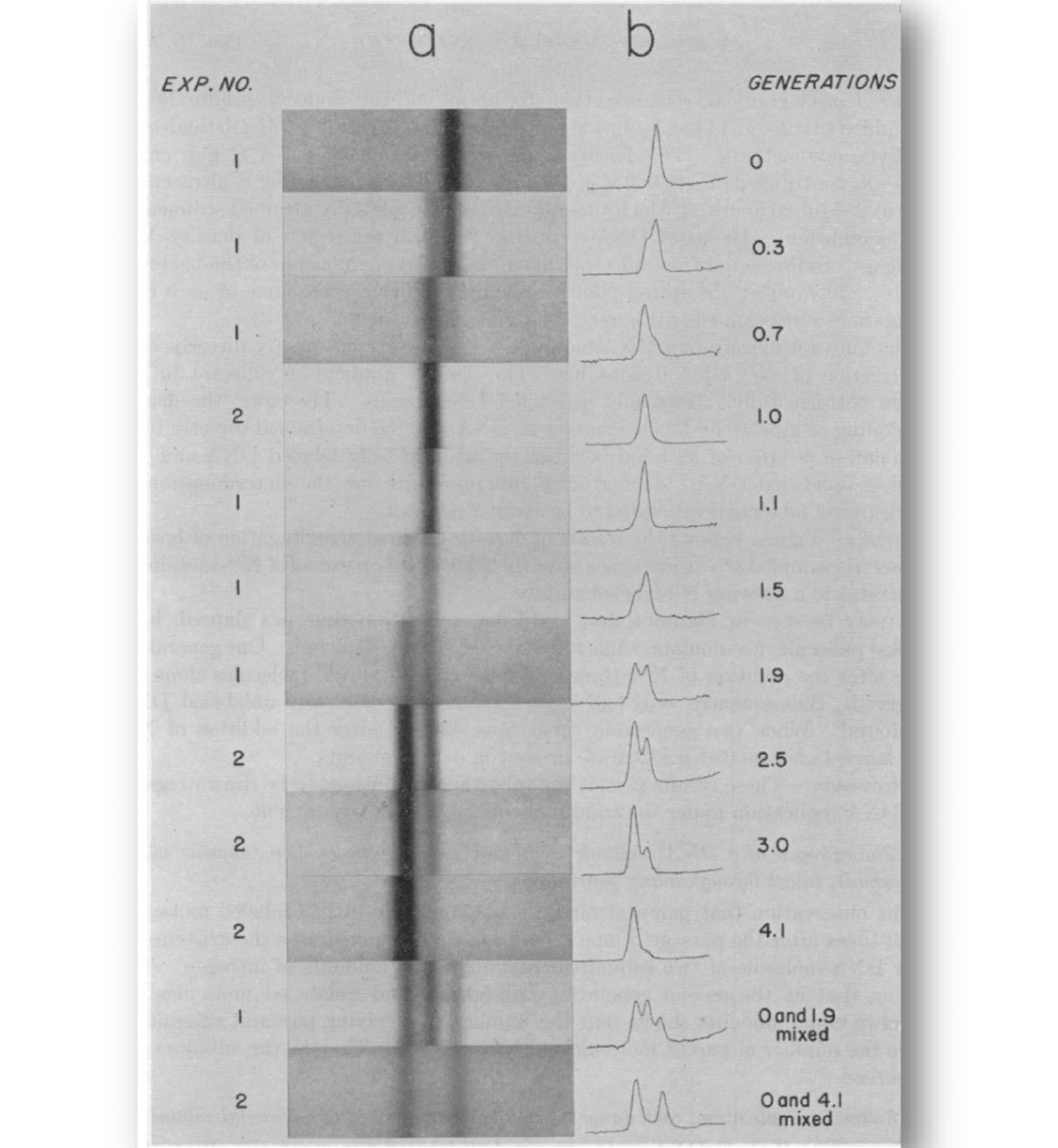
What was the outcome of the Meselson-Stahl experiment? What model did it prove to be true?
Heavy DNA → hybrid DNA + light DNA
Bands of middle and light