The Relationship between Attitudes, Prejudice and Discrimination
 Call Kai
 Learn
Learn Practice Test
 Spaced Repetition
 Match
Match Flashcards
 Knowt Play
1/30

There's no tags or description
Looks like no tags are added yet.
Name | Mastery | Learn | Test | Matching | Spaced | Call with Kai | Chat |
|---|
No analytics yet
Send a link to your students to track their progress
31 Terms
Prejudice
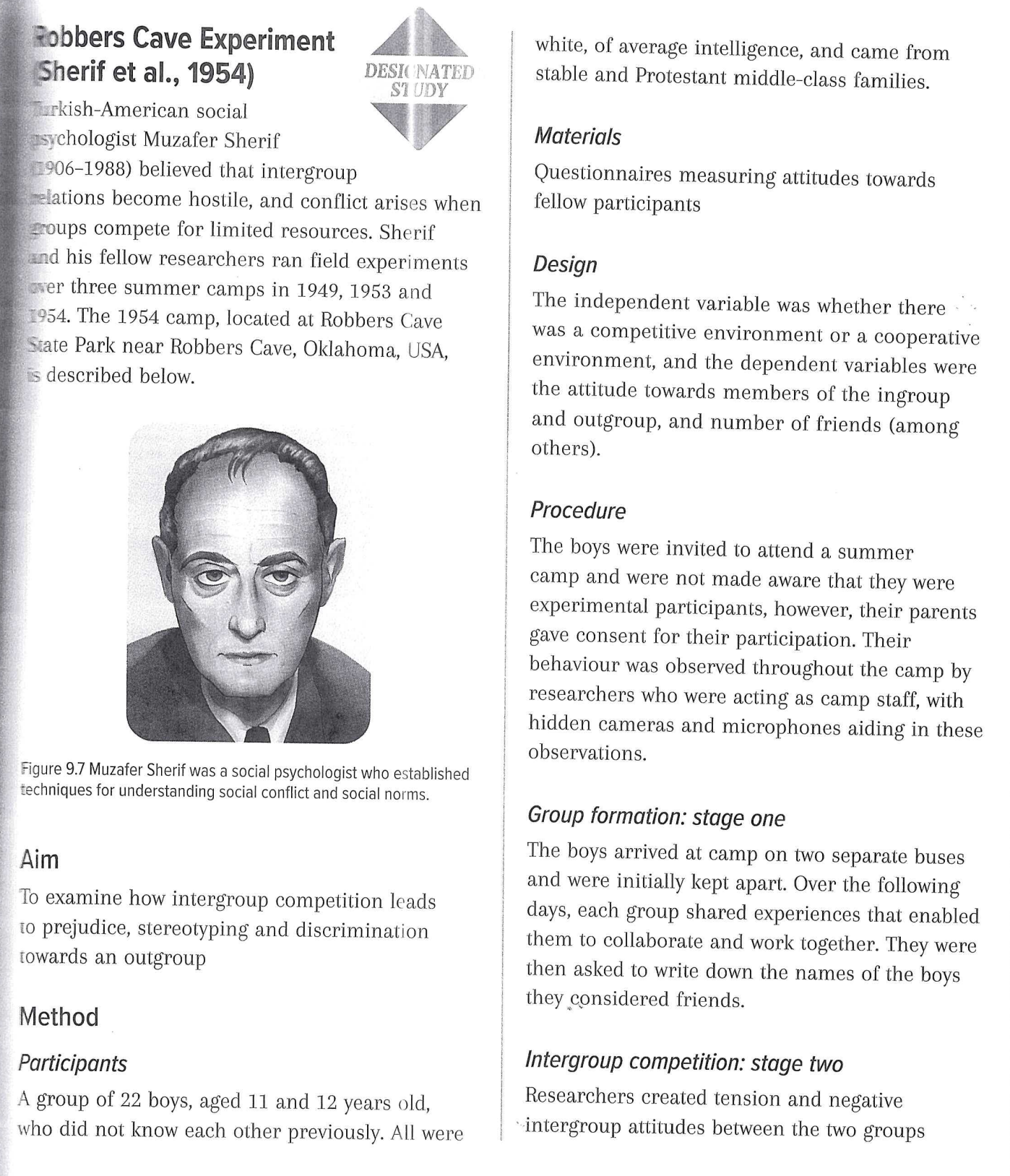
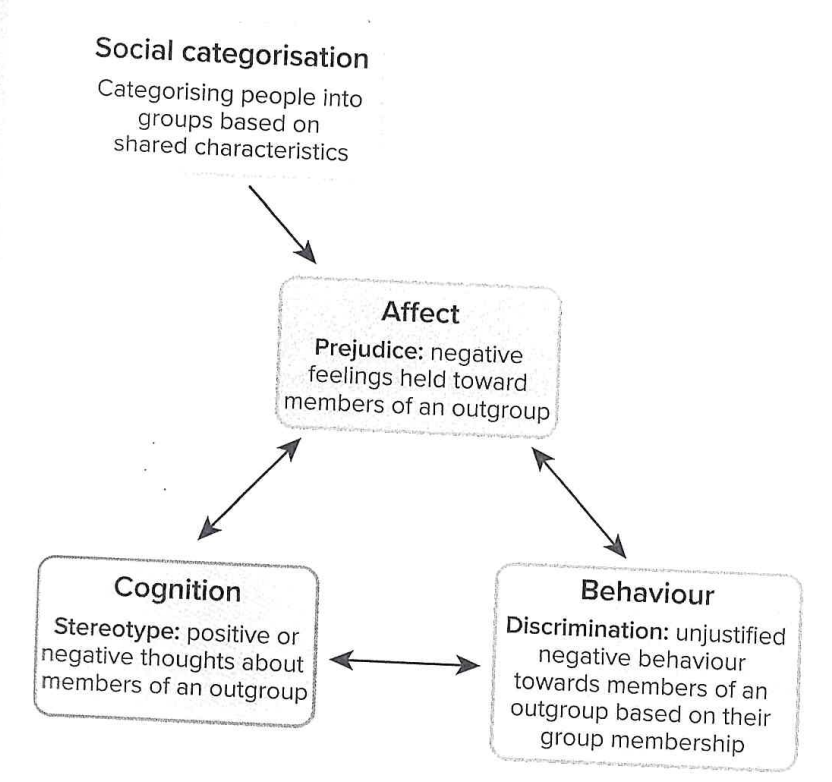
Prejudice is often described as unjustified attitudes towards members of social groups and is made up of the three components of an attitude, however, people mainly focus on the affective component of prejudice.
What can lead to prejudice
Social categorisation can lead to prejudice - negative feelings, such as fear, disgust and discomfort, held towards members of an outgroup (any group an individual does not belong to).
Discrimination
Discrimination refers to unjustified negative behaviours towards members of an outgroup based on their group membership, such as exclusion and violence. Importantly, discrimination involves only actions, not thoughts or feelings. Discrimination involves interactions between the members of groups, this is known as intergroup behaviour, or intergroup relations.
Direct discrimination
Direct discrimination happens when someone is treated unfairly because of a characteristic they have, or are believed to have, and is always intentional.
unjust, negative, or harmful behavior directed toward members of a group because of their membership in that group
Indirect discrimination,
Indirect discrimination, on the other hand, occurs when conditions or regulations that apply to everyone end up
Indirect discrimination is when a rule or requirement that applies to everybody unfairly disadvantages people who possess a characteristic
Gender
Prejudice and discrimination against people based on their gender is called sexism. Historically, women have experienced more sexism than men, due partly to women tending to have lower positions of power than men in employment, business and government sectors, and in society in general.
Disability
Feeling uneasy in the presence of a person with a physical disability is an example of prejudice. An example of discrimination based on disability is an individual being denied access to public transport or a taxi service because they have an assistance dog.
Mental illness
Although attitudes towards physical disabilities have improved over the last two decades, similar progress has not been made regarding mental or psychological illnesses. Many people continue to avoid or fear people with mental health issues due to a lack of education about these conditions. An employer refusing to negotiate reduced work-hours for an individual with a mental illness exemplifies this form of discrimination.
Key words:
Prejudice:
negative feelings held towards members of an outgroup.
a negative attitude or feeling toward a person based on their membership in a group
Discrimination:
unjustified negative behaviours towards members of an outgroup based on their group membership.
Intergroup behaviour:
interactions members from one group have with members of another group. Also known as intergroup relations.
Direct discrimination:
occurs when an individual is treated unfairly because of a characteristic they have or are assumed to have.
Indirect discrimination:
occurs when individuals who have a particular characteristic are unfairly disadvantaged due to conditions or regulations that apply to everyone.
Sexism:
prejudice and discrimination against people based on their gender.
Ageism:
prejudice and discrimination against people based on their age.
Racism:
prejudice and discrimination against people based on their race.
Causes of Prejudice
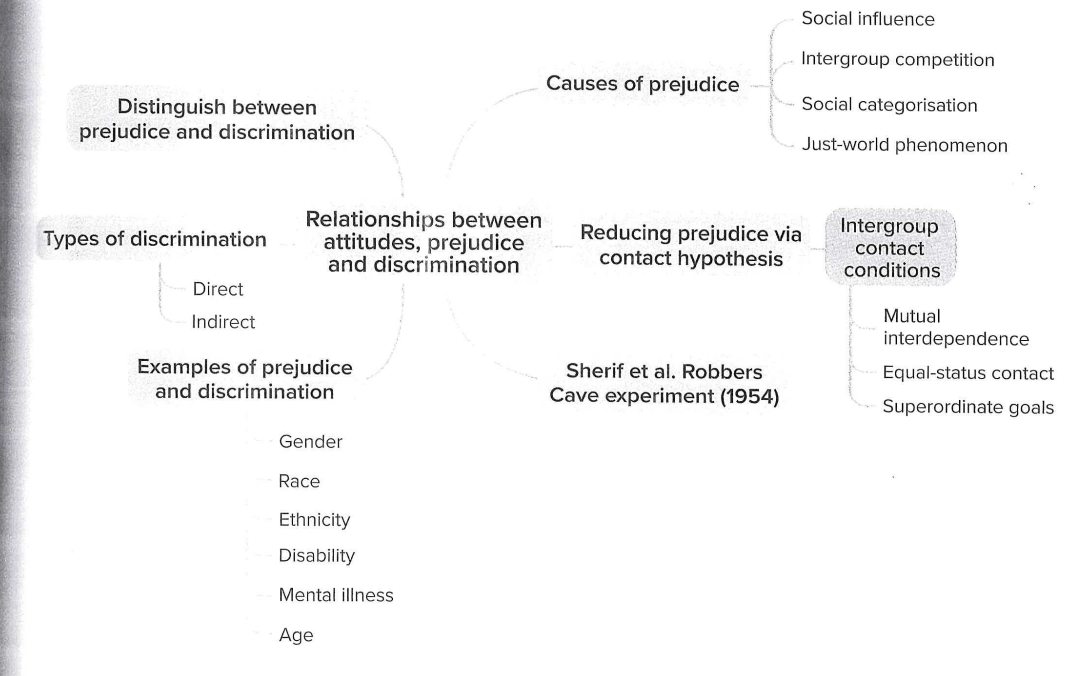
Causes of prejudice include social categorisation, social influence, intergroup competition and the just-world phenomenon. These are all interrelated and often reinforce one another, exacerbating negative attitudes and discriminatory behaviour towards people based on their group membership.
Social influence
Children learn prejudices from their family, teachers, peers and friends. Television, music and movies are examples of mass media that can reinforce the prejudices learned from the people around them.
If an individual aspires to join a social group that accepts prejudices as the social norm, they may feel compelled to conform to these attitudes and develop similar prejudices.
Intergroup competition
Economic competition over access to resources, wealth and jobs can lead to groups purposefully inciting prejudice against outgroups by portraying them as a threat. The chance of prejudice incręases when the competing groups are of relatively equal status. An example of prejudice being caused by intergroup competition is the economic threat a social group feels from new immigrants arriving in a country where there is high competition over access to jobs.
Just-world phenomenon
The just-world phenomenon is an often unconscious cognitive bias whereby individuals assume that everything happens for a reason that the world is just (fair). People make dispositional attributions by blaming victims for the misfortune they are experiencing. For example, that victims of rape are responsible for being assaulted and that people who have HIV or AIDS do not deserve high-quality health care because having the illness is their own fault. Making dispositional attributions for people who have had bad things happen to them may lead to negative emotions felt towards them, thus prejudice is caused.
Reducing Prejudice
Intergroup contact is a strategy for reducing prejudice, defined as the interactions between members of different social groups. interaction among social groups (intergroup contact) can lead to reduced prejudice and negative stereotypes held by members.
Just-world phenomenon:
the assumption that everything happens for a reason and that the world is just (fair).
Intergroup contact:
contact between members of different social groups.
Contact hypothesis:
intergroup contact can reduce prejudice and negative stereotypes held by members.
Mutual interdependence:
groups depend on each other to meet their goals; they have a co-dependent relationship.
Equal-status contact:
members of both groups must have roughly equal power for contact to reduce prejudice and stereotypes.
Superordinate goals:
goals both groups want to achieve, but that can only be achieved if both groups cooperate.