lecture 3
 Call Kai
 Learn
Learn Practice Test
 Spaced Repetition
 Match
Match Flashcards
 Knowt Play
1/15

There's no tags or description
Looks like no tags are added yet.
Name | Mastery | Learn | Test | Matching | Spaced | Call with Kai | Chat |
|---|
No analytics yet
Send a link to your students to track their progress
16 Terms
Proteins
Major agents of biological function
present in all cells
vary enormously in size
have extensive functional diversity
Gene expression
molecular instruments through which genetic information is expressed
more diverse than the set of genes that encode them
Amino acid composition
formed mainly from 20 common amino acids
other amino acids are occasionally found in proteins
Structure
amino acids are covalently linked in a linear sequence
amino acid side chains give proteins distinct chemical properties
Amino acid basics
Most amino acids are chiral
allows stereospecific interactions
R group
gives each amino acid its distinct chemical properties
Nonstandard amino acids
also exist
can have important biological roles
Amino acids as building blocks of proteins
Proteins are linear heteropolymers of α-amino acids
Amino acids are joined by condensation reactions
Amino acids are well suited for many biological functions because they have:
capacity to polymerize
useful acid-base properties
varied physical properties
varied chemical functionality
Shared features of amino acids
Amino acids differ mainly in their R group
α-carbon
tetrahedral
bonded to 4 substituents
Most amino acids have:
acidic carboxyl group
basic amino group
α-hydrogen
unique R group
Exceptions
proline has a modified amino group because its side chain bonds back to the nitrogen
glycine’s R group is H
gives the α-carbon 2 hydrogens
therefore glycine is not chiral
D vs L amino acids
D and L designations are based on the configuration of glyceraldehyde
For amino acids, D and L refer to configuration around the chiral center
They do not indicate the direction the molecule rotates plane-polarized light
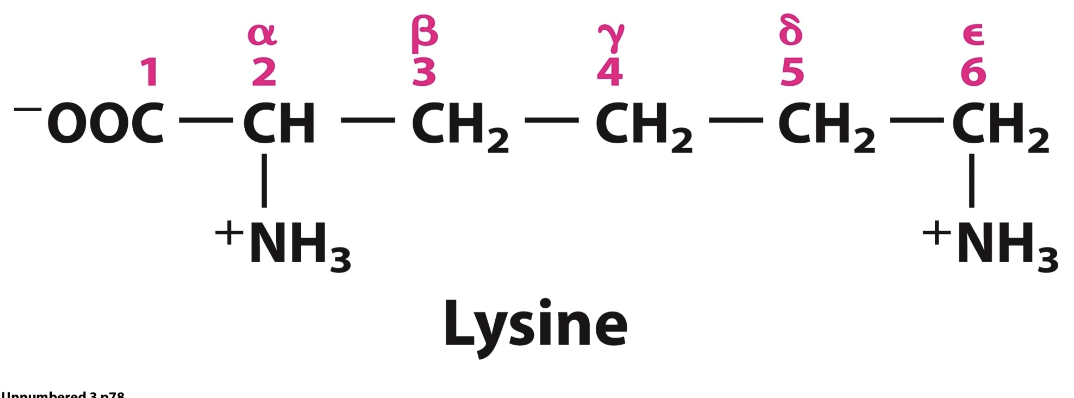
Amino acid atom naming
Biochemical naming starts at the α-carbon and moves outward along the R group
Side-chain carbons are named in order:
α
β
γ
δ
ε
General properties of amino acids
Each free amino acid has at least 2 pKₐ values
one for the α-carboxyl group
one for the α-amino group
Some side chains also contain ionizable groups
gives those amino acids additional pKₐ values
At physiological pH, free amino acids are zwitterionic
amino group is protonated
carboxyl group is deprotonated
allows amino acids to act as both acids and bases
Solubility
most are highly soluble in water
minimally soluble in organic solvents
due to their ionic nature
Nonpolar amino acids
Glycine
Alanine
Proline
Valine
Leucine
Isoleucine
Methionine
General properties
stabilize protein structure through hydrophobic interactions
often located in the protein interior
often among the most conserved amino acids in protein sequences
Structural differences
proline has a rigid structure
glycine has a very flexible structure
glycine and proline are especially often conserved
Aromatic amino acids
Phenylalanine
Tyrosine
Tryptophan
General properties
participate in hydrophobic interactions
absorb UV light around 280 nm
Tyrosine
has a hydroxyl group
can participate in hydrogen bonding
Tryptophan
has fluorescent properties
Polar uncharged amino acids
Serine
Threonine
Cysteine
Asparagine
Glutamine
General properties
often found on protein surfaces
interact with water through hydrogen bonding
Cysteine
readily forms disulfide bonds
two cysteines linked by a disulfide bond form cystine
Positively charged amino acids
Lysine
Arginine
Histidine
General properties
carry significant positive charge at neutral pH
often act as proton donors or acceptors
Histidine
side-chain pKₐ ≈ 6
can readily gain or lose a proton near biological pH
Negatively charged amino acids
Aspartic acid (aspartate)
Glutamic acid (glutamate)
General properties
structurally similar to asparagine (Asn) and glutamine (Gln)
carry significant negative charge at neutral pH
can act as proton donors or acceptors
Modified amino acids found in proteins
Usually not incorporated directly by ribosomes
exception: selenocysteine
Typically arise through post-translational modification of proteins
Reversible modifications
especially phosphorylation
important in regulation and signaling
Amino acids as acids and bases
Amino acids commonly exist in zwitterionic form
Have characteristic titration curves
Isoelectric point, pI
pH at which the amino acid has no net charge
pKₐ values of functional groups
can change depending on the local environment
Some amino acids
carry a net charge at neutral pH
Isoelectric point
Isoelectric point, pI
pH at which a molecule has no net charge
Amino acids without ionizable side chains, such as glycine
only consider the α-amino and α-carboxyl groups
Amino acids with ionizable side chains
first identify the species with net charge = 0
then use the two pKₐ values that surround that neutral species
Formation of peptides
Peptides
small condensation products of amino acids
Peptide bond
covalent
formed by condensation
broken by hydrolysis
Numbering and naming
start at the amino terminus