Proteins pt 1 (ppt 1)
 Call Kai
 Learn
Learn Practice Test
 Spaced Repetition
 Match
Match Flashcards
 Knowt Play
1/11

There's no tags or description
Looks like no tags are added yet.
Name | Mastery | Learn | Test | Matching | Spaced | Call with Kai | Chat |
|---|
No analytics yet
Send a link to your students to track their progress
12 Terms
pKa
indicates strength of the acid
strong acid=low pKa
weak acid= high pKa
pKa=-logKa
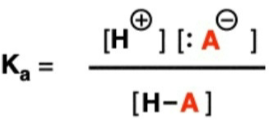
Ka
dissociation constant- determined experimentally
strong acid= large Ka
weak acid=small Ka
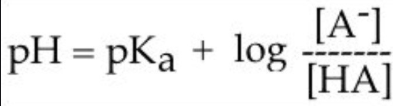
Henderson‑Hasselbalch Relationship
When pH > pKa, the deprotonated form (A⁻) dominates.
When pH < pKa, the protonated form (HA) dominates.
At pH = pKa, concentrations of HA and A⁻ are equal
amino acid
R group varies
amino group= weak base
carboxyl group=weak acid
both can ionize depending on pH
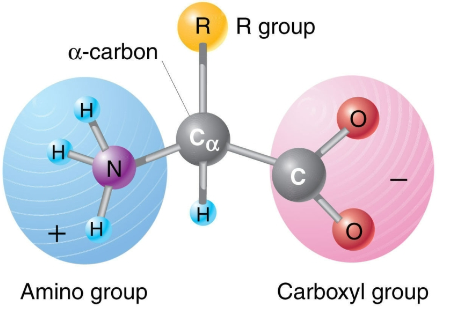
How to find R group?
find a.a
NH3, COO-, H, whatever is attached to this is the R
acidic amino acids
extra -COOH group
deprot.
basic amino acids
N in the R group
prot.
nonpolar amino acids
hydrocarbons (C+H)
polar amino acids
-OH in the R group
how are amino acids linked?
peptide bonds
peptide bonds
N terminal is always the start (a.a)
C terminal is the end (carboxyl)
bond is C-N after C=O
