microbiology test 1 review (9/17/26)
 Call Kai
 Learn
Learn Practice Test
 Spaced Repetition
 Match
Match Flashcards
 Knowt Play
1/70

Earn XP
Description and Tags
only the ones that are yellow/red
Name | Mastery | Learn | Test | Matching | Spaced | Call with Kai | Chat |
|---|
No analytics yet
Send a link to your students to track their progress
71 Terms
algae found in…
algae is known for
algae produces…
water
making their own food with sunlight (photosynthesis)
glucose and oxygen
fungi get their energy how? (different from algae)
they get nutrients by digesting them outside their body and absorbing them
are viruses prokaryotes or eukaryotes?
why?
none
made of no cells
methanogens?
located?
type of archaea that makes methane gas
in places with no oxygen (ex: swamps, sediments, animal intestines)
Robert Hooke?
van Leeuwenhoek?
Robert Hooke observed cells in cork and came up with the term cell
van Leeuwenhoek first observed living microorganisms

Needham?
Spallanzani?
Virchow?
Needham supported spontaneous generation after briefly heating broth and later observing that microoganisms appeared
Spallanzani: challenged spontaneous generation + observed no microbial growth after boiling broth longer and sealing it shut
Virchow supported biogenesis and stated that cells come from preexisting cells
Joseph Lister?
Robert Koch?
used a chemical antiseptic (phenol) to prevent surgical wound infections
linked specific microbes to specific diseases
What was Ehrlich’s “magic bullet”?
Ehrilich is known for developing? (hint: one of the first examples of a chemotherapeutic drug)
“magic bullet”: chemical that targets a pathogen without harming the host.
for developing a synthetic arsenic drug, Salvarsan, to treat syphilis
Name two examples of biotechnology that use recombinant DNA technology and two examples that do not.
Recombinant DNA examples: Human insulin production, Human growth hormone production
Biotechnology that doesn't use recombinant DNA: Yogurt production, Bread production
define resistance?
factors?
Resistance: ability of a microorganism to survive or continue growing despite something that is supposed to kill or stop it.
Resistance factors include skin and antimicrobial chemicals
1 micrometer (μm) is ___ nanometers (nm)?
1 micrometer (μm) = ___ millimeter (mm)?
1000
0.001
Phase-contrast
viewing the internal structure in living cells without staining
Differential interference contrast (DIC):
gives living cells a 3D like appearance + helps see surface details and internal structures
Fluorescence:
identifying specific cells/structures using fluorescent dyes + uses UV (short wavelength) light
Confocal
stained with fluorochrome dyes + short-wavelength light used to excite single plane of specimen + produces detailed 3D images
Two-photon:
2 photons of long-wavelength (red) light used to excite dyes + deeper into living tissues
Scanning acoustic:
examining structures using sound waves
color used for primary stain in gram stain?
cystal violet
Acid-fast stain:
stain for myobacterium and nocardia?
identifies bacteria with waxy mycolic acid in their peptidoglycan cell walls
stained endospores show as?
whats the stain name and what else does the schaeffer-fulton (aka endospore staining method) use?
Stained endospores show as green within red/pink cells
malachite green and heat
The glycocalyx
helps? (3)
is a sticky layer outside the bacterial cell wall
Helps bacteria attach to surfaces, helps prevent phagocytosis, and can help form biofilms
how do bacteria move?
Bacteria with flagella move by rotating their flagella.
Spirochetes move using axial filaments
functions of prokaryotic plasma membrane?
Controls what enters/leaves the cell
Produces energy (ATP)
Contains receptors and enzymes
Which agents can cause injury to the bacterial plasma membrane?
Alcohols
Detergents
Phenols
Some antibiotics
Certain disinfectants
Group translocation:
A substance is chemically changed while being transported into the cell
DNA locations in eukaryotes and prokaryotes?
nucleoid in prokaryotes
nucleus in eukaryotes
Metachromatic granules →
Polysaccharide granules →
Lipid inclusions →
Sulfur granules →
Metachromatic granules → phosphate storage
Polysaccharide granules → store carbon/energy
Lipid inclusions → store lipids/energy
Sulfur granules → store sulfur
how does the flagella move in prokaryotic vs eukaryotic
prokaryotic: rotate like a propeller
eukaryotic: move by bending/whipping
eukaryotic and/or prokaryotic: cilia & microvilli?
cilia vs microvilli?
eukaryotes have cilia and microvilli, prokaryotes dont
cilia = movement, microvilli = increase surface area, which increase absorption)
plasma membrane difference in prokaryotic vs eukaryotic?
Prokaryotic: generally lacks sterols, except organisms such as mycoplasmas (they get sterol from environment and dont have cell wall so need sterols in their cell membrane)
Eukaryotic: typically contains sterols such as cholesterol
eukaryotic ribosome and subunits?
prokaryotic ribosome and subunits?
80S with 60S large subunit and 40s small subunit
70S with 50S large and 30S small
6-1 Classify microbes into five groups on the basis of preferred temperature range
Psychrophile 0–20°C
Psychrotroph 0–35°C
Mesophile 20–45°C
Thermophile 45–80°C
Hyperthermophiles: 80* C+
nitrogen for…
sulfur for…
phosphorus for…
Nitrogen: Proteins and nucleic acids
Sulfur: proteins & certain amino acids (cysteine & methionine)
Phosphorus: DNA, RNA, ATP, phospholipids
aerotolerant anaerobe?
microaerophile?
Aerotolerant anaerobe: doesn't use O₂ but tolerates it
Microaerophile: needs low levels of O₂
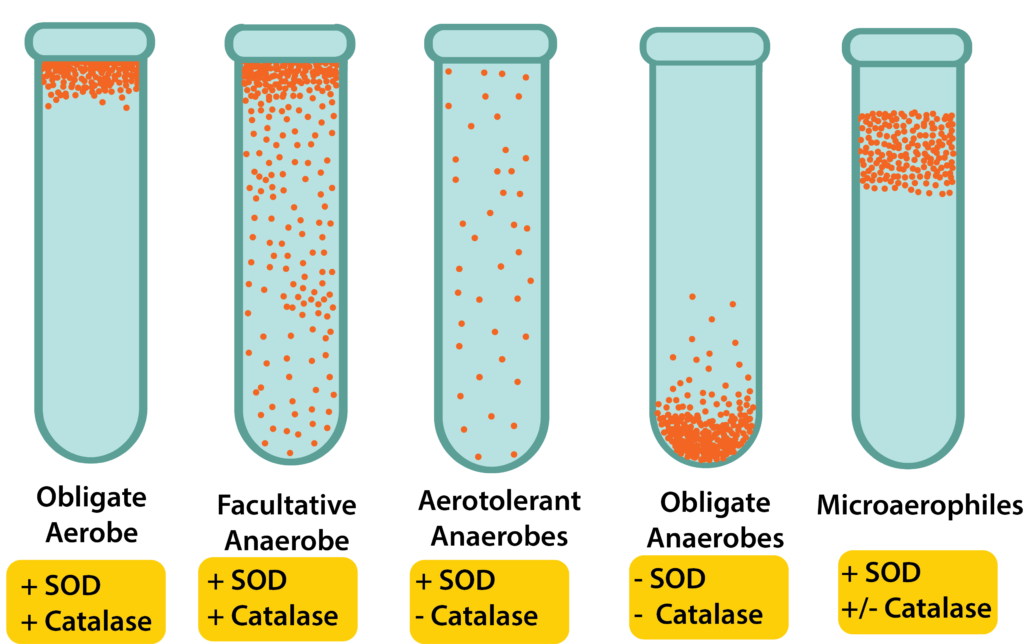
growth pattern for
obligate aerobe?
obligate anaerobe?
facultative anaerobe?
aerotolerant anaerobe?
microaerophile?
obligate aerobe: only at top
obligate anaerobe: only at bottom
facultative anaerobe: everywhere but more on top
aerotolerant anaerobe: evenly throughout
microaerophile: right below the top

6-6 Identify ways in which aerobes avoid damage by toxic forms of oxygen. (hint: these are toxic molecules made from oxygen)
Aerobes protect themselves using enzymes such as:
Superoxide dismutase (Gets rid of superoxide (O₂⁻) & converts superoxide into hydrogen peroxide)
Catalase (Breaks down hydrogen peroxide (H₂O₂) into water + oxygen)
Peroxidase (breaks down hydrogen peroxide using another molecule into harmless products)
Differential media:
Enrichment media:
Differential media: allow you to distinguish microbes based on visible biochemical differences
Enrichment media: encourage growth of a particular desired organism
colony?
visible mass of microorganisms growing on a solid surface, usually originating from one cell or group of cells.
Can you think of any reason why a colony does not grow to an infinite size, or at least fill the confines of the Petri plate?
Nutrients become limited and waste products accumulate
6-12 Describe how pure cultures can be isolated by using the streak plate method.
Streak → spread bacteria out → individual cells → separate colonies → pure culture.
Binary fission:
One bacterial cell copies its DNA and divides into two cells.\
6-16 Explain four direct methods of measuring cell growth
Direct microscopic count
Viable plate count
Membrane filtration
Electronic cell counting
6-18 Explain three indirect methods of measuring cell growth.
Turbidity: more cells → cloudier culture
Metabolic activity: measures products of microbial metabolism
Dry weight: measures the mass of cells after drying
7-1 Define the following key terms related to microbial control: sterilization, disinfection, antisepsis, degerming, sanitization, biocide, germicide, and asepsis.
Sterilization: destroys/removes ALL microbial life, including endospores.
Disinfection: destroys pathogens on nonliving surfaces.
Antisepsis: destroys/inhibits microbes on living tissue.
Degerming: removes microbes from a limited area, usually by mechanical action (scrubbing).
Sanitization: reduces microbes to safe public-health levels.
Biocide: chemical that kills organisms.
Germicide: chemical that kills pathogens/microbes.
Asepsis: preventing contamination by unwanted microbes
7-2 Describe the patterns of microbial death caused by treatments with microbial control agents
Microbial death usually happens at a constant percentage, not a constant number
Describe the effects of microbial control agents on cellular structures.
Cell membrane → damaged → contents leak out → cell dies
Proteins → denatured → enzymes stop working
DNA/RNA → damaged → cell can't reproduce
Cell wall → damaged → cell can burst (lyse)
7-5 Describe how filtration, low temperatures, high pressure, desiccation, and osmotic pressure suppress microbial growth
Filtration → physically removes microbes from liquids or air.
Low temperatures → slow enzyme activity and metabolism, so microbes grow more slowly.
High pressure → damages cellular structures/proteins and inhibits microbial growth.
Desiccation → removes water needed for microbial metabolism and growth.
Osmotic pressure → high salt/sugar causes water to leave microbial cells, inhibiting growth.
7-6 Explain how radiation kills cells.
Radiation can split water molecules and produce hydroxyl radicals (•OH).
What is the connection between the killing effect of radiation and hydroxyl radical forms of oxygen?
These highly reactive molecules damage DNA and other cellular components, causing cell death.
7-8 Interpret the results of use-dilution tests and the disk-diffusion method.
Use-dilution test: Tests how effectively a disinfectant kills microorganisms on contaminated objects.
Disk-diffusion method: Measures how well a chemical inhibits microbial growth by observing a zone of inhibition around a disk.
Which is more likely to be used in a medical clinic laboratory, a use-dilution test or a disk-diffusion test?
Disk-diffusion test bc its commonly used to determine how effective an antimicrobial chemical/drug is by measuring the zone of inhibition
7-9 Identify the methods of action and preferred uses of chemical disinfectants.
Protein denaturation
Membrane disruption
DNA damage
Enzyme inhibition
Oxidation
Why is alcohol effective against some viruses and not others?
Alcohol is effective against viruses with a lipid envelope because it can disrupt the envelope.
➡ Enveloped virus = generally more susceptible (aka easily affected/harm)
➡ Non-enveloped virus = generally more resistant
halogens?
halogens include? what are they most commonly used as?
a group of chemicals used as antimicrobial agents/disinfectants
Halogens:
Iodine: Commonly used as an antiseptic on skin
Chlorine: Commonly used as a disinfectant for water and surfaces
7-11 Identify the appropriate uses for surface-active agents.
Surface-active agents, like soaps and detergents, reduce surface tension and help remove microorganisms from surfaces
7-12 List the advantages of glutaraldehyde over other chemical disinfectants.
Is a high-level disinfectant (Can kill a wide range of microorganisms)
Is effective against endospores with sufficient exposure
Can be used on medical equipment that cannot tolerate high temperatures
What chemical disinfectants can be considered sporicides?
Glutaraldehyde
Hydrogen peroxide at appropriate concentrations
Peracetic acid
What chemicals are used to sterilize?
Ethylene oxide
Glutaraldehyde (also considered a sporicide)
Hydrogen peroxide (also considered a sporicide at appropriate concentrations)
Peracetic acid (also considered a sporicide)
7-14 Explain how the type of microbe affects the control of microbial growth
Endospores → highly resistant
Mycobacteria → relatively resistant
Nonenveloped viruses → relatively resistant
Enveloped viruses → generally less resistant
autoclave is what temp, pressure, and minutes
121 C at 15 psi for 15 mins
membrane filters are physically trap what size microorganism?
microorganisms above the size 0.22 µm
physical methods of microbial control?
low temps like refrigeration, deep-freezing, and lyophilization (freeze dying)
ionizing radiation makes…
which can…
free radicals, which are highly reactive molecules/atoms w/ an unpaired electron
damage DNA, proteins, cell membranes
using heat sterilzation on plastic sleeves/balls can…
melt or deform
many heat-sensitive foods like steak (meat) can be microbial controlled by…
(i mean heat-sensitive as in heat needed for heat sterilization could damage food)
gamma rays (type of ionizating radiation)
test hint from professor:
soap is NOT a….
plasma is the…
main supercritical fluid and used for medical implants?
disinfectant
4th state of matter
carbon dioxide
supercritical fluid?
high pressure + high temp + has liquid-like and gas-ike properties
Pasteurization is the
Pasteruization is not a __ technique
heating a food/liquid for short time to kill/reduce harmful bacteria (wihtout changing food)
sterilization
Why can both Gram-positive and Gram-negative bacteria undergo plasmolysis (cytoplasm shrink) when placed in a hypertonic solution, despite having cell walls?
Gram-positive and Gram-negative cell walls do not prevent water loss in a hypertonic solution
generation time formula?
bacterial growth formula?
total time/generation time = n
final # of cells = starting number of cells x 2n (# of generations)
bacteria load formula?
number of colonies x 1/dilution = bacteria/mL