Final ME3010
 Call Kai
 Learn
Learn Practice Test
 Spaced Repetition
 Match
Match Flashcards
 Knowt Play
1/84

There's no tags or description
Looks like no tags are added yet.
Name | Mastery | Learn | Test | Matching | Spaced | Call with Kai | Chat |
|---|
No analytics yet
Send a link to your students to track their progress
85 Terms
Primary Bonding types
Includes Ionic, Covalent, Metallic
Secondary Bonding Types
Van der waals bonding
Ionic bonding example
ceramics
Covalent bonding example
polymers, diamonds
Metallic bonding example
metals, alloys
Ionic bonding is between
Metals, Nonmetals
Covalent bonding is between
Nonmetals, nonmetals & metalloids
Secondary bonding is between
all atoms
How does ionic bonding happen
Transferring of valence electrons => IONIC
How does metallic bonding happen
Free valence => “Sea” of electronsH
How does Van der Waals bonding happen
Attraction between atomic or molecular dipoles
Ionic bonding characteristics
Hard & Brittle
Electrical & thermal insulators
Metallic bonding characteristics
Good ductility
Good electrical conductivity
Crystalline materials
Repetitive three dimensional pattern over large atomic distance
Noncrystalline materials
Lacking regularity over large atomic distances
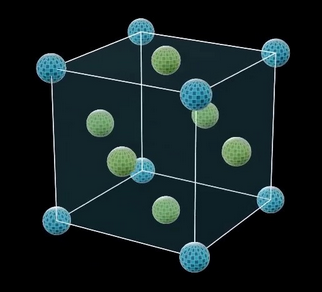
Face Centered Cubic
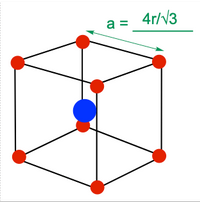
Body Centered Cubic
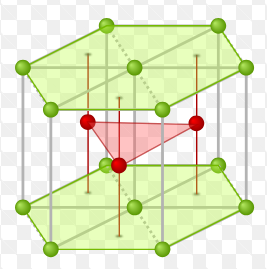
HCP
FCC number of atoms
4
FCC equation
a = 2Rsqrt2
FCC APF
0.74
APF ratio
Vs / Vc
BCC number of atoms
2 atoms
BCC equation
a = 4R / sqrt3
BCC APF
0.68
HCP APF
0.74
Single Crystal materials
Crystalline solid w/ periodic and repeated arrangement w/o interruption
Polycrystalline materials
Composed of more than one crystal or grain. GB is the region where crystals meet
Bonding in ceramics
mostly ionic, some covalent
Crystal structures of Ceramics
Composed of electrically charged ions
Structure of polymers, decreasing strength
Network, Cross-linked, Branched, Linear
Molecular weight
Mass of moles of chain
Polymer chains
many kinks and coils that form naturally
Polymers - two main types
Plastics & rubbers
Plastics
synthetic
molded into shape while soft
set into rigid, slightly elastic form
Thermoplastics
Softens when heated & hardened when cools
Mostly van der waals
ductile, flexible, easy to recycle
Thermoplastics example
polyethylene, nylon
Thermosets/ Thermosetting plastics
Polymers become hard when heated, does not soften upon subsequent healing
mostly covalent
hard, brittle, difficult to recycle
Thermosets/ Thermosetting plastics examples
epoxy, polyurethane
Rubber
Material that may be elastically stretched to at least 2x the original length. It returns after force is removed
Composites
Combination of two or more materials to obtain a new material w/ desirable properties
Composite properties
function of constituents
-relative amounts & geometry of phases
Matrix
Continuous phase of composite
Dispersed
Reinforced phase of composite
Purpose of matrix
Transfers load from fiber-fiber
Protects phases form environment
Purpose of dispersed phase
Primary load carrier'
Enhanced matrix properties
Fiber-reinforced
3 types
continuous and aligned
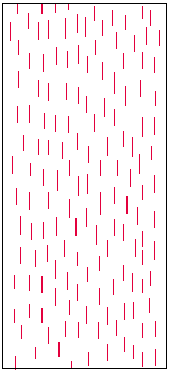
discontinuous and aligned
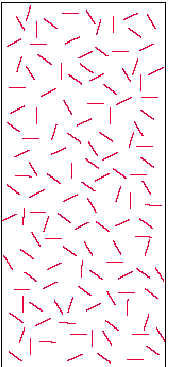
discontinuous and misaligned
Continuous and aligned
long aspect ratio, along the piece
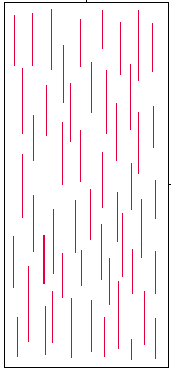
Discontinuous and aligned
short aspect ratio, along the piece
discontinuous and misaligned
Short aspect ratio, random orientation
Example of particle reinforced
Tires.
Matrix: rubber
Particle: Carbon
Example of structural reinforcement
Laminar, sandwich panels
0 - Dimensional defects are also called
Point defects
Types of Point Defects
Vacancies
Interstitial
Substitutional
1 - Dimensional defects are also called
Linear defects
Types of Linear Defects
Dislocations
3 - Dimensional defects are also called
Bulk Defects
Types of Bulk Defects
Pores
Inclusions
Second Phases
Cracks
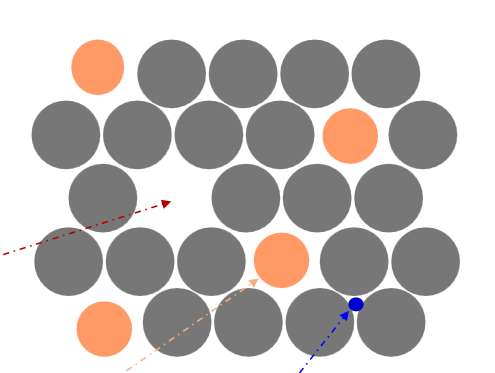
The Red Arrow represents what type of defect
Vacancy
The Blue Arrow represents what type of defect
Interstitial
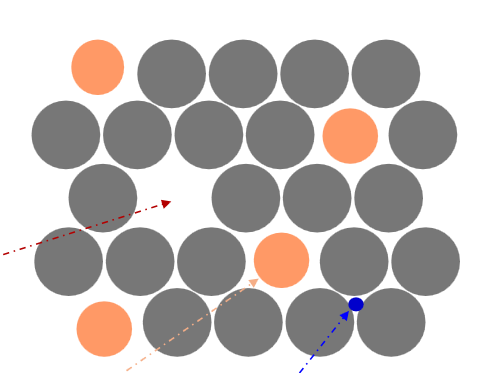
The Orange Arrow represents what type of defect
Substitutional
Vacancy Defect
Vacant lattice sites; absence of an atom
How are alloys created
impurity atoms are added in order to impart desirable characteristics on the materials
Second Phases
impurity atoms added to host
crystal structures change and a new structure is formed
Solid Solutions
In the event of the addition of impurity atoms NOT being added to host, crystal structure is maintained and no new structures are formed.
SolVENT
element present in greatest concentration
soLUTE
presents in the least common concentration
How can you recall Solvent & Solute?
solVENT - VENT = modern → common today
soLUTE - LUTE = olden → not common today
Substitutional Defects
Solute or impurity atoms replace or substitute for host aotmsi
Interstitial Defects
Impurity atoms fill voids(interstitials)
Requirements for interstitial impurity
Atomic diameter of the interstitial impurity is less than host atoms
Dislocations
Introduced during 1-D defects associated with the edge of the an extra half-plane
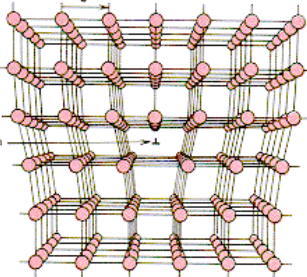
Dislocation movement produces…
plastic deformation
If there is no dislocation movement
no plastic deformation
Grain Boundaries exist iff
Boundary between two grains (polycrstalline)
Needs to have an orientation transition (misorientation)
How do grain boundaries strengthen metals?
The act as barriers to dislocation movement
What is grain boundary energy, what causes it?
Energy stored in boundary due to atomic disorder. Temperature up = less; disorder up = more
Higher chemical reactivity (GB)
allows etchants to reveal microstructure
Impurity segregation (GB)
material properties altered
Grain size
average diameter of grains in polycrystalline material
Bulk defects
larger than atoms :)
Metallographic prep steps
Sample, Mount, grind, Polish, etch, Capture image
Optical microscope use case
crystallographic orientation variation
chemical potential variation
some phases may be revealed by etchant, but not all
SEM use case
useful for analyzing fracture surfaces (recall cup & ball)
may reveal fine microstructural features & second phases
may reveal elemental composition through use of Energy Dispersion Spectroscopy