PRAXIS World Music
 Call Kai
 Learn
Learn Practice Test
 Spaced Repetition
 Match
Match Flashcards
 Knowt Play
1/40

Earn XP
Description and Tags
Name | Mastery | Learn | Test | Matching | Spaced | Call with Kai | Chat |
|---|
No analytics yet
Send a link to your students to track their progress
41 Terms
Latin Jazz
A style of jazz that originated in the late 1940s when musicians merged the rhythms and instruments of Afro-Latin music with American Jazz music. Sub genres include Afro-Cuban Jazz and Afro-Brazilian Jazz.
Griot
An African tribal storyteller and musician is called a griot. The griot's role was to preserve the genealogies and oral traditions of the tribe. They were usually among the oldest men in a tribe.
Guitarrón
This instrument is a large bass guitar. It translates translates to large guitar – the suffix means big or large
German Polkas
German Polkas are commonly performed in beer halls and traditional weddings/celebrations. Polkas are dance songs.
Irish Reels
Irish reels are typically performed in pubs or social gatherings. Reels are lively jigs that are often danced to.
Seneca Rabbit Song
One of first few dances where men could choose a woman partner; occurs twice during a social. Originated with the Seneca People of northern New York.
Chinese Opera vs Japanese Noh Music
Chinese opera is known for its colorful costumes, makeup, and acrobatics, while Japanese Noh features minimalism, masked performances, and spiritual themes. Both reflect their distinct cultural aesthetics and values. Chinese opera features loud percussion and two string fiddles. Japanese Noh music features more vocal music.
Afro-Cuban Jazz
Incorporated Cuban rhythms such as the mambo and habanera with elements of bebop. Bass lines featured distinctive syncopated rhythms such as 2-3 clave or 3-2 clave.
Afro-Brazilian Jazz
Incorporated rhythms of the samba with music of Europe and America. A new style of Samba known as Bossa Nova featured a laid back singing style, increased textural complexity, and a distinctive rhythmic pattern known as the Bossa nova clave.
Blues
Originated through African work songs. The rise occurred around the time of the emancipation of slaves in the US. Elements include call and response, and the unaccompanied voice. Had a standard 12 bar harmonic progression usually centers on a melancholy emotion, moans, growls, and cries.
I-I-I-I-IV-IV-I-I-V-IV-I-I
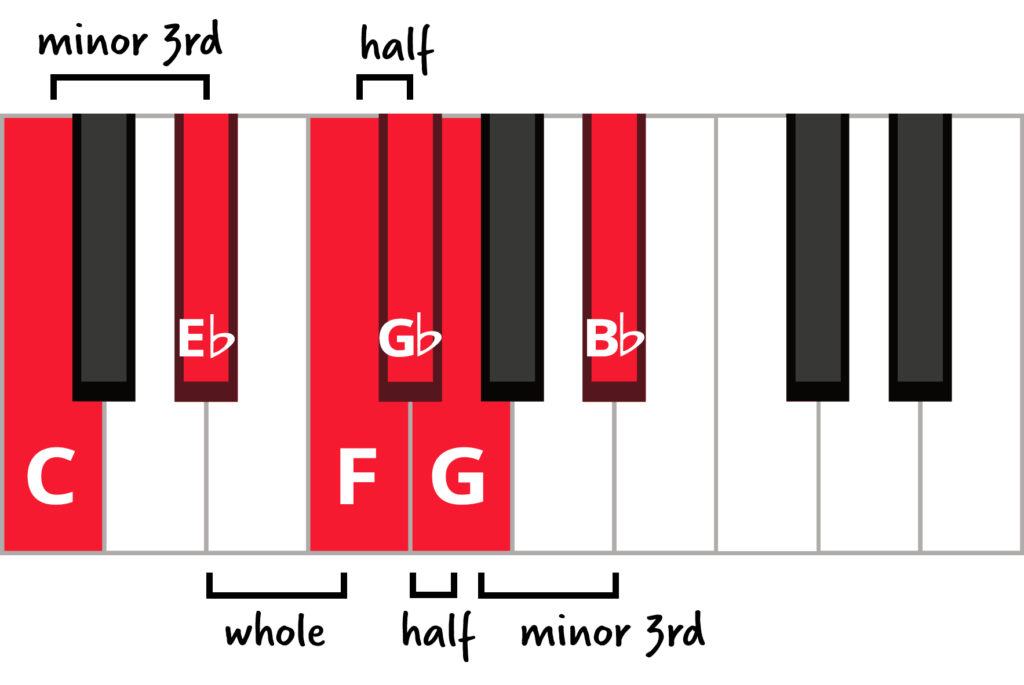
Blues Scale
Features a lowered third, lowered fifth, and dominant seventh called blues notes.
Appalachian Music
Folk tradition of the Eastern US. Heavily influenced by the Irish, Scottish and English emigrants that feature traditions such as English and Scottish ballads, dance tunes, and fiddle songs. African American traditions also contributed in aspects such as the banjo, strong rhythmic drive, harmonic blues notes, and group singing. Features heavily ornamentation, improve, rhythmic and melodic focus, and an upbeat tempo.
Waltz
Originated in Germany/Austria and was prominent in the Romantic era, triple time, 2 or 4 repeated 8 measure sections, emphasis on the downbeat, long complex works, with a fast tempo.
Mazurka
Originated in Mazovia in Poland and was prominent in the Romantic era, triple time, 2 or 4 repeated 8 measure sections, emphasis on beats 2 and 3. No stylistic variations with an intense militant aesthetic.
Arab Culture in North African Music
Jewish and Muslim refugees came to this area and brought traditions that originated in Baghdad. Elements in music include the Quranic chant, poetry/harp/lute playing and instruments such as gimbi, drums, and metal castanets.
West African Musical Traditions
Traditions used in praise singing, various ceremonies, work activities, and national identities. Court musicians continued oral tradition through singing and performing instruments such as lute, long trumpet, fiddle, drum. Talking drum in Ghana, Senegal, and Niger. Music plays an important role in birth, adulthood initiations, marriages and death through singing, drumming and dancing. Musicians can perform special music to induce trance, possession, or direct contact with spirits. Highlife praise singing emerged in Ghana and incorporates guitar playing with traditional Akan music.
Djembe
A rope tuned membranophone dating back to the Mali empire.
Dunun
A double headed membranophone and can be hit with a stick or hand. 3 sizes. Can accompany the djembe.
Traditional African Music
Features call and response form, polyrhythms, syncopation, offbeat phrasing in rhythmic patterns, cyclic form and uses instruments that jingle, buzz, or rattle. Built off the pentatonic scale.
Traditional African Instruments
Mbira, dagbamba, xylophones, lutes, and harps that have been manipulated to buzz, jingle, or rattle.
Kabuki
Japanese theater form stemming from thee do period of the 1600s where performers where Kesho (makeup). The three types include; jidai-mono=historical plays, sewa-mono=domestic theater plays, shosagato=dance pieces.
Kabuki Form
Mastered
Kabuki Form
Four parts
1. Deha: introduce the mood & characters (ohi & michiyuki)
2. Dhuha: build the plot emotionally and climatically (Kudoki & monogatari)
3. Odoriji: dance component
4. Iriha: musical finale and end of the plot (chirashi and dangire)
Maqam System
Used in Middle Eastern music and most resembles the western mode but is distinctively confined to the lower tetra chord. There are more than 30 maqamat. They define melodic contour, pitches, and hierarchal development of the scale. Fifth notes are tuned based on the third harmonic.
Middle Eastern melodic organization
Scalar intervals may include approximations of quartertones, semitones, and microtones. Musicians freely improvise over a single maqam but can modulate to others. Music of the region is mostly melodic and rarely harmonic.
Traditional Chinese instruments
Pipa= pear shaped lute
Erhu= traditional Chinese lute
Yangqin= trapezoidal, hammered dulcimer
Dizi= transverse flue
Australian Aboriginal Instruments
Didgeridoo= wooden tube flared at the end
Bull-roarer= a simple wooden slat connected to the end of a length of chord
Gum leaf= the leaf of a eucalyptus tree held against the lip as a simple wind valve for the mouth
Music in Australian Aboriginal Culture
Storytelling, preserving history, and leading ceremonies. Strong oral tradition. Music from a spiritual realm. Sing and dance during everyday tasks.
Polynesian nose flute
Important throughout the Pacific (except Australia and New Zealand). Commonly made of bamboo, played through a single nostril. Played an important role in musical traditions such as courtship and lovemaking.
Indian Music Overview
NO harmony, just melody and rhythm. Highly improvise and is rarely written down. Melodic instrument and drum. Simple melodies and complex rhythms. Polyrhythmic. Northern India-Hindustani and Southern India-Carnative. Improvised. Pentatonic scale.
Raga
In Indian classical music, a complete and self-contained melodic system that serves as the basis for all the melodic materials in any composition or performance created in that raga. Scales or melody
Indonesian Music
Focused on percussion. Played from memory. Kendang drummer guides the pulse and changes the piece. Gamelan orchestra. Everything usually played in unison with no harmony.
Caribbean Music
Music influenced by African and European culture, highly call and response. Syncopated rhythms, heavy drumming, based on a specific key, lush harmony, guitar adapted from European culture. Calypso music.
Origins of Jazz
A style of music originating in 20th century NOLA which combined elements of Euro-American and African music. Developed in urban areas. Starting in NOLA and then moving to Chicago, then NY. Improvisational, expressive, and characterized by syncopated rhythms, "blue notes", and the use of 7th and 9th chords.
Rap
Rapping is an artistic form of vocal delivery and emotive expression that incorporates "rhyme, rhythmic speech, and [commonly] street vernacular". It is usually performed over a backing beat or musical accompaniment. The components of rap include "content", "flow", and "delivery".
R&B
American pop that became big in the late 1940s. Played by an ensemble, generally with a lead vocalist or instrumentalist, a rhythm section, ensemble of voices/winds/guitar. Most R&B is vocal in quadruple time, major, with blue notes.
Motown
Emerged from Detroit in 1960s. "Motown Sound" was a mixture of several popular musical styles and can be considered a form of soul. Short for Motor City Detroit.
Dixieland Music
(1920-1930) New Orleans and Chicago- Louis Armstrong, Jelly Roll Morton (piano), Sydney Bechet (sax/clarinet)
Dixieland music is often referred to as "Traditional jazz", and its style is a precursor to the most recognizable parts of modern jazz. Dixieland jazz had unique instrumentation (trumpets and brass, clarinet, trombone, and rhythm sections including tuba, drums, and piano)
Swing/Big Band
(1930-1945) Duke Ellington, Count Bassie, Coleman Hawkins, Roy Eldridge, Lester Young (ten. sax)
Swing music is made up of several instruments and vocalists. Instruments are categorized as rhythmic instruments or horn instruments. Pianos, drums, clarinets, saxophones, trumpets, and trombones are instruments common to swing bands.
Bebop
(1945-1950) Charlie "Bird" Parker (sax), Dizzy Gillespie, Thelonious Monk and Dexter Gordon, John Coltrane towards the end of the bebop era. very fast or slow tempos with improvised lines of eighth notes. Irregular accents and extended harmony. Often ends with a 2 note figure that sounds like "be-bop".
Gospel Music
The creation, performance, significance, and even the definition of gospel music varies according to culture and social context. Gospel music is composed and performed for many purposes, including aesthetic pleasure, religious or ceremonial purposes, and as an entertainment product for the marketplace
Brazilian Music
Traditional Brazilian Music encompasses a rich tapestry of rhythms, melodies, and styles that reflect the diverse cultural heritage of Brazil. Influenced by indigenous, African, and European traditions, Brazilian music is characterized by its vibrant rhythms, lush harmonies, and lyrical storytelling. Genres such as samba, bossa nova, and choro are celebrated worldwide for their infectious energy and emotional depth. Instruments like the pandeiro, berimbau, and cuíca contribute to the distinct sound of Brazilian music, while artists like João Gilberto, Elis Regina, and Pixinguinha have left an indelible mark on its legacy. From the streets of Rio de Janeiro to the shores of Bahia, traditional Brazilian music continues to captivate audiences with its soulful melodies and irresistible rhythms.