A&P Skeletal and Muscular Systems
 Call Kai
 Learn
Learn Practice Test
 Spaced Repetition
 Match
Match Flashcards
 Knowt Play
1/164

There's no tags or description
Looks like no tags are added yet.
Name | Mastery | Learn | Test | Matching | Spaced | Call with Kai | Chat |
|---|
No analytics yet
Send a link to your students to track their progress
165 Terms
Bone is a type of _____________________ tissue – defined as living cells in a non-living matrix.
Connective
The ______________ cell is a stem cell. When it divides, one cell remains a stem cell and the other becomes a _______________________, which will secrete bone matrix.
osteogenic / osteoblast
Bone matrix is made of __________________ which is the organic part of bone matrix and consists largely of __________________ and _______________________.
osteoid / collagen / ground substance
: About 65% of bone matrix is comprise of hard mineral salt called ________________________.
hydroxyapatite
: Osteoblast mature into cells called _________________________ that reside in small cavities of compact bone called ____________________ which lie between layers of compact bone.
osteocytes / lacunae
: The layers are concentric rings called _____________________________. Tiny canals run through the layers allowing these cell to communicate with each other.
lamellae
: These tiny canals are called _________________________. The function of these mature cells is to monitor the bone and alert the body when changes in bone occur.
canaliculi
: The functional unit of compact bone is called the _________________.
osteon
: These structures are long and cylindrical with a tunnel running through the middle of them called the _________________________ __________________. Blood vessels and nerves travel through this to bring nutrients and innervation to the bone.
Haversian canal (Note: also referred to as a central canal)
True or false: Compact bone is very hard and lines the outer surfaces of bones.
True
: A different kind of bone is found in the interior of long bones in an open space called the _______________________________ and is a porous bone (called _________________ bone ) which is also found in the ends of long bones called ______________________________.
medullary cavity / spongy / epiphyses
: A type of tissue called ________________________ is found in this type of bone and is where all the cells of the blood are made.
bone marrow
: The shaft of a long bone is called the _________________________.
Diaphysis
: The outside of the bone is covered with a strong connective tissue called ________________________ which is where tendons of muscles attach to bones. This tissue does not cover the articular surfaces of bones.
periosteum
: Instead, all articular surfaces are covered by ___________________ cartilage, which is the most abundant type of cartilage in the body.
hyaline
: This process of breakdown and rebuilding is called bone , which consists of making bone ( ) and breaking down bone (_______________).
remodeling / bone deposition / bone resorption
: Bone is made by osteoblasts and broken down by _______________________.
osteoclasts
: When blood calcium is too low, the ___________________ gland releases a hormone called ________________________ to stimulate bone breakdown and make free calcium available to the blood.
parathyroid / PTH
: When blood calcium is too high, _____________________ cells the thyroid gland release the hormone _________________________ which causes the excessive blood calcium to be taken up by the bone and made into new bone.
parafollicular / calcitonin
: Linear growth of long bones (increase in height) occurs at the ______________________________ which consists of hyaline cartilage.
epiphyseal plate
: After adult height is reached, the hyaline cartilage is totally replaced with bone (ossification) and what remains is called the ____________________________.
epiphyseal line
: A pituitary gland tumor which secretes growth hormone before adult height is reached may cause abnormally large height called __________________________.
gigantism
: If such a tumor forms after maturing, bone growth would result in abnormally widening of bones in a condition called ________________________________.
acromegaly
: The skeleton has two divisions: the _______________ skeleton that includes the skull which consists of ________ number of bones that form a protective bony cage for the brain and the _____________ bones which number 14 as well as the spinal or vertebral column and the ribs and sternum.
axial / 8 / facial (Note: 8 cranial bones form the protective bony cage for the brain)
: The thoracic vertebrae, ribs and sternum together form the __________________ that protects the heart and lungs.
bony thorax
: The ___________ bone forms the forehead. The left and right ____________________ bones make up most of the top and sides of the head.
frontal / parietal
: The _________________ bones contain the external auditory meatus and form the only movable joint in the skull with the __________________ bone which holds the lower teeth.
temporal / mandible
: Sinuses, air-filled, lined with mucosal membranes which warm and moisten air inhaled through the nose are found in four facial bones, which are the _______________, ________________, ___________________ and __________________ bones.
frontal / ethmoid / maxillary / sphenoid
: Bones which help make up the nasal septum are the ___________________ and __________________________ bones along with a contribution from cartilage.
ethmoid / vomer
: The hard palate of the mouth is made up of the maxillary and ___________________ bones.
palatine
: The parietal bones are joined to each other at the ____________________________________.
sagittal suture
: The parietal bones join the most posterior cranial bone, the _____________________ at the lambdoid suture, and the parietal bones connect with the temporal bones at the ___________________ suture and the frontal bone at the _________________________ suture.
occipital / squamous / coronal suture
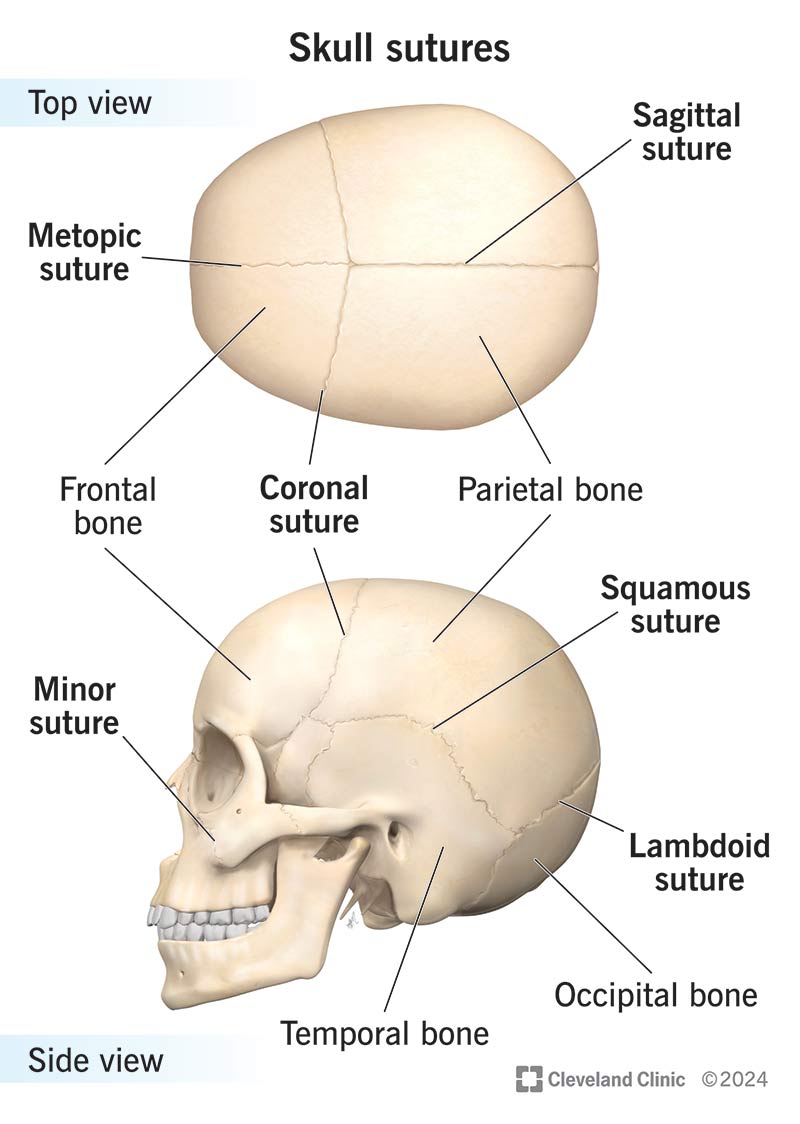
: What we commonly called cheekbones are the __________________________ bones. The bridge of the nose is formed by _________________ bones.
Zygomatic / nasal
: The smallest bone in the skull is the _________________ bones.
Lacrimal
: The sphenoid bone also called the ‘keystone’ bone contains a bony cavity called the ______________________ in which the pituitary gland sits.
sella turcica
: The __________________ bone, which is not a part of the skull is the only bone in the body that does not articulate with (form a joint with) any other bone in the body.
hyoid
: The vertebral column (spinal column) consists of ______________ vertebrae that form a bony tunnel for the spinal cord which exits from the brainstem through a large hole in the occipital bone called the ________________________.
26 / foramen magnum (Note: counting 24 individual vertebrae + 1 sacrum + 1 coccyx)
: The occipital bone articulates with cervical vertebra number one, which is also called the ________________.
atlas
: It articulates inferiorly with cervical vertebra 2 also called the _____________. There are ____________ (#) of cervical vertebrae.
axis / 7
: There are ______________(#) of thoracic vertebrae and _______________(#) of lumbar vertebrae.
12 / 5
: The vertebra to which the lower limb girdle bones attach is the _________________ and it lies just superior to the _____________, the last of the vertebrae.
sacrum / coccyx
: The bony thorax is formed by the thoracic vertebrae, 12 pairs of ribs and the _________________, which consists of 3 sections (from top to bottom) which are the ______________, _________________ and __________________.
sternum / manubrium / body / xiphoid process
: The limbs (arms and legs) and girdle bones make up the _______________________ skeleton.
appendicular
: The girdle bones that hold the upper limbs to the axial skeleton are the _______________________ and ___________________ bones.
clavicle / scapula (or pectoral girdle)
: The only joint that actually connects the upper limbs to axial skeleton is the ____________________________ joint. The shoulder girdle is also called the _________________ girdle. The head of the ____________________ forms the shoulder joint with the scapula at the ________________________.
sternoclavicular joint / pectoral / humerus / glenoid cavity (fossa)
: Distally, the humerus articulates with the lateral forearm bone, the __________________ at the ___________________ and the medial forearm bone, the ______________ at the _________________ to form the elbow joint.
radius / capitulum / ulna / trochlea
: The wrist joint is formed by wrist bones called the _________________ and the two forearm bones.
carpals
: The bones of the palm of the hand are the ______________________, of which there are five.
metacarpals
: The digits of the hand (fingers) are comprised of bones called __________________- of which there are a total of _______ in each hand. All fingers except number one which is the _________________ have 3 phalanges.
phalanges / 14 / thumb
: The lower limbs (legs) are attached to the axial skeleton by way of the pelvic girdle bones which are the ____________ bones. These bones are fused and have three areas which are the ____________, ___________ and ______________.
coxal / ilium / ischium / pubis
: They attach to the spinal column at the ________________________ joint. Anteriorly they connect to each other at a joint called the __________________.
sacroiliac / pubic symphysis
: The hip joint is formed by the ___________________________ (a deep fossa) of the hip bones and the head of the _______________________, which is the largest bone in the body.
acetabulum / femur
: Distally this bone forms the knee joint with the medial bone of the lower leg, the __________________, and a small sesamoid bone called the ___________________. The lateral bone of the lower leg is the _________________.
tibia / patella / fibula
: The bones of the lower leg form the _____________ joint with the ________________ (specific name) which sits atop the ______________________ (also called the heel bone).
ankle / talus / calcaneus
: The tarsals articulate with the bones that make up the top and sole of the foot and are called _____________________.
metatarsals Articulations (Joints)
: Articulations are where bones come together. They are classified by structure and function. (Concept Review)
Structure = anatomy (built of), Function = physiology (movement allowed).
: Structurally, there are three classes of joints: ____________________, ____________________ and __________________.
fibrous / cartilaginous / synovial
: Functionally, there are three types of joints: ___________________________, ________________________ and ____________________.
synarthroses / amphiarthroses / diarthroses
: Fibrous joints found only in the skull which allow no movement are called __________________.
sutures
: The only movable joint in the skull is the ___________________________________ joint.
temporomandibular
: Two examples of amphiarthrotic cartilaginous joints are the _______________________________ and pubic symphysis.
intervertebral disc joints
: A special type of fibrous joint that holds teeth in their sockets is called a _____________.
gomphosis
: Most fibrous joints are totally immovable, but the textbook gives you an example of a slightly movable fibrous joint which is the _______________________________ joint.
distal tibiofibular
: Synovial joints have a joint cavity lined with a serous membrane that secretes a viscous fluid called ____________________________ which reduces friction.
synovial fluid
: All synovial joints are lined with hyaline cartilage which is also known as ______________________ cartilage.
articular
: In addition, there are strong fibrous C-shaped cartilage in the knee called _______________________.
menisci
: The most movable joint in the body is the ________________. Examples of hinge joints include: the __________________, ________________ and ________________________________.
hip / elbow / knee / interphalangeal (Note: Shoulder could also be the most movable, but matching answers fit hip/elbow/knee/interphalangeal here)
: The proximal radioulnar joint which allows you to supinate your hand is a ________________ type of synovial joint.
pivot
: The MCP joint (metacarpal/phalangeal joint) is an example of a ____________________ type of synovial joint.
condyloid
: The proximal phalange of the thumb forms a _________________ joint with the first metacarpal.
saddle
: The bones of the wrist form __________________-types of synovial joints. Ball and socket joints include the shoulder and the _________________.
gliding (plane) / hip
: The decrease in the angle of a joint is called _____________________;
flexion
: the increase in the angle of a joint is called __________________________.
extension
: Turning the hand palm up is ____________________, while turning the hand palm downward is _________________________.
supination / pronation
: Pulling the foot with toes upward is called ________________________________ while pointing the toes downward is called __________________________.
dorsiflexion / plantar flexion
: Connective tissue sheath surrounding individual muscle fibers.
endomysium
Bundle of muscle cells surrounded by a perimysium.
Fascicle
: Connective tissue covering the exterior of a muscle organ.
: epimysium
Connective tissue surrounding muscle fiber bundles.
perimysium
: Individual muscle fiber.
muscle fiber (myofiber)
: Sarcomere Structure: I band.
Only thin filaments are found here.
: Sarcomere Structure: H zone.
Only thick filaments are found here.
: Sarcomere Structure: A band.
Overlapping thick and thin filaments are found here.
: Sarcomere Structure: Z disc.
Defines the boundaries of a single sarcomere.
: Sarcomere Structure: M line.
Anchors myosin filaments centrally.
: _________________________ is the connective tissue membrane surrounding the entire muscle.
epimysium
: ________________________ is the sheath surrounding the individual muscle fiber.
endomysium
: _______________________ is the muscle cell membrane.
sarcolemma
: _______________________ is defined as the portion of a myofibril that runs from Z to Z lines.
sarcomere
: _______________________ is the midline of the H Zone.
M line
: True or False: The H band gets bigger when muscles contract.
FALSE (It shortens/disappears)
: True or False: Myosin heads interact with actin during muscle relaxation.
FALSE (They interact during contraction/crossbridge cycle)
: True or False: A fascicle is a bundle of sarcomeres.
FALSE (A fascicle is a bundle of muscle fibers)
: True or False: Elasticity is the same thing as extensibility.
FALSE (Extensibility is the ability to stretch; elasticity is the ability to recoil)
: True or False: Muscle contraction begins at the fascicle.
FALSE (Contraction kinetics begin at the molecular/sarcomere level)
: Invaginations of the sarcolemma penetrating deep into the interior of the muscle cell.
: T tubule
: The space between the axon terminal and the motor end plate.
synaptic cleft
: The swollen distal end of the motor neuron axon.
axon terminal
: The muscle cell membrane.
sarcolemma
: Structures within the axon terminal that contain the neurotransmitter acetylcholine.
synaptic vesicles