Blood Component Preparation and Storage
 Call Kai
 Learn
Learn Practice Test
 Spaced Repetition
 Match
Match Flashcards
 Knowt Play
1/76

There's no tags or description
Looks like no tags are added yet.
Name | Mastery | Learn | Test | Matching | Spaced | Call with Kai |
|---|
No analytics yet
Send a link to your students to track their progress
77 Terms
what are the phases of blood component preparation and the steps involved in each?
donor blood testing - T&S and Infectious Disease Screen
component preparation - creating components and preparing them for storage, appropriate labeling, and assessing stability
FDA requires that at least ___% of transfused cells survive 24 hrs post transfusion
75%
storage lesions refer to …?
changes in red cells during storage
how does polyvinylchloride (PVC) plastic help improve blood component storage conditions?
PVC contains plasticizers that leach into blood components and have been shown to stabilize the RBC membrane
how does citric acid/citrate help improve blood component storage conditions?
an anticoagulant that slows the breakdown of glucose during cell metabolism
how does dextrose help improve blood component storage conditions?
provides a source of sugar to feed RBC metabolism
how does monobasic sodium phosphate help improve blood component storage conditions?
acts as a buffer to maintain physiologic pH
how does adenine help improve blood component storage conditions?
helps sustain ATP levels
what are some changes that can happen to donated blood during storage
increased free Hgb and potassium
decreased viable cells, plasma pH, plasma sodium, RBC ATP, and RBC 2,3 DPG
during the storage of donated blood, ATP within the RBC decreases due to
metabolism
adenine is a useful donor blood preservative because it
acts as a substrate for ATP generation
the addition of CPDA-1 provides blood components with a shelf life of ___ days
35
the addition of CPD & CP2D provides blood components with a shelf life of ___ days
21
the addition of AS-1, AS-3, and AS-7 provides blood components with a shelf life of ___ days
42
blood drawn directly into CPDA-1 has a storage/shelf life of
35 days
describe the process of manufacturing pRBCs, FFP, PLTs, and CRYO from a donated whole blood unit
whole blood w/ satellite bags attached are centrifuged in a light spin
platelet-rich plasma is separated off the RBCs in a separate bag
additive solution is added to pRBCs and they are now sealed off
PLT rich plasma is centrifuged, and plasma is separated off the PLTs
PLTs are sealed in their own bag
plasma can either be frozen to make FFP OR frozen and thawed to make CRYO/CRYO poor plasma
***you can’t make FFP and cryo from the same unit***
PRP is separated into ____ & ____
Platelets and plasma
light spin is used to
separate plasma from pRBCs
heavy spin is used to
separate plasma from PLT
what components are in whole blood
RBCs, plasma, leukocytes, and PLTs
what temperature is whole blood stored at
1-6 degrees Celsius
what temperature is whole blood transported at
1-10 degrees Celsius
whole blood is not used often, but may be used for
autologous donations (blood from oneself, typically used before surgery)
what components are in pRBCs
RBCs, leukocytes, and PLTs
what temperature are pRBCs stored at
1-6 degrees Celsius
what temperature are pRBCs transported at
1-10 degrees Celsius
what are the QC requirements for pRBCs
HCT should be 60-80%
what components are in PLT concentrates
PLTs, some RBC`
what temperature are PLTs stored at
20-24 degrees Celsius with constant agitation
what temperature are PLTs transported at
20-24 degrees Celsius
what are the QC requirements for PLTs
PLT count and pH
PLT products for transfusion are stored
at room temp. with constant agitation
what are the components in FFP
plasma, coag factors
what temperature is FFP stored at
< -18 degrees Celsius
if thawed then 2-6 degrees Celsius
what temperature is FFP transported at
< -18 degrees Celsius with dry ice
FFP has a shelf life of
5 days after thawing (kept at 2-6 degrees Celsius)
12 months (kept at -18 degrees Celsius in freezer)
7 years if kept at -65 degrees Celsius
what are the components of cryo
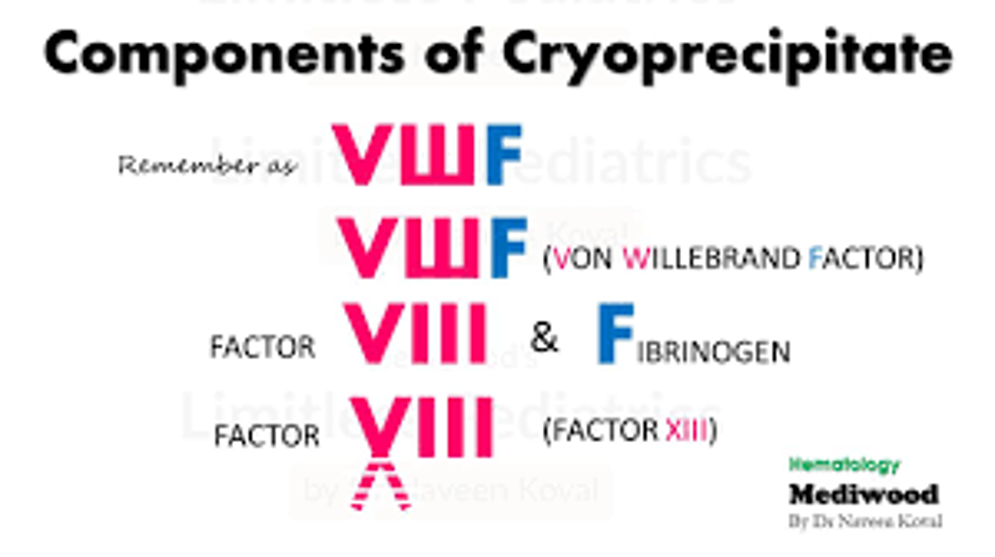
fibrinogen, factor VIII, Factor XIII, vWF, and plasma
what temperature is cryo stored at
< -18 degrees Celsius
if thawed, 20-24 degrees Celsius
what temperature is cryo transported at
< -18 degrees Celsius using dry ice
what is the shelf life of cryo
12 months if frozen
6 hours if thawed
cryo contains fibrinogen, factor VIII, vWF, and
factor XIII
what temperature are RBCs with additive solution stored at and how long is their shelf life?
1-6 degrees Celsius
42 days
what temperature are washed or deglycerolized RBCs (open system) stored at and how long is their shelf life?
1-6 degrees Celsius
24 hours once system becomes open
what temperature are irradiated RBCs stored at and how long is their shelf life?
1-6 degrees Celsius
28 days after irradiation or original outdate
what temperature are frozen RBCs stored at and how long is their shelf life?
< -65 degrees Celsius
up to 10 years
what is the difference between PF24 and FFP
`PF24 is plasma that was frozen within 24 hrs instead of 8 and is only good for 1 year
what temperature is PF24 stored at and how long is its shelf life
< -18 degrees Celsius
1 year
what temperature is FFP stored at and how long is its shelf life
< -18 or < -65 degrees Celsius
1 year if -18; 7 years if -65
what temperature is cryo stored at and how long is its shelf life
< - 18 degrees celsius
1 year
what temperature is thawed PF24 stored at and how long is its shelf life
1-6 degrees celsius
24 hours
what temperature is thawed FFP stored at and how long is its shelf life
1-6 degrees Celsius
24 hours
what temperature is thawed cryo stored at and how long is its shelf life
20-24 degrees celsius
4-6 hours
what temperature are PLTs stored at and how long is its shelf life
if closed system or obtained from leukopheresis, store at 20-24 degrees Celsius & shelf life is 5 days
if open system, store at 20-24 degrees Celsius & shelf life is 4 hours
how are pRBCs changed when they are leukoreduced
85% of RBCs are retained but WBC are reduced to < 5 × 10⁶/unit
to make an RBC aliquot, the unit used must be …?
collected in a special bag with chambers
when are RBC aliquots typically used
for neonates (4 months and younger)
***must be used within 24 hours and stored at 1-6 degrees Celsius
how are washed RBCs made & why would you wash them
wash the RBCs with 1-2L of normal saline to help remove plasma proteins and lyres
what happens to pRBC shelf life after they’re washed
shelf life changes to 24 hrs
the PIPA solution is used to
rejuvenate pRBCs; can extend expiration date by 3 days
glyceration/freezing of RBC units is done to
store units with rare phenotypes for long periods
what is added as a cryoprotective to RBCs before freezing?
glycerol
after frozen RBCs are thawed, how long is their shelf life?
24 hours if stored at 1-6 degrees Celsius
why would RBCs be irradiated
to prevent GVHD (graft vs host disease)
what is the shelf life of irradiated pRBCs
28 days
plasma cryoprecipitate reduced (CPP) contains
Factor II, V, VII, X, XI, ADAMST13
CPP does not contain
Factor VIII, fibrinogen, factor XIII, vWF, cryoglobulin, and fibronectin
what are required components for ISBT blood unit labeling
blood supplier, component description, and ABO/Rh type
Once fresh frozen plasma is thawed, how long can it be stored in a refrigerator and still be considered thawed fresh frozen plasma and be relabeled as thawed plasma?
24 hrs
Which statement about the blood storage lesion is FALSE
All the changes are irreversible
Changes affect all components of the blood
Stored RBC continue to metabolize
WBC’s release cytokines and enzymes
all the changes are irreversible
A whole blood donation occurred at 9:00AM. The processing of the unit began at 3:00PM and the plasma was frozen by the 5:30PM. This plasma should be labeled as:
PF24 (it wasn’t frozen within 8 hrs)
The shelf life of thawed FFP that is stored at 1-6 deg C is:
1 day
What is the shipping temperature for leukoreduced red blood cells?
1-10 degrees Celsius
What is the approved shelf-life in days of red blood cell components at use one of the three additive solutions currently licensed in the United States?
42
for standard freezing at -65 degrees C, what percent (w/v) of glycerol should be used?
40%
PIPA solution is used to (select all that apply):
Protect RBC's during the freezing process
Increase 2,3DPG and ATP levels
Remove excess potassium and citrate
increase the expiration date
Increase 2,3DPG and ATP levels & increase the expiration date
What temperature must be maintained (in degrees Celsius) for shipping RBC’s
1-10
What is the maximum temperature frozen red blood cells can be stored at?
-65 deg C