Stats - Writing
 Studied by 0 people
 Call Kai
 Learn
Learn Practice Test
 Spaced Repetition
 Match
Match Flashcards
 Knowt Play
1/112

There's no tags or description
Looks like no tags are added yet.
Name | Mastery | Learn | Test | Matching | Spaced |
|---|
No study sessions yet.
113 Terms
Numerical interval
Type of quantitative data in which its categories are ordered or structural and their spacing is EQUIDISTANT
5+ categories and can be assumed to be equidistant
negatively skewed
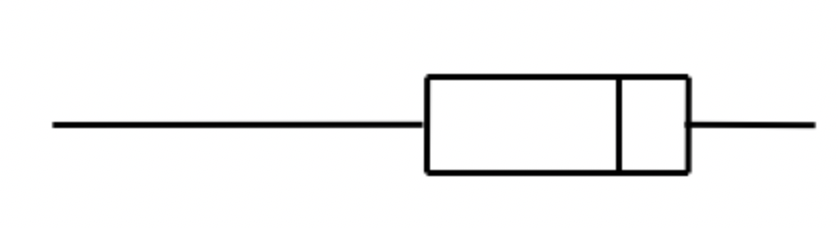
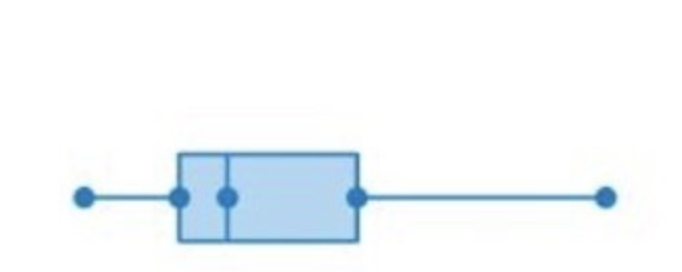
Is is a type of error which is unpredictable. Goes on either direction. Either your measurement one time emerges randomly to be higher and another time lower) Due to unknown factors.
The theory that, as sample size increases, the distribution of sample means of size n, randomly selected, approaches a normal distribution.
The larger the number off samples the clsoer to the normal distribution
the standard deviation of a sampling distribution. How much a sample stat, is likely to vary for the actual population parameter.
The smaller the variability in our population the smaller this measure is (greater precision)
The larger the sample size, the smaller this measure (greater precision)
Hypothesis that states that something is equal to zero and there is no finding.
We can not accept it; do not have enough evidence to reject it.
Hypothesis that states there is a statistical difference, correlation, association, etc.
We can not reject it; not enough evidence to accept it.
Part of the group of 4; we use it to know the sufficient sample size for research. Ability to find the difference if it is actually there.
Type II error; By convention set to 0.8 If there is a difference in the population I am at least 80% confident that I would be able to reveal it.
Sample size
What do you calculate on an a priori power analysis
power
What do you calculate on an a posterior power analysis?
Is the probability of observing the value we observe, or something more extreme, under the null hypothesis.
Not the probability of being correct.
The smaller this value, the smaller the probability of being wrong.
One sample t-test
Used to determine if a single sample mean is equal to a certain population mean.
Continuous
Assumptions:
Observations are randomly and independently drawn
Symmetrical, bell shaped data
There are no outliers.
Independent samples t-test
Used to test according to the current data, the mean in the population across two groups.
Assumptions:
observations are randomly and independently drawn
symmetrical, bell-shaped data within each group
there are no outliers
continuous data / equality of means
Used to test if, according to the current data, the mean in the population differs across matched groups. (ej. weight before and after).
assumptions:
The (paired) observations are randomly and independently drawn.
the (paired) difference are is symmetrical continuous variable.
There are no outliers in the difference.
continuous data / equality of means
assumptions of independent samples t-test
data are independently sampled
from a normally distributed population
variance of the two groups is the same in the population
Wilcoxon Signed Rank Test
Non parametric test used when the continuous data is skewed in one sample t-test.
Analyze → non parametric → one sample
Assumptions;
The observations re randomly and independently drawn.
At least interval data.
Mann-Whitney U Test (Wilcoxon sum rank)
Used for skewed continuous data in with independent groups.
Assumptions:
The observations are randomly and independently drawn.
At least interval data.
Wilcoxon Mathced-Paired Signed Rank test
Used for skewed continuous data in paired groups.
Assumptions:
The pairs of observations ar randomly and independently drawn.
At least interval data
The samples need to dependent observations of the cases. (paired or matched)
One Sample chi-square test
Used to test if according to current data, the proportion, the proportion in the population equals a certain, pre-specified value.
CATEGORICAL data / Legacy dialogs
the observations re randomly and independently drawn.
The number of cells with expected frequencies less than 5, are less than 20%.
The minimum expected frequency is at the the very least 1.
Pearson’s chi-square test
Used to test if, according to the current data, the proportion of 1 variable change based on another variable.
CATEGORICAL data / Crosstabs
In the population, is the proportion of group A equal to the proportion of group B?
Add by column, interpret by row
Add by row, interpret by column (check the one that doesn’t add up to 100)
Assumptions:
The observations are randomly and independently drawn.
The number of cells with expected frequencies less than 5, are less than 20%
The minimum expected frequency is at the very least 1.
The observations are not paired

McNemar Chi-square test
Used to test if, according to the current data, proportions in the population of a variable change based on another matched variable.
CATEGORICAL data / Crosstabs
In the population, is the proportion of a. group in one condition equal to the proportion of the same (or paired) group in another condition?
Assumption:
The observations are randomly and independently drawn.
There are at least 25 observations in the discordant cells.
The data are paired.
discordant cells (yes - no)
What do we base ourselves when checking McNemar test
One sample binomial test
Used when the assumptions fo the one sample chi-square test do not hold.
Categorical data
Fisher’s Exact Test
Used when the assumptions for the Pearson’s chi-square test do not hold
McNemar-Bowker test
usen when the assumptions for the McNemar test are not met…
Scatterplots
Used when both the predictor and the outcome are continuous.
The plot of data points x and y with x and y being continuous. It is method for displaying a relationship between 2 variables observed over a number of instances.
Used to investigate an empirical relationship between x (independent) and y (dependent).
correlation
What is r?
correlation ( r)
It represents the strength of the linear relationship
Pearson’s Correlation Coefficient
Used to check magnitude and direction
Assumptiosn:
variables should aproxximately be normally distributed
each variable should be continuous
each participant or observation should have ap air of value
no significant outliers in either variable
linearity, a “straight line” relationship between the variable should be formed.
Spearman’s correlation Coefficient
When one or both of the variables are not normally distributed. This concept of correlation is less sensitive to extreme influential points, so it should be used in the case of non normality.
Used when the data in both variables are skewed (nonparametric version)
Measures the strength and direction of the monotonic relationship between 2 variables
Monotonic relationship
When one variable increases/decreases the other also decreases/increases, but not necessarily at a constant rate, as it does a linear relationship.
Simple Linear Regression Model
A set of statistical processes for estimating the relationship among variables. It describes the relationship between variables by fitting a line to the observed data.
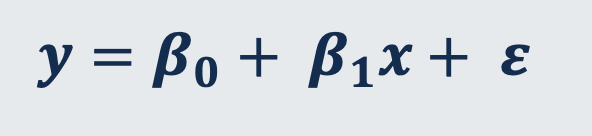
x
independent variable; predictor/explanantory or covariate variable
Can be continuous or categorical
y
dependent variable, outcome/response; “depends on…”
always continuous
intercept
β₀
value of your takes when x is zero.
If the ______ is zero than y increases in proportion to x (ej. x doubles then y doubles)
predicted value of the dependent variable (y) when x=0
slope (steepness/gradient)
β1 (ONLY for simple linear regression )
Determines the change in y when x changes by 1 unit.
It’s the amount that the dependent that the dependent variable will increase (or decrease) for each unit in the independent variable.
partial regression coefficients
βi’s (β1, β2, β3)
Represent the change in average y for one unite change in x (holding/ adjusting for) all other x’s fixed.
Residual
e
Difference between an observed value and a value predicted by a stats model. Distance between points and the line of best fit.
The best linear regression line is the one closes to all data point - makes this variables as small as possible.
ordinary least square
method used to find the best‑fitting straight line through your data.
Is one method that can be used to estimate the regression line that
minimises the squared residuals to give us the estimates for 𝜷𝟎 and𝜷𝟏.
Simple Linear Regression Model
Used to measure to what extent there is a linear relationship between 2 variables.
Ho = there is no linear association (𝜷𝟏. = 0)
Ha: There is a linear association (𝜷𝟏 not equal 0)
Assumptions:
There is a linear relationship between the dependent and independent variable
• Residuals (or “errors”) ε are independent of one another: the observations in the dataset were collected using statistically valid sampling methods, and there are no hidden relationships among observations
• Residuals follow a Normal distribution, with mean 0 and constant Standard Deviation σ
• Homogeneity of variance (homoscedasticity): the size of the error in our prediction doesn’t change significantly across the values of the independent variable.
Homoscedasticity
When scatter plot seemed to follow a general linear pattern
r value
value of strength for a simple correlation
r squared value
indicates how much of the total variation in the dependent value, y, can be explained by the independent value, x.
ej. 27% of weight can be explained by height.
Association studies:
how much of the variation in y is explained by x
Prediction context:
How well does the model predict your values from x
does not indicate:
whether the independent variables are a cause of the changes in the dependent variable; we can only say they are associated.
the correct type of association was used
most appropriate set of independent variables have been chosen
there are enough ata points to make a solid conclusion
ANOVA
reports how well the regression equation fits the data. We interpret its p-value.
Multiple Linear Regression model
Allows us to hold all other variables constant, allowing us to get an estimate of the effect of the independent variable of interest, while adjusting for other variables in the model which are hypothesized confounders.
There are multiple explanatory variables. Can deal with multiple confounders (within reason)
Use it as a method to study the relationship between 1 dependent variable (ej. weight) and 2+ independent variables simultaneously (ej. exercise, diet, etc.) to understand how a dependent variable can be explained by a set of other variables.
Ho = holding all other variables constant, there is no linear association between y and x1
holding all other variables constant, there is linear association between y and x1
Aim to answer:
whether and how several facts are related with one other fact?
whether and how a set of independent variables are relates with a dependent variables.
confounder
A situation in which the association between an explanatory variable (e.g exercise 𝒙𝟏) and outcome (e.g. weight y) is distorted by the presence of another variable (e.g. hours of free time 𝐱𝟐).
This variable has a common effect on the independent and dependent variables. Is extrinsic (not part of) to the causal pathway.
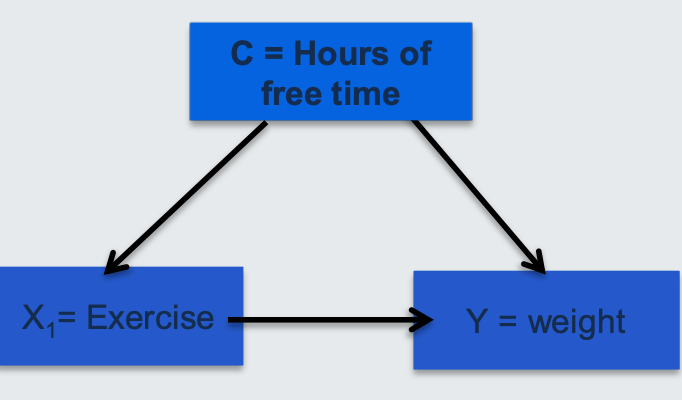
confounding varialbes
any other variable that cause both your dependent and your main independent variable of interest. It’s like a “extra independent variable” having a hidden effect on your dependent variables, while being related to the independent variable of interest.
If not taken into account, will introduce bias in the estimation of β1.djA
Adjusted R squared
is modified version the adjusts for the number of independent variables in the model. The other one increases every time an extra independent variable is added regardless of whether it has an effect or not.
This one increases only when the new variable actually improves the model more than you’d expect by chance.
Assumptions for Multiple Regression Inference
The relationship between the dependent (y) and each continuous independent variable (x variables) is linear.
How to check:Scatter plots of Y vs each X variable.
Residuals (error terms) e should be approximately normally distributed
Homoscedasticity - stability in variance of residuals
Independent observations
ZRESID
when testing for assumptions to make inference from a multiple linear regression… which one needs to be added to y?
ZPRED
when testing for assumptions to make inference from a multiple linear regression… which one needs to be added to x?
mediator
explains a portion of the association between Y
and x1.
_______ of the causal effect of independent variable (x1) on dependent variable (Y) is a variable x2 on nonthe causal pathway from x1 to Y.
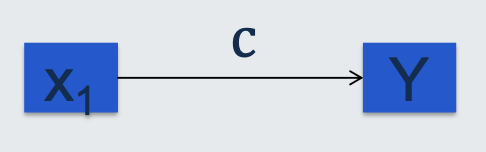
non-mediated model
the total effect of the independent variable x1 on the dependent Y is denoted by the path 𝑐
mediated model
the total causal effect 𝑐 can be split into an indirect (or mediated) part with paths 𝑎 and 𝑏 and a direct (non-mediated) path
c’
It’s the direct non-mediated path between x1 and y
path c
In the mediator model is the total effect of the variable x1 on y (both direct and indirect)
Total effect
Simpel linear regression between x1 and y (tell us how much y changes when x increases by 1)
Y= β0 + β X1+ε
a * b
indirect effect in the mediated model
path a
Simple linear regression between the mediator and the main independent variable
x1 → Mediator
M= β0 + β1X1 +ε
path b
Multiple linear regression that give us value of pathway b
Y = β0 + β2M +β3X1+ε
path c
Step1 of the Baron and Kenny steps test for….
(x1 → y)
Establish that the causal variable x1 is associated with the dependent y
path a
Step 2 of the Baron and Kenny steps test for….
(x1 → M)
Show that the causal variable x1 is associated with the mediator
path b
Step 3 of the Baron and Kenny steps test for….
(M → y, adjusting for x1)
Shows the mediator M is associated with Y, adjusting for the causal variable x1
path c’
Step 4 of the Baron and Kenny steps test for….
(x1 → y, adjusting for M)
complete mediation
No significant association between x1 and y, when we control for M.
B3 is not significatn
partial mediation
There is a significant association between x1 and y, when we control for M.
modifier
is a variable that alters the relationship between the independent X1 and idependent Y variables.
interaction term
the cross-product between x1 and the modifier z
(x1 * z)
outlier
is an observation that lies an abnormal distance from other values in a random sample from a population.
can be problematic for many statistical analyses because they can cause tests to either miss significant findings or distort real results.
generally serve to increase error variance and reduce the power of statistical tests.
Evaluate to remove an outlier
• if it appropriately reflects your target population, subject-area, research question, and research methodology.
• Did anything unusual happen while measuring these observations, such as power failures, abnormal experimental conditions, or anything else out of the norm?
• Is there anything substantially different about an observation, whether it’s a person, item, or transaction?
• Did measurement or data entry errors occur?
to remove or not to remove
A measurement error or data entry error, correct the error if possible. If you can’t fix it, remove that observation because you know it’s incorrect.
Not a part of the population you are studying (i.e., unusual properties or conditions), you can legitimately remove the outlier.
A natural part of the population you are studying, you should not remove it.
Odds
describes the ratio of the number of people with the event to the number without.
relative risk
is the probability of an adverse outcome in an exposure group versus its likelihood in an unexposed group. This statistic indicates whether exposure corresponds to increases, decreases, or no change in the probability of the adverse outcome.
RR equals one
The risk ratio equal 1 when the numerate rand denominator are qual.
exposed group = unexposed group
Equivalence (the probability of the event occurring int he exposure group is equal to the likelihood of it happening in the unexposed group)
ej. There is no association between mothers smoking status and baby being born with a low birth weight.
Equivalence
the probability of the event occurring int he exposure group is equal to the likelihood of it happening in the unexposed group
RR is greater than one
The numerator is greater than the denominator in the risk ratio. Therefore the event’s probability is greater in the exposed group than in the unexposed group (risk value).
Ej. if the RR = 1.4, the smoking status corresponds to a 40% greater probability of a mother having a child with low birthweight.
RR is less than one
The numerator is less than the denominator in the risk ratio. Consequently, the probability of the event is lower in the exposed group than the unexposed group (protective value).
ej. if the RR = 0.4, the smoking state corresponds to a 60% lower probability of another having a child with low birthweight.
OR equals 1
odds of 1 mean the outcome occurs at the same rate in both groups. Exposure doesn’t affect the odds of outcome.
Ej. There is no difference in the odds of low birth rate between smokers and non-smokers.