Anatomy and Physiology Final Practice
 Call Kai
 Learn
Learn Practice Test
 Spaced Repetition
 Match
Match Flashcards
 Knowt Play
1/143

Earn XP
Description and Tags
Flashcards 1-84 were before the midterm. Flashcards 85- are after the midterm.
Name | Mastery | Learn | Test | Matching | Spaced | Call with Kai | Chat |
|---|
No analytics yet
Send a link to your students to track their progress
144 Terms
Homologous chromosomes are best described as:
A. Identical copies of a chromosome produced during DNA replication
B. Chromosomes joined together by a centromere after fertilization
C. Maternal and paternal versions of the same chromosome
D. Chromosomes that separate during mitosis
c. Correct.
Homologous chromosomes are a pair of chromosomes, one inherited from the mother and one inherited from the father. They contain the same genes arranged in the same order and at the same locations (loci), although they may carry different alleles.
Which organelle is the primary site of protein synthesis?
a. Ribosome
b. Golgi apparatus
c. Lysosome
d. Mitochondria
a. Correct.
Ribosomes translate mRNA into proteins and are the primary site of protein synthesis.
Which anatomical plane divides the body into dorsal and ventral portions?
a. Median
b. Sagittal
c. Transverse
d. Dorsal
a. Wrong. Median plane → divides the body into equal left and right halves.
b. Wrong. Sagittal plane → divides the body into left and right portions.
c. Wrong. Transverse plane → divides the body into cranial and caudal portions.
d. Correct. divides the body into dorsal and ventral portions.
Analysis of a gamete reveals that it contains both members of a homologous chromosome pair. Which cellular event most likely failed?
a. Meiosis I, homologous chromosomes failed to separate
b. Meiosis II, sister chromatids failed to separate
c. Mitosis, cleavage divisions of the zygote failed
d. Fertilization, sperm and egg nuclei did not fuse properly
a. Correct.
During Meiosis I, homologous chromosomes are supposed to segregate into different daughter cells. If they fail to separate (nondisjunction), both the maternal and paternal versions of the chromosome enter the same gamete, resulting in a gamete that contains both members of a homologous pair.
The blastocyst shows increased or dysregulated protein synthesis, reflecting high metabolic activity and potential compensatory responses.
Which combination of organelles is most directly involved in supporting this high level of protein production and metabolic activity?
a. Golgi apparatus, lysosomes, peroxisomes, smooth ER
b. Lysosomes, smooth ER, plasma membrane, mitochondria
c. Nucleus, lysosomes, plasma membrane, ribosomes
d. Nucleus, mitochondria, rough ER, Golgi apparatus
d. Correct.
Protein synthesis begins in the nucleus (gene transcription), continues at ribosomes on the rough ER (translation), is processed and packaged in the Golgi apparatus, and requires ATP from mitochondria to fuel these energy-dependent steps. Lysosomes and peroxisomes are not directly involved in protein production.
The blastocyst shows high metabolic activity and increased protein synthesis. To support this level of activity, the cells must maintain stable internal conditions.
Which membrane transport process is most directly responsible for maintaining the ion gradients necessary for normal cellular function?
a. Facilitated diffusion of glucose into the cell
b. Active transport via the Na⁺/K⁺ pump
c. Secondary active transport of glucose with Na⁺
d. Osmosis through aquaporins
b. Correct.
The Na⁺/K⁺ ATPase uses ATP to pump sodium out of the cell and potassium into the cell, establishing the ion gradients necessary for membrane potential, cell volume regulation, and normal cellular function. These gradients are essential for sustaining high metabolic activity and supporting processes such as nutrient transport and protein synthesis.
A blastocyst has implanted within the left uterine horn of a female dog. Which description best identifies the anatomical location of the blastocyst?
a. Located cranial to the kidneys, within the dorsal body cavity, and viewed in a transverse plane dividing cranial and caudal portions
b. Located caudal to the kidneys, within the ventral body cavity, and viewed in a sagittal plane dividing left and right portions
c. Located medial to the kidneys, within the thoracic cavity, and viewed in a frontal plane dividing dorsal and ventral portions
d. Located lateral to the kidneys, within the cranial cavity, and viewed in an oblique plane dividing equal right and left halves
B. Correct.
In the dog, the uterus lies caudal to the kidneys within the ventral (abdominopelvic) cavity. The left uterine horn is best appreciated in a sagittal plane, which divides the body into left and right portions.
A developing embryo shows abnormal formation of skeletal muscle and vertebrae.
These structures are primarily derived from which germ layer?
A) Mesoderm
B) Ectoderm
C) Endoderm
D) Surface ectoderm
Correct Answer: A.
Skeletal muscle and vertebrae develop from mesoderm. Mesoderm gives rise to musculoskeletal tissues, connective tissues, and much of the cardiovascular system. Vertebrae arise from the sclerotome portion of somites, and skeletal muscle arises from the myotome.
Which tissue type is characterized by abundant extracellular matrix and relatively few cells?
A) Epithelial tissue
B) Nervous tissue
C) Connective tissue
D) Muscle tissue
Correct Answer: C.
Connective tissue is defined by having relatively few cells surrounded by abundant extracellular matrix, including fibers and ground substance. This matrix provides support, cushioning, and structural organization.
Which type of epithelium is best suited for protection against abrasion?
A) Simple squamous epithelium
B) Simple cuboidal epithelium
C) Simple columnar epithelium
D) Stratified squamous epithelium
Correct Answer: D. Stratified squamous epithelium has multiple layers of cells, making it well suited for protection against friction and abrasion. This is important in areas exposed to mechanical stress, such as skin and oral surfaces.
Which feature is most characteristic of a neuron?
A) Multiple layers of flattened cells
B) Long cellular processes extending from a cell body
C) Dense collagen fibers
D) Striated multinucleated fibers
Correct Answer: B.
Neurons are identified by a cell body with long processes, including dendrites and axons, that allow communication over distance. This structure supports rapid signal transmission for sensation and coordination.
Both skeletal muscle and cardiac muscle are striated.
Which feature best distinguishes cardiac muscle from skeletal muscle on histology?
A) Long cylindrical fibers arranged in parallel
B) Branched cells joined by specialized junctions
C) Multiple nuclei located at the cell periphery
D) Voluntary control of contraction
Correct Answer: B.
Both skeletal and cardiac muscle are striated, so students must look for additional distinguishing features. Cardiac muscle is identified by branched cells connected by intercalated discs, which are specialized junctions that allow coordinated contraction. Skeletal muscle has long parallel fibers with multiple peripheral nuclei and lacks branching and intercalated discs.
In a homeostatic control system, which component compares incoming information to the normal set point and determines the response?
A) Receptor
B) Effector
C) Control center
D) Stimulus
Correct Answer: C.
The control center, such as the hypothalamus, receives information from receptors, compares it to the normal set point, and determines the appropriate response by activating effectors.
If thermoreceptors cannot detect an increase in body temperature, what is the most immediate consequence?
A) The control center receives no signal to respond
B) Sweat glands stop producing sweat permanently
C) Blood vessels automatically constrict
D) Body temperature immediately returns to normal
Correct Answer: A.
If thermoreceptors fail to detect rising temperature, no sensory input is sent to the control center, such as the hypothalamus. Without that signal, the hypothalamus cannot activate appropriate effectors, such as sweating or vasodilation, to promote heat loss and restore normal body temperature.
Referring to the in vitro fertilization (IVF) study in previous session:
To study the developmental consequences of the observed abnormalities, the embryo was implanted into a surrogate dam, and the resulting neonate was monitored after birth.
The abnormal chromosome number altered gene expression during embryogenesis, disrupting normal tissue and organ development. As development proceeded, these disruptions became evident as congenital abnormalities affecting multiple organ systems.
• Alopecia (patchy hair loss) and skin depigmentation and fragility
• Reduced peripheral sensation
• Mild cardiac arrhythmia
• Shortened limbs
• Kyphosis (mild spinal curvature)
The neonate shows abnormalities affecting the skin, peripheral sensation, heart, limb skeleton, and vertebral column.
Which developmental explanation best accounts for abnormalities?
A. A localized defect limited to ectodermal derivatives
B. A generalized defect limited to mesodermal derivatives
C. A localized defect affecting tissues from multiple germ layers
D. A generalized disruption affecting multiple germ layers
D. Correct.
There are abnormalities in structures derived from both ectoderm (skin, melanocytes, peripheral sensory tissues) and mesoderm (heart, limb bones, vertebral column). This pattern is most consistent with a generalized developmental disruption affecting multiple germ layers during embryogenesis.
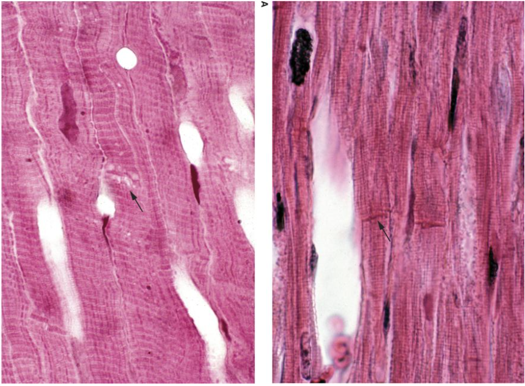
The neonate develops a cardiac arrhythmia characterized by irregular and poorly coordinated heart contractions. A histologic image of the affected heart tissue is shown.
Damage to which specialized structure in this tissue would most directly contribute to the arrhythmia?
a. Sarcomeres
b. Intercalated discs
c. Branching muscle fibers
d. Tight junctions
B. Correct
Intercalated discs contain gap junctions that allow electrical impulses to rapidly spread between adjacent cardiac muscle cells. This electrical coupling coordinates contraction throughout the heart and helps maintain a normal heart rhythm.
A skin sample was obtained for histologic evaluation. Examination revealed a thinner epidermis with fewer layers of flattened surface cells, an intact basement membrane, and decreased number of sensory receptors. The underlying dermis contained disorganized collagen fibers and reduced density.
Which histologic finding contributes most directly to the skin's fragility?
A. Reduced number of surface epithelial cell layers
B. Disorganized collagen fibers in the dermis
C. Epidermal, dermal, and sensory disorganization
D. Decreased number of sensory receptors
b. Correct.
The dermis is composed of dense irregular connective tissue, rich in type I collagen, which provides the skin’s tensile strength and resistance to mechanical stress. When this connective tissue collagen is disorganized and decreased in density, structural integrity is compromised, directly leading to increased skin fragility and susceptibility to tearing
The developmental defect disrupted normal bone growth during embryogenesis leading to shortened limbs and kyphosis. Histologic examination reveals abnormal bone development characterized by reduced extracellular matrix and impaired skeletal growth.
Which explanation most directly accounts for the shortened limbs and kyphosis?
A. Reduced osteoblast activity
B. Reduced osteocyte communication
C. Reduced mineral deposition
D. Decreased vascular supply
A. Correct.
Osteoblasts are responsible for synthesizing bone extracellular matrix (osteoid), composed primarily of type I collagen and ground substance. Decreased osteoblast activity leads directly to reduced matrix production, impairing longitudinal bone growth and resulting in shortened limbs and spinal deformities such as kyphosis.
The following describes a normal thermoregulatory homeostatic control system:
• Stimulus: Cold outside temperature, decrease in skin temperature.
• Receptors: Thermoreceptors in skin (free nerve endings located in the epidermis and dermis) detect cold temperature
• Control Center: Hypothalamus
• Effectors:
Cutaneous blood vessels: Vasoconstriction reduces blood flow to the skin to conserve heat
Skeletal muscles (shivering): Shivering generates heat through rapid involuntary contractions
• Feedback: Rising body temperature reduces hypothalamic output, decreasing shivering and vasoconstriction
The neonate has congenital defects affecting peripheral sensory function.
Which component(s) of the thermoregulatory loop is/are most likely impaired in this neonate?
a. Effectors
b. Control center
c. Receptors
d. Stimulus
c. Correct.
The receptor is responsible for detecting changes in temperature. Because the neonate has impaired sensory function and difficulty detecting temperature changes, the defect is most likely at the level of the thermoreceptors. The hypothalamus (control center) and effectors may be normal, but they cannot respond appropriately if the temperature change is not detected.
The neonate is exposed to a progressively colder environment. Shivering and cutaneous vasoconstriction are not activated immediately, and core body temperature begins to decline. Several minutes later, thermoregulatory responses become evident, but core temperature remains below normal.
Which interpretation is most appropriate?
A. Negative feedback has been activated, but it is insufficient.
B. Negative feedback is effective because shivering and vasoconstriction have been activated.
C. Thermoregulation is unaffected because negative feedback responses eventually occur.
D. Homeostasis has been restored because the effectors are functioning normally
A. Correct.
Shivering and cutaneous vasoconstriction are negative feedback responses that oppose the decrease in core body temperature. However, because core temperature remains below the normal range, the response has not been sufficient to fully correct the disturbance.
Why must nutrients reach the epidermis by diffusion from the dermis?
a. Keratin prevents direct blood flow into the skin.
b. The epidermis lacks embedded blood vessels.
c. The dermis blocks vascular access to the surface.
d. Tight cell junctions limit space for blood vessels.
b. Correct.
This is correct because the epidermis is avascular and depends on diffusion of oxygen and nutrients from capillaries in the dermis.
What is a function of osteons in compact bone?
a. Produce synovial fluid
b. Store triglycerides
c. Resist mechanical loads
d. Generate active contraction
c. Correct.
Osteons are the structural units of compact bone. Their concentric arrangement of lamellae helps bone withstand and resist the mechanical stresses generated during weight bearing and locomotion.
Which of the following is a function of ligaments?
a. Shock absorption.
b. Force transmission.
c. Load bearing.
d. Passive stabilization.
d. Correct.
Ligaments primarily function to provide passive stabilization of joints by limiting excessive movement between bones and maintaining proper joint alignment without muscular contraction.
Which structure of a synovial joint produces the fluid that lubricates the joint cavity?
a. Articular cartilage
b. Synovial membrane
c. Joint capsule
d. Periosteum
b. Correct.
The synovial membrane lines the inner surface of the joint capsule and produces synovial fluid, which lubricates the joint and helps provide nutrients to the avascular articular cartilage. Articular cartilage reduces friction but does not produce the fluid.
While unloading from a trailer, a calf slips and strikes the lateral aspect of its thigh against a metal divider. The calf develops localized swelling and bruising over the lateral thigh but remains weight-bearing, and radiographs reveal no skeletal injury.
Which tissue layer is most responsible for dissipating compressive forces during blunt trauma?
a. Epidermis
b. Dermis
c. Hypodermis
d. Muscle
c. Correct.
Composed of loose connective tissue and abundant adipocytes (fat cells). This layer cushions underlying tissues, distributes impact forces, and dissipates compressive loads during blunt trauma.
Which structural feature best explains the cushioning and shock-absorbing properties of this tissue during blunt trauma?
a. Parallel collagen fibers aligned along a primary axis of loading
b. Numerous myofibrils with longitudinal arrays of repeating sarcomeres
c. Interwoven bundles of type I collagen arranged in multiple directions
d. Loosely organized connective tissue with abundant adipocytes
D. correct.
Directly describes the hypodermis, whose adipose tissue acts as a shock absorber during blunt trauma.
Four tissues are collected from different musculoskeletal locations in a retired racing greyhound dog.
Tissue A contains densely packed, parallel bundles of type I collagen fibers.
Tissue B contains a proteoglycan-rich extracellular matrix with high water content and type II collagen.
Tissue C contains abundant type I collagen fibers arranged in multiple directions with scattered fibroblasts.
Tissue D contains type I and II collagen, chondrocytes, and relatively low proteoglycan content
During repeated running, which tissue would be least capable of maintaining structural integrity when exposed primarily to tensile forces?
a. Tissue A
b. Tissue B
c. Tissue C
d. Tissue D
B. correct.
Hyaline cartilage. Its proteoglycan-rich matrix, high water content, and type II collagen make it well adapted for resisting compression, but relatively poor at resisting tensile forces.
During his last race, this dog appeared lame on its right hindlimb. Physical examination revealed excessive motion at the stifle joint, while active muscle contraction and joint range of motion remained intact.
Which tissue would be best adapted to prevent this abnormal motion?
a. Tissue A
b. Tissue B
c. Tissue C
d. Tissue D
A. correct
The finding of excessive motion at the stifle joint suggests a loss of passive joint stability, such as injury to a ligament. Ligaments are composed of dense regular connective tissue with parallel bundles of type I collagen, allowing them to resist tensile forces and prevent abnormal movement between bones. This makes Tissue A the tissue best adapted to stabilize the joint during running.
A horse has a full-thickness defect of articular cartilage that extends down to the underlying bone in the stifle joint. Over time, the defect begins to fill with reparative tissue.
Which source of cells is most important in initiating the repair process in this full-thickness cartilage defect?
a. Chondrocytes from nearby intact cartilage
b. Synovial membrane cells
c. Bone marrow cells from the underlying bone
d. Ligament fibroblasts
Correct Answer: c.
Articular cartilage is avascular, meaning it lacks a direct blood supply. As a result, cartilage has limited intrinsic repair capacity. In a full-thickness defect, the lesion extends through the cartilage and reaches the underlying bone, creating access to the vascularized bone marrow compartment. Bone marrow cells can then enter the defect and initiate the repair process, making them the most important source of cells involved in repair.
A 13-year-old female Quarter Horse used for barrel racing presents with progressive right forelimb lameness after several weeks of intensive training. Examination reveals:
reduced weight-bearing
preserved joint stability
preserved range of motion
preserved active muscle contraction
Which function is most likely compromised?
a. Active force generation
b. Friction reduction
c. Passive stabilization
d. Load bearing
D. correct
Reduced weight-bearing indicates impaired ability of the limb to tolerate and distribute mechanical forces. This suggests a failure in load-bearing structures such as bone, especially under repetitive high-intensity training where microfractures are common.
Which tissue primarily performs that function?
a. Compact bone
b. Ligament
c. Skeletal Muscle
d. Hyaline cartilage
A. correct
Compact bone is the primary tissue responsible for structural support and load-bearing in the skeleton. It forms the dense outer cortex of bones and resists compression, bending, and torsional forces during movement and weight-bearing.
Which structural feature best enables that function?
a. Sarcomere arranged in series
b. Parallel collagen bundles
c. Osteons (Haversian systems)
d. Interconnected trabeculae
e. Proteoglycan-rich ECM with high water content
C. correct
These are the fundamental structural units of compact bone. Their concentric lamellae and central canals provide organized strength and allow bone to resist compression, torsion, and bending forces.
Which sequence correctly describes the pathway by which force generated in a sarcomere reaches bone?
A) Sarcomere → tendon → perimysium → bone
B) Sarcomere → endomysium → perimysium → epimysium → tendon → bone
C) Sarcomere → ligament → tendon → bone
D) Sarcomere → epimysium → cartilage → bone
Correct Answer: B.
Force generated within sarcomeres is transmitted outward through connective tissue layers in a hierarchical sequence: endomysium (surrounding individual fibers), perimysium (surrounding fascicles), epimysium (surrounding the entire muscle), then tendon, and finally to bone. A common misconception is skipping connective tissue layers or confusing tendons (muscle-to-bone) with ligaments (bone-to-bone).
Which change would most directly impair the ability to precisely control limb stabilization during dynamic movement?
A) Decreased bone mineral density
B) Reduced motor unit recruitment and firing frequency
C) Increased stiffness of ligaments
D) Decreased thickness of articular cartilage
Correct Answer: B.
Precise limb stabilization depends heavily on neural regulation of muscle contraction. Reduced motor unit recruitment or altered firing frequency decreases the nervous system’s ability to finely adjust force production, impairing coordination and dynamic stabilization even if structural tissues remain intact.
Which structure is primarily responsible for generating the active force?
a. Tendon
b. Ligament
c. Skeletal muscle
d. Articular cartilage
c. Correct.
Skeletal muscle is the primary source of active force generation. Tendons transmit force, ligaments provide passive restraint, and cartilage distributes compressive forces.
Which structure is primarily responsible for transmitting force from muscle to bone?
a. Ligament
b. Tendon
c. Joint capsule
d. Articular cartilage
b. Correct.
Tendons are specialized dense regular connective tissue structures that transmit tensile force generated by muscle to bone. Ligaments connect bone to bone and provide passive joint stability.
Which change would most directly impair precise control of limb stabilization, even if muscle strength is still adequate?
a. Reduced motor unit recruitment timing
b. Increased bone mineral density
c. Decreased adipose tissue
d. Increased periosteal blood supply
a. Correct.
Neuromuscular control depends on the timing and coordination of motor unit activation. Delayed or poorly coordinated recruitment causes instability during dynamic tasks even when overall strength is preserved.
A limb is immobilized in a cast for several weeks. According to Wolff’s Law, what is the most likely change in the bone of the immobilized limb?
A. Increased cortical thickness due to lack of movement
B. Decreased bone mass due to reduced mechanical loading
C. Increased trabecular connectivity due to immobilization
D. No change in bone structure because bone is static tissue
b. Correct.
According to Wolff’s Law, bone continuously adapts to the mechanical forces placed on it. When mechanical loading is reduced, such as during immobilization in a cast, bone no longer receives the normal stress signals that stimulate maintenance of bone structure. As a result, bone remodeling shifts toward resorption over formation, leading to decreased cortical thickness, reduced trabecular connectivity, and overall loss of bone mass.
A 4-year-old Border Collie lands awkwardly after clearing an agility obstacle.
Physical examination reveals:
• Reduced push-off strength in the affected hindlimb
• Normal joint range of motion
• Joint stability is preserved
• A palpable skeletal muscle contraction occurs during attempted extension of the tarsus
• Radiographs show no evidence of fracture
Which functional step in the movement pathway is most directly compromised?
A. Neuromuscular activation
B. Force generation
C. Force transmission
D. Skeletal loading
C. Correct.
Force transmission is the most likely problem because the dog shows a palpable muscle contraction, meaning neuromuscular activation and force generation are intact. However, push-off strength is reduced despite normal joint range of motion, preserved stability, and no radiographic abnormalities. This combination indicates that the muscle is producing force, but that force is not being effectively transmitted through the tendon and connective tissue system to generate movement at the skeleton.
During stance, the tarsus is noted to sink further toward the ground than normal under load because extension of the tarsus is compromised, though passive range of motion and joint stability are preserved on manual exam.
Which movement would most likely become excessive?
A. Tarsal abduction
B. Tarsal flexion
C. Tarsal elevation
D. Tarsal supination
B. Correct.
During stance, the tarsus must resist flexion as body weight and ground reaction forces load the limb. This resistance is provided primarily by the gastrocnemius muscle acting through the common calcanean tendon, which functions as a tension band across the caudal aspect of the tarsus, opposing the flexion generated by weight-bearing. If force transmission through this musculotendinous unit is reduced, the tarsus is less able to oppose the flexion forces imposed by body weight during stance. The result is excessive tarsal flexion under load — clinically apparent as the tarsus sinking lower than normal, producing a stance known as plantigrade or semi-plantigrade.
A 6-year-old Labrador Retriever is presented for intermittent hindlimb "collapse."
The owner reports that the dog walks and runs normally on level ground but frequently stumbles when:
• Descending stairs
• Walking downhill
• Jumping off furniture
Physical examination reveals:
• Normal muscle mass in both pelvic limbs
• Normal active range of motion
• No obvious pain on palpation
• No evidence of ligament laxity or joint instability during orthopedic examination
• The dog can rise from sitting and accelerate normally
Which functional component of movement is most likely impaired?
A. Force generation during concentric contraction
B. Force transmission through tendons
C. Neuromuscular control during eccentric contraction
D. Passive stabilization provided by ligaments
C. Correct.
The dog's deficit is task-specific: it fails only during descending stairs, downhill walking, and jumping off furniture — all tasks requiring the limb to decelerate body weight under load. This demands the hip and stifle extensors contract eccentrically (producing force while lengthening), which is physiologically distinct from concentric contraction (producing force while shortening, as in propulsion). Eccentric loading requires continuous neuromuscular regulation — integration of proprioceptive feedback (limb position, load, ground contact) with graded motor output (recruitment and firing rate) to control the rate of joint flexion rather than to produce joint movement. A deficit in this regulatory process — not in the muscle's capacity to generate force, and not in a passive structure — best accounts for selective failure under deceleration loading with preservation of propulsive function.
A 5-year-old Quarter Horse has competed successfully in barrel racing for several seasons. As competition and training intensity progressively increase, some regions of the skeleton become denser and stronger, while one region eventually develops a stress fracture despite no single traumatic event.
The veterinarian explains that both the adaptation and the injury are consequences of normal bone responses to mechanical loading.
Which explanation best accounts for both the increased bone strength in some regions and the development of a stress fracture in another region?
A. Bone remodeled in response to repeated mechanical loading, but in one region repetitive stress eventually exceeded the rate at which remodeling could maintain structural integrity.
B. Osteocytes detected increased mechanical strain and coordinated remodeling responses that increased bone strength in high-load regions, maintaining structural integrity under progressive training loads.
C. Increased mechanical loading stimulated site-specific bone remodeling, resulting in regionally increased bone mass in areas of higher strain across the skeleton.
D. Trabecular and cortical bone locally redistributed mechanical loads within loaded regions, partially reducing peak stresses but not eliminating localized overload during repetitive training.
A. Correct.
The question explicitly requires an explanation that accounts for both halves of the scenario: adaptive strengthening and failure (stress fracture), as two outcomes of the same underlying process of mechanical loading driving bone remodeling. C is the only option that frames these as a single continuous mechanism with two possible outcomes depending on the balance between loading rate and remodeling capacity: when remodeling keeps pace with repetitive strain, bone strengthens (Wolff's law / bone functional adaptation); when the rate or magnitude of loading outpaces the remodeling process, microdamage accumulates faster than it can be repaired, and a stress fracture results. This directly mirrors the case stem's own framing: both the adaptation and the injury are consequences of normal bone responses to mechanical loading.
A veterinary orthopedic surgeon is designing two prosthetic joints for dogs.
One prosthesis will replace the shoulder of a working retriever that must retrieve birds over uneven terrain and swim.
The other will replace the elbow of a livestock guardian dog that spends most of its day supporting body weight while walking and standing.
The surgeon explains that although both are synovial joints, each prosthesis must emphasize different biomechanical properties to restore normal function.
Which biomechanical principle should guide the design of these two prosthetic joints to restore normal leverage, movement, and weight-bearing function for each joint?
A. Both prostheses should provide the same balance of mobility and stability because both joints primarily function to transmit forces during weight bearing.
B. Both prostheses should maximize joint mobility because greater range of motion improves limb function under all conditions.
C. The shoulder prosthesis should prioritize intrinsic stability over mobility because the shoulder experiences greater forces during locomotion.
D. The shoulder prosthesis should prioritize mobility, whereas the elbow prosthesis should prioritize intrinsic stability to support efficient weight bearing.
D. Correct.
Joint motion and stability are determined by articulating surface shape, ligament arrangement, and muscular support. The shoulder's ball-and-socket geometry allows multiplanar motion but has little bony congruity, so it relies on surrounding soft tissue for stability — favoring mobility, which suits the retriever's need for reach and adaptability over uneven terrain. The elbow's hinge geometry restricts motion to one plane but provides strong intrinsic bony stability, suiting the guardian dog's need for efficient, stable weight-bearing.
The surgeon notes that successful long-term function of either prosthetic joint depends on maintaining normal loading of the surrounding synovial tissues.
Which process is most important for maintaining the health of articular cartilage in a normal synovial joint?
A. Hyaluronic acid in synovial fluid directly diffuses into chondrocytes to supply oxygen and metabolic substrates.
B. Cyclic loading and unloading that promotes movement of synovial fluid through cartilage.
C. Static compression of cartilage during prolonged weight-bearing maximizes nutrient diffusion from synovial fluid into the matrix.
D. Vascular perfusion of the synovial membrane delivers nutrients directly to chondrocytes during joint movement.
B. Correct.
Cartilage has no blood supply and depends on diffusion from synovial fluid for nutrients. Because diffusion alone isn't sufficient, movement is required: compression during loading pushes fluid out of the cartilage, and unloading lets nutrient-carrying synovial fluid back in. This cyclic exchange functions as a pump that sustains chondrocyte viability and matrix integrity.
Blood flow between two points in the circulatory system will decrease if:
A) The pressure gradient decreases
B) Resistance decreases
C) Vessel diameter increases
D) Blood velocity increases
Correct Answer: A.
Blood flow depends on pressure gradients. When the difference in pressure between two points decreases, the driving force for circulation is reduced, lowering blood flow.
A vessel must maintain high pressure and withstand repeated expansion during each cardiac cycle. Which structural feature is most important?
A) Presence of valves
B) Large lumen with low resistance
C) Thin endothelial lining
D) Thick smooth muscle and elastic fibers
Correct Answer: D.
Arteries experience high pressures and repeated stretching with each heartbeat. Thick smooth muscle and elastic fibers help maintain structure and recoil.
If pressure in the arterial and venous ends of a vascular pathway became equal, what would be the most immediate effect?
A) Increased turbulence
B) Reversal of blood flow
C) Cessation of blood flow
D) Increased capillary exchange
Correct Answer: C.
Blood flow requires a pressure difference. If arterial and venous pressures equalize, there is no driving force and circulation stops.
A decrease in plasma protein concentration would most directly result in:
A) Decreased fluid movement out of capillaries
B) Increased fluid reabsorption into capillaries
C) Increased fluid movement out of capillaries
D) Decreased lymphatic return
Correct Answer: C.
Plasma proteins create oncotic pressure that pulls fluid back into capillaries. Lower protein levels reduce this force and allow more fluid to leave vessels.
Which situation would most likely overwhelm the lymphatic system?
A) Reduced capillary permeability
B) Increased plasma protein concentration
C) Decreased hydrostatic pressure
D) Excess fluid leaving capillaries
Correct Answer: D.
The lymphatic system returns excess interstitial fluid to circulation. Excessive fluid leaving capillaries can exceed lymphatic capacity and contribute to edema.
Which change would most directly increase resistance to blood flow in a vessel?
A) Increased vessel diameter
B) Decreased vessel diameter
C) Decreased blood viscosity
D) Shortened vessel length
Correct Answer: B.
Smaller vessel diameter dramatically increases resistance to flow, making vasoconstriction a major regulator of blood pressure.
A newborn fails to establish normal pulmonary circulation at birth. Which underlying issue best explains this condition?
A) Persistence of high pulmonary vascular resistance
B) Increased oxygen delivery to tissues
C) Decreased cardiac output
D) Increased systemic vascular resistance
Correct Answer: A.
Normal birth transitions require pulmonary vascular resistance to decrease, allowing blood flow through the lungs. Failure of this transition impairs oxygenation.
Which vessel type is structurally best suited for rapid exchange of gases and nutrients?
A) Artery
B) Vein
C) Arteriole
D) Capillary
Correct Answer: D.
Capillaries have extremely thin walls and large surface area, allowing efficient exchange of gases, nutrients, and waste products.
Turbulent blood flow is most likely to occur when:
A) Blood flows at low velocity
B) Blood moves in smooth, parallel layers
C) Vessel diameter changes abruptly
D) Resistance is minimal
Correct Answer: C.
Abrupt changes in vessel diameter disrupt laminar flow and increase turbulence, which may produce murmurs or abnormal flow patterns.
A compensatory response that increases heart rate in response to decreased blood pressure is best described as:
A) Elimination of the underlying cause
B) Passive diffusion of blood flow
C) Structural adaptation of vessels
D) Maintenance of function despite disturbance
Correct Answer: D.
Compensatory responses help maintain homeostasis despite disturbances. Increased heart rate following reduced blood pressure is an example of physiologic compensation.
Two blood vessels are directly connected. One carries blood at higher pressure than the other. Which outcome is most likely?
a. Blood flow will stop once the vessels connect and pressure equalizes.
b. Blood will move from the lower-pressure vessel to the higher-pressure vessel
c. Blood will move from the higher-pressure vessel to the lower-pressure vessel
d. Blood flow will alternate direction during the cardiac cycle
c. Correct.
Blood flows down a pressure gradient from high to low pressure, flow is continuous if the gradient persists.
Under which condition is turbulent blood flow most likely to occur?
a. Low velocity and small vessel diameter
b. Low velocity and small vessel diameter
c. High velocity with abrupt change in vessel diameter
d. Equal pressure throughout the vessel
c. Correct.
• Turbulence occurs with:
✓ Increased velocity
✓ Abrupt diameter change
• Leads to audible vibrations (murmurs)
Which structural feature best allows arteries to maintain blood flow during diastole?
a. Thin walls with large lumens
b. Presence of valves to prevent backflow
c. Elastic fibers that allow stretch and recoil
d. Single-layer endothelial lining
c. Correct.
• Elastic lamellae:
✓ Stretch during systole (contraction)
✓ Recoil during diastole (relaxation)
• Maintains continuous forward flow
If capillary hydrostatic pressure increases while plasma oncotic pressure remains constant, what is the most likely effect?
a. Increased fluid reabsorption into capillaries
b. No change in fluid movement
c. Increased filtration of fluid into interstitial space
d. Decreased lymphatic return
c. Correct.
• Hydrostatic pressure pushes fluid out (filtration)
• Increased hydrostatic pressure results in increased filtration
• Can lead to interstitial fluid accumulation (edema), especially if the lymphatic system is overwhelmed
A fetal vascular structure fails to close after birth. Which general outcome is most likely?
a. Blood flow remains unchanged from normal postnatal patterns
b. Blood is redirected between circulatory pathways that should be separate
c. Oxygen delivery becomes independent of circulation
d. Pulmonary resistance increases permanently
b. Correct.
• Fetal shunts:
✓ Exist to redirect blood away from nonfunctional lungs before birth
• Persistence after birth is an abnormal connection
✓ Alters normal flow pathways
A 2-month-old intact Maltese female puppy presents with:
• Exercise intolerance
• Increased respiratory effort
• Upon auscultation, blood flow appears abnormally continuous between systole (contraction) and diastole (relaxation) with a heart murmur heard deep in the left axillary (armpit) region
• Mild hypoxia
• Diagnostic imaging performed (x-ray, ultrasound) reveals a persistent abnormal vascular connection between two major blood vessels with different pressure profiles.
• Imaging (Doppler) of the thoracic cavity suggests increased pulmonary blood flow and mild edema in the pleural cavities.
Histology slides provided show normal dog:
• Cardiac and smooth muscles
• Elastic artery
• Vein
• Lymphatic vessel
Which abnormal blood vessel connection explains increased pulmonary blood flow and a continuous heart murmur?
a. A. Pulmonary trunk connected to right atrium
b. Aorta connected to pulmonary trunk
c. Pulmonary vein connected to right ventricle
d. Caudal vena cava connected to left atrium
b. Correct.
• Aorta relates to high pressure.
• Pulmonary trunk relates to lower pressure.
• Blood flows from high to low.
• Continuous pressure gradient between aorta and pulmonary artery results in turbulent blood flow that produce uncharacteristic sound – a heart murmur.
• Increased pulmonary blood flow explains respiratory signs
Which vessel type is structurally adapted to accommodate high systolic pressure?
a. Vein
b. Lymphatic
c. Artery
d. Capillaries
c. Correct.
• A thick tunica media with multiple layers of smooth muscle that integrate elastic fibers creating lamellae that provides resistance to high pressure with flexibility or stretch.
• Recoiling of elastin fibers allows the arteries to maintain forward blood flow during diastole.
• Supports systemic pressure load.
The abnormal vascular connection observed in the puppy results from failure of a fetal vessel to close after birth (i.e., patent ductus arteriosus, PDA). The majority of the cardiovascular structures involved in this defect develop from what embryonic germ layer tissue type?
a. Ectoderm
b. Mesoderm
c. Endoderm
d. Neural crest alone
b. Correct.
• The heart and major blood vessels develop from cardiogenic mesoderm.
• During fetal development, the ductus arteriosus developed to shunt blood away from the nonfunctional lungs and typically closes shortly after birth, so blood can be directed to the functional neonatal lungs.
• Failure of closure results in persistent or patent vascular connections that alter normal circulation.
What mechanism directly explains the mild pulmonary edema?
a. Decreased plasma protein concentration
b. Increased capillary hydrostatic pressure
c. Decreased lymphocyte production
d. Increased venous valve competence
b. Correct.
• High pressure and volume overload of the pulmonary vasculature drives fluid out of the continuous type of capillaries.
• Elevated hydrostatic pressure pushes fluid into the interstitial space.
• Accumulation of fluid into the tissue (interstitial) space between alveoli (air sacs) and capillaries (interstitium) happens because the lymphatic system cannot keep up with excess volume of fluid being filtered into the interstitium.
What event represents an early compensatory mechanism for the altered blood flow?
a. Increase heart rate
b. Increase respiratory rate
c. Decrease cardiac contractility
d. Increase pulmonary blood flow
b. Correct.
• The body is not getting enough oxygen (hypoxia).
• Body responds by increasing ventilation (breathing).
• Increasing ventilation brings in more oxygen and removes carbon dioxide.
Air moves into the lungs during inspiration because:
A) Alveolar pressure becomes greater than atmospheric pressure.
B) Thoracic volume decreases, increasing pressure.
C) Alveolar pressure becomes lower than atmospheric pressure.
D) Oxygen concentration increases in the lungs.
Correct Answer: C.
Air moves into the lungs when alveolar pressure falls below atmospheric pressure. During inspiration, expansion of the thoracic cavity increases lung volume and lowers pressure, causing airflow into the lungs down a pressure gradient.
A reduction in lung expansion would most directly affect:
A) Gas diffusion by decreasing surface area
B) Blood flow through pulmonary veins
C) Cardiac output from the left ventricle
D) Oxygen binding to hemoglobin
Correct Answer: A.
Reduced lung expansion decreases alveolar recruitment and available surface area for gas exchange, limiting oxygen diffusion into the bloodstream.
Which structural feature most directly enhances diffusion of gases across the alveolar wall?
A) Thick epithelial lining
B) Close proximity of a capillary to an alveolus
C) Presence of cartilage in alveoli
D) Increased airway resistance
Correct Answer: B.
Efficient gas exchange depends on minimizing diffusion distance. Close proximity between alveoli and capillaries allows rapid movement of oxygen and carbon dioxide.
If the diffusion distance between alveoli and capillaries increases, what is the most likely effect?
A) Increased oxygen diffusion into blood
B) No change in gas exchange efficiency
C) Increased airflow into lungs
D) Decreased oxygen diffusion into blood
Correct Answer: D.
Increasing diffusion distance slows oxygen transfer across the respiratory membrane and decreases gas exchange efficiency.
Which condition would most directly reduce the ability of an alveolus to remain open during breathing?
A) Increased capillary blood flow
B) Decreased surfactant production
C) Increased oxygen concentration in alveoli
D) Increased ventilation rate
Correct Answer: B.
Surfactant reduces surface tension within alveoli. Reduced surfactant production increases collapse risk and decreases alveolar stability.
Effective oxygen delivery to tissues requires:
A) Ventilation only
B) Perfusion only
C) Neither airflow nor blood flow
D) Both ventilation and perfusion
Correct Answer: D.
Adequate oxygen delivery depends on airflow reaching alveoli (ventilation) and blood flow transporting oxygen to tissues (perfusion).
If ventilation is normal but perfusion is impaired, what is the most likely outcome?
A) Efficient oxygen delivery to tissues
B) Reduced oxygen delivery despite adequate airflow
C) Increased carbon dioxide removal
D) Increased lung compliance
Correct Answer: B.
Normal airflow without sufficient blood flow results in reduced oxygen transport to tissues despite adequate ventilation.
An increase in carbon dioxide levels in the blood would most directly:
A) Decrease respiratory rate
B) Have no effect on ventilation
C) Trigger increased ventilation through feedback mechanisms
D) Reduce oxygen diffusion at the alveolus
Correct Answer: C.
Elevated CO₂ stimulates chemoreceptors that increase respiratory drive, helping restore homeostasis through negative feedback.
Which statement best explains the role of surfactant in lung function?
A) It increases airway resistance
B) It increases diffusion distance
C) It reduces surface tension and stabilizes the alveolus
D) It transports oxygen across the alveolar membrane
Correct Answer: C.
Surfactant reduces surface tension, helping alveoli remain open and improving breathing efficiency.
Which scenario best demonstrates failure of system integration in oxygen delivery?
A) Normal ventilation and normal perfusion
B) Impaired gas exchange despite normal blood flow
C) Increased respiratory rate during exercise
D) Increased oxygen concentration in inspired air
Correct Answer: B.
Oxygen delivery depends on coordinated respiratory and circulatory function. Impaired gas exchange despite normal perfusion demonstrates system integration failure.
A 4-month-old puppy presents with hypoxia and reduced alveolar expansion. Which structural change would most directly impair oxygen diffusion across the alveolar–capillary interface?
a. Increased thickness of the alveolar epithelial layer
b. Increased pulmonary blood flow
c. Increased surfactant production
d. Increased airway diameter in bronchi
a. Correct.
• Diffusion efficiency depends on short diffusion distance
• Thickening the alveolar barrier:
✓ Increases diffusion distance
✓ Reduces oxygen movement into blood
In the puppy, oxygen enters the alveolus, but tissue hypoxia persists. Which mechanism best explains this finding?
a. Ventilation increases alveolar pressure
b. Blood flow from lungs to systemic circulation is impaired
c. Surfactant increases diffusion distance
d. Oxygen cannot bind hemoglobin
b. Correct.
• Oxygen delivery requires:
✓ Ventilation → diffusion → circulation
• If blood flow is impaired:
✓ Oxygen cannot reach tissues
Imaging of thoracic cavity shows reduced alveolar expansion. What is the most direct physiological consequence of this finding?
a. Increased diffusion distance
b. Increased airway resistance
c. Increased oxygen partial pressure
d. Decreased alveolar surface area
d. Correct.
• Reduced alveolar expansion:
✓ Fewer functional alveoli
✓ Reduced surface area for gas exchange
• Surface area is a primary determinant of diffusion efficiency
During exercise, the puppy’s respiratory rate increases. Which mechanism best explains this response?
a. Positive feedback increases oxygen levels
b. Increased blood pressure stimulates ventilation
c. Chemoreceptors detect increased CO₂ and stimulate ventilation
d. Decreased lung compliance directly increases respiratory drive
c. Correct.
• Primary driver of ventilation:
✓ CO₂ and pH changes
• Chemoreceptors:
✓ Detect increased CO₂
✓ Signal brainstem/medulla → increase ventilation
• Represents negative feedback control
Which developmental abnormality would most directly impair postnatal oxygenation in this puppy?
a. Reduced skeletal muscle mass
b. Failure of cartilage development in trachea
c. Incomplete formation of the alveolar–capillary interface
d. Delayed closure of fetal shunts
c. Correct.
• Gas exchange requires:
✓ Thin alveolar epithelium
✓ Close capillary association
• Developmental disruption:
✓ Increases diffusion barrier
✓ Impairs oxygen transfer
A 4-month-old puppy presents with:
• Exercise intolerance – a symptom indicated by a reduced ability to perform typical physical tasks, resulting in severe fatigue, exhaustion, or discomfort during or after activity that should be manageable for this age
• Dyspnea (increased respiratory effort)
• Pulse oximetry indicates mildly decreased oxygen saturation (hypoxia).
• Decreased tissue oxygen indicated by cyanosis (blueish mucous membranes)
• Imaging of thoracic cavity reveals reduced alveolar expansion in portions of lungs.
• No structural cardiac defects are identified on the initial examination.
• No other obstructions associated with nasal cavity/passages, pharynx, larynx, or trachea.
Histologic slides of normal puppy provided:
• Alveolus
• Bronchus
• Pulmonary capillary bed
• Respiratory epithelium
Efficient oxygen diffusion from an alveolus into a pulmonary capillary is facilitated by what structural feature?
a. Fenestrated capillary
b. Cartilage support within alveolus
c. Thin alveolar epithelium
d. Thin bronchiolar epithelium
c. Correct.
• Thin alveolar epithelial barrier reduces diffusion distance with capillary bed.
• Close association with pulmonary continuous type capillaries increases gas exchange efficiency.
• Short diffusion path between alveoli and capillaries supports rapid oxygen diffusion into blood.
The movement of blood from the level of oxygenation in the lungs, to the heart, and to the body is depicted by which series of steps along the pathway?
a. Alveoli→ pulmonary capillaries → pulmonary venules → pulmonary veins → left atrium → left ventricle → aorta → body
b. Alveoli → pulmonary capillaries → pulmonary arterioles → pulmonary arteries → left atrium → left ventricle → cranial vena cava → body
c. Bronchioles → pulmonary capillaries → pulmonary venules → pulmonary veins → left atrium → left ventricle → aorta → body
d. Bronchioles→ pulmonary capillaries → pulmonary arterioles → pulmonary arteries → right atrium → right ventricle → aorta → body
a. Correct.
• Oxygen diffuses from the alveoli (air sacs) into pulmonary capillaries then venules
• Returns to the left atrium via pulmonary veins.
• Distributed to systemic tissues via the left ventricle to aorta and systemic arteries, arterioles, capillaries.
Imaging of the thoracic cavity indicates reduced expansion of alveoli in portions of the lungs. The ability of alveoli sacs to remain open and not collapse during breathing is facilitated by which component of the lungs?
a. Continuous capillaries
b. Bronchiolar Type II pneumocytes
c. Pulmonary surfactant
d. Lymphatic drainage
c. Correct. Pulmonary surfactant is produced by type II pneumocytes, which are large, cuboidal epithelial cells. The surfactant reduces surface tension of fluid within the alveolus, helping keep alveoli open and improving lung expansion (compliance).
If surfactant levels decrease:
• alveoli become less stable
• surface tension of fluid increases
• lung compliance decreases
• alveoli collapse more easily during breathing
Wholly or partially collapsed alveoli reduces effective surface area for gas exchange, contributing to decreased oxygen diffusion.
The respiratory rate of the puppy increases during physical exertion, which is considered a state of homeostatic imbalance. Which mechanism explains the body’s response to restore respiratory rate and return to homeostasis?
a. Breathing increase due to positive feedback increasing oxygen levels
b. Internal sensory receptors signal an increase in breathing to improve oxygen delivery
c. Increased lymphatic return directly stimulates increase breathing
d. Decreased cardiac output stimulates increased breathing
b. Correct.
• Low body oxygen levels are detected by peripheral chemoreceptors for oxygen, carbon dioxide, and pH in the aortic arch and carotid bodies of the carotid arteries.
• Peripheral and CNS chemoreceptors receptors detect a change in blood gas concentrations and signals the brainstem/medulla to increase breathing.
• Increase in ventilation and blood oxygen levels is a negative feedback response to reduce the respiratory rate.
After the puppy’s birth, which embryological developmental defect could impair oxygenation associated with exercise intolerance?
a. Failure of neural crest migration to skin
b. Dysfunctional alveolar-capillary interface
c. Delayed closure of umbilical arteries
d. Thickening of skeletal muscle fibers
b. Correct.
• Proper alveolar-capillary interface must be thin, closely opposed, and highly vascularized for sufficient gas exchange or diffusion
• Structural abnormality increases diffusion barrier.
• Impaired oxygen transfer results.
• Impaired surfactant levels
Session 4A
Which structural feature best supports rapid signal conduction in peripheral nerves?
A) Dense connective tissue
B) Myelin sheath formed by Schwann cells
C) Large extracellular spaces
D) Capillary networks
Correct Answer: B.
Schwann cells form myelin around peripheral nerves, increasing conduction speed by allowing action potentials to travel more efficiently through saltatory conduction.
Session 4A
Which structure is primarily responsible for signal integration?
A) Peripheral nerve
B) Ganglion
C) Central nervous system
D) Effector organ
Correct Answer: C.
The central nervous system processes and integrates information from sensory inputs to coordinate responses throughout the body.
Session 4A
Which feature distinguishes exocrine glands from endocrine glands?
A) Presence of neurons
B) Secretion into ducts
C) High vascularity
D) Hormone production
Correct Answer: B.
Exocrine glands release products through ducts to a surface or local environment, whereas endocrine glands secrete directly into circulation.
Session 4A
Which gland type releases its product directly into the bloodstream?
A) Exocrine
B) Endocrine
C) Both equally
D) Neither
Correct Answer: B.
Endocrine glands are ductless and release hormones directly into circulation for systemic effects.
Session 4A
Which pathway carries signals from the CNS to a salivary gland?
A) Afferent sensory pathway
B) Somatic motor pathway
C) Autonomic efferent pathway
D) Endocrine signaling pathway
Correct Answer: C.
Salivary gland secretion is controlled through autonomic efferent pathways that regulate involuntary glandular activity.
Session 4A
Which glial cell is responsible for myelination in the CNS?
A) Astrocyte
B) Microglia
C) Oligodendrocyte
D) Schwann cell
Correct Answer: C.
Oligodendrocytes produce myelin within the central nervous system. Schwann cells perform this role in the peripheral nervous system.
Session 4A
A gland has ducts and secretes locally. This gland is best classified as:
A) Endocrine
B) Exocrine
C) Neuroendocrine
D) Lymphatic
Correct Answer: B.
The presence of ducts and local secretion are defining characteristics of exocrine glands.
Session 4A
Which best describes the role of a ganglion?
A) Hormone production
B) Signal integration in CNS
C) Switching point for neurons outside CNS
D) Site of muscle contraction
Correct Answer: C.
Ganglia are collections of neuronal cell bodies outside the CNS and often serve as relay or switching points in neural pathways.
Session 4A
If gland structure is normal but secretion is impaired, the most likely problem is:
A) Structural defect in epithelium
B) Vascular insufficiency
C) Neural control dysfunction
D) Hormone deficiency
Correct Answer: C.
Normal gland structure with impaired secretion suggests dysfunction in regulatory pathways, such as neural control mechanisms.
Session 4A
Which statement best reflects structure–function relationships?
A) Structure and function are independent
B) Function determines structure
C) Structure supports and enables function
D) Function occurs without structural organization
Correct Answer: C.
Biological structures are organized in ways that support specific functions. Understanding these relationships is foundational to physiology and pathology.
Session 4A
Which structural feature most directly increases the speed of signal conduction in peripheral nerves?
a. Epineurium
b. Myelin sheath
c. Synapse
d. Endoneurium
b. Correct.
• Neurolemmocytes (Schwann cells) form myelin in the PNS
• Myelin enables saltatory conduction in association with nodes of the nerve fiber (nodes of Ranvier)
• Significantly increases signal conduction velocity
• connective tissue layer that surrounds individual axons
Session 4A
Which feature best describes the autonomic pathway controlling salivary gland secretion?
a. Single neuron from CNS to effector
b. Two-neuron chain with peripheral ganglion
c. Afferent pre- and postganglionic pathway
d. Absence of synaptic transmission
b. Correct.
• Preganglionic neuron → ganglion → postganglionic neuron
• Allows modulation and coordination
Session 4A
Which histologic feature best supports the function of a salivary gland?
a. Stratified squamous epithelium
b. Simple cuboidal cells forming acini and ducts
c. Dense collagen fibers
d. Large extracellular spaces
b. Correct.
• Acinar cells produce secretions
• Ducts transport and modify secretions
• Simple cuboidal epithelium supports secretion and transport
Session 4A
Which structural feature best distinguishes endocrine glands from exocrine glands?
a. Presence of ducts
b. Direct release into bloodstream
c. Association with neural tissue
d. Stratified epithelial layers
b. Correct.
Endocrine glands are ductless
Secrete hormones directly into bloodstream via capillaries
Session 4A
Which glial cell is responsible for myelination in the central nervous system?
a. Astrocyte
b. Micrologia
c. Oligodendrocyte
d. Neurolemmocyte
c. Correct.
Oligodendrocytes myelinate axons in CNS
Increase conduction velocity
Session 4A
A young domestic short-haired cat presents with intermittent abnormal salivation when food is offered. Typically, the sight and smell of food activate neural pathways that stimulate salivary glands before feeding begins. A disruption in neural control of glandular secretion is suspected.
Neurologic exam reveals:
• Inconsistent salivary secretion during feeding
• Delayed reflex responses to oral stimulation
• No structural abnormalities of salivary glands
Histology slides of normal tissue provided show:
• Cranial nerve tissue - Facial Nerve and Glossopharyngeal Nerve
• Dorsal root ganglion
• Salivary gland as an exocrine gland
• Thyroid gland as an endocrine gland
Which histologic feature best supports the function of salivary gland secretion?
a. Stratified squamous epithelium with thick keratin layers
b. Simple cuboidal cells arranged around acini and ducts
c. Dense collagen fibers with minimal cellular activity
d. Clusters of secretory cells surrounded by capillaries
b. Correct.
• Salivary glands are exocrine glands specialized for secretion and delivery of saliva into ducts
• Simple cuboidal epithelial cells form the lining of both acini (secretory units) and ducts (transport pathways). (Note: alveolar and acinar are both adjectives that describe the luminal diameter: acinus has a narrow lumen, alveolus has a wider lumen)
• These cells are metabolically active and structurally adapted for fluid and protein secretion (e.g., enzymes such as amylase, mucins).
• Acinar arrangement increases surface area for secretion, while the duct system modifies and transports saliva to oral cavity.
Thus, this histologic organization directly supports efficient production and delivery of saliva.