Gas Behavior I & II - Ideal Gas Law, Kinetic Molecular Theory
 Call Kai
 Learn
Learn Practice Test
 Spaced Repetition
 Match
Match Flashcards
 Knowt Play
1/38

Earn XP
Description and Tags
) define pressure as force per unit area, and recognize various units of pressure (e.g. atm, bar, kPa) 7) perform calculations with the ideal gas law (PV = nRT) to relate the pressure, volume, temperature and amount of a gas 8) perform calculations that relate density and molar mass of gases (ρ = MMቀ P RTቁ) 9) describe the molecular basis for pressure and temperature of a gas in terms of the force and frequency collisions of gas particles 10) rationalize all behavior predicted by the ideal gas law in terms of the kinetic molecular theory of gases and particle collisions
Name | Mastery | Learn | Test | Matching | Spaced | Call with Kai | Chat |
|---|
No analytics yet
Send a link to your students to track their progress
39 Terms
Ideal Gas Law Equation
PV=nRT
What are the variables in the Ideal Gas Law?
P= Pressure
V= volume
n= number of particles
R= Ideal Gas Law constant
T= temperature
Gas particle distance
Far apart
Gas particle interaction
minimal, little to no interaction
for equal number of gas particles at same volume and temperatue, heavier gas molecules produce ___ pressure as lighter molecules
same
the relation between gas pressure and mass of gas particles
does not vary
the relation between gas pressure to volume of gas
inversely proportional
the relation between gas pressure and temperature of gas
directly proportional
when temperature is measured in Kelvin, the intercept of a P vs T graph is ____
effectively zero
when temperature is measured in Celsius, the intercept of a P vs T graph is ___
far from zero
the relation between gas pressure and number of gas particles
directly proportional
Describe proportionality of behavior of pressure of gas
P does not vary with gas mass, P ∝ 1/V, P ∝ T, P ∝ n
Describe proportionality relationship of gas variables
P ∝ nT/V
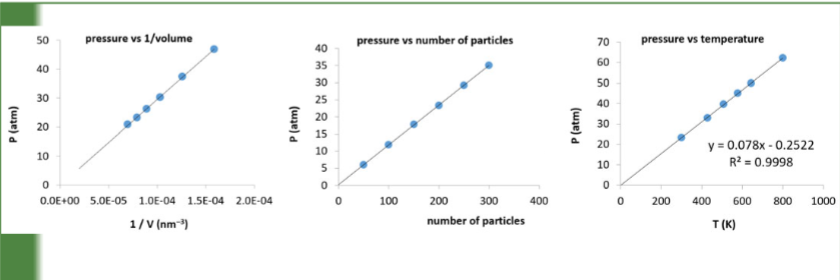
statement describing relationship between variables and graph of P vs T, P vs n and P vs V
P = 0 when V = ∞, or n = 0, or T = 0 (in K)
converting value from Celsius to Kelvin
+273.15
A 50.0 L compressed gas cylinder holds 3.00×10⁴ kPa of
N2 gas at 25°C. How many moles of gas are in the cylinder?
605 moles
A balloon has a volume of 0.500 L at 25°C and 1.00
bar pressure. What is the new volume if T is increased
to 50°C and P to 2.00 bar ?
0.271 L
A unknown gas has a density of 1.38 g/L at 17°C
and 1.04 bar. What is the molar mass?
32.0 g/mol
According to the Ideal Gas Law, if temperature of gas increases, the pressure will ____
increase
As temperature of gas increases, average speed and kinetic energy of particles ____
increases
On average, gas particles in same size chamber at higher temperature take more or less time to cross the chamber
less
To cross the chamber, gas particles at higher temperature collide with chamber surface less or more often
more often
heated gas particles
increase in speed, kinetic energy, frequency and force of collisions
According to the Ideal Gas Law, if number of gas particles increases, the pressure will ___
increase
increase number of gas particles, same temperature, average speed ____
stays same
increase number of gas particles, same temperature, kinetic energy ____
stays same
increase number of gas particles, same temperature, collision frequency ____
occurs more often
Relationship between overall gas pressure and particle mass
does not vary
Relationship between particle mass on speed and kinetic energy
heavier particles have lower speed, same kinetic energy as lighter particles
Relationship between particle mass on collision force and frequency
greater force, lower frequency
temperature
measurement of average kinetic energy of particles
pressure
measurement of frequency and force of particle collisions
n↑ = P↑
more particles = greater collision frequency
T↑ = P↑
greater kinetic energy of particles results in
greater force and frequency of collisions
V↑ = P↓
more space means particles at the same
speed strike the container walls less often,
decreasing collision frequency
T↑ = V↑
greater kinetic energy increases pressure,
pressure in > pressure out, outward force
expands the container until collision
frequency drops so pressures are equal
P↑ = V↓
pressure out > in causes inward force that
compresses the container, until collision
frequency increases so pressures are equal