Lecture 3: Types & Sources of Radiation
 Call Kai
 Learn
Learn Practice Test
 Spaced Repetition
 Match
Match Flashcards
 Knowt Play
1/36

There's no tags or description
Looks like no tags are added yet.
Name | Mastery | Learn | Test | Matching | Spaced | Call with Kai | Chat |
|---|
No analytics yet
Send a link to your students to track their progress
37 Terms
Radiation
defined as the kinetic energy that passes from one location to another and can be displayed in many ways
Moving subatomic particles passing through space from one location to another.
Examples are:
Protons
Neutrons
Beta Particles
etc.
Electromagnetic Spectrum
Full range of electromagnetic waves
Types of Radiation
Mechanical vibrations of materials
Ultrasound
Electromagnetic Waves
Radio waves
Microwaves
Visible light
X-rays
Electromagnetic waves
Electric and magnetic fields fluctuate rapidly as they travel through space
a limited range of these frequencies is interpreted by its reaction with human systems as visible light.
Electromagnetic radiation has a dual nature referred to as wave-particle duality
Meaning this form of radiation propagates through space in the form of a wave but can interact with matter as a particle of energy called a photon, so x-rays are described as both waves and particles
Two divisions of the electromagnetic spectrum
ionizing radiation
nonionizing radiation
Ionizing Radiation includes:
High-energy ultraviolet radiation
x-rays
gamma rays
Nonionizing radiation
These are radiations that do not have sufficient kinetic energy to eject electrons from an atom:
Low-energy ultraviolet radiation (less than 10 eV)
visible light
infrared rays
microwaves
radio waves
Ionization
electromagnetic radiation that has a high enough frequency to transfer sufficient energy to some orbital electrons and remove them from the atom
Ionization describes the interaction of x-rays with human tissue
It makes x-rays valuable for creating images but has the potential for producing some damage in the biological material
The amount of energy transferred to electrons by the ionizing radiation is the concept of radiation dose
Particulate radiation
In addition to electromagnetic radiation, we have another category of ionizing radiation called _______.
As opposed to x-rays and gamma rays (which are ER) _________ is a form of radiation that includes these subatomic particles:
alpha particles
beta particles (electrons)
neutrons
protons
Ionization continued
The subatomic particles are ejected from atoms at very high speeds and have enough kinetic energy to cause ionization by direct atomic collision
When these particles are at rest, there is no ionization
Radioactive decay
a naturally occurring process in which unstable nuclei relieve that instability by some type of nuclear spontaneous emission, like charged particles
Alpha particles (alpha rays)
are emitted from the nuclei of very heavy elements during the process of radioactive decay
emitted from Uranium and Plutonium
Alpha particles have:
2 protons and 2 neutrons
Large mass
Are a simple helium atom minus their electrons
Less penetrating than Beta particles
Lose energy quickly as they travel short distances (stopped by superficial layers of the skin or piece of paper)
They have a scattering probability
Considered to be a harmless external source of radiation, but internally if emitted from a radioisotope, can cause damage to healthy epithelial tissue (brachytherapy)
Beta particle (beta rays) compared to electrons
Are identical to high-speed electrons except for their origin
Electrons originate in atomic shells outside the nucleus
Beta particles are emitted from within the nuclei of radioactive atoms
Beta particle
8000 times lighter than alpha particles
Have one unit of electrical charge (-1)
They do not interact as strongly as alpha particles
They penetrate further than alpha particles with less ionization along their path
Stopped by 1 cm piece of wood or 1mm thick lead shield, aluminum
Beta decay
is a nuclear decay process where an unstable nucleus transforms and ejects particles to become more stable, beta ray is emitted
During beta decay, the proton in the nucleus is transformed into a neutron and vice versa.
If a proton is converted to a neutron, it is known as β+ decay. Similarly, if a neutron is converted to a proton, it is known as β– decay
Beta decay cont.
β+ decay: a proton decays into a neutron, a positron, and a neutrino
Neutrinos are particles with little or no mass and are released in order to conserve energy during the beta decay process.
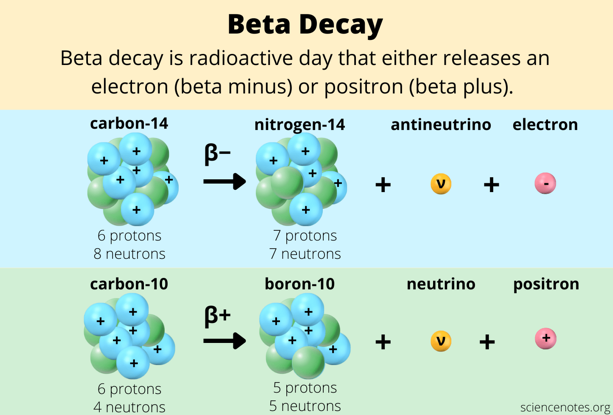
β+ and β– decay

Other sources of electrons
Not all high speed electrons are beta radiation
alternative sources of high speed (high energy) electrons are commonly produced by linear accelerators (used to treat more superficial lesions)
Gamma Radiation
a high-energy form of electromagnetic radiation emitted from an atomic nucleus
Breakdown of Gamma radiation key properties
Source: Originates from radioactive decay or nuclear reactions.
Energy: Possesses the highest energy in the electromagnetic spectrum.
Wavelength: Features the shortest wavelengths, Charge: Completely neutral with no electrical charge or mass.
Penetration: Highly penetrating, requiring thick lead or concrete to stop.
Hazard: Classed as ionizing radiation, meaning it damages living tissue.
Protons
Positively charged part of an atom
Isolated proton (ionized hydrogen atom) has more mass than electron by a factor of 1800
Typically less penetrating that a high energy electron
Remember: The number of protons in a nucleus of an atom determines its atomic number (Z) and placement on the periodic table and identifies it as an element
Neutrons
Have no charge
Neutrons have same mass as a proton
If you have 2 atoms with the same number of protons but different number of neutrons in the nuclei then you have isotopes
If a combination of protons and neutrons cause an unstable nucleus, then this combination is called a radioisotope
Quality Factor (Q)
are values used in radiation protection to quantify the different biological effectiveness of various types of radiation
Q factor is a specific value that accounts for the ability of different types of ionizing radiation to cause varying degrees of biological damage, in units of absorbed dose.
In other words, they convert the absorbed dose (measured in Grays) to an equivalent dose (measured in Sieverts), providing a measure of risk that accounts for the greater harm from radiation types like alpha particles compared to gamma rays or X-rays.
Higher quality factor (Q)
Means that this type of radiation is more damaging to cells than a radiation with a lower quality factor for the same amount of abosbred dose.
In radiation safety/protection, not all radiation is equal. The quality factor is a multiplier used to convert the physical dose of radiation absorbed by a material into the actual biological risk to human tissue.
Examples of Radiation Types and their Q Factors:
Photons (X-rays, gamma and beta particles) and Electrons: Have a Q factor of 1
High Energy protons: have a Q factor of 10
Alpha particles: Have a high Q factor of 20.
Sources of radiation
Natural & Manmade
Natural Sources of Radiation
Radioactive elements in the Earth’s crust and in the human body can be classified as ______.
Terrestrial – from radioactive occurring materials in the Earth’s crust
Cosmic – from the sun and beyond the solar system
Internal – from radioactive atoms (radionuclides) that make up a small percentage of the body’s tissue
Terrestrial source of radiation
Naturally occurring radioactive materials found in the Earth's crust, rocks, soil, water, and living organisms.
Radon accounts for 37% of the natural background radiation exposure
Cosmic source of radiation
______ is of extra-terrestrial origin as a result of nuclear interactions between the sun and stars
Earth’s atmosphere and magnetic field shield the Earth from cosmic rays
Internal souce of Radiation
Tissues of the body contain naturally occurring radionuclides that have been ingested from various foods or inhaled particles in the air.
Remember:
A radionuclide is an unstable nucleus that emits forms of ionizing radiation to achieve stability
Types of ionizing radiation released by radionuclides may include:
Alpha particles (helium nuclei)
Beta particles (electrons)
Gamma rays (MeV)
Emission of X-rays due to some type of radioactive decay
Manmade sources of radiation (Artificial Radiation)
ionizing radiation that is manmade and can come from:
Consumer products containing radioactive material
Medical radiation
Nuclear power plant accidents
Air travel
Nuclear fuel for power generation
Consumer products that emit radiation:
Airport surveillance systems
Older televisions
Electron microscopes
Ionization–type smoke detectors
Luminous dials on watches
Medical radiation results from the use of:
CT scanning
Interventional fluoroscopy
Conventional radiography or fluoroscopy
Nuclear Medicine
Equivalent dose (EqD)
Provides an overall dose value that includes the different degrees of tissue interaction (harm) that could be caused by different types of ionizing radiation
The most common unit of measure of EqD is the millisievert (mSv)
Takes organ or tissue into account
Sources of Radiation chart
