Microgravity
 Call Kai
 Learn
Learn Practice Test
 Spaced Repetition
 Match
Match Flashcards
 Knowt Play
1/47

There's no tags or description
Looks like no tags are added yet.
Name | Mastery | Learn | Test | Matching | Spaced | Call with Kai | Chat |
|---|
No analytics yet
Send a link to your students to track their progress
48 Terms
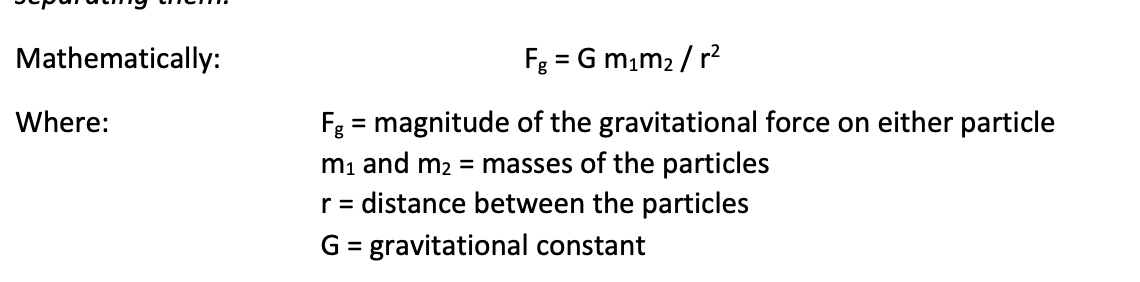
Gravitational law
Every particle in matter in the universe attracts every other particle with a force directly proportional to the product of the masses of the particles and inversely proportional to the square of the distance separating them
Equation for force of gravity
What is the force of gravity between the ISS and Earth
8.7 m/s²
around 89% of that arising from the effect of gravity at the earth’s surface
What underlies apparent weightlessness? (is it weightlessness?)
ISS in orbital velocity
accelerate toward single point at Earth’s centre
but ISS moves enough tangentially that you are not falling
outward centrifugal force ‘balances’ the downward gravitational force
so orbit is a state of continuous free-fall
THEREFORE do not perceive the external force
so feel weightless
this is MICROGRAVITY (not weightless ness or zero-G)
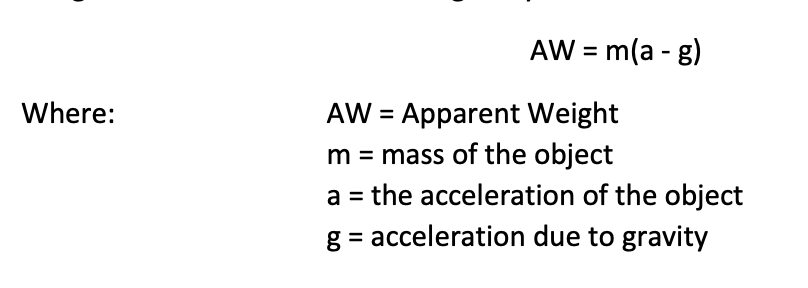
Apparent weight equation
feeling we experience when a lift cable snaps and we accelerate to the ground
no apparent weight because individual and floor of the lift accelerate at same rate
so no opposing force generated by the floor
Can gravitational force ever reach 0?
no
there is always matter so there is always an attractive force
What gravity is zero-gravity
1 millionth of that on Earth
When is true weightlessness experienced + example
If the gravitation influences of cosmic bodies are balanced:
Example:
Positition between the Earth and moon where grav pull of each is in equilibrium
Lagrangian point
Strategies used by NASA and ESA to stimulate microgravity and its physiological consequences
Head down tilt bedrest (HDBR)
bed tilted 6 degree for 30 days to a year
replicate headward fluid shift and disuse of load-bearing tissues
combined with other stressors (0.5% CO2) to mimic ISS
Hindlimb suspension in rodents
stimulate unloading of muscle and bone
Water immersion
neutral buoyancy facility
train for extra-vehicular activity (space walks)
Parabolic flight
vomit comet
22 seconds of weightlessness
test equipment
Concordia station antarctica
extreme isolation
for psychological testing
Atomospheric conditions on ISS
Similar to on Earth
101.3kPa barometric pressure
21% O2
How is O2 made
by electrolysis
using solar power
How is water made?
recycled
How is water recovered and CH4 made
CO2 scrub from atmosphere
reacted with H2
recover water and mades CH4
CH4 vented overboard
What do astroanuts breathe when on space walk and advantage
100% O2 at 1/3 of atm
allows to extend their time outside the spacecraft
reduced pressure prevents O2 toxicity
Disadvantage of the reduced pressure
Decompression sickness
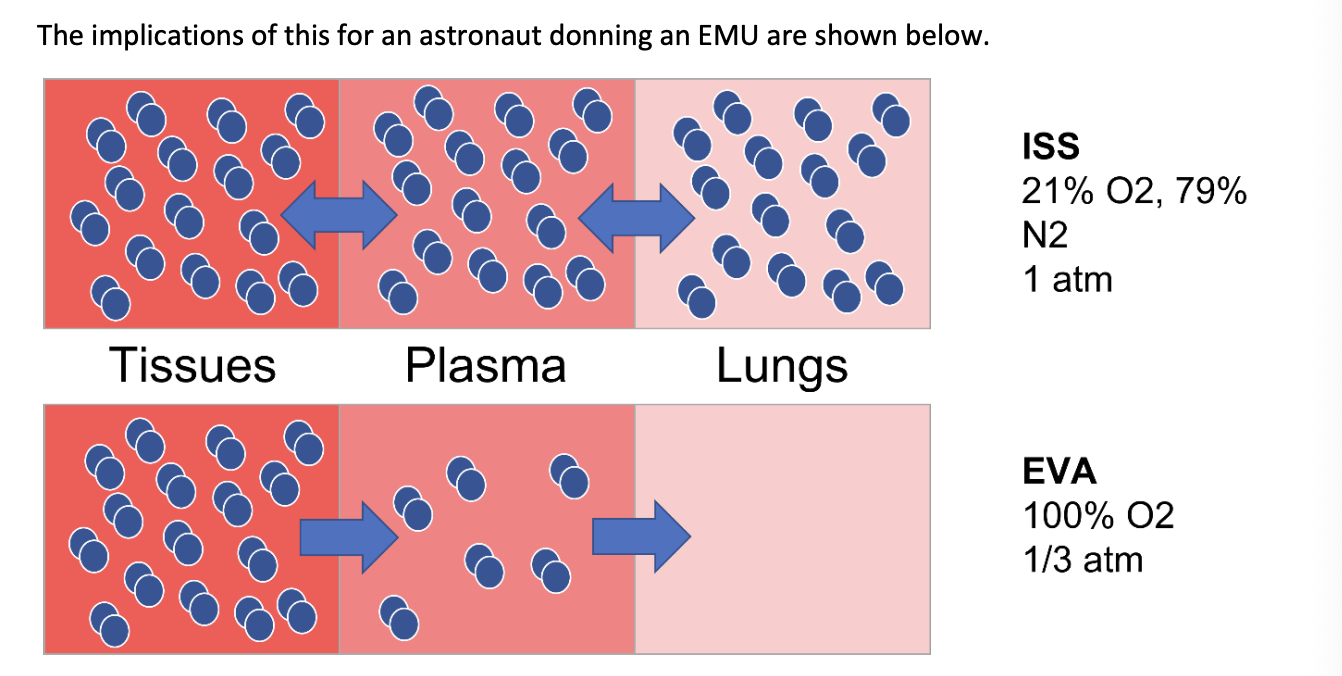
Henry’s law
amount of any given gas that is dissolved in a liquid at a given temperature is a function of the partial pressure of that gas in contact with the liquid
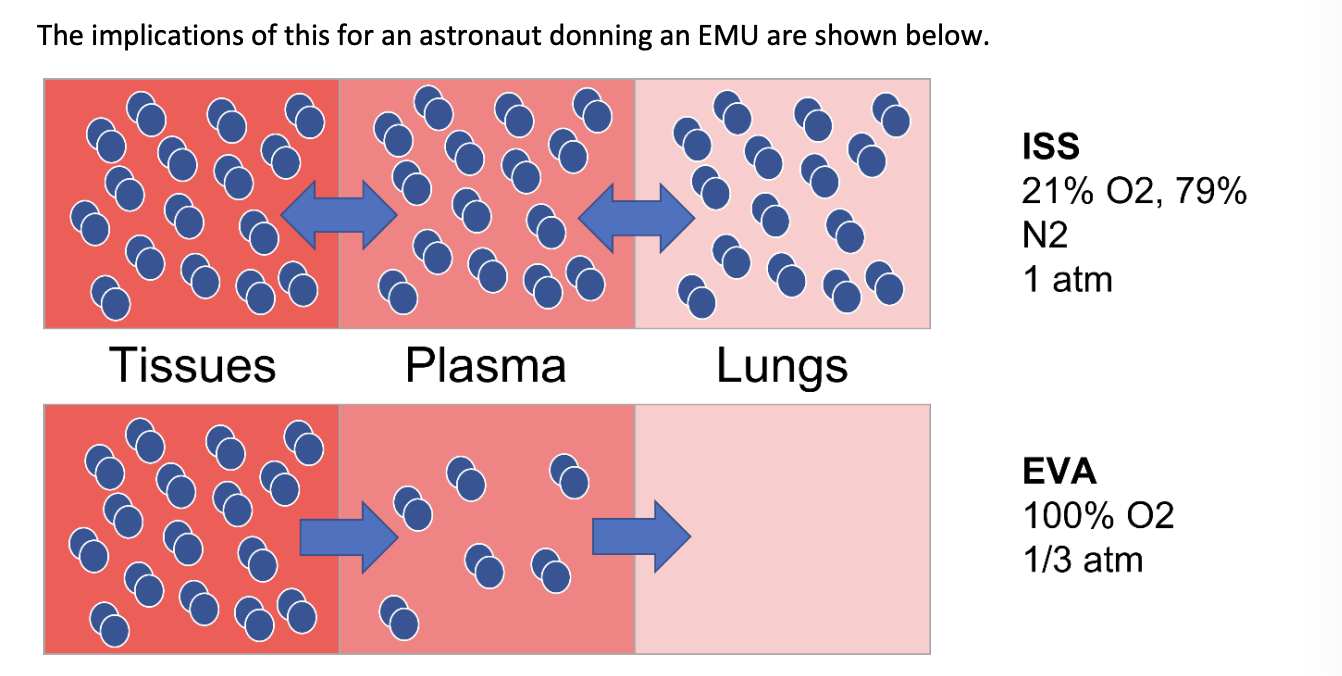
Why get decompression sickness in EMU and not ISS
ISS
dissolved gases in blood and tissues are proportional to the partial pressures of those gases in the lungs at 1 atm
So N2 is in equilibirium→ sets the amount of gas dissolved in the tissues and plasm
EMU
marked N2 gradient between tissues, plasma and lungs
THEREFORE: nitrogen rapidly come out of solution in response to reduction in its partial pressure
Where is N2 normally accumulated
body tissues (fat) where N2 solubility is higher
Why does equilibrium between tissues and environment slow
blood supply to adipose is poor
blood carries very little N2
What happens when decompression is rapid
N2 bubbles form in the blood
Small→ removed by circulation in the lungs
Large→ painful and lethal
N2 embolism in the joints ‘bends’
bubbles result in neurological disorders
result in death if they occlude coronary vessels/ cerebral vessels
Solution to this issues in astronauts?
denitrogenate bodies prior to donning EMU
minimum 12 hour staged decompression of spacecraft
100 mints of preoxygenation (breathing 100% O2) at lower pressure to replace N2 with O2
What four major stresses happen when experience weighltessness
altered hydrostatic pressure gradients
unloading/disuse of load-bearing tissues
altered vestibular function
altered sensory and balance information
Altered hydrostatic pressure gradients: What happens when arrive in microgravity First few minutes
Within minuts: 2 litres of body fluid redistributed towards the head and chest
puffy face
engorged neck and facial veins
feeling of bulging eyes
fluid accumulation in sinuses (lose sense of taste and smell)
leg volume decreases by 10% → bird legs
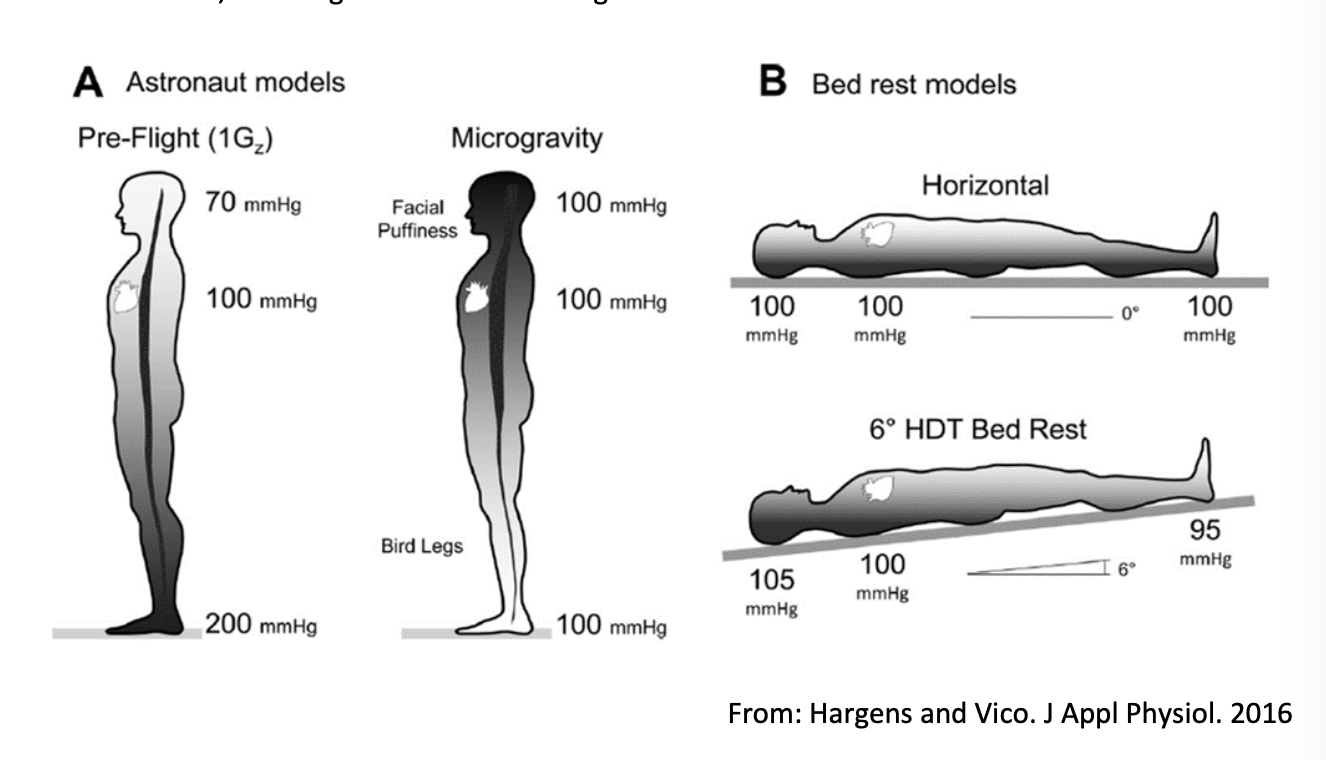
In first 48 hours
17% loss of plasma volume
decreased transmural pressure and lower muscle tone
→ short-term shift in fluid from plasma to interstitial/intracellular compartments
Headward fluid shift→ distends baroreceptors of central vasculature (henry-Gauer reflex)
Suppresses RAAS and increases ANP and suppress ADH:
increase diuresis
decreased thrist
fluid loss→ increases haematocrit
erythopoeiss is suppressed to stabilise equilibirium
BUT many returning show depressed haematocrits space anaemia
What is the most recent study explanation of space anaemia
Actually no sustained suppression of EPO
increase haemolysis (blood ferritin, transferrin and free iron and CO clearance) elevated in spaceflight
indicative of a marked and sustained destruction of RBC
What cardiovascular changes happen
Reduction in blood volume which causes:
reduces work output of the heart
overall reduction in heart size (cardiac atrophy) due to reduced left ventricular volume and left ventriucalr end-diastolic volume
increase HR post-spaceflight
MAP reduced
Orthostatic intolerance post-spaceflight cauused by what
Postrual changes that require regulation of arterial blood pressure to maintain cerebral blood flow
reduction in arterial baroreflex
loss of plasma volume
Orthostatic intolerance post-spaceflight what it causes
can cause
causea
vomiting
light-headedness (presyncope)
fainting (syncope)
How to counteract the reduced plasma volume loss
lower body negative pressure
isotonic water loading immediately before return to 1G
What is Spaceflight Associated neuro-ocular syndrome (SANS)
collection of morphological and functional changes to the eye
1/3 of astronauts experience
leads to longer-term impairmnets when back on earth
some permanent loss of vision
Characteristics of SANS
optic disc oedema
globe flatterning
increased choroidal folding in retina
What is the cause of SANS
hydrostatic gradient which causes
elevated intracranial pressure
In what way is the lung sensitive to gravity (1G)
influences the control of
pulmonary perfusion
alveolar ventilation
Gravity upon blood flow
gravitationl influences on lung compliance leading to preferential ventilation of the alveoli at the bas of the lungs
Wherefore what happens in a microgravity environemnt
removes regional variations in blood flow
BUT not eniterly uniform
Wht does this suggest
there are also non-gravitational variables controlling regional differences in these parameters in lungs
Changes in lung volumes in response to microgravity
Functional Residual Capacity FRC)→ decreased by 15%
why: cranial shift of diaphragm and abdominal contents
outward movement of rib cage as weight of abdomen removed
upward movement f shoulder girdle follwoing exposure to microgravity
Residual volume→ decreased by 18%
Why: large apicobasal gradient in regional lung volume is abolished in microgravity
What happens to the hypoxic ventilatory response (HVR) during spaceflight?
Suppressed during spaceflight
Why does this happen?
Explained by HVR being different in standing and supine positions
increase in carotid level pressure of 10mmHg
reduces ventilatory response to breathing 10% O2 by 33%
blood pressure changes when move from standing to supine because of abolition of hydrostatic differences
so pressures in carotid region in supine subject are 15-20 mmHg higher
pooling blood in lower extremities
predicted to elevate pressure in carotid region
explains depressed response to isocapnic hypoxia
Reduced loading and disuse of weight bearing tissues: What happens when you remove the load from the muscles and bones
1% per month loss of weight bearing bone mass
though non-load bearing bones (arms) relatively protected
Accompanied by signficiant calcium balance
altered Caclium homeostasis with excess plasma calcium excreted in the urine and faeces
more excretion
can cause more kidney stones
reduction in formation of new bone
decline in osteroblast activity
incrased osteroclasts
What have bed rest studies shown
accelerated bone resorption
inhbition of bone formation
→ causes of loss of bone
Who is susepatble to bone remodelling?
depends on the astronaut
alterations in blood flow brought about by loss of hydrostatic pressures may play a crucial role?
How to counteract these changes: exercise?
does not really work
What happens to stature?
Increases
why: removal of continual compressive force
expands vertebral column and significant increase in height
increases in first 2 weeks and stabilises after
noramlises again after return to Earth
Counteract loss of load solution
Short arm centrigfugation
effective during bed rest experiment
but massive equipment to take up space
Nutritional (vit D and Ca2+ supplements)
Bone remodelling also causes
decreased muslce mass
decreased strength
decreased metabolsim
How does muscle mass decline
Muscle fibre corss sectional area declines
Type I and type II fibres undergo decline in mean corss sectional area
muscle atrophy
EVIDENCE: needle biopsies taken before and after microgravity exposure
confirm atrophy
confirm mitochondrial morphology changes
As cross sectional area is prop to force: have loss of strength
Metabolic changes: mitochondrial protein changes
differentially expressed between samples from scott Kelly and his twin brother who did not go to space
but both trained the same
evidece of mitochondrial stress
Importance of HIT exercise
max oxygen consumption becomes suppressed unless moderarelty high intenesity exericse
needed to counteract muscle disuse
BUT important implications since aerobic exercie in microgravity taxes the already tight space allocations of current orbiting space craft
plus equipment is massive to have in the ISS