Unit 1: Biomolecules and Cellular Systems
 Call Kai
 Learn
Learn Practice Test
 Spaced Repetition
 Match
Match Flashcards
 Knowt Play
1/23

There's no tags or description
Looks like no tags are added yet.
Name | Mastery | Learn | Test | Matching | Spaced | Call with Kai | Chat |
|---|
No analytics yet
Send a link to your students to track their progress
24 Terms
Carolus Linnaeus (1700s)
Was the “first” taxonomist
The 5-Kingdom taxonomic hierarchy (classification system) became the
standard in Western science, what was it based on?
Similarities and diffrences in morphological and nutritional characteristics
Binomial nomenclature
Genus, species
Morphological
How it looks on inside and outside (observable)

What is a trend as you go down?
From most inclusive to more specific
The 5-Kingdom Classification System
Monera Protista Fungi Plantae Animalia
From Monera Protista Fungi Plantae Animalia, who has a nucleus?
Protista Fungi Plantae Animalia
From Monera Protista Fungi Plantae Animalia who has multicellularity?
Fungi Plantae Animalia
From Monera Protista Fungi Plantae Animalia, list who has these following nutritional characteristics: Aerobic respiration, photosynthesis, decomposers
Aerobic respiration: All
Photosynthesis: Mon, Pro, Plan
Decomposers: Mon, Pro, Fun
All life stores genetic information within and uses?
DNA molecules and use ribosomes (rRNA) to translate the information into proteins
What is an essential component of all life?
Ribosomes
When do mutations occur?
Randomly over time
How do nucleotides vary with their importance?
Some nucleotides are critical to the function of the ribosome and must be conserved, but some can change
The nucleotide sequences of the ribosome gene among species can be compared:
The more similar the sequence - the more closely related the organisms
The more differences = the longer ago the species diverged

The 3-Domain Classification system is based on?
Similarities and differences in molecular information (rRNA gene)
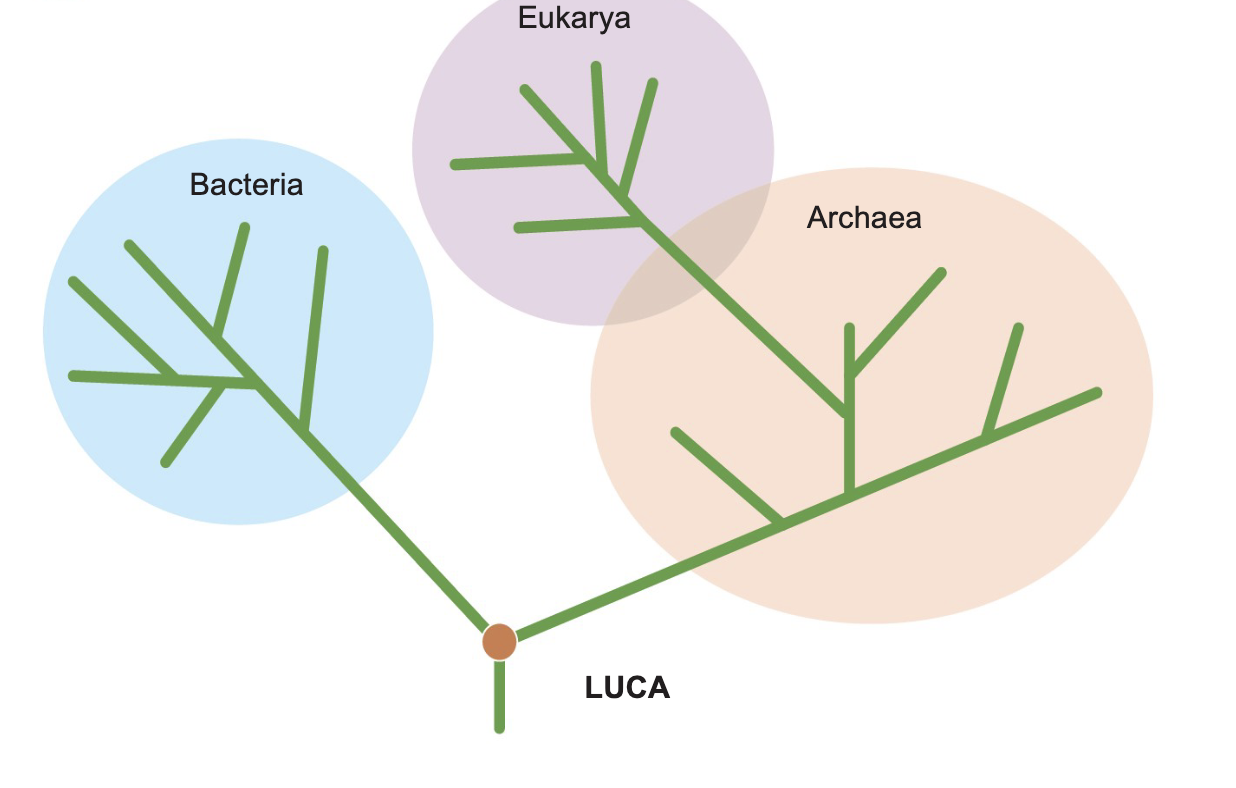
Name the 3 domains and list which where monera, fungi, plantae, protista, and animalia went.
Bacteria (monera), archaea (used to be monera), eukarya (fungi, plantae, protista, animalia)
Archaea are believed to emerge from?
Hydrothermal vents
Out of eukarya and bacteria, which have a nuclei?
Eukarya yes, bacteria no
In which order did the 3 from the domain classificartion system emerge?
Bacteria, archaea, eukarya
Eukaryotes and Prokaryotes both have?
Cell membrane : cytosol : use ATP : have DNA : use ribosomes for translation and existed in LUCA
Eukaryotes vs. Prokaryotes
E: Multiple linear ds DNA, Nucleaus with double membrane, 80 S ribosomes, endomembrane system (within the cell), and 10-100 micrometers
P: Single circular ds DNA, Nucleoid with no nucleus, 70 S ribosomes, Lack internal membranes, 0.5 - 5 micrometers

Domain bacteria characteristics
Prokaryotic
Unicellular
Cell wall of peptidoglycan (almost all)
Small ( 0.5-5 micrometers)

Domain Archaea characteristics
Prokaryotic
Unicellular
Cell walls of pseudopeptidoglycan
Also small (0.5-5 micrometers)

Domain Eukarya characteristics
Eukaryotic
Uni and multicellular
Cell walls (if present) of cellulose, chitin, pectin
Large!
