Unit 3
 Call Kai
 Learn
Learn Practice Test
 Spaced Repetition
 Match
Match Flashcards
 Knowt Play
1/33

There's no tags or description
Looks like no tags are added yet.
Name | Mastery | Learn | Test | Matching | Spaced | Call with Kai | Chat |
|---|
No analytics yet
Send a link to your students to track their progress
34 Terms
Explain PCR
Polymerase chain reaction
Tehcnique used to amplify segments of DNA. Cycles occur many times to increase amplification of DNA to 2^n copies (n=number of cycles). 1→2, 2→4, 4→8 and so on. Realisitcally, less copies will be made
-helps researches generate a large amount of the DNA region of interest to study
What are the components of PCR
-Template DNA: a small amount of starting DNA contaiing oyr reagion of intereste that will be the template to make additional copies of the DNA.
-Primers: a mix of two short, single stranded DNA sequences designed by researchers to bind at each end of the DNA region we want to amplify
-Taq DNA Polymerase: a DNA polymerase (which synthesizes the new DNA) that was isolated from thermophillic bacteria and is stable at high temps.
-Mg2+: a required co-factor for DNA polymerae to function
-dNTPs: a miz of the four nucleotide triphosphates (ATG, GTP, CTP, TTP) that will be the ‘binding blocks’ to synthezise new DNA strands.
-Buffer: a buffer containing various ions at concentrations optimized for Taq DNA Poly activity.
Steps of PCR
1) Combine all creation components (template DNA, primers, Taq DNA Poly, Mg2+, dNTPs, and buffer), and put inside a thermocycler, a machine that is programmed to rapidly and accuratley change temp.
Each Cycle has 3 steps, each with its own temperature to correlate with each steps purpose. Each cycle will be repeated multiple times
-Initial denaturation
a) denaturing: 94*C
b) primer annealing: 55-66*C
c) extension: 72*C
-Final extension
Typical PCR programs have 30 cycles, and there is an initial denatureation step at the beginning of program and final extension step to make sure all strands are at proper length
What temperature is Denaturation, and explain this step in deeper detail
94* C
The two DNA strands will come apart so primers can bind. this occurs at a high temp which breaks H bonds between the 2 strands.
What temperature is primer annealing
55-60*C (exact temp depends on the exact nucleotide compositions and length of the specifc primers)
The single strand DNA binders will bind to the single strands of template DNA at atrget sequences. 2 primers are used, which are designed to be complementary to the target sequences at each end of the section of DNA that you want to amplify.
Each primer s about 20 nucleotides long ]
Each primer also has a 5’ and 3’ end and can only bind to DNA strands in complementray fashion.
Conc. of primer is higher than conc. of template DNA so improve the changes that the primers anneal to the template DNA instead of the two single strands of the template DNA just reanneling to each other.
Whart temperature is extension
72*C
After primers are bound to template DNA, temp is raised to allow Taq poly to synthesize new DNA strands. The strands will start at the primer, and extend towards the 3’ end with matcing completmentary nucleotides.
Taq poly binds to 3’ end of each primer and uses dNTPs as building blocks to sequentially add the complementary nucleotides. Taq will catalyze the formation of a phosphodiester bond between nucleotides as it builds the DNA strand. To do this, the high energy phosphate bonds of the dNTP must be broken. This bond breakage will release energy to be used to drive the reaction.
What direction does Taq Poly add nucleotides to a new DNA strand
5’→ 3’
Whch direction does Taq poly read the template strand of the DNA template
3’→ 5’
What do researchers use to visualize the amplified DNA,
Gel electrophorises
Explain how gel electrophoresis work
Macromolecules like DNA, RNA, and protines are loaded into a solid matrix of gel and exposed to electric field which induces movement of molecules through the gel according to their size.
the gel is made by dissolving a polymer ( like agarose or polyarcylamide) in a buffer and heating the solution to pour into the gel cast. upon cooling the solution will solidify and be places into a container that acts as an electric cell with a (+) end and a (-) end. The container is filled with a buffer solution tht facilitate the movement of charged molecules from one end to the other when an electric field is applied.
The DNA samples to be analyzed mixed with dye, such as our PCR samples, are loaded into wells of the gel.
It is important to add a DNA ladder in one of the wells for size comparison.
Once ladder and sample are loaded, the gel apparatus is connected to a power source to create electric field. the samples will migrate down te cell towards the pos end.
Ethidium bromide (or other compounds) are used to allow the DNA in the gell to be visualized under a UV Light.
A camera can be used to take an image of the gel under UV light, resulting in a black and white image of the DNA bands in the gel.
What is the net charge of a DNA molecule
negative
this is due to the neg charged phosphate groups that make up the backbone of the DNA molecule
In whih direction will DNA molecules travel when an electric field is applied to the gel apparatus?
From the neg charged end to the pos charged end
Negativley charged DNA will move towards the positivley charged end.
What size DNA molecules move faster down the gel
smaller
What is a DNA Ladder
a medium compromised of a mix od DNA fragments of specific sizes. Recearches can use the ladder to compare the sizes of the DNA fragments in their sample
Explain ethidium bromide
a chemical used to make the DNA fragments in gel elecrophesis be visualized under UV light.
The ethidium bromide insters itself between DNA bases and floureseces an orange color under the light when it is bound to DNA.
Explain how gel electrophoresis is applied to protien fragment idetification, what is it called?
-Involves the tandem use of 2 types of gels to seperte protiens first by electric charge (up and down) and then by size (left to right).
This is called a 2D Gel and enables the fine seperation of individual protiens within a sample based on their unique combination of charge and size
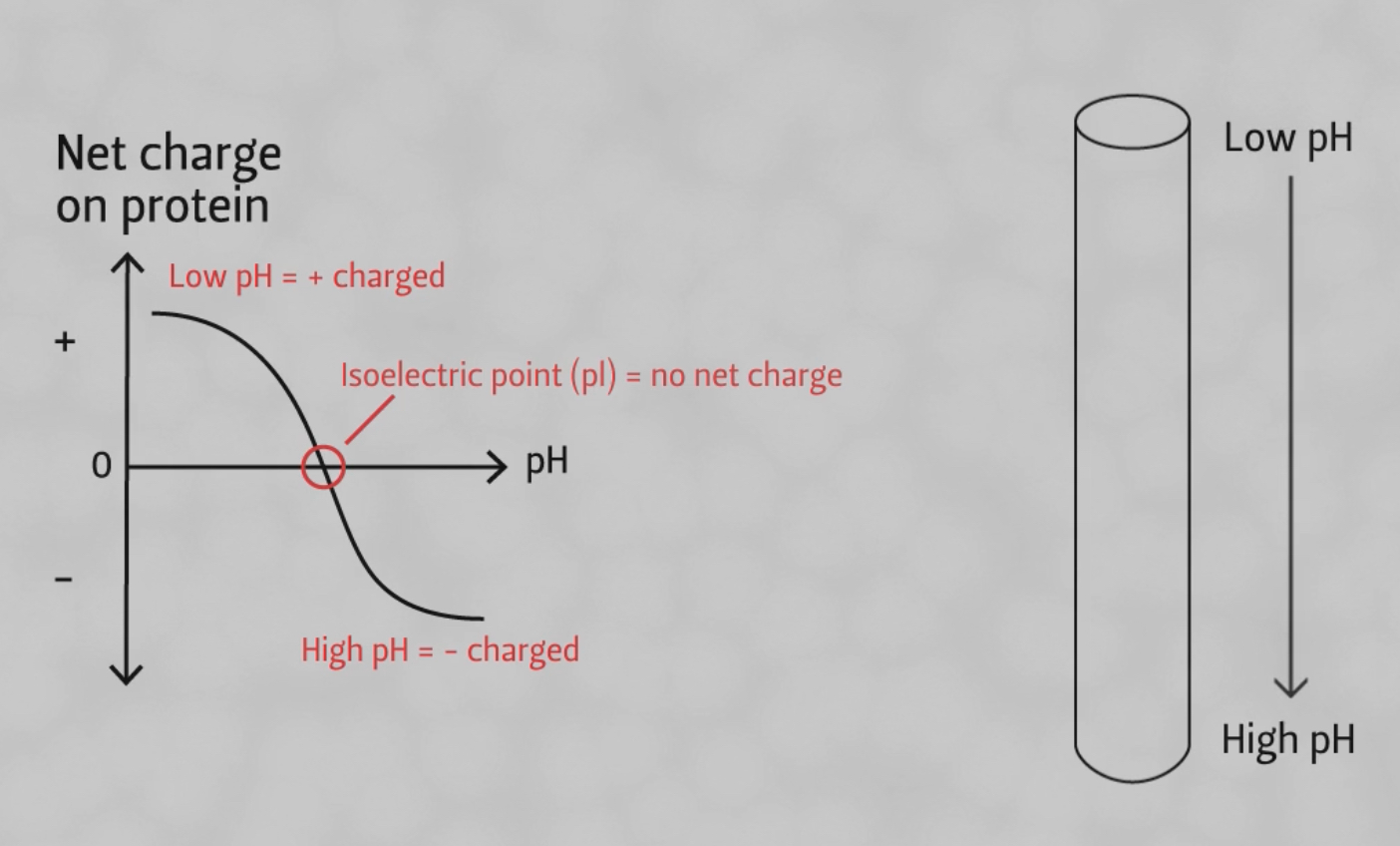
Net charge of a protien can be positve negative or neutral.Side chains of amino acids can be ceome charged depending of ph of the solution surrounding the protien.
The charges of each amino acid residue (along with charges arrising from post-translational modifications to protien) add up to give overall net charge.
Low pH means a ______ number of protons
large
At low pH, side chains tend to be _____, and most proteins tend to have a net ______ charge
protonated, positive
Carboxyl groups have ___ charge, while amine griups have _____ charge.
no, positive
As pH of the solution sorounding protiens increases, side chains become _____ and _____ protons. This means most proteins have a net _____ charge
ionized, lose
negative

At high pH, Carboxyl groups carry a ____ charge while aine grouns carry a ____ charge
neg, no
Explain the isoelectric point (pI), and how it is used in 2D gel eletrophorises
The pH in which all charges on the amino acids of the protien become balanced, making an overall met charge of the protien as zero.
Used during the first step of 2D gel electrophorises, and this feature is used to accomplish Isoeletric focusing. instead of the agarose gel is poured in a tube or skinny strip with a pH gradient along its length, making the pH of the gel low at one end and high at the other. The sample will be applied along the length of the gel. Each protien will become electrically charged depending on the pH of the gel surrounding it.
al electric field is applied across the length of the gel
Since the pH varies along the gel, charge on each protien changes as it migrates. Remember that side chains will lose protons as protines move to higher pH and gain protons as it moves to a lower pH. Eventually each protien will reach its isoelectric point (have a net charge of 0). Once they have no net electric field, they will not move in an electric field, even if the power supply is re-connected.
Some protiens may have the samd pI, so a second gel is used. This gel will seperate protiens based on size (molecular weight) and is called an SDS-PAGE gel
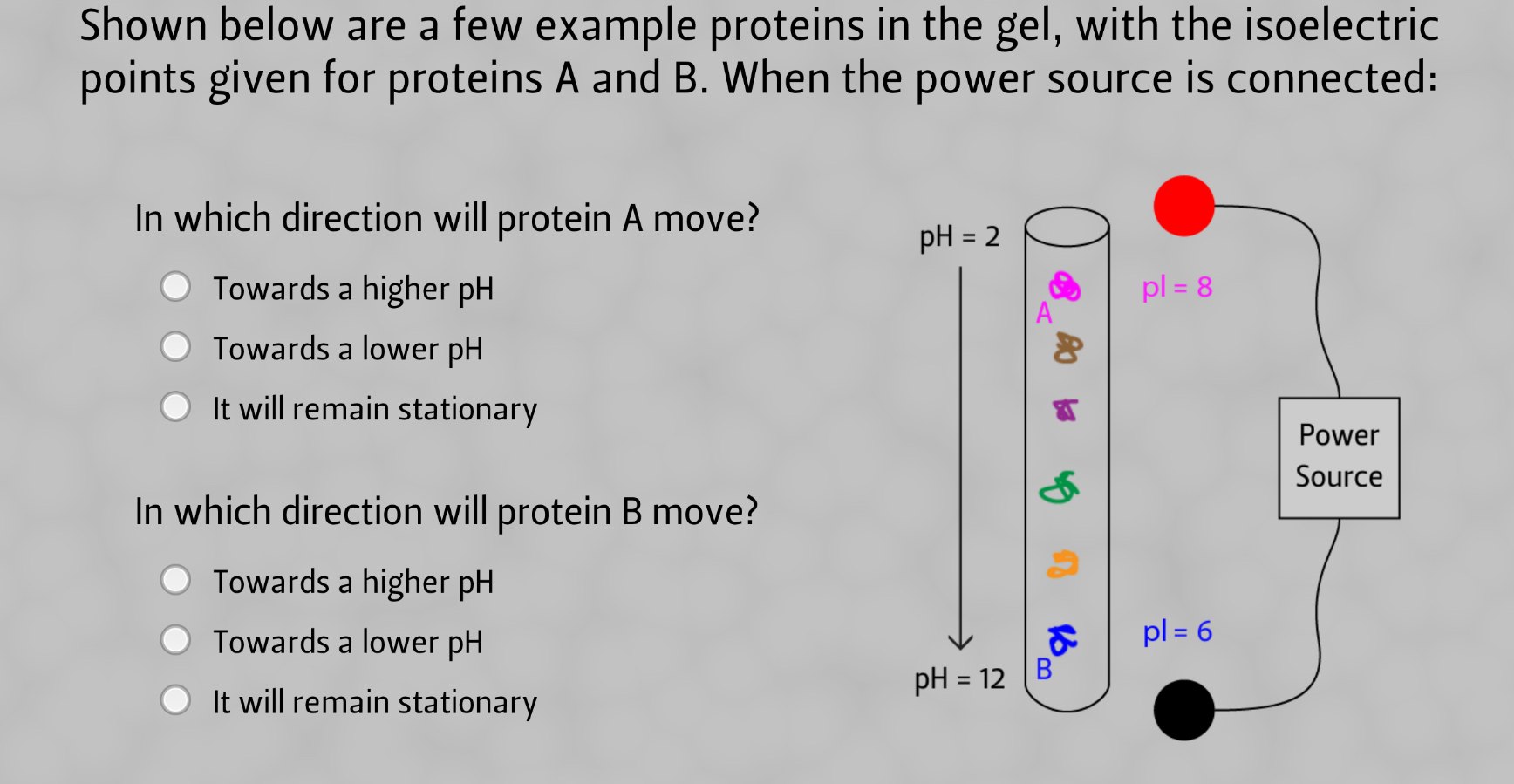
A will go towards a higher pH, while B will move towards a lower pH
What is a SDS-Page gel
The second gel used in 2D gel eletrophoresis of protiens.
Once the proteins are seperated by charge (by first gel), protiens will then go in SDS-PAGE gel to be seperated via size (molecular weight)
PAGE- PolyAcrylamide Gel Eletrophorises
(gel is made with polyacrylamide insted of agar)
SDS= Sodium dodecyl sulfate (- charge detergent that is added that will denature the protiens and code them with - charge so they migrate through gel according to their molecular weight)
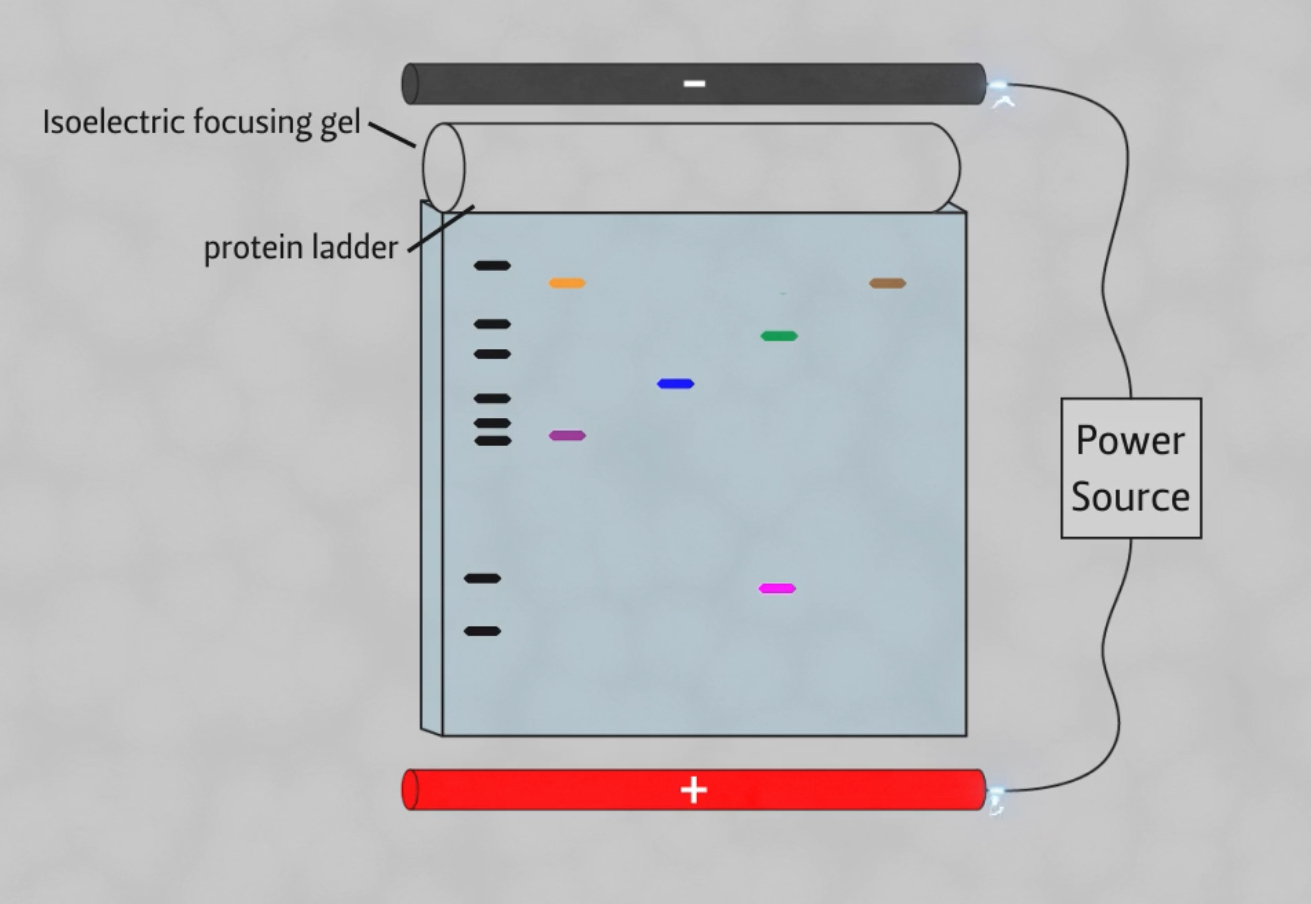
in a SDS-PAGE gel, large protines will be located closer to the
top of the gel (negative end)
Explain size exclusion chromatography
Another method used to seperate protiens in their active forms based on size. It seperate sprotiens based on the average radius of the folded protien moleculeas (this functions as both mol weight of protien and 3-D shape of protien). In this cse, proteins do not need to be denatured unlike they do during SDS-PAGE.
The sample (and buffer solution) is applied over a columb of porous beads (pores act as tunnels running through the beads). Molecules with a larger diameter than the largest pore in the beads cannot pass through the tunnels and move around the beads to reach the bottom of the column (ths means BIGGEST GOES FASTEST).
Size of poors determine ‘exclusion limit’
The smaller proteins will travel down the colunm slower due to these tunnels, so they will elute out of the column last.
Larger molecules will elute out of the Size Exclusion chromatography colum ____
first
Explain affinity chromtography
A method to seperte and purify protiens based on thier ability to bind to specific molecules. this method also uses a column that is backed with beads and buffer. the beads dont have holes but are coasted with molecule that binds to the protien(S) that the researchers want to purify.
Protiens that can bind will, and protiens that dont bind to that specific moledule will float to the bottom. We can seperate protien from beads by using a different and more concentrated source of the moecule that protien will bind to. This source will be poured over columb mulitple times and will wash through the column.
ex: ATP will be coated on beads so protiens that bind will ATP molecules will bind to beads.
what are Omics
A bioinformatic field that utlizes technques that are a mixture of computational analysis with laboratory analysis
Monogenic diseases vs Polygenetic diseases
Not all diseases are monogenic (disease due to a mutation found in a single gene)
Ex: Cystic fibrosis has mutations only on the DeltaF508 gene.
Diseases that are casued by a combination of mutations in many genes are polygenetic
Explain Genomics and give some applications
Geomicss: studies the definition and scope of the genome (entire DNA content of an organism.)
Can observe genetic predispositions
Often used to compare populations to an individuals genome to a “standard” one.
-Next-generation sequencsing (NGS) rapidly determined the sequence of a whole genome or exome.Uses a computer instead of a big gel
-Manhattan plots show SNPs
-CRISPR can be used to edit genes