Lab 10
 Call Kai
 Learn
Learn Practice Test
 Spaced Repetition
 Match
Match Flashcards
 Knowt Play
1/92

There's no tags or description
Looks like no tags are added yet.
Name | Mastery | Learn | Test | Matching | Spaced | Call with Kai | Chat |
|---|
No analytics yet
Send a link to your students to track their progress
93 Terms
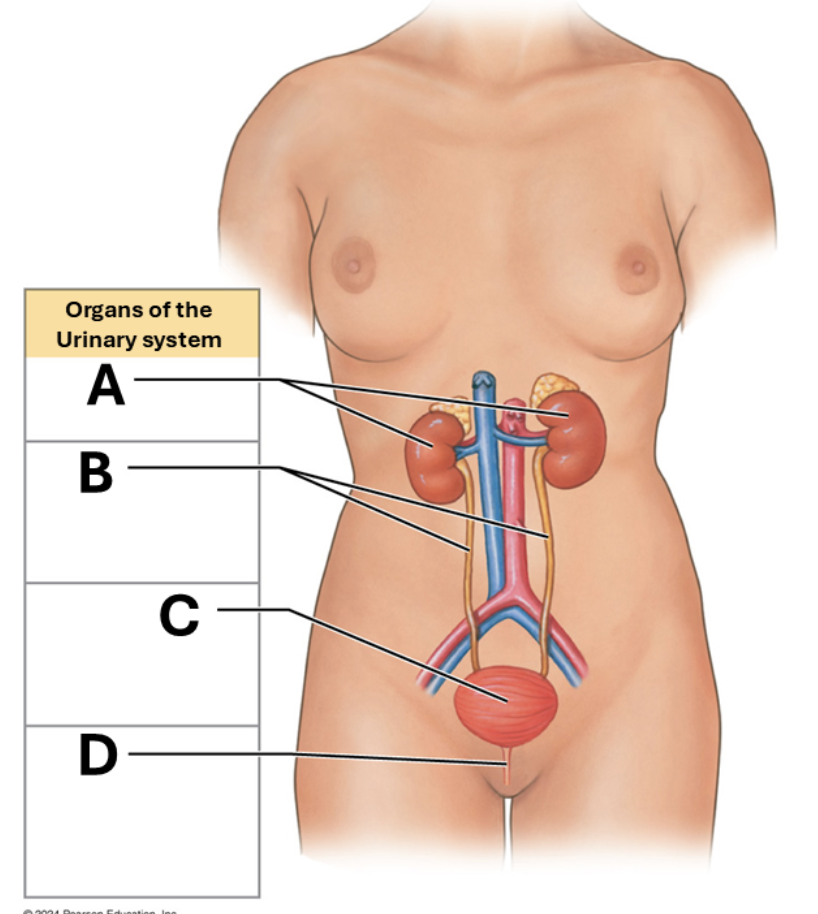
Urethra
D
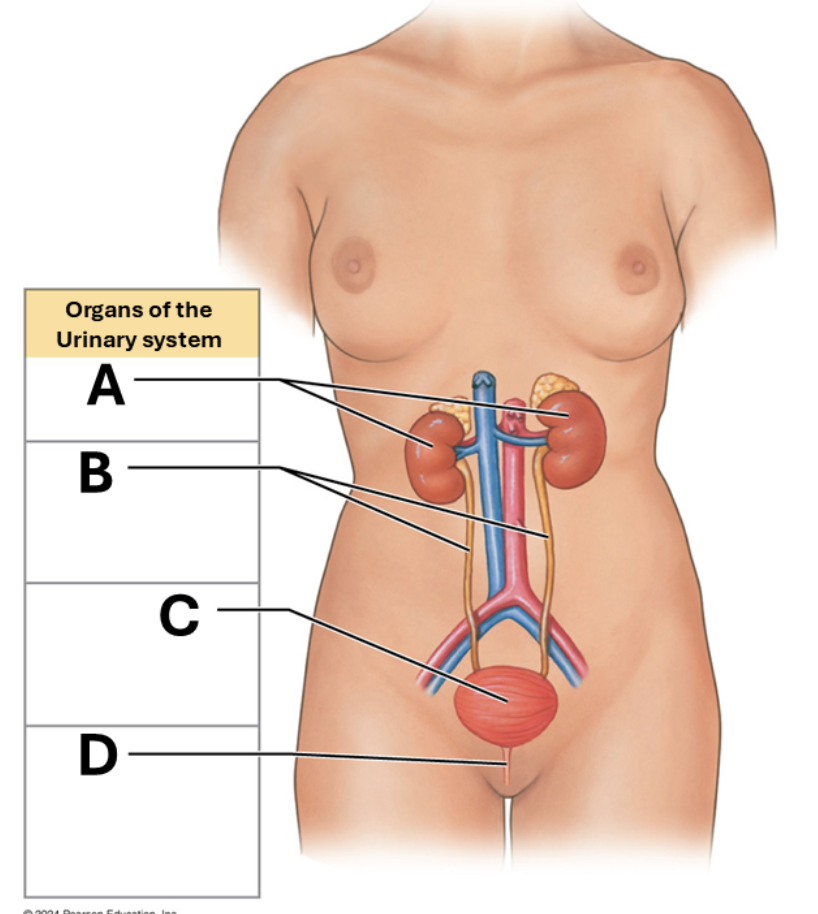
Ureters
B
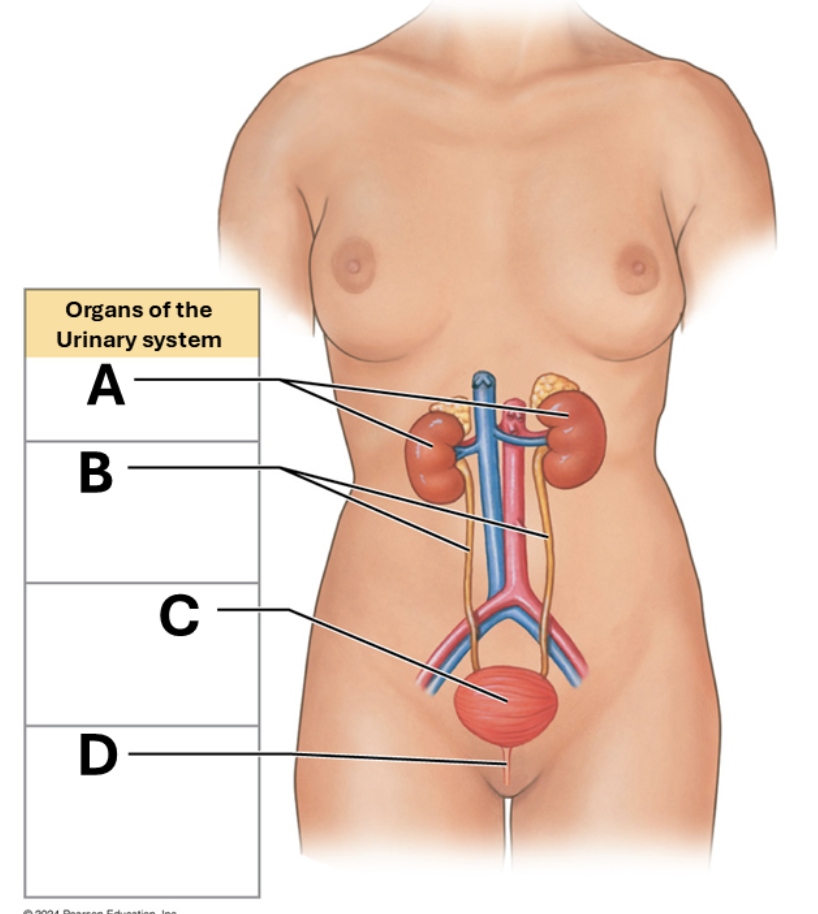
Kidneys
A
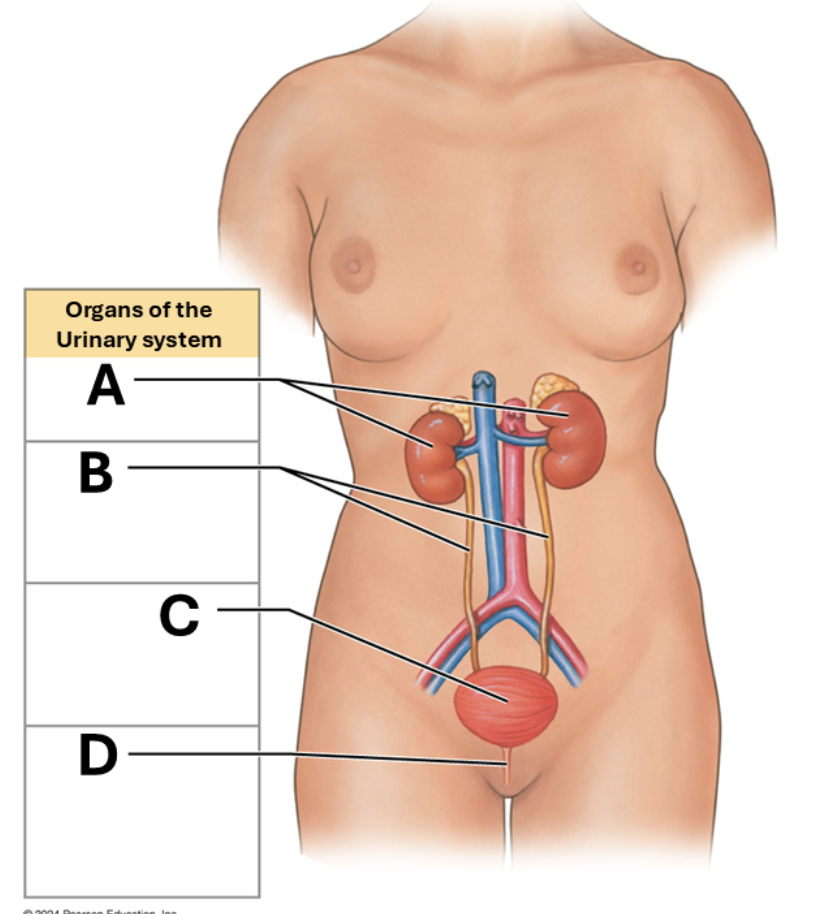
Urinary Bladder
C
Kidney Function
produce urine
Ureters function
transport urine to urinary bladder
Urinary Bladder function
temporarily stores urine
Urethra function
conducts urine out of body
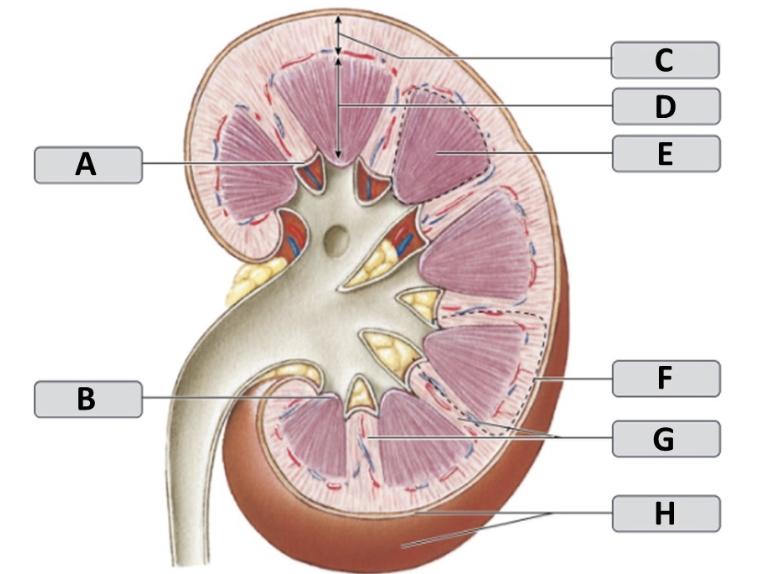
Renal Medulla
D
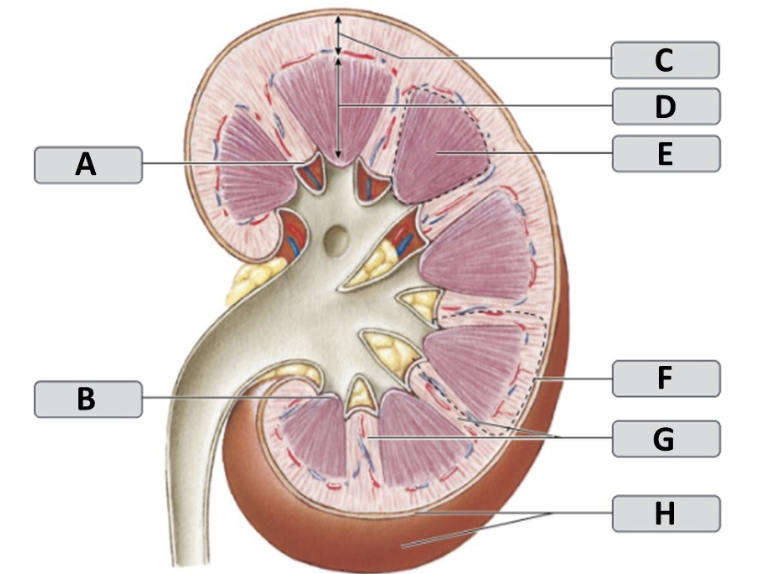
Renal Columns
G
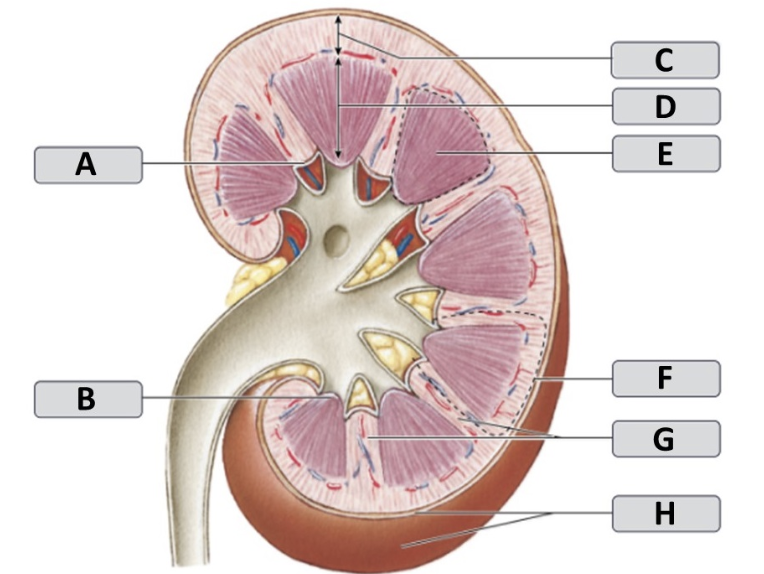
Kidney Lobe
F
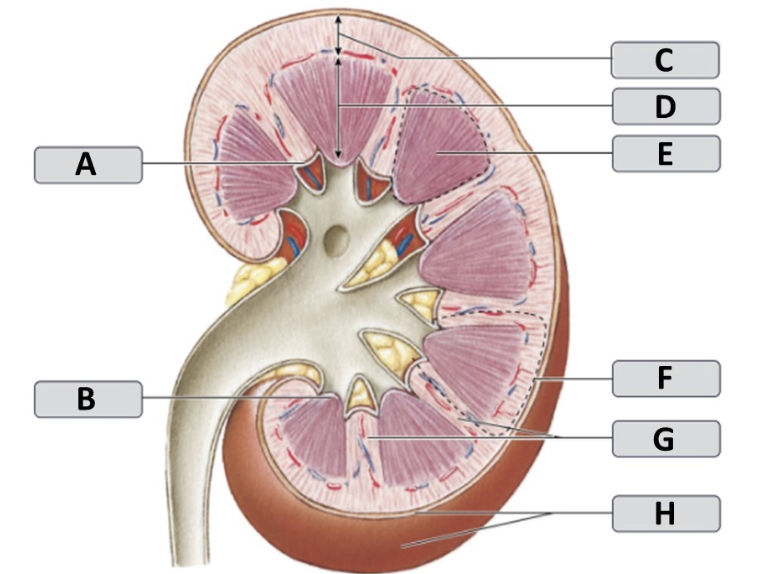
Renal Papilla
B
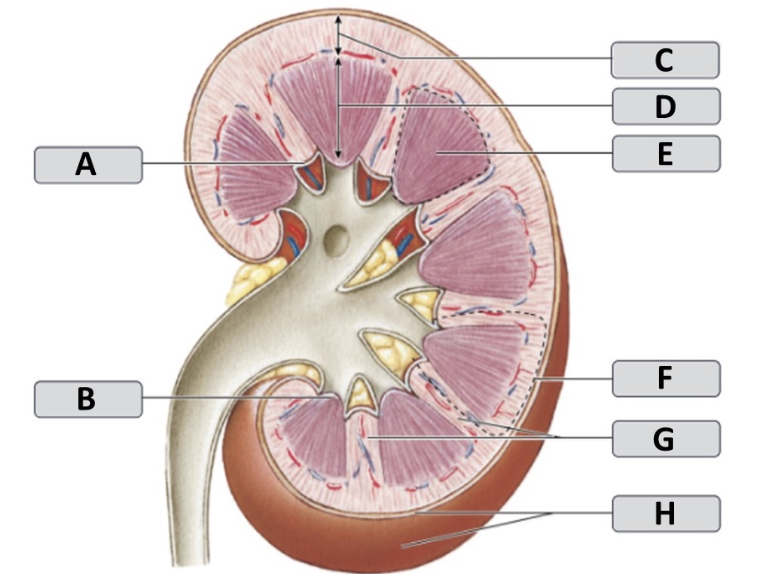
Fibrous Capsule
H
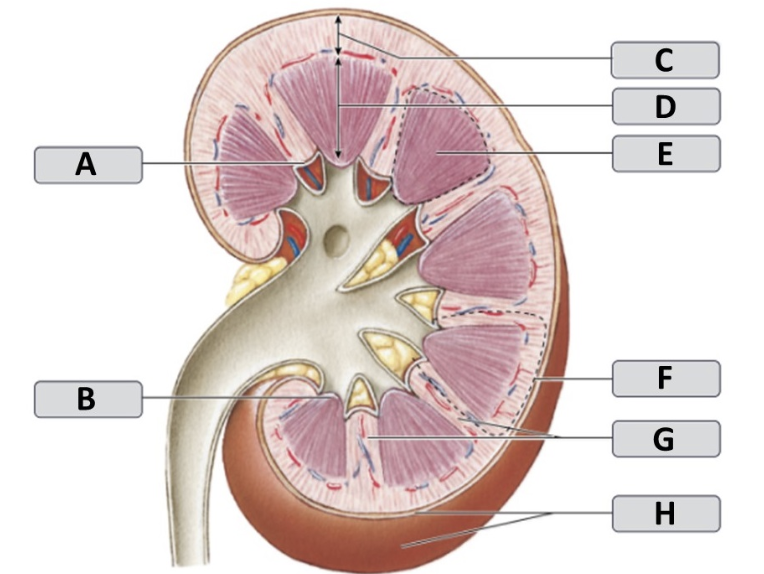
Renal Cortex
C
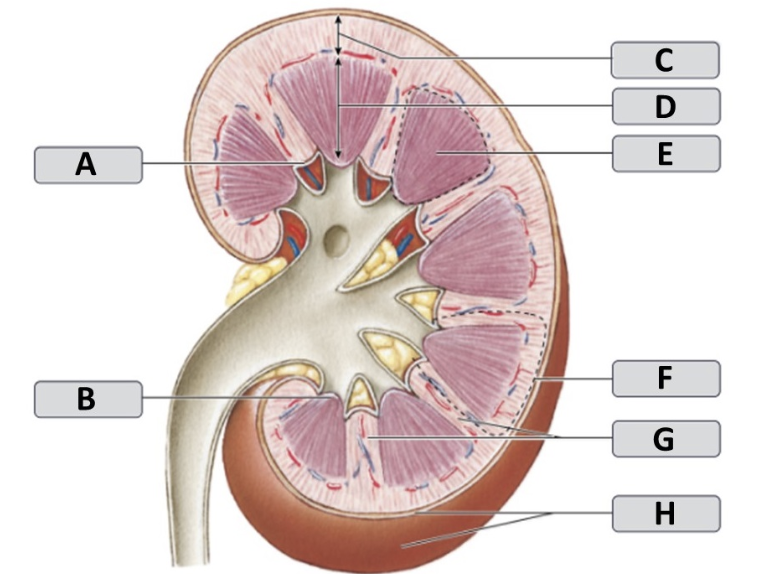
Renal Pyramid
E
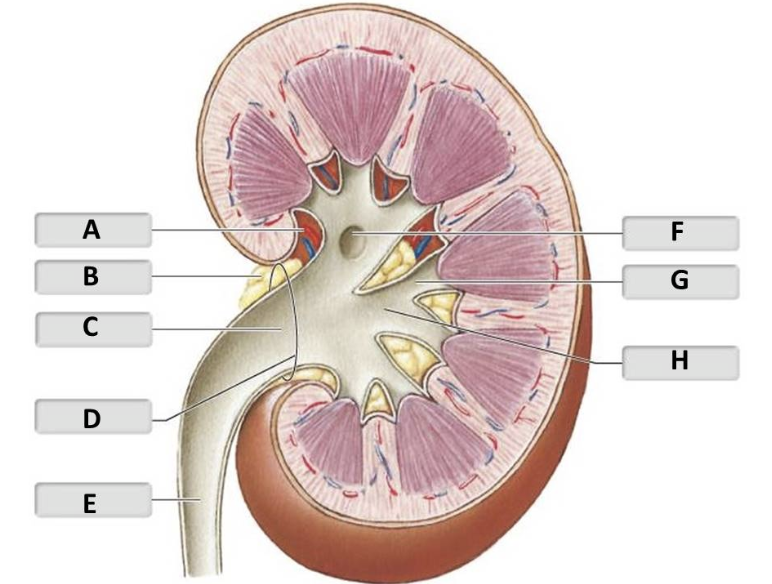
Major Calyx
H
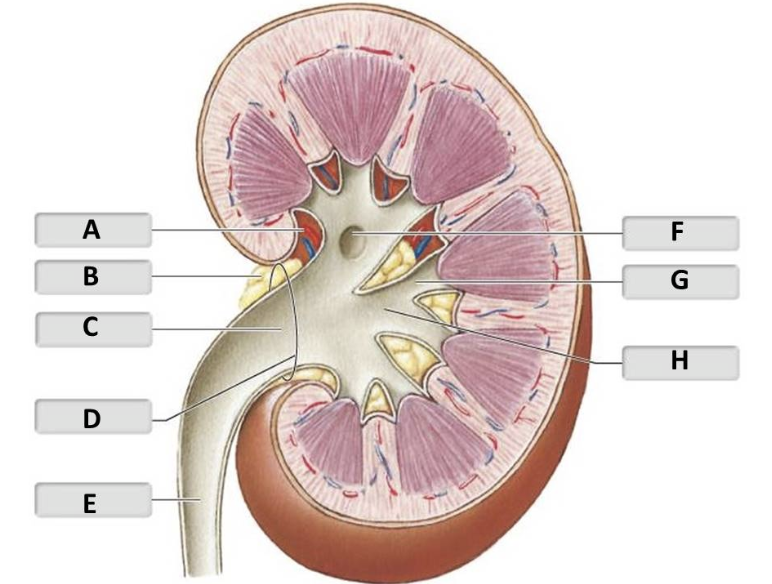
Ureter
E
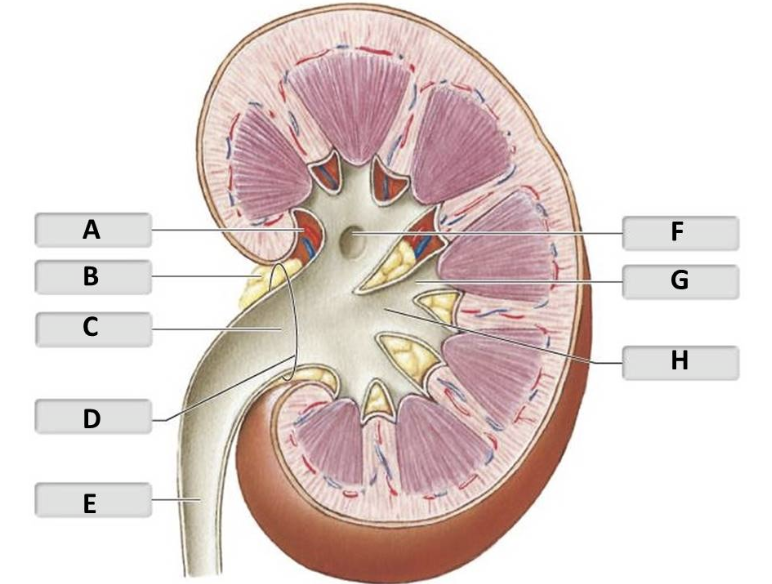
Renal Sinus
A
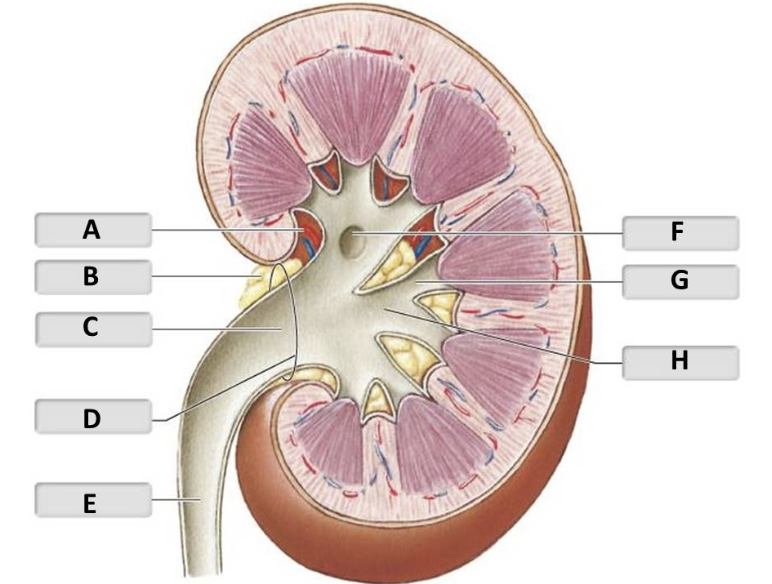
Hilum
D
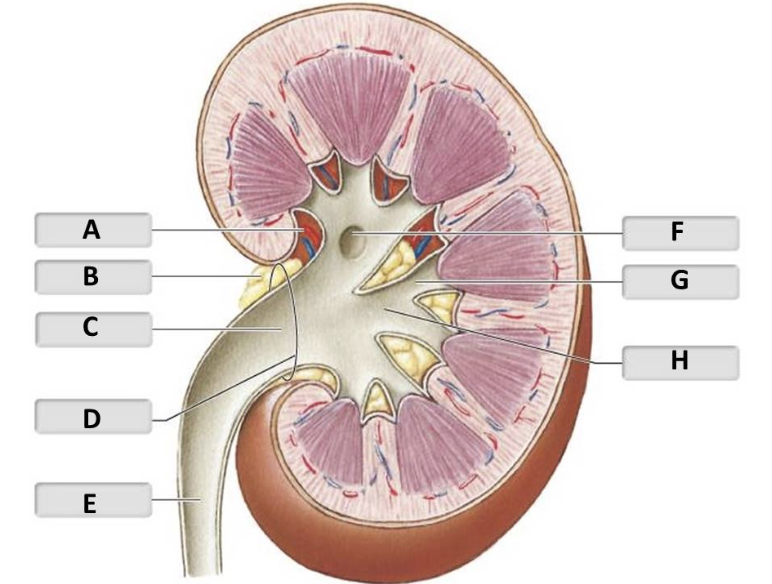
Minor Calyx
G
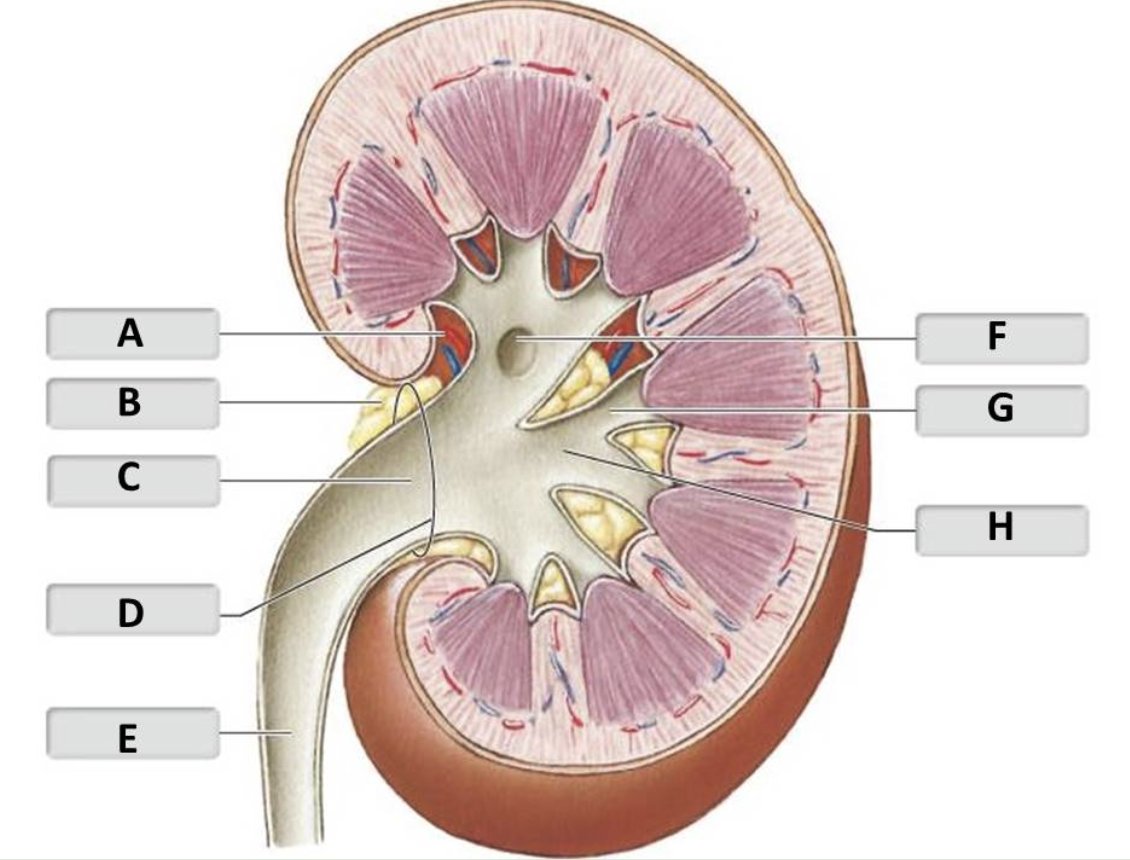
Renal Pelvis
C
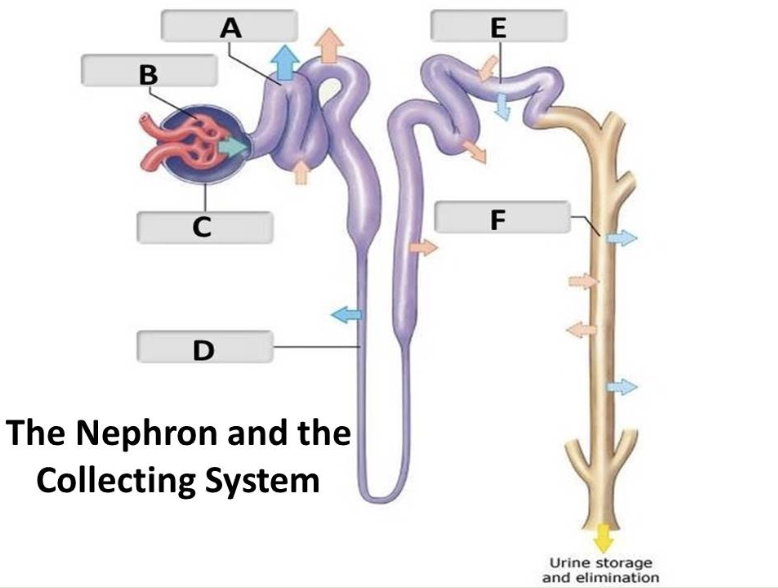
distal convoluted tubule
E
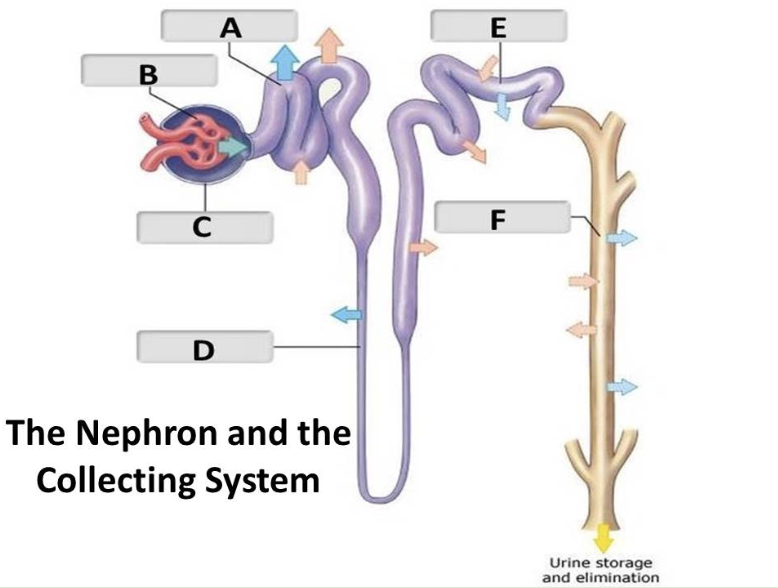
proximal convoluted tubule
A
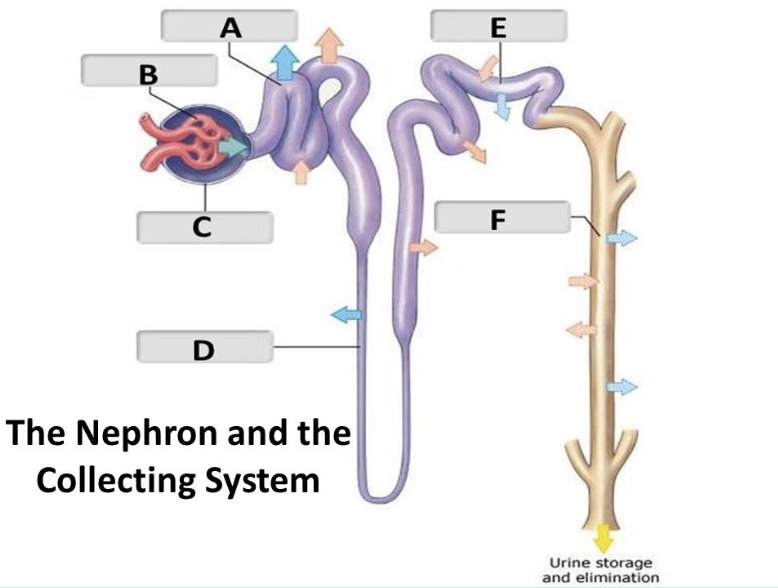
glomerular capsule
C
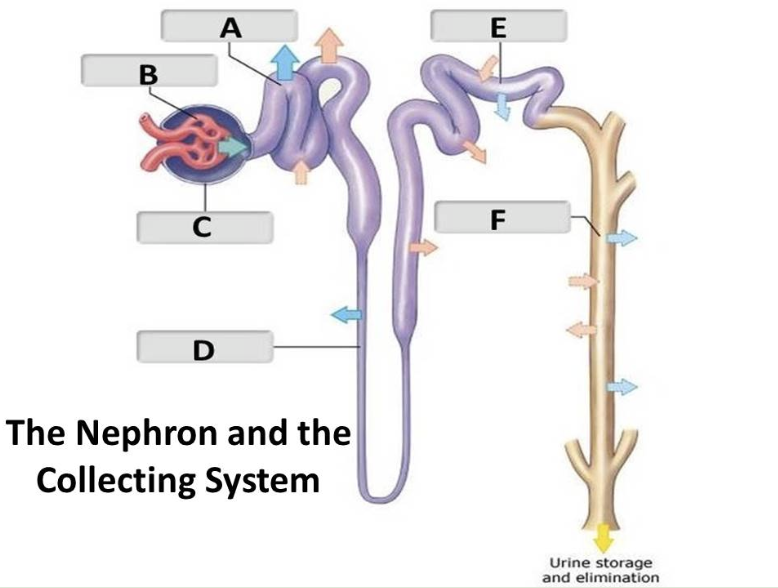
nephron loop
D
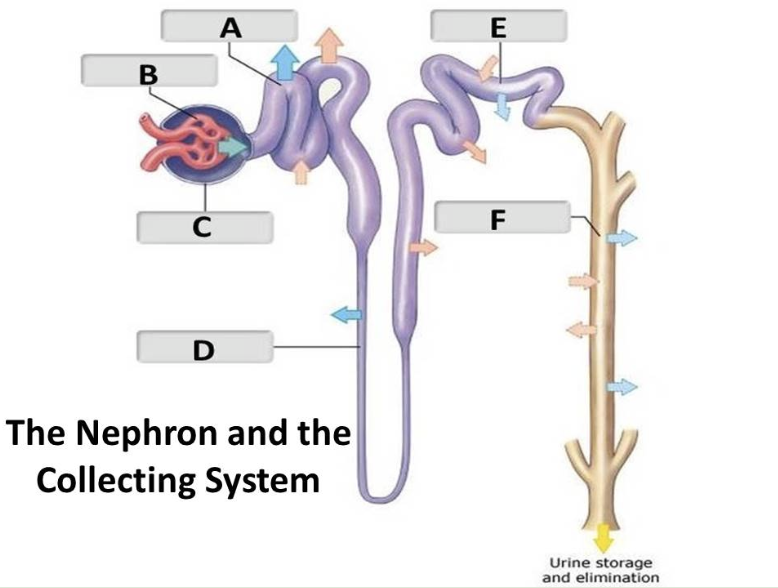
collecting duct
F
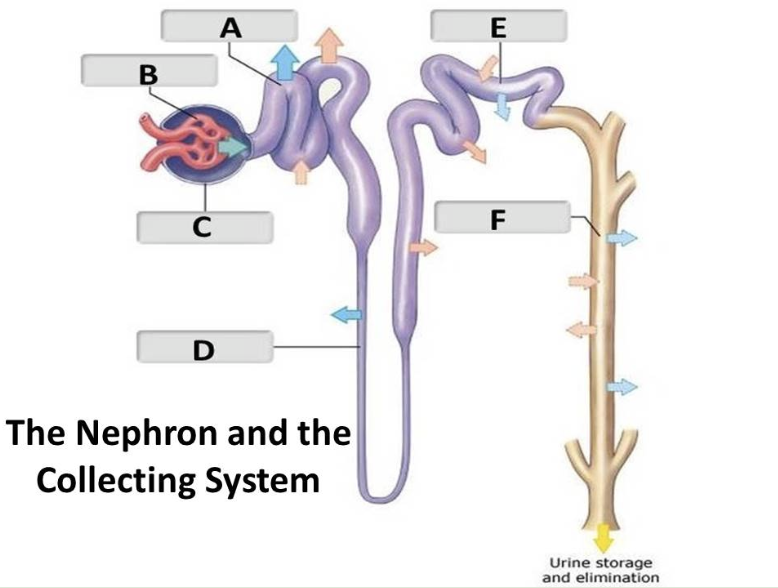
glomerulus
B
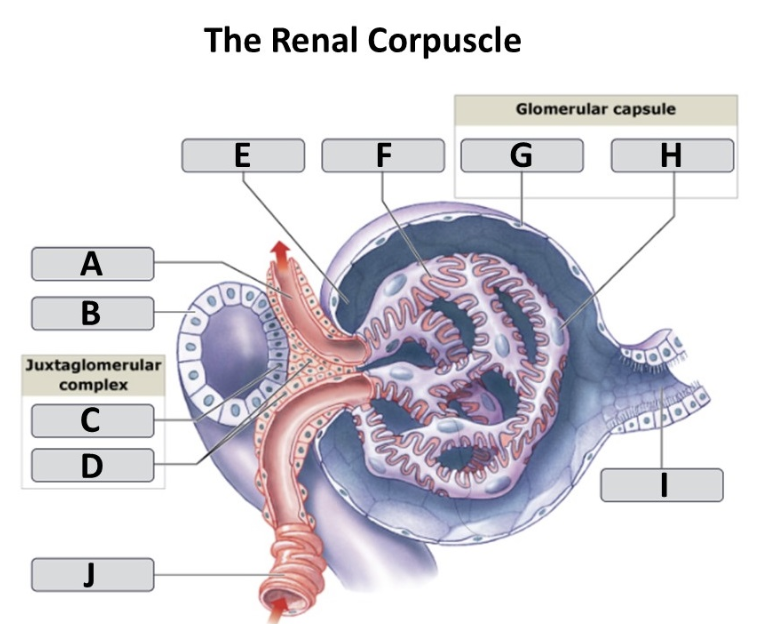
capsular outer layer
G
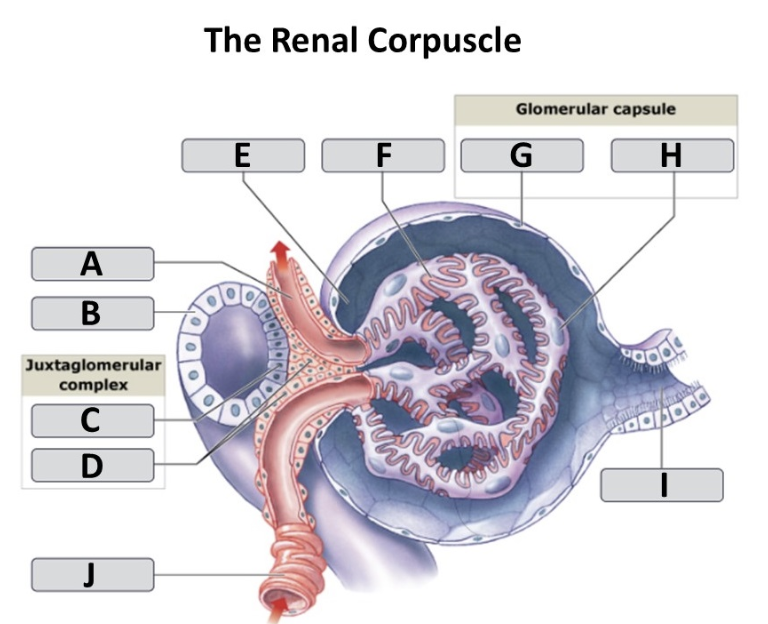
efferent arteriole
A
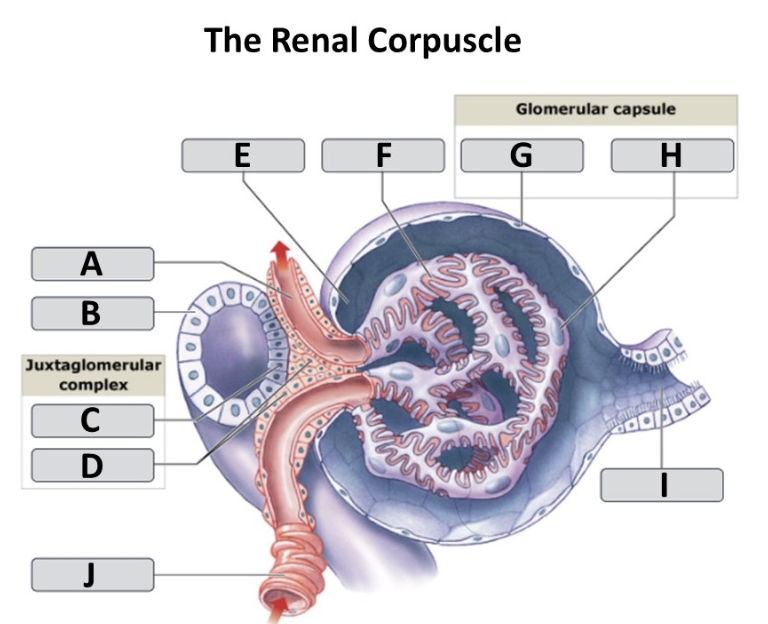
extraglomerular mesangial cells
D
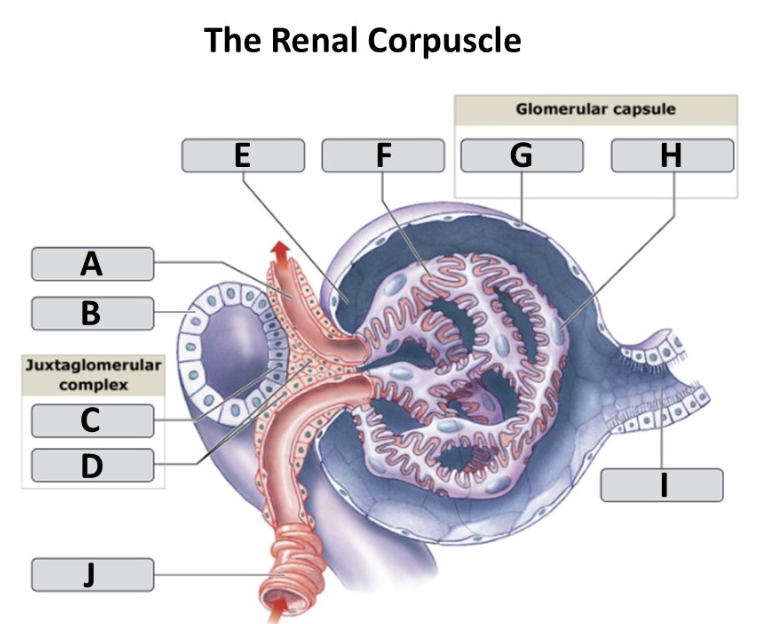
afferent arteriole
J
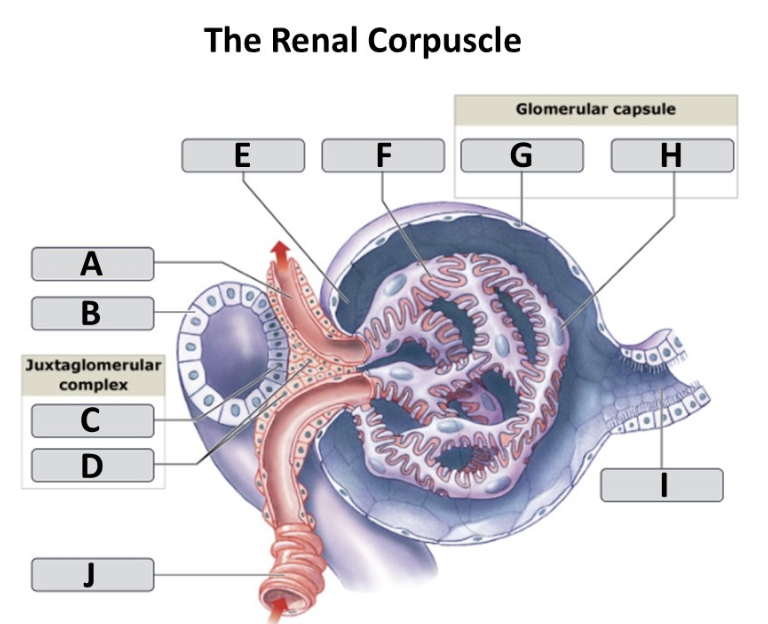
glomerular space
E
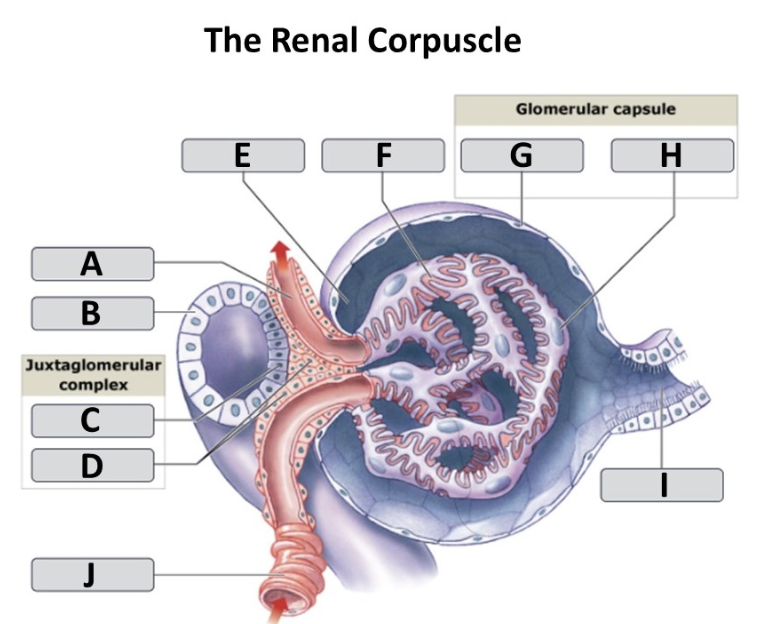
proximal convoluted tubule
I
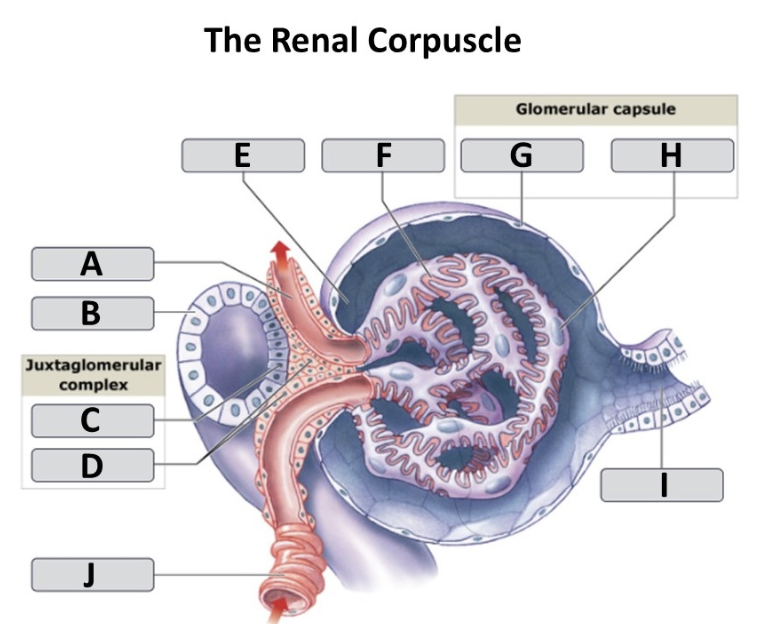
visceral layer
H
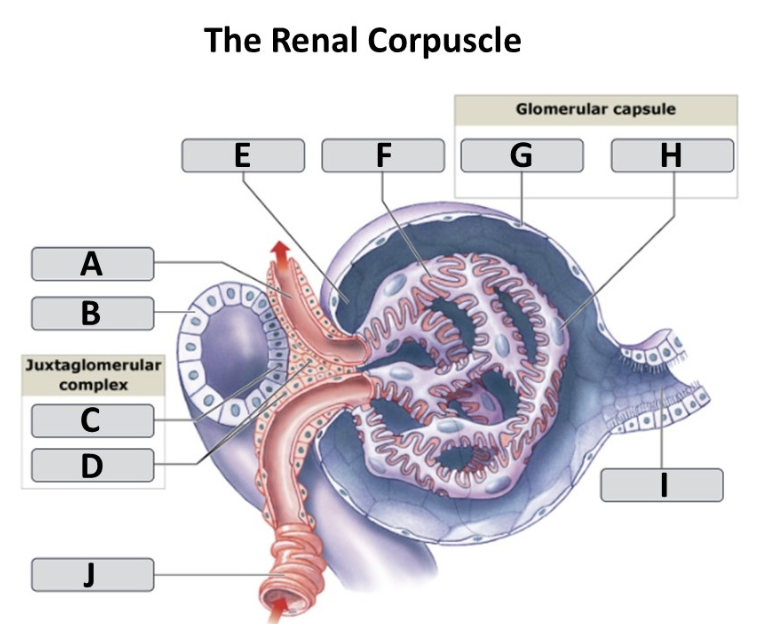
distal convoluted tubule
B
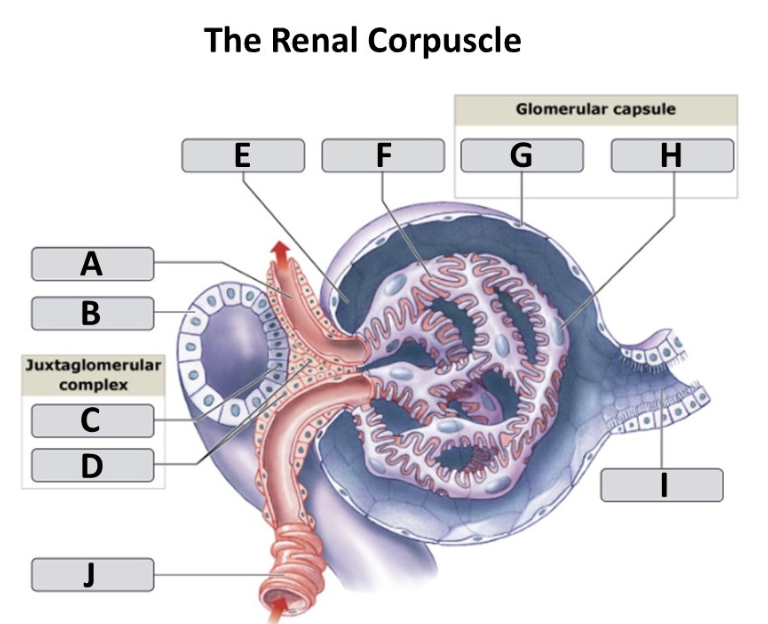
macular densa
C
The fluid generated by the renal corpuscle that is similar to blood plasma's osmotic pressure and composition, but doesn’t contain plasma proteins is __________.
filtrate
What renal segment functions to generate ~180L/day of fluid similar in composition to protein-free blood plasma?
renal corpuscle
Metabolic processes produce nitrogenous waste products that are eliminated in urine. Which nitrogenous waste is the most abundant in urine?
urea
Which of the following substances should not be detected in the urine of a healthy individual?
protein
Which of the following should not be detected in glomerular filtrate?
proteins and lipids
The pressure exerted by a fluid on the walls of its container is ___________ pressure.
hydrostatic
The pressure created in a fluid by large nondiffusible molecules, such as plasma proteins that cannot move across a capillary wall is called ___________ pressure.
colloid osmotic
True or False? The afferent arteriole bringing blood to the glomerulus is narrower than the efferent arteriole.
false
The average pressure in the systemic arteries over a complete cardiac cycle is the _____________ pressure.
mean arterial
Blood is sieved through three layers of the glomerular filtration membrane producing a protein-free fluid using a process called _______________.
filtration
Which of the following would not pass through fenestrated glomerular epithelium?
formed elements
The fluid in the renal corpuscle’s capsular space exerts a force called ______________.
capsular hydrostatic pressure (CHP)
The pressure exerted by the blood within the glomerular capillaries, which forces water and solutes through the filtration membrane is ____________.
glomerular hydrostatic pressure (GHP)
The pressure exerted by proteins in blood plasma, which draws water back into the glomerular capillaries from the filtrate is ____________.
glomerular osmotic pressure (GOP, also known as BCOP)
Hypertension exposes the glomerular filtration membrane to increased force. Which force would be affected by hypertension?
glomerular hydrostatic pressure (GHP)
Hypertension exposes the filtration membrane to increased force and increases the glomeular hydrostatic pressure from 55 to 65 mmHg. What will happen to the glomerular filtration rate?
it will increase
Liver disease hinders the liver's ability to make plasma proteins such as albumin. Which force would be affected?
glomerular osmotic pressure (GOP also known as BCOP)
Liver disease hinders the liver's ability to make plasma proteins such as albumin. GOP (BCOP) drops from 30 mmHg to 25 mmHg. What will happen to the glomerular filtration rate?
it will increase
Urinary tract obstructions may occur along any part of the urinary tract. These blockages cause urine to back up in the kidneys. Which force would be affected by urinary tract obstruction?
capsular hydrostatic pressure (CHP)
Urinary tract obstructions may occur along any part of the urinary tract. These blockages cause urine to back up in the kidneys. Capsular hydrostatic pressure increased from 15 mmHg to 20 mmHg. What will happen to the glomerular filtration rate?
it will decrease
The amount of filtrate produced by the glomerulus in one minute is the ____________.
glomerular filtration rate
A direct intrinsic control mechanism called myogenic control modifies glomerular filtration rate by vasodilating or vasoconstricting the _______________.
afferent arteriole
True or False? Two intrinsic control mechanisms to maintain glomerular filtration rate are myogenic control and tubuloglomerular feedback.
true
When intrinsic controls cannot maintain a normal glomerular filtration rate, extrinsic controls take over to remediate the situation so renal failure doesn’t occur. Which of the following are extrinsic controls?
the sympathetic system and RAAS
Jordan goes out for a morning run. His mean arteriole pressure increases to 115 mmHg, thus increasing his glomerular filtration rate (GFR). Would vasodilation or vasoconstriction of his afferent arteriole bring his GFR to normal?
vasoconstriction
While Jordan is reading the Sunday paper, the dog starts barking. Jordan goes to investigate. His mean arterial pressure increases to 88 mmHg. His glomerular filtration rate (GFR) increases slightly. Would vasodilation or vasoconstriction of his afferent arteriole bring his GFR to normal?
vasoconstriction
Jordan is napping with his son. His mean arterial pressure decreases to 80 mmHg. His glomerular filtration rate (GFR) decreases too. Would vasodilation or vasoconstriction of his afferent arteriole bring his GFR to normal?
vasodilation
Jordan is experiencing chest pain. His mean arterial pressure plummets to 70 mmHg. causing a major decrease in his glomerular filtration rate (GFR). In this emergency situation, would the afferent arteriole vasodilate, vasoconstrict, or would neither occur?
vasoconstriction
In the juxtaglomerular complex, what cells monitor and respond to changes in the NaCl concentration in the renal filtrate?
macula densa cells
The renal corpuscle consists of two parts, the glomerular capillaries and what?
the glomerular capsule
Glomerular filtration is a process of bulk flow driven by what?
glomerular hydrostatic pressure
Lower than normal NaCl concentration in the ascending limb of the nephron will cause the afferent arterioles to __________.
vasodilate
Glucose is reabsorbed by ______________ in the apical membrane of epithelial cells of the PCT.
secondary active transport
In the PCT, the apical membrane of epithelial cells cotransport sodium and glucose. Since they are moving in the same direction, this cotransporter is a/n _____________.
symporter
In the PCT, glucose leaves the basolateral surface of the epithelial cell by _______________.
facilitated diffusion
When blood sugar levels are high, excess glucose is excreted in the urine. This is known as ____________.
glycosuria
Which transport pathway involves the transport of a solute across both the apical and basolateral membranes of a tubular epithelial cell?
transcellular transport
Which transport pathway involves transport of a solute between the cells of the renal tubule?
paracellular transport
Which answer describes tubular secretion?
it disposes of toxins, drugs and metabolic wastes
Which answer describes the process of tubular reabsorption?
it reclaims items from filtrate and returns them to the blood
During osmosis, water moves toward________.
the highest solute concentration
The following items have what in common? Water, nutrient molecules such as glucose, and specific ions.
they get reabsorbed from the PCT filtrate
Reabsorption of nutrients like glucose and amino acids takes place in the proximal convoluted tubule (PCT) via secondary active transport. This transport would decrease if which change took place?
the number of sodium-potassium ATPases in the basolateral membrane decreases
Which hormone causes an increase in urine volume and urine sodium content?
ANP
Which two hormones promote facultative water reabsorption (water follows solute)?
aldosterone and ADH
A decrease in blood volume and an increase in extracellular fluid osmolarity leads to the formation of what?
a small volume of concentrated urine
Molly produces copious, dilute urine on an ongoing basis and is severely dehydrated. This could be due to which condition?
absence of ADH
What is the function of aldosterone?
stimulates the reabsorption of sodium
What would be the effect of inhibiting aldosterone?
all of these are effects of inhibiting aldosterone
How would inhibiting aldosterone affect blood volume and urine volume (assume ADH is present)?
urine volume would increase and blood volume would decrease
Why would inhibiting aldosterone help to control high blood pressure?
sodium and water remain in the filtrate, increasing urine volume and decreasing blood volume.
The majority of reabsorption of water and solutes from the filtrate takes place in which part of the renal tubule?
proximal tubule
During reabsorption, what causes water to move from renal tubules into the interstitial space around the peritubular capillaries?
sodium is transported from the tubule cell to the interstitial space, and water follows by osmosis.
Toxins, drugs, and metabolic wastes are cleared from the body by secretion into the filtrate. Which parts of the nephron could these items be secreted into?
any part of the nephron except the nephron loop
Glucose reabsorption utilizes transport proteins in the proximal convoluted tubule cells to move glucose into the blood. The maximum amount of glucose that can be transported when all of the transport proteins are full is known as what? Any remaining glucose will be excreted in the urine.
transport maximum
Some drugs and waste products do not pass through the filtration membrane of the glomerulus into the filtrate. How do the kidneys ensure that these waste products get excreted in urine?
by utilizing secretion
An individual is severely dehydrated. How would this affect their ADH release and the volume of their urine?
ADH release would increase and urine volume would decrease