Life, Earth and Universe
 Call Kai
 Learn
Learn Practice Test
 Spaced Repetition
 Match
Match Flashcards
 Knowt Play
1/20

There's no tags or description
Looks like no tags are added yet.
Name | Mastery | Learn | Test | Matching | Spaced | Call with Kai | Chat |
|---|
No analytics yet
Send a link to your students to track their progress
21 Terms
Cosmology
study of the universe as a whole
Astronomy
study of space and celestial objects
Astrophysics
the application of physics to the study of space and celestial objects
Scientific Method
science must be empirically testable, and models must be falsifiable and make testable predictions
Positivism
knowledge must be based on empirical, observable phenomena
Logical Positivism
scientific theories must be empirically testable and based on observational data
Falsifiability
the property of a scientific hypothesis that allows for the possibility of evidence that could contradict it
Cosmological Principle
at sufficiently large scales and on average, the universe can be assumed to be homogeneous (statistical similarity between locations = irrelevant where you are) and isotropic (statistical similarity between directions = see the same in all directions)
Perfect Fluid Approximation
at sufficiently large scales and on average, cosmic content is modelled as a perfect fluid = barotropic medium (pressure depends only on density), in cosmology assumed compressible (to allow for the expansion or contraction of space); galaxies (and clusters) are treated as point-like masses in the fluid
1920 “Great Debate”
Key Questions: what is the true scale of the universe, and what are the mysterious “spiral nebulae” seen in the sky?
Harlow Shapely: “Milky Way is the entire universe, spiral nebulae are small, nearby clouds.”
Heber Curtis: “Milky Way is just one of many galaxies. Spiral nebulae are huge, faraway “island universes”.”
Parallax
the apparent shift in an object's position when you view it from two different points
Stellar Parallax
apparent shift of a nearby star’s position against background stars, as Earth moves around the Sun; works only for relatively nearby stars

Cosmological Units
Astronomical Unit (AU): average distance from the earth to the sun
Parsec (pc): the distance at which the mean radius of the earth’s orbit subtends and angle of one arc second (1/3600th degree)
Light Year (ly): the distance light travels in a year

Standard Candles
an astronomical object with a known luminosity; used in the Cosmic Distance Ladder
Luminosity
the true power output of a source (unit: L)
Apparent Brightness / Flux
the power measured per unit area [m^2] in distance r [m] from the point source; follows inverse-square law
![<p>the power measured per unit area [m^2] in distance r [m] from the point source; follows inverse-square law</p>](https://assets.knowt.com/user-attachments/f0605503-e03d-44b3-8a34-078021a932ba.png)
Main Sequence Star
stable, long lived stars that still fuse hydrogen (like the sun)
White Dwarf Stars
no fusion, just stable core of smaller stars
Giant / Supergiant Stars
evolved stars with expanded envelopes, burning helium and heavier elements up to iron group
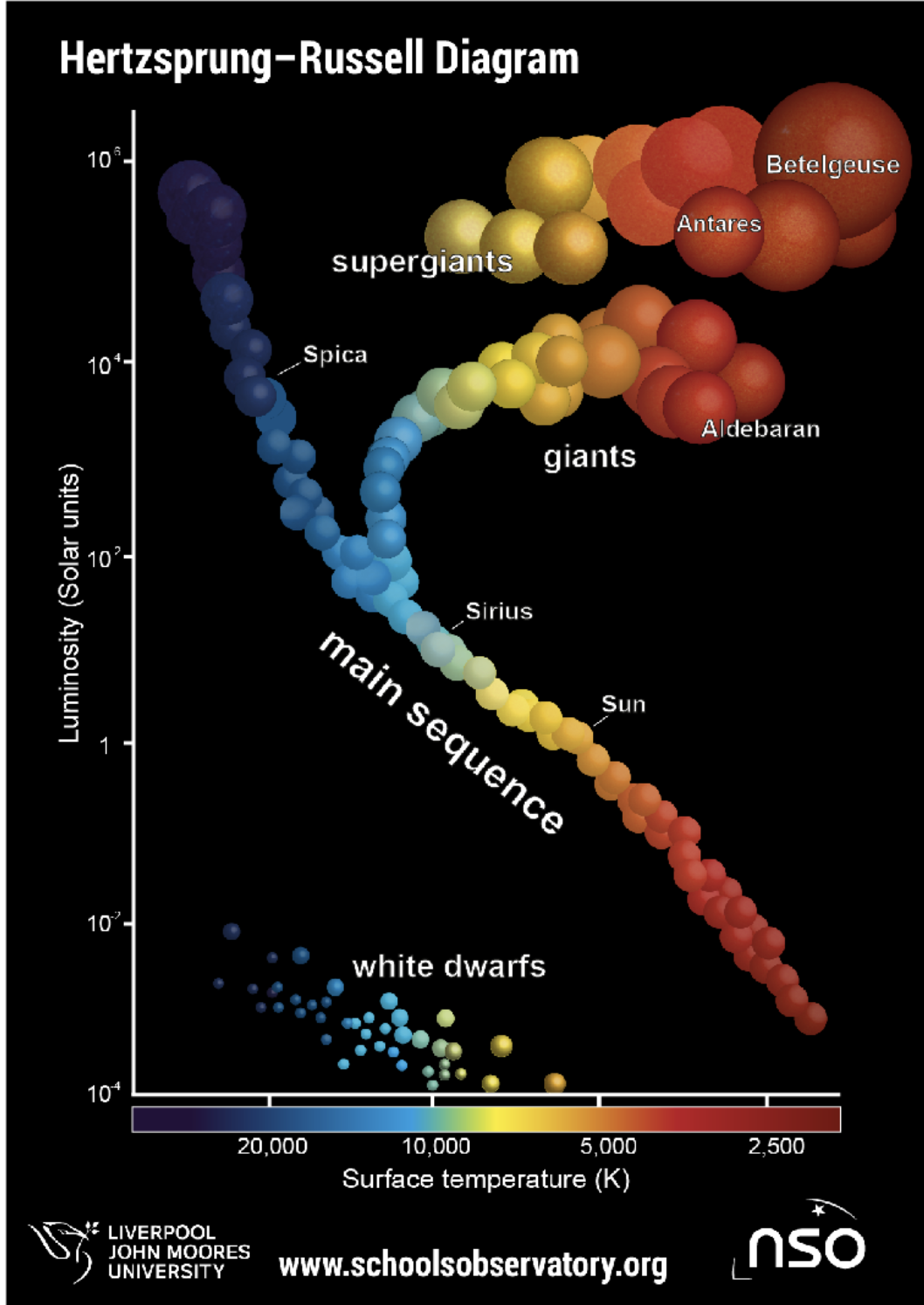
Hertzsprung-Russel Diagram