Ch. 2-3 - cells, tissues, chemistry
 Call Kai
 Learn
Learn Practice Test
 Spaced Repetition
 Match
Match Flashcards
 Knowt Play
1/24

There's no tags or description
Looks like no tags are added yet.
Name | Mastery | Learn | Test | Matching | Spaced | Call with Kai | Chat |
|---|
No analytics yet
Send a link to your students to track their progress
25 Terms
Epithelial tissue
Functions: covering/lining surfaces, glands
Close together, usually gap junctions
Innervated, no blood supply (usually needs to be connected to connective tissue via basement membrane)
Epithelial tissue classifications:
Simple squamous
One row, flattened shape
Facilitates diffusion (eg. O2 in lungs, serous fluid)
Air sacs in lungs, lining heart, lymph vessels, serous membranes

Epithelial tissue classifications:
Simple cuboidal
One row, square shape (w/ nucleus in center)
Excretion and absorption
Various small glands, ducts, kidney tubules

Epithelial tissue classifications:
Simple columnar
One row, rectangular shape (w/ nucleus closer to basement membrane)
Excretion and absorption
GI tract, bladder (smooth), uterus, bronchioles (ciliated)
Can have microvilli on apical surface for absorption

Epithelial tissue classifications:
Pseudostratified columnar / PCCE
Protection, secretion of mucous, movement of substances across membrane
Lines most portions of upper respiratory tract, typically cilliated

Epithelial tissue classifications:
Stratified squamous
Protection against abrasion, preventing water loss (in squamous cells with keratin)
Lines esophagus, mouth, vagina, skin

Epithelial tissue classifications:
Stratified cuboidal
Protection
Not common, found in ducts of sweat glands + mammary glands

Epithelial tissue classifications:
Stratified columnar
Secretion and protection
Also uncommon, found in urethrae and ducts of some glands

Epithelial tissue classifications:
Transitional epithelium
Allows expansion and stretching
Urinary bladder, ureters

Types of glandular epithelial tissue
Endocrine
Secretes into tissues/bloodstream
Exocrine
Infolded, secretes several molecules out of body/into a compartment (eg. sweat)
Connective tissue
Sparsely packed, provide support, protection, energy storage, pathogen defense
Consist of tissue cell + extracellular protein fibers + ground substances (gel-like substance btwn cells + fiber)
-blast / immature cell, -cyte / mature cell
Connective tissue types
Connective tissue proper (have visible fibers)
Loose
Areolar
Adipose
Reticular
Dense
Dense reg
Dense irregular
Elastic
Fluid connective tissues
Supportive connective tissues
Bone
Cartilage
Hyaline
Fibrocartilage
Elastic
Connective tissue proper: loose - areolar
Collagen + elastic fibers
Mostly ground substance, stretches and provides scaffolding for vessels
Between the top and underlying skin layers, connects to epithelial tissues (lamina propria)
Connective tissue proper: loose - adipose
Has collagen, elastic + reticular fibers with adipocytes (fat cells)
“packing” material, storage, protection
Surrounds organs susceptible to shock/jarring
Heart, behind eyeballs, distributed in buttocks/breasts/etc
Connective tissue proper: loose - reticular
Reticular fibers
Provides framework for cells + organs
Connective tissue proper: dense
*More collagen than loose and has greater stretch rest.
Regular
Run parallel + resist tensile strength in one direction, has collagen
Eg. tendons/ligaments
Irregular
Meshwork of collagen in diff. directions to resist being pulled in various directions
Eg. dermis, surrounding bones + cartilage + joints
Elastic
Densely packed elastic fiber to allow for more movement
Eg. elastic ligaments in vertebral column
Supportive connective tissues: bone
Dense ground matrix with calcium crystals covering collagen (osteoid)
Osteocytes live in lacuna (pockets) within hardened osteoid
Can be spongey or compact
Supportive connective tissue: cartilage
Only avascular connective tissue
Hyaline
Most common: clear appearance, scattered chondrocytes
In nose/trachea/larynx/ribs/ends of long bones
Fibrocartilage
Dense, weight/shock absorbing with more numerous collagen in matrix
In vertebral discs, knees + joints, connect L+R pubic bones
Elastic cartilage
Flexible, less collagen in matrix, more elastic fibers
In external ear + epiglottis
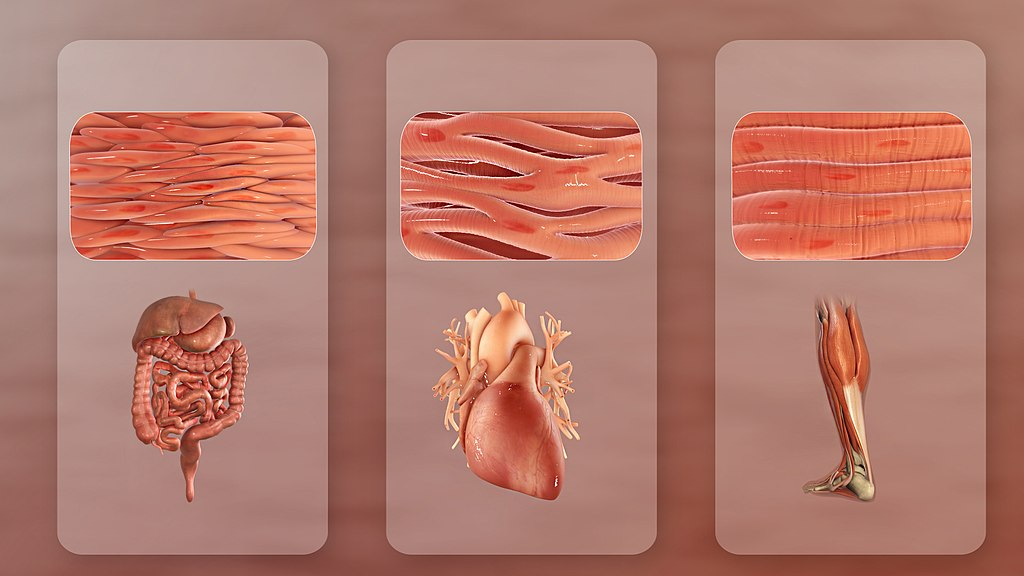
Types of muscular tissue
Skeletal
Striated, multinucleated, voluntary. Thin, cylindrical fiber-like shape
Cardiac
Striated, uninucleate, involuntary. Only in heart. Branched structure
Smooth
Nonstriated, uninucleate, involuntary. Automatic movements eg. GI, respiratory, reproductive tracts, pupils. Spindle-shaped
Nervous tissue
Neuron consists of a soma (body) with dendrites branching out and an axon
Electrical signals travel down axon to communicate with other cells
Maintained + held together by glial cells

Lamina propria
Areolar connective tissue that serves as the underlying layer to epithelial tissue and provides it with a blood supply in mucosal membranes
Mucous membranes
Lines areas exposed to outside (eg. digestive, respiratory, urinary, reproductive tracts)
Absorption + secretion
Has goblet cells + multicellular glands that secret mucus
Mucin glycoprotein combined with water
Lamina propria
Serous membranes
Lines cavities not exposed to protect organs (eg. peritoneal, pleural, pericardiac)
Recall: folds to protect organs (visceral + parietal)
Made of simple squamous epithelium that secretes serous fluid
Synovial membranes
Lines joint cavities and produces synovial fluid to nourish cartilage and allow ease of movement
Made of areolar connective tissue, not epithelium
Cutaneous membrane
Skin / integument
Keratinized stratified squamous epithelial cells + connective tissue (dermis)
Largest sensory organ, covers body surface, protects + prevents water loss