Neuroscience: learning and memory
0.0(0)
Studied by 2 people Call Kai
 Learn
Learn Practice Test
 Spaced Repetition
 Match
Match Flashcards
 Knowt Play
Card Sorting
1/22

Earn XP
Last updated 5:37 AM on 4/5/23
Name | Mastery | Learn | Test | Matching | Spaced | Call with Kai | Chat |
|---|
No analytics yet
Send a link to your students to track their progress
23 Terms
1
New cards
Learning
Process of acquiring new information (studying/practice)
2
New cards
Memory
is the ability to store information & then retrieve that \n information as needed
3
New cards
Memories
stored in the hippocampus before moving to the cortex for long term storage
4
New cards
Memory stages (based on Time)
Sensory buffers (iconic memory) \n Short-term memories \n Long-term memories
5
New cards
sensory buffers
A sensory buffer is a vanishing memory that is not retained
6
New cards
Short Term Memory
\
STM memory lasts for 30 sec without rehearsal \n • Example: Someone tells you a phone number, you remember it long enough to write it down, then memory gone \n When information rehearsed, STM lasts few minutes longer, till we get involved in another task then STM gone
STM memory lasts for 30 sec without rehearsal \n • Example: Someone tells you a phone number, you remember it long enough to write it down, then memory gone \n When information rehearsed, STM lasts few minutes longer, till we get involved in another task then STM gone
7
New cards
Working Memory
Working memory is a cognitive system that temporarily holds and manipulates information needed to perform complex cognitive tasks, such as learning, reasoning, and decision-making. It is often described as the mental workspace where information is actively processed and manipulated. UNDER SHORT TERM MEMORY
8
New cards
Long term memory
\
Type of memory lasting from days, to months to years \n • LTM has very large capacity \n • LTM divided into different types \n • Forgetting is a normal aspect of LTM, filters out \n unimportant information & frees up space
Type of memory lasting from days, to months to years \n • LTM has very large capacity \n • LTM divided into different types \n • Forgetting is a normal aspect of LTM, filters out \n unimportant information & frees up space
9
New cards
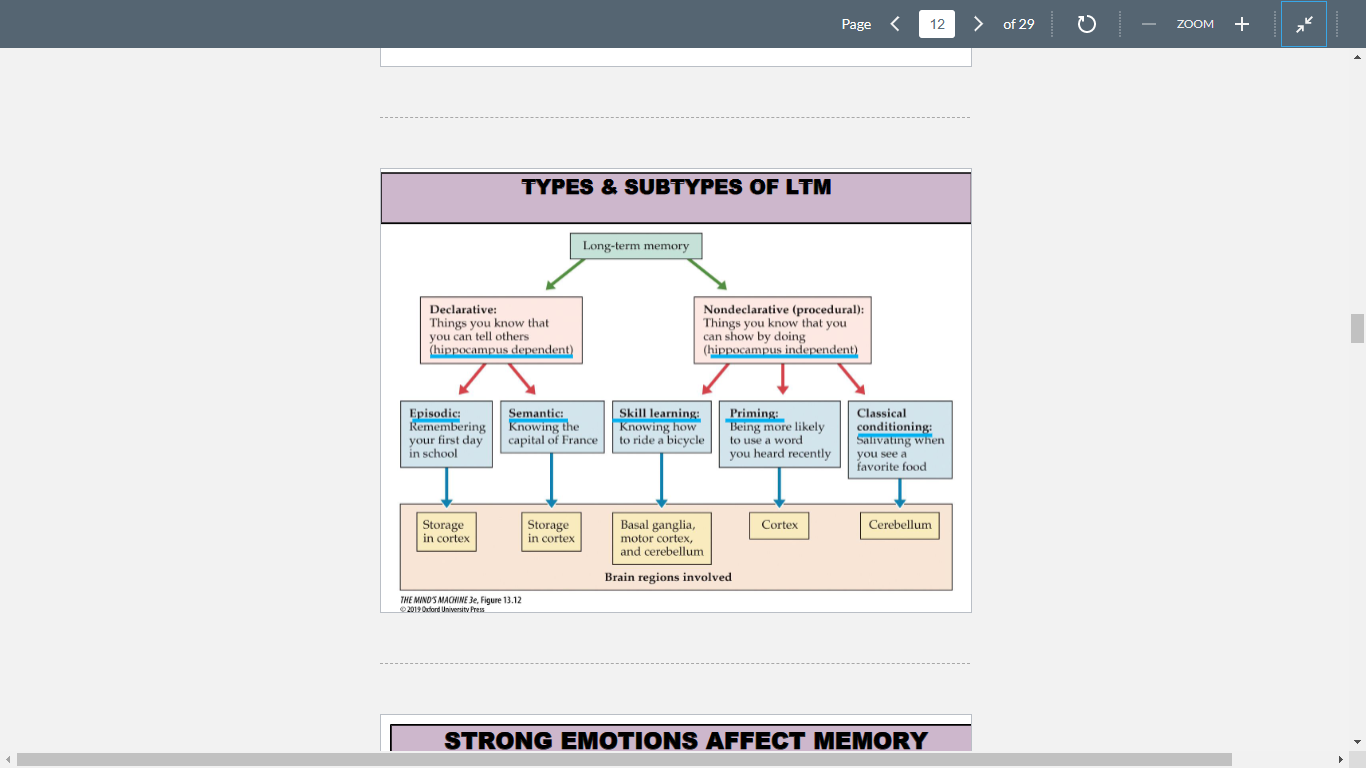
Declarative memory
things you know & tell others \n (answering questions on a test)
10
New cards
Nondeclarative memory:
things you know that you show \n others (skills, animals can demonstrate)
11
New cards
Subtypes of memory
12
New cards
Two neurochemicals are involved in enhancing memory formation during a high emotional state
epinephrine and norepinephrine
13
New cards
Emotions and memory formation
Emotions cause a release of Epinephrine from adrenal glands. Epinephrine then goes to the amygdala & releases Norepinephrine from the amygdala. Norepinephrine then enhances memory formation.
14
New cards
Memory systems
the three processes involved in memory formation (encoding, consolidation, retrieval)
15
New cards
encoding
Information from sensory systems passed to \n the short term memory
16
New cards
consolidation
Information transferred from short term memory to long term memory.
17
New cards
retrieval
obtaining the stored information from long term memory
18
New cards
factors affecting long term memory
1 .False memories are created because of interference from other information right before or after that LTM forms \n 2. Memory recall or retrieving information from LTM can also cause memories to become temporarily unstable \n 3. Memories can be altered or disrupted before you \n reconsolidate again (send it back to LTM)
19
New cards
engram
physical representation of memory
20
New cards
Retrograde amnesia
Retrograde amnesia: difficulty in retrieving old memories (formed before injury or disorder)
21
New cards
Anterograde amnesia
difficulty in forming new memories (after injury or disorder)
22
New cards
Henry Molaison
Henry Molaison, also known as H.M., was an American man who had brain surgery in 1953 to treat his epilepsy. The surgery involved the removal of parts of his brain, including the hippocampus. As a result, he suffered from severe anterograde amnesia and was unable to form new memories. (lobectomy, hippocampus plus some cortex)
23
New cards
KORSAKOFF’S syndrome
Alcohol Addiction: causes dietary deficiency of Vitamin \n B1(thiamine). This deficiency gives rise to a condition called = Korsakoff’s Syndrome: \n Damage to the mammillary bodies & the dorsomedial thalamus
Symptoms: memory loss, do not remember things that they encounter all the time, deny that anything is wrong with them. Show anterograde amnesia (unable to form new memories) & Confabulations. Confabulation is trying to fill gaps in memory by false \n information that they believe is true
Symptoms: memory loss, do not remember things that they encounter all the time, deny that anything is wrong with them. Show anterograde amnesia (unable to form new memories) & Confabulations. Confabulation is trying to fill gaps in memory by false \n information that they believe is true