Foundations of MSE - Exam 1 Definitions
 Call Kai
 Learn
Learn Practice Test
 Spaced Repetition
 Match
Match Flashcards
 Knowt Play
1/99

Earn XP
Description and Tags
On Lectures 1-8 (really 2-8)
Name | Mastery | Learn | Test | Matching | Spaced | Call with Kai | Chat |
|---|
No analytics yet
Send a link to your students to track their progress
100 Terms
Solid
A solid is a sample of matter that can retain its volume and shape,
Liquid
Can retain its volume but not rigid
Gas
Cannot retain its volume and is not rigid
Atoms
The elementary chemical constituents of matter.
They cannot be broken during a chemical reaction.
They can interact with one another more or less strongly to form materials
Atoms are made of
Protons and neutrons, surrounded by electrons

What does X, A and Z represent?
X- atomic symbol
A- mass number (number of protons and neutrons)
Z - atomic number (number of protons only)
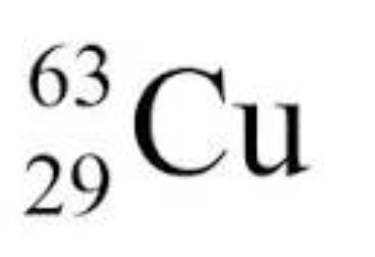
Identify how many protons, neutrons and electrons are in this system
P+ 29
N0 34
e- 29
Mass Defect
Mass of atom isn’t exactly equal to the masses of its isolated subatomic constituents

Atomic units (definition)
Used to simplify calculations such as the Schrodinger Equation
Definition of angular momentum
L = mrvθ
When is the angular momentum a constant of motion?
When force acting on particle is radial only with no angular component (Fθ=0)
Total energy as a function of KE + PE in polar coordinates
½ * me (rnθ)2 - e2/ 4πε₀ rn = R∞/n2
Velocity in polar coordinates
v = dr/dt r̂ + r dθ/dt θ̂
What does Bohr’s Model not explain?
Why can energies and radii only have specific values En and rn?
What is the reason for orbit shapes?
How are electrons represented in Bohr’s Model vs. Schrodinger’s Model?
Bohr: Electrons are points
Schrodinger: Electrons are clouds
In which model are position and momentum precisely known?
Bohr’s Model
In which model are position and momentum averages known?
Schrodinger’s Model
What defines the electron state and electron energy E in Schrodinger’s Model?
Wave function Ψ
What defines the electron state and energy E for the Bohr Model?
p, r
Wave function Ψ( r ) definition
Wave function of an electron is the function of the space variable r describing the state of the electron
The values of the wave function are
Complex
Square modulus of wave function
Gives probability density
Square Modulus of Ψ (r )
ρ ( r) = |Ψ (r )|2
Normalization condition
Total probability (of where electron must be in space) = 1

How do we find the specific values of the total energy E = K + U (for quantum mechanics)
Schrodinger’s Equation
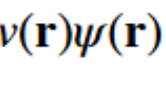
General Schrodinger’s Equation (full)

kinetic portion of SE

potential part of SE
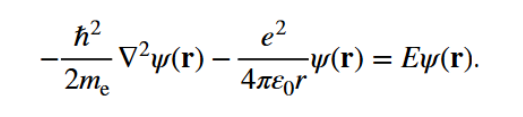
Schrodinger’s Equation for 11H
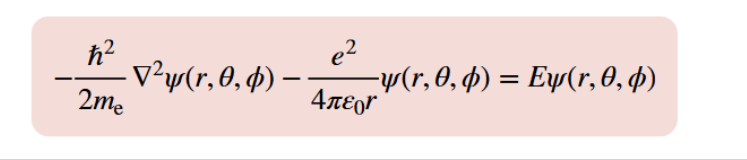
Schrodinger Equation for 11H in Spherical coordinates
Spherical harmonics
Special functions defined on the surface of a sphere, used in different fields
Spherical harmonic of order l is an angular function Y(θ, Φ) such that…
∇² (rlY(θ,Φ)) = 0
For each value of l = 0, 1, etc. there exist _____ independent solutions of ________ that are labeled by index ___ ranging from _____ to ______
2l + 1
Ylm(θ,Φ)
m
-l to l
Nodal surface
Where function is 0
A positive sign for m means an _____ orientation for Ylm
x-axis
Kinetic energy portion of 11H S.E.

Potential Energy portion for 11H S.E.

Hybridized molecular orbital (ψ (r )) written as…

Way to write out the minimization of energy in a generalized eigenvalue form


What is H?
Hamiltonian Matrix of Orbital Interaction Coefficients

What is S?
The matrix of orbital overlap coefficients
Born-Oppenheimer Approximation for H2+

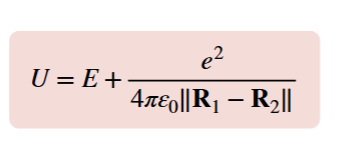
Which part of this equation is the quantum energy and which part is classical?
Quantum: First
Classical: 2nd
Generalized Born-Oppenheimer Approximation for System with 2+ Nuclei

What does ||Ri - Rj|| represent in the B-O Equation?
Distance between nuclei i and j
What does Zi and Zj in the B-O Approximation Represent
Nuclei charge

What kind of orbital is this, and will this molecule be stable?
Bonding Orbital, yes

What kind of orbital is this, and will this molecule be stable?
Anti-bonding
No
Equation to determine orbit radii rn (Bohr)
rn = aon2
A material is made of these 2 subatomic particles
nuclei and electrons
Hybridized Orbital
Mixture of orbitals of atoms that form a covalent bond
Hybridized molecular orbital equation
Ψ(n) = c1Φ1 + c2Φ2
How can the minimization of energy be written?
H (c1 c2) = ES (c1 c2)

H is what
Hamiltonian
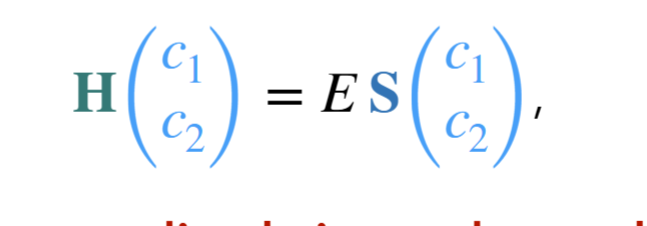
E is what
Overlap integral matrix
Hybridization of H2+
1s orbitals form 1 bonding and 1 antibonding orbital
sp, sp2, sp3 orbitals good for?
Linear, hexagonal, or tetrahedral bonding
Ionic bonding
2 molecules of differing electronegativity (less EN gives electron to more EN)
electronegativity
ability to attract/retain electrons
When does electronegativity increase?
As energies of outer-most orbitals are more negative
What can happen to orbitals when there are electronegativity differences (ex. HF)
Orbitals will favor characteristics 1 molecule over another
Covalent bonding
Electrons shared with directional preference
Ionic bonding
electrons are localized around atoms but unequally distributed
Metallic bonding
Electrons are shared and delocalized without directional preference
VDW bonding
Electrons are localized around atoms and are equally distributed
Strongest to weakest bonds
covalent
ionic
metallic
VDW
Spherical harmonics Y(θ, Φ)
Angular functions that model lots of processes
Angular function Y(θ, Φ) such that
∇² (rl (Y(θ, Φ)) = 0
Radical Orbital Function equation

What does a radial orbital function calculate?
Exact probability of locating an electron at a specific distance from the atom’s nucleus
Number of nodes is where Rnl(r ) goes to 0 is represented by what equation?
n-l-1
As r —> 0, what happens to Rnl(r )?
is proportional to rl
Hydrogen-like atoms
1-electron atom with nuclear charge Z>1, net charge of Z-1 and are denoted by AZX(Z-1)+
Nuclear shielding
Electron-electron repulsion leads to nucleus attraction to be WEAKER
How is nuclear shielding calculated?
= Zeffε₀ / n2
Electron spin
Magnetic moment carried by electron, can take on 2 values +- µb
Electron pattern for quantized system
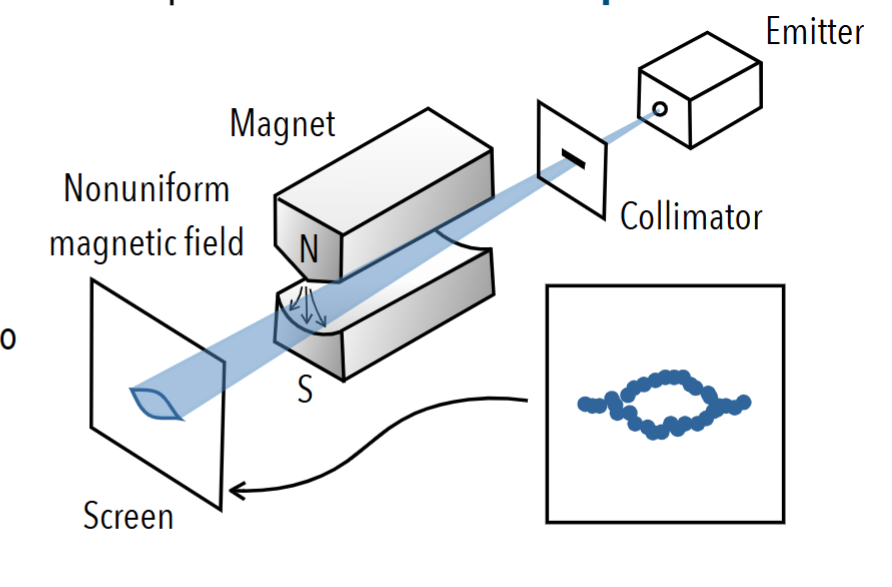
Electron pattern for non-quantized system

Building-up principle
To get electron configuration
lowest E to highest E
no more than 2 e- in orbital
Separate on orbital level first
Order of orbital levels
1s 2s 2p 3s 3p 4s 3d 4p 5s 4d 5p 6s 4f 5d 6p 7s 5f 6d 7p
What do orbital levels help with
To estimate electronic configuration of atom by approximating the nuclear shielding effect
What is a symmetry operation?
Mathematical operation that maps an object back onto itself

What kind of symmetry is this?
Mirror
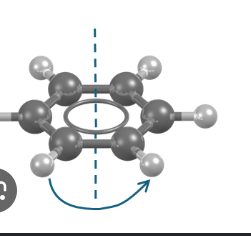
What kind of symmetry is this
Rotational

What kind of symmetry is this?
Translational
Which symmetry operation defines a lattice?
Translation
Translation vector t connects any 2 lattice points through this equation
t = ua + vb + wc
where u, v, w are the scalar translation and a, b, c are lattice vectors
Lattice (τ)
Set of translation vectors for all possible values of u, v, w and thus infinite
τ =
{ t | t = ua + vb + wc (u, v, w integers) }
Unit Cell
Smallest repeat building block of a crystal that can be replicated across an entire crystal
Lattice parameters of unit cell
[a, b, c, alpha, beta, gamma]
4 unit cell types
primitive
body-centered
face-centered
side-centered
Crystallographic Restriction Theorem
If a rotational symmetry of an angle α is permitted in a lattice, then:
cos α = M/2
Where m is an integer
What does the CRT restrict
geometries to 2, 3, 4, or 6-fold rotation
M values of CRT
-2, -1, 0, 1, 2
Why are quasicrystals not considered crystals? I.e. why do they fail the CRT
5-fold means that M is not an integer
Quasicrystals violate what
Translational symmetry
Volume of primitive unit cell
V/N = V*
V = volume, N = # of lattice points
Spatial Lattice vs Crystal Structure
Lattice - mathematical array of points, where every point has identical surroundings
Crystal Structure - physical material created by placing a motif (such as atom) at every lattice point