Week 8, Pt 1: Celadon Prunus Vase & Crane Design
 Call Kai
 Learn
Learn Practice Test
 Spaced Repetition
 Match
Match Flashcards
 Knowt Play
1/12

There's no tags or description
Looks like no tags are added yet.
Name | Mastery | Learn | Test | Matching | Spaced | Call with Kai | Chat |
|---|
No analytics yet
Send a link to your students to track their progress
13 Terms
proper title of celadon
Celadon Prunus Vase w/ Inland Cloud and Crane Design
period
13th C
location
goryeo
what is bisaek
jade-like blue green color of celadon
how is bisaek achieved
purified clay and glaze containing a small amount of iron oxide.
Applying a translucent celadon glaze.
Fired in controlled low oxygen kiln conditions
interaction between the iron in the glaze and firing produces blue-green color.
what happens when producing bisaek is failed
If kiln atmosphere or temp is not controlled:
glaze may become brown, yellowish, gray, or muddy green
surface loses clear, jade-like translucency that defines high-quality.
what is the inlay (sanggam) step by step process
Shape via clay
Allow to dry to leather-hard state.
Carve desired design into the surface.
Fill the carved areas with white clay (white details) and/or black clay (dark details).
Scrape and polish the surface smooth.
Apply transparent celadon glaze.
Fire the vessel in a reduction kiln.
Final result
The design appears beneath the translucent glaze.
White and black motifs contrast beautifully against the jade-green background.
In the Prunus Vase, the cranes and clouds seem to float within the celadon surface, creating a refined and elegant effect.
inlay vs stamping
Traditional inlay
motif is carved individually by hand.
Produces highly detailed and refined designs.
Time-consuming and labor-intensive.
Stamping
Small stamps are pressed repeatedly into the clay to create patterns.
Much faster and more efficient.
Allows mass production and consistency across vessels.
How did the inlaid chrysanthemum pattern change with the use of stamping?
In Goryeo celadon:
Chrysanthemum motifs were typically carved and inlaid individually.
The designs were refined, delicate, and highly detailed
In Buncheong ware:
Chrysanthemum motifs were increasingly produced using stamps.
Rather than individually carved flowers, the patterns became:
Simplified
Repeated many times
More geometric and regular
More robust and less delicate in appearance
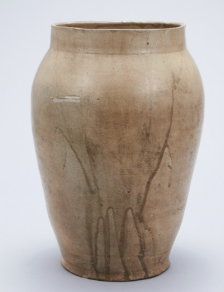
what is the jar with the inscription “the 4th year of sunhwa”
993, Goryeo
associated w/ a royal celebration
Inscription identifies the date and occasion, often a royal wedding or palace banquet
"Sunhwa" refers to Sunhwa Palace
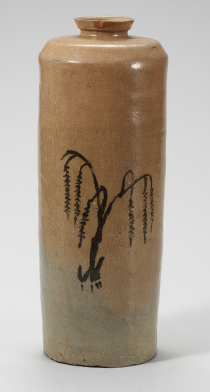
what is the celadon tube shaped bottle w/ willow design in underglaze iron
12th C Goryeo
Example of Goryeo celadon decorated using underglaze iron-brown painting.
Iron-oxide pigment painted directly onto the body before glazing.
Underglaze iron decoration was an early Goryeo technique
Willow motifs reflect influence from Chinese ceramic painting traditions.

what is the ewer w/ lotus shaped lid
1050-1150
A celadon pouring vessel (ewer) featuring sculptural decoration.
Lotus motifs most common decorative themes in Goryeo celadon.
ewers incorporated sculpted decorative elements, including animals, flowers, and elaborate lids.
Lotus imagery is closely associated with Buddhist symbolism
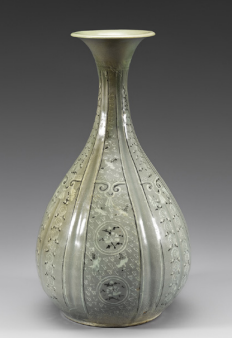
what is the celadon bottle w/ inlaid crane and cloud design
Late 13th to 14th C, Goryeo
AKA Prunus Vase with Inlaid Clouds and Cranes.
One of the most famous examples of Goryeo sanggam (inlay) technique.
Made by carving designs into the clay and filling them with white and black slip before glazing.
shows the sophisticated three-color effect of:
white inlay,
black inlay,
jade-green celadon glaze.
Design depicts cranes flying among clouds, symbols of longevity and nobility.