ECH - QUIZ 1
 Call Kai
 Learn
Learn Practice Test
 Spaced Repetition
 Match
Match Flashcards
 Knowt Play
1/37

There's no tags or description
Looks like no tags are added yet.
Name | Mastery | Learn | Test | Matching | Spaced | Call with Kai | Chat |
|---|
No analytics yet
Send a link to your students to track their progress
38 Terms
Emotion
biological theories that state that emotions evolved to solved specific problems in specific situations
Fear
when there is a threat
Sadness
when there is an irrevocable loss
Anger
when someone frustrates or demeans us
Disgust
when something is toxic or offensive
Joy
when we share something with another
Pride
when we accomplish something
Shame/guilt/embarrassment
when we have transgressed rules or expectations
Emotion
universal, functional reaction to an external stimulus event, temporarily integrating physiological, cognitive, phenomenological, and behavioral channels to facilitate a fitness-enhancing, environment shaping response to the current situation (thoughts, experiences, behaviors)
functional
adaptions to the problems and physical survival - SOLUTIONS
Emotion vs mood
emotions are context bound, time limited episodes (short time frame)
moods are enduring, without specific boundaries (longer time frame)
emotions have specific action tendencies and functionality (behaviors)
moods are tied to more closely to affective traits, can be circadian/cyclical (can depend on time of day)
Moods
lasting longer, having fewer clear-cut causes, and being less associated with specific action tendencies
Basic emotion criteria
fundamentally distinct from one another biologically determined distinct separate groups and periods
criteria (disputed):
universal within our species, similar across cultures
facilitate a functional response to a specific, prototypical life event
built in way of expressing the emotion
through facial expressions or tone of voice (tone of voice harder to measure)
evident early in life (debated)
specific “behavioral signature”
cross - species evidence
What are the basic emotions?
fear
anger
sadness
disgust
joy
pride
positive emotions are harder to differentiate from one another - therefore less
Characteristics of emotions
nonverbal signal/behavioral signature (e.g., facial or bodily expression — adapted over time and important)
physiological changes/cardiovascular response (e.g., autonomic nervous system)
motivated behavioral tendencies or “action tendencies”
elicitors/antecedents: types of situations or other factors that typically cause or lead to the emotion
influences: cognitive changes (e.g., cognitive appraisals of the situation, which are typically what elicit the emotion; planning; prioritizing goals; enhanced memory or attentional focus)
sensory changes (e.g., heightened vision, smell)
Fear specific behavioral signatures
facial expression
widening of eyes. open mouth raised or slanted eyebrows
behavioral freezing + preparation for action
sympathetic nervous activation
increased heart rate and blood flow
Fear Elicitors
threats to self, survival
situations that are unexpected, unpleaseant
externally caused, and uncontrollable
fear occurs more when you lack power
Fear influences
memory, attention, perception, learning
Fear today vs in the past
today can occur for anything
used to be for actual danger
Anger specific behavior signatures
facial expression
lowering of the eyebrows, whites of eyes, compression of the mouth (internal or external baring of teeth)
approach Behavior
sympathetic Nervous Activation
increased heart rate, increased parasympathetic activity
Anger elicitors
goal blockage (frustration-aggression hypothesis)
situations that are unpleasant, unfair, and potentially changeable
Anger influences
agility, flexibility — helps us solve problems
Sadness specific behavioral signatures
facial expression
lowering of the corners of the mouth, eyebrows slant to middle, chin comes up, eye contraction
withdrawal behavior
sympathetic nervous activation
decreased heart rate
Sadness elicitors
loss
situations appraised as unpleasant
incompatible with goals
caused by something external to the self
feeling helpless
Sadness influences:
problem solving, deliberation, support from others
Disgust specific behavioral signatures
facial Expression
upper lip raise, close or open mouth, widen eyes/constricted eyes
avoidance behavior
sympathetic nervous activation
decreased heart rate
Disgust elicitors
contamination risk
moral transgression
Disgust influences
sensory attunement, learning
heightened awareness
Joy specific behavioral signatures
facial expression
raised corners of mouth, contracted eye, relaxed face
approach behavior
sympathetic nervous activation
increased HR,increased parasympathetic nervous activation
Joy elicitors
gain or success, rewards, especially social ones
Joy influences
trust/relationship building, cognitive flexibility
Pride specific behavioral signatures
bodily expression
erect stance, raised chest, and arm
approach behavior
sympathetic nervous activation
increased heart rate
Pride elicitors
personal accomplishment/recognition
Pride influence
social status/heirarchy
Shame/guilt/embarrassment specific behaviors
bodily expression
head down, eyes lowered (avoid eye contact)
sympatric nervous activation - unclear
Shame/guilt/embarrassment elicitors
public or private personal error or transgression Fail to live up to expectations
Shame/guilt/embarrassment influences
social status
Measurement on 3 dimensions
reported experience
psychological change
behavioral change
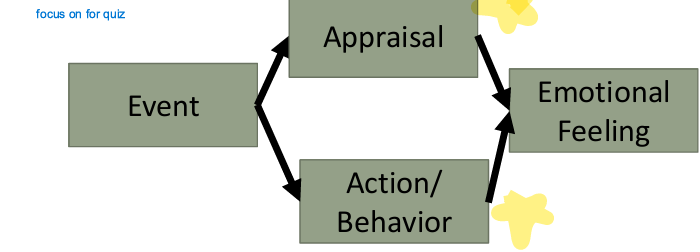
Schachter-Singer Theory of Emotion
Stanley Schachter and Jerry Singer (1960’s) developed what is sometimes referred to as the “Two-Factor” Theory, as an alternative to the James-Lange theory. It does not contradict James- Lange but really speaks to the role of appraisal in determining one emotion from the next
ex: bridge study - interpret heart rate as attracted to leader but in reality it was a stress respinse to being scared because up higher on suspention bridge