PSYCH257 Term Test 3 Trouble Areas
 Call Kai
 Learn
Learn Practice Test
 Spaced Repetition
 Match
Match Flashcards
 Knowt Play
1/13

There's no tags or description
Looks like no tags are added yet.
Name | Mastery | Learn | Test | Matching | Spaced | Call with Kai | Chat |
|---|
No analytics yet
Send a link to your students to track their progress
14 Terms
People with personality disorders often enter treatment:
Because they have another (episodic) disorder
The dark triad consists of ________, ________, and _______ and is characteristic of __________.
narcissism; psychopathy; Machiavellianism; narcissistic personality disorder
depressive attributional style
Internal: Blaming oneself for negative events rather than external circumstances.
Stable: Believing the cause is permanent and will not change over time.
Global: Assuming the cause affects all areas of life rather than just a specific situation.
Chen et al. (2009) reported that _____ is the most culture-laden diagnosis of the personality disorders as it is rooted in the individualistic North American culture.
dependent personality disorder
The therapy for personality disorders that focuses on changing the cognitive dysfunctions of people with personality disorders is known as:
Schema therapy
According to a 27-year investigation conducted in Montreal by Paris and colleagues, what can be said about the prognosis of borderline personality disorder (BPD)?
Most patients gradually improve over time
Studies of psychopathy by Canadian researcher Robert Hare have shown that psychopaths, in comparison to non-psychopaths, have all of the following EXCEPT:
Slower heart rates in anticipation of a stressor
A person with which of the following diagnoses is most likely to also have a mood disorder?
Borderline personality
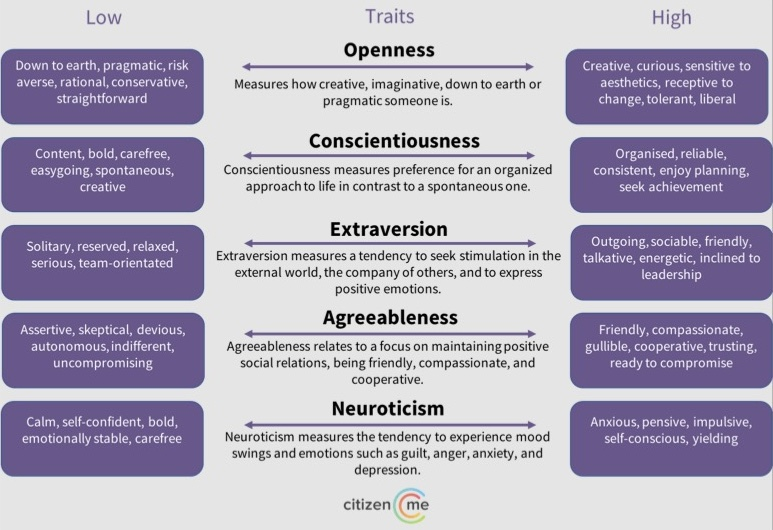
Borderline Personality Disorder would be associated most likely with which factor from the five-factor model of personality?
Neuroticism/antagonism
What is the gender difference in dying by suicide attributed to?
the social role expectations
Which of the following is false about bipolar disorder?
One cannot experience delusions or hallucinations
Last year, Debbie experienced a three-month period of depressed mood, feelings of worthlessness, difficulty concentrating, recurrent thoughts of death, sleep difficulties, and loss of energy. Four weeks ago, she began to experience the same severe symptoms. What is Debbie’s most likely diagnosis?
major depressive disorder, recurrent
borderline personality disorder
Borderline personality disorder (BPD) is a mental health condition marked by intense mood swings, unstable relationships, and a fear of abandonment. People with BPD often struggle with a poor self-image and hard-to-control impulses.