Human Physiology: Cell Membrane Structure and Transport Mechanisms
 Call Kai
 Learn
Learn Practice Test
 Spaced Repetition
 Match
Match Flashcards
 Knowt Play
1/24

Earn XP
Description and Tags
Vocabulary flashcards covering the cell membrane structure, membrane proteins, bulk transport mechanisms, diffusion, and osmosis based on the Human Physiology lecture notes.
Name | Mastery | Learn | Test | Matching | Spaced | Call with Kai | Chat |
|---|
No analytics yet
Send a link to your students to track their progress
25 Terms
Human physiology
study of human function
Plasma membrane (function)
allows certain substances in and out to protect it and allows intercellular communication, allowing effect to the body at a cellular level
Plasma membrane
Defines the boundaries of cells, gives them form/shape, made of bilayer of phospholipids
Intracellular organelles
Subcellular structures inside the cytoplasm
Fluid Mosaic Model (draw and label)
The model used to describe cell membrane structure and organization
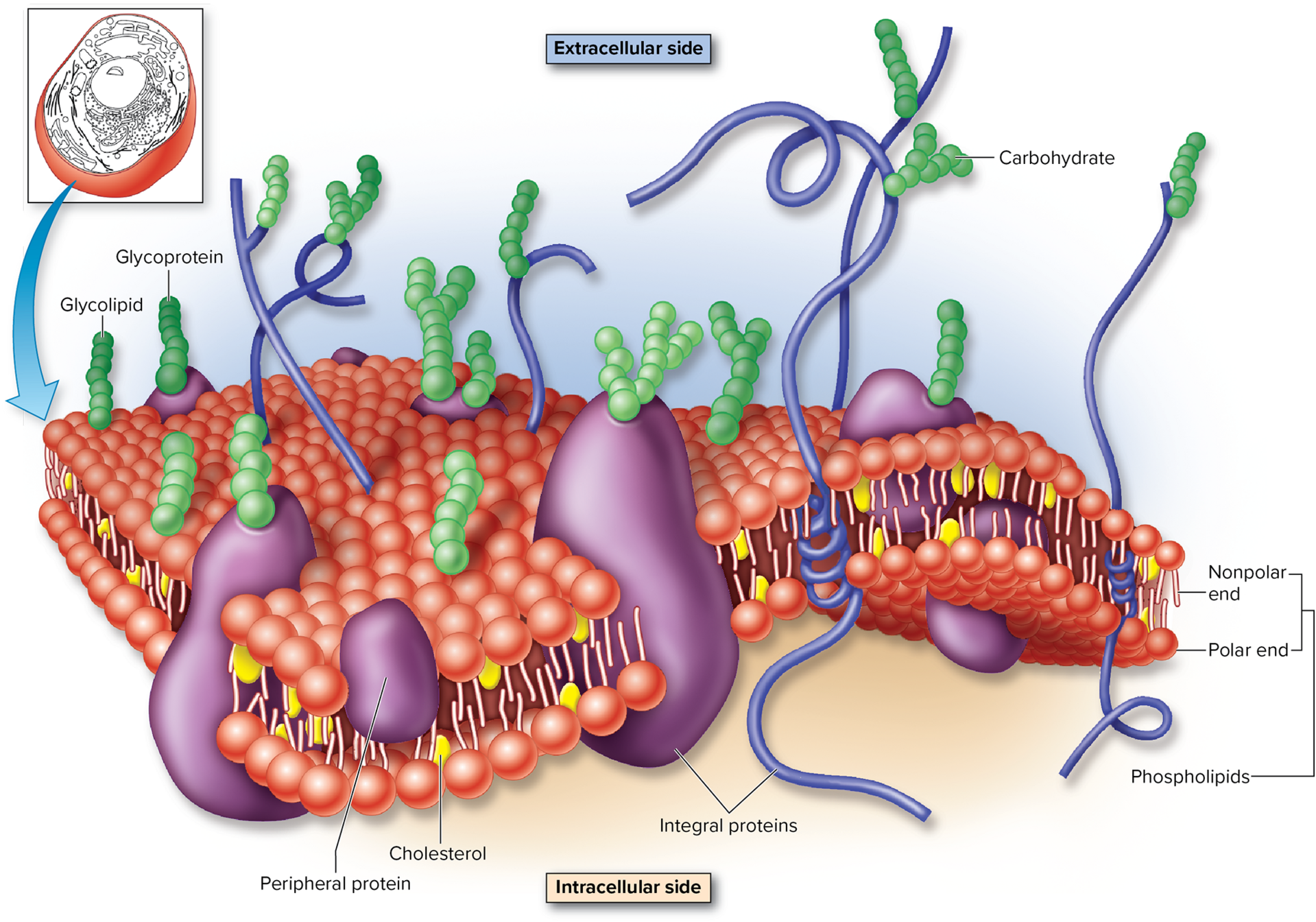
Phospholipid
main component of membranes is organized in a double layer (bilayer) with a hydrophilic head and two hydrophobic fatty acid tails.
Glycolipids
Carbohydrates attached to phospholipids on the extracellular side.
Glycoproteins
Carbohydrates are attached to proteins on the extracellular side.
Cholesterol
Component located between the fatty acid tails of phospholipids that binds weakly to adjacent phospholipids and contributes to membrane flexibility.
Integral proteins
Membrane proteins that typically penetrate all the way through the phospholipid bilayer.
Peripheral proteins
Membrane proteins that are partially embedded in one face of the membrane but do not span the entire width of the phospholipid bilayer.
Bulk transport
The general term for the cellular uptake (endocytosis) or secretion (exocytosis) of materials into or out of the cell, respectively.
Endocytosis
A process of cellular uptake where the membrane invaginates (furrows inward), fuses, and pinches off to form a vesicle inside the cell.
Exocytosis
A process where molecules (e.g., neurotransmitters) are sequestered within secretory vesicles which, under proper stimulation, release their contents to the outside of the cell.
Diffusion
The passive movement of substances from a region of high concentration to a region of low concentration due to random molecular motion.
Membrane permeability
The ease with which a solute/molecules can move through a membrane
Kidney dialysis
procedure used to remove wastes from blood because failed through the kidneys - osmosis
Osmosis
The passive transport of water across a membrane from a region of higher water concentration to a region of lower water concentration
Hydrophilic
Attracted to water, aka polar phoslipids, always face h20
Hydrophobic
Scared of water, aka nonpolar phoslipids
Monlayer & Bilayer
single layer & double layer
Intergral & peripheral proteins
embedded in the membrane fully & embedded in the membrane halfway
Intergral & peripheral protein (function)
ion channels, pumps, enzymes, carriers, receptors and provides strucutral support
Factors of Osmosis
Concentration gradient
Temperature
Membrane permeability
Surface area
Diffusion distance
Molecular structure/shape/size
Osmosis (draw and label)