Spinal Cord Injury Overview and Management
 Call Kai
 Learn
Learn Practice Test
 Spaced Repetition
 Match
Match Flashcards
 Knowt Play
1/70

There's no tags or description
Looks like no tags are added yet.
Name | Mastery | Learn | Test | Matching | Spaced | Call with Kai | Chat |
|---|
No analytics yet
Send a link to your students to track their progress
71 Terms
Neuroanatomy
Study of nervous system structure and function.
Spinal Cord Injury (SCI)
Damage to spinal cord affecting motor/sensory functions.
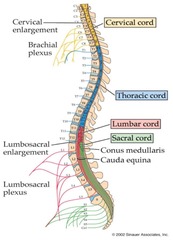
Conus Medullaris
Terminal end of spinal cord at L1-L2.
Cauda Equina
Bundle of spinal nerves below conus medullaris.
ASIA Scale
Classification system for spinal cord injury severity.
DCML
Dorsal Column Medial Lemniscus pathway for proprioception.
ALS
Anterolateral system for pain and temperature sensation.
Corticospinal Tract
Descending tract controlling voluntary motor movements.
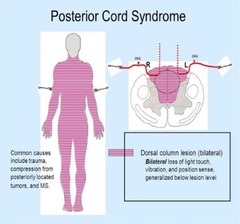
Posterior Cord Syndrome
Loss of proprioception and vibration; iatrogenic cause.
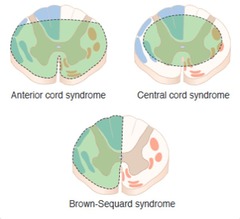
Anterior Cord Syndrome
Loss of pain/temperature and motor function; hyperflexion injury.
Central Cord Syndrome
Variable motor/sensory loss due to small/large lesions.
Brown Sequard Syndrome
Hemi-section injury causing ipsilateral and contralateral symptoms.
Ipsilateral Symptoms
Symptoms occurring on the same side as injury.
Contralateral Symptoms
Symptoms occurring on the opposite side of injury.
Vibration Sensation
Ability to perceive oscillating stimuli; tested via tuning fork.
Proprioception
Awareness of body position and movement.
Crude Touch Sensation
Basic sense of touch without fine discrimination.
Pain Sensation
Perception of harmful stimuli; mediated by STT.
Temperature Sensation
Ability to perceive heat and cold; mediated by STT.
Lumbar Puncture
Procedure performed at L3-L4 to avoid spinal cord injury.
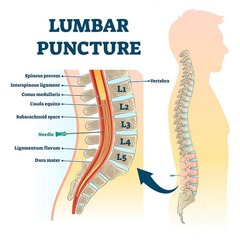
Vertebral Level
Specific location of vertebrae in the spinal column.
Spinal Nerve Root
Nerves exiting spinal cord through intervertebral foramen.
Conus Medullaris
End of spinal cord at L1-L2 vertebrae.
Cauda Equina
Bundle of spinal nerves below L2.
Sensory Distribution
Pattern of sensory loss in injury.
Motor Distribution
Pattern of motor loss in injury.
UMN
Upper Motor Neuron; affects voluntary movement.
LMN
Lower Motor Neuron; affects reflexes and muscle tone.
Complete Injury
No sensory or motor function at S4-S5.
Incomplete Injury
Some function below neurological level remains.
Anterior Cord Syndrome
Loss of motor function, preserved proprioception.
Posterior Cord Syndrome
Loss of proprioception, preserved motor function.
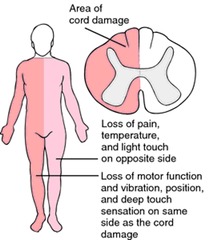
Brown-Sequard Syndrome
Hemisected spinal cord; unilateral symptoms.
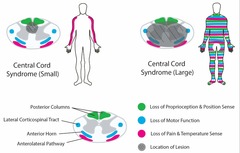
Central Cord Syndrome
Motor impairment greater in upper limbs.
C5 Muscle Group
Elbow flexors; key muscle for C5 level.
C6 Muscle Group
Wrist extensors; key muscle for C6 level.
C7 Muscle Group
Elbow extensors; key muscle for C7 level.
C8 Muscle Group
Finger flexors; key muscle for C8 level.
T1 Muscle Group
Fifth finger abductors; key muscle for T1.
L2 Muscle Group
Hip flexors; key muscle for L2 level.
L3 Muscle Group
Knee extensors; key muscle for L3 level.
L4 Muscle Group
Ankle dorsiflexors; key muscle for L4 level.
L5 Muscle Group
Long toe extensors; key muscle for L5 level.
S1 Muscle Group
Ankle plantar flexors; key muscle for S1 level.
ASIA A
Complete injury; no function at S4-S5.
ASIA B
Incomplete; sensory function below NLI.
ASIA C
Incomplete; less than half key muscles ≥3.
ASIA D
Incomplete; at least half key muscles ≥3.
ASIA E
Normal function; motor and sensory intact.
Motor Function Preservation
More than half key muscles below injury grade
Orthostatic Hypotension
Drop in blood pressure upon standing up
Autonomic Dysreflexia
Severe hypertension due to noxious stimuli
Respiratory Dysfunction
Impaired breathing function post-spinal injury
Urinary Retention
Inability to empty bladder completely
Bowel Retention
Inability to evacuate bowels effectively
Pressure Ulcers
Skin sores from prolonged pressure on skin
Contracture
Shortening of muscles/tendons affecting movement
Muscle Weakness
Reduced strength in affected muscle groups
Increased Muscle Tone
Higher than normal tension in muscles
Systolic Blood Pressure Rise
Increase of 20-30 mmHg indicates AD
Noxious Stimuli
Painful stimuli triggering autonomic dysreflexia
Signs of Autonomic Dysreflexia
Severe headache, anxiety, flushing, blurred vision
Bladder Distension
Overfilled bladder causing discomfort and complications
Physical Therapy Interventions
Supine/prone strengthening and stretching exercises
Cervical Level Injury
Spinal injury affecting neck region
ASIA Scale
Assessment tool for spinal cord injury severity
Bradycardia
Slowed heart rate often seen in AD
Tachycardia
Increased heart rate potentially indicating distress
Hypotension
Abnormally low blood pressure, opposite of hypertension
Flaccidity
Lack of muscle tone, often in lower extremities
Positive Babinski Sign
Reflex indicating neurological impairment in adults