chapter 47 Animal development
 Call Kai
 Learn
Learn Practice Test
 Spaced Repetition
 Match
Match Flashcards
 Knowt Play
1/39

There's no tags or description
Looks like no tags are added yet.
Name | Mastery | Learn | Test | Matching | Spaced | Call with Kai | Chat |
|---|
No analytics yet
Send a link to your students to track their progress
40 Terms
model organisms
are used by biologist to study development, chosen for the ease with which they can be studied in the laboratory: sea urchin, frog, chick, nematode
fertilization
is the formation of a diploid zygote from a haploid egg and sperm
Acrosomal reaction
is triggered when the sperm meets the egg
the cortical reaction
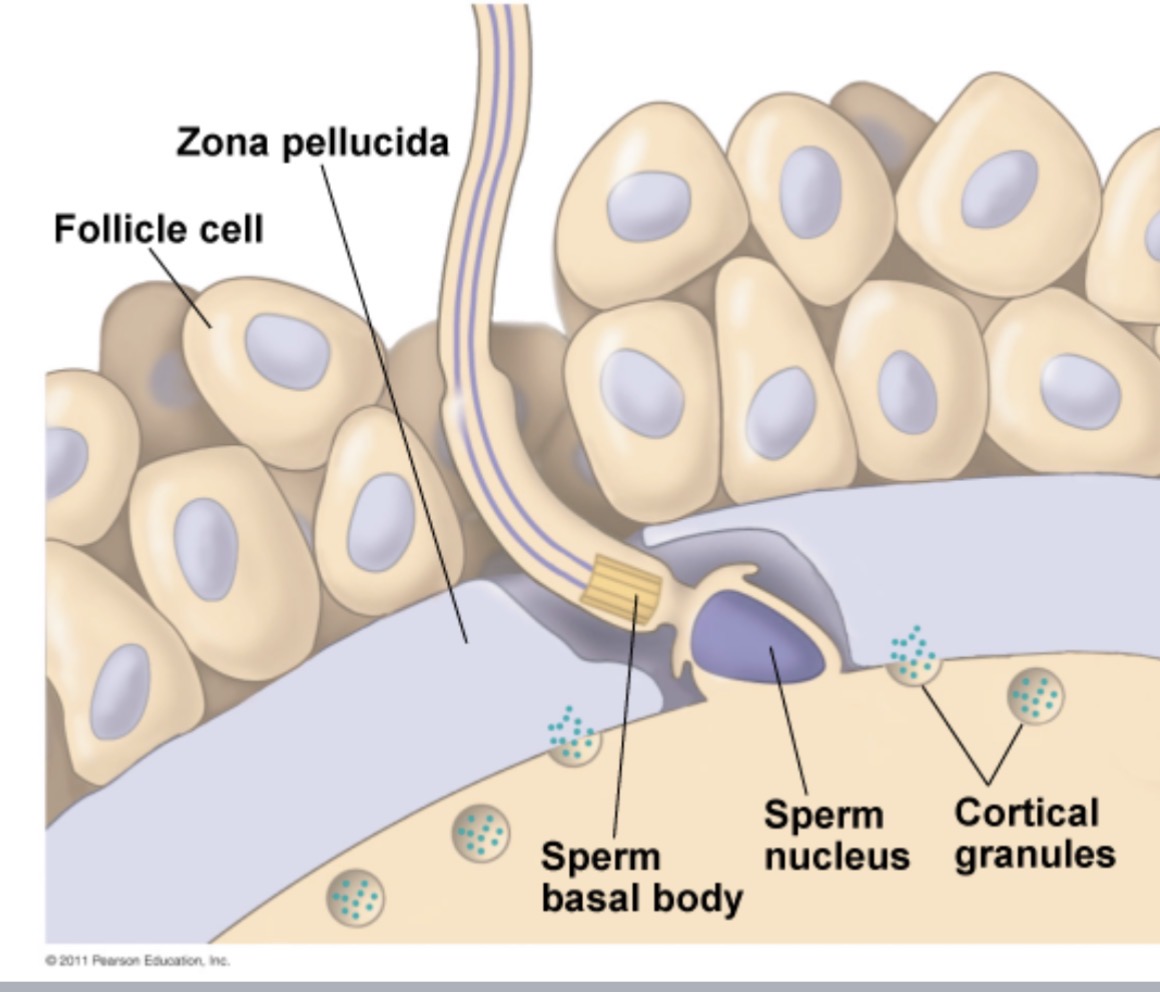
seconds after the sperm binds to the egg, vesicles just beneath the egg plasma membrane release their contents and form a fertilization envelope which acts as the slow block to prevent polyspermy
the acrosome
at the tip of the sperm releases hydrolytic enzymes that digest material surrounding the egg
High concentration of calcium ions
is required to the cortical reaction to take place
Egg Activation
The rise in Ca2+ in the cytosol increases the rates of cellular respiration and protein synthesis by the egg cell
•The proteins and mRNAs needed for activation are already present in the egg
•The sperm nucleus merges with the egg nucleus and cell division begins
zona pellucida
extracellular matrix of the egg
zona pellucida, or extracellular matrix of the egg
sperm must travel through a layer of follicle cells surrounding the egg, before it reaches the ___________
Cleavage
a period of rapid cell division without growth. fertilization is followed by this
blastomeres
are cleavage partitions the cytoplasm of one large cell into many smaller cells
blastula
is a ball of cells with a fluid-filled cavity called a blastocoel
blastocoel
fluid filled cavity in a blastula (a ball of cells)
holoblastic cleavage
complete division of the egg, occurs in species whose eggs have little or moderate amounts of yolk, such as sea urchins and frogs
meroblastic cleavage
incomplete division of the egg, occurs in species with yolk-rich eggs, such as reptiles and birds
morphogenesis
the process by which cells occupy their appropriate locations, involves
–Gastrulation, the movement of cells from the blastula surface to the interior of the embryo
–Organogenesis, the formation of organs
gastrulation
rearranges the cells of a blastula into a three layered embryo called a gastrula
organogenesis
the formation of organs
gastrula
is a three layered embryo
Embryonic Germ layers
The three layers produced by gastrulation
ectoderm
forms the outer layer
endoderm
lines the digestive tract
mesoderm
partly fills the space between the ectoderm and endodermis
ectoderm (outer layer of embryo)
• epidermis if the skin and its derivatives like sweat glands, hair follicles
• nervous and sensory systems
• pituitary gland, adrenal medulla
• jaws and teeth
• germ cells
mesoderm (middle layer of embryo)
skeletal and muscular systems
lymphatic and circulatory systems
excretory and reproductive systems (except germ cells)
dermis of skin
adrenal cortex
endoderm (inner layer of embryo)
epithelial lining of digestive tract and associated organs (liver, pancreas)
epithelial lining of respiratory, excretory and reproductive tracts and ducts
thymus, thyroid, and parathyroid glands
blastocysts
human equivalent of the blastula
inner cell mass
cluster of cells at one end of the blastocyst
trophoblast
is the outer epithelial layer of the blastocyst and does not contribute to the embryo, but instead initiates implantation
organogensis
various regions of the germ layers develop into rudimentary organs
neurulation
begins as cells from the dorsal mesoderm form the notochord, a rod extending along the dorsal side of the embryo
neural crest cells
develop along the neural tube of vertebrates and form various parts of the embryo (nerves, parts of teeth, skull bones, and so on)
somites
Mesoderm lateral to the notochord forms blocks
differentiation
refers to the resulting specialization in structure and function