Clinical Chemistry - Lecture 2: Electrolytes/Acid-Base Balance (Part 2)
 Call Kai
 Learn
Learn Practice Test
 Spaced Repetition
 Match
Match Flashcards
 Knowt Play
1/125

There's no tags or description
Looks like no tags are added yet.
Name | Mastery | Learn | Test | Matching | Spaced | Call with Kai |
|---|
No analytics yet
Send a link to your students to track their progress
126 Terms
What does the Coulometric-amperometric method measure for chloride determination?
It measures chloride indirectly by generating silver ions (Ag⁺) that react with chloride (Cl⁻).
In Cotlove titration, the number of silver ions generated is proportional to what?
The concentration of chloride (Cl⁻) in the sample.
Is the Coulometric-amperometric method a direct or indirect method?
It is an indirect method.
What are the advantages of the Coulometric-amperometric (Cotlove) method?
It is accurate and rapid.
What is an important maintenance requirement for the electrodes in this method?
The electrodes must be kept clean.
What substance can interfere with the Coulometric-amperometric chloride method?
Bromide (Br⁻).
What are the specimen requirements and stability for the Coulometric-amperometric chloride method?
They are the same as for the ISE (Ion-Selective Electrode) method.
What is the major component of total CO₂ in plasma?
Bicarbonate (HCO₃⁻), which makes up more than 90% of total CO₂.
What buffering system is bicarbonate part of?
The bicarbonate-carbonic acid buffering system.
What is the main transport form of CO₂ in the blood?
Bicarbonate (HCO₃⁻).
What happens to bicarbonate in the renal tubules?
It is almost completely reabsorbed.
Besides plasma, where else is bicarbonate found?
In cerebrospinal fluid (CSF).
What is the reference interval (RI) for serum bicarbonate (CO₂)?
22-28 mEq/L.
What can cause increased bicarbonate (HCO₃⁻) levels?
Excess ingestion of antacids and renal overcompensation for respiratory acidosis.
Why does respiratory acidosis increase bicarbonate levels?
The kidneys retain more bicarbonate to help buffer the excess acid.
What conditions can decrease bicarbonate (HCO₃⁻) levels?
Diarrhea, metabolic acidosis, and renal overcompensation for respiratory alkalosis.
Why does diarrhea decrease bicarbonate levels?
Bicarbonate is lost through the gastrointestinal tract.
Why is bicarbonate decreased in metabolic acidosis?
Bicarbonate is used up buffering excess acids.
What analytical method is commonly used to measure bicarbonate?
A modified pH method.
How does the modified pH method for bicarbonate work?
CO₂ diffuses through a semipermeable membrane into an electrolyte solution, causing a pH change that is measured.
What specimen type is used for bicarbonate testing?
Serum or plasma.
Why must bicarbonate specimens be kept capped?
To prevent CO₂ from escaping, which could falsely lower results.
What is the anion gap (AG)?
A calculation of the difference between measured anions and cations in the blood.
Even when there is an anion gap, what is still maintained in the body?
Electrolyte neutrality.
What is the most common formula for calculating anion gap? and the reference range?
AG = Na⁺ − (Cl⁻ + HCO₃⁻)
7–16.
What is another formula used to calculate anion gap? (using Potassium) and the reference range?
AG = (Na⁺ + K⁺) − (Cl⁻ + HCO₃⁻)
10-20.
What does a large anion gap usually indicate?
Excess unmeasured anions in the blood.
What are examples of unmeasured anions that can increase the anion gap?
PO₄³⁻ (phosphate), SO₄²⁻ (sulfate), organic acids, and lactic acid.
What conditions can cause an increased anion gap?
Uremia/renal failure, lactic acidosis, methanol poisoning, salicylate poisoning, and instrument error.
Why does lactic acidosis increase the anion gap?
Excess lactic acid adds unmeasured anions to the blood.
In what form are calcium and phosphorus found in bone?
As calcium phosphate crystals.
What are the two main forms of calcium in the blood?
Non-diffusible (bound) calcium and diffusible (free/ionized) calcium.
What is non-diffusible calcium?
Calcium bound mainly to albumin that cannot easily cross membranes.
Approximately how much total calcium is bound to albumin?
About 45-50%.
What happens to total calcium levels in hypoalbuminemia?
Total calcium decreases because less calcium is bound to albumin.
In hypoalbuminemia, what usually happens to ionized (free) calcium?
Ionized calcium usually remains normal.
How does acidosis affect free (ionized) calcium?
Acidosis increases free calcium.
How does alkalosis affect free (ionized) calcium?
Alkalosis decreases free calcium.
What is diffusible calcium?
Free ionized calcium that is physiologically active.
Which form of calcium is physiologically active?
Ionized (free) calcium.
Which form of calcium can cross the blood-brain barrier?
Diffusible (ionized/free) calcium.
What is the reference interval (RI) for calcium (Ca)?
9-11 mg/dL (2.25-2.75 mmol/L).
What is the adult reference interval (RI) for phosphorus (P)?
3.0-4.5 mg/dL (0.75-1.1 mmol/L).
What is the pediatric reference interval (RI) for phosphorus (P)?
4.5-6.5 mg/dL (1.1-1.6 mmol/L).
What are common symptoms of hypercalcemia?
Lethargy, hyporeflexia, nausea, and vomiting.
What complications can hypercalcemia increase the risk for?
Pancreatitis and peptic ulcers.
What endocrine disorder commonly causes hypercalcemia?
Hyperparathyroidism.
Why does hyperparathyroidism cause hypercalcemia?
Because of high secretion of parathyroid hormone (PTH), which raises blood calcium levels.
How can excess vitamin D affect calcium levels?
Hypervitaminosis D can cause hypercalcemia.
What cancer is associated with hypercalcemia and CRAB syndrome?
Multiple myeloma.
What does CRAB stand for in multiple myeloma?
Calcium elevation, Renal problems, Anemia, and Bone lesions.
What are common symptoms of hypocalcemia?
Neurologic excitability, hyperreflexia, periorbital tingling (paresthesia), and muscle spasms.
What classic physical signs are seen in hypocalcemia?
Chvostek sign and Trousseau sign.
What severe complications can occur in hypocalcemia?
Tetany and respiratory arrest.
What endocrine disorder can cause hypocalcemia?
Hypoparathyroidism.
How can decreased absorption lead to hypocalcemia?
Conditions like steatorrhea reduce calcium absorption from the intestine.
How can nephrosis contribute to hypocalcemia?
Excess protein loss lowers albumin-bound calcium levels.
What conditions can cause hyperphosphatemia?
Hypoparathyroidism, hypervitaminosis D, and renal failure.
Why does hypoparathyroidism cause hyperphosphatemia?
Low PTH decreases phosphate excretion by the kidneys, causing phosphate to build up.
How can hypervitaminosis D affect phosphate levels?
Excess vitamin D increases phosphate absorption, leading to hyperphosphatemia.
Why does renal failure cause hyperphosphatemia?
The kidneys cannot properly excrete phosphate.
What conditions can cause hypophosphatemia?
Hyperparathyroidism, rickets, Fanconi syndrome, and absorption problems like sprue and celiac disease.
Why does hyperparathyroidism cause hypophosphatemia?
Excess PTH increases phosphate excretion by the kidneys.
What vitamin deficiency disease is associated with hypophosphatemia?
Rickets.
What renal disorder can cause hypophosphatemia due to phosphate wasting?
Fanconi syndrome.
What gastrointestinal disorders can cause hypophosphatemia from poor absorption?
Sprue and celiac disease.
What is hyperparathyroidism?
A condition with excessive secretion of parathyroid hormone (PTH).
What can primary hyperparathyroidism cause?
Renal disorders and irreversible kidney damage.
What causes secondary hyperparathyroidism?
Renal disorders that increase serum phosphorus and lower serum calcium, which stimulates increased PTH secretion.
Why does kidney disease lead to secondary hyperparathyroidism?
Diseased kidneys retain phosphorus and lower calcium levels, triggering more PTH release.
What is hypoparathyroidism?
A condition with decreased secretion of parathyroid hormone (PTH).
What is the most common cause of hypoparathyroidism?
Thyroidectomy.
What does iatrogenic mean in hypoparathyroidism?
The condition was caused by medical treatment or surgery.
How does hypoparathyroidism affect phosphorus levels?
It decreases urinary phosphorus excretion, causing increased serum phosphorus.
How does hypoparathyroidism affect calcitriol levels?
It decreases 1,25(OH)₂ vitamin D (calcitriol) levels.
What laboratory findings are seen in hypoparathyroidism?
Low serum PTH, low serum calcium, high serum phosphorus, low urine calcium, and normal ALP.
Why can alkalosis cause hypocalcemia?
Alkalosis increases calcium binding to albumin, which lowers free ionized calcium levels in the blood.
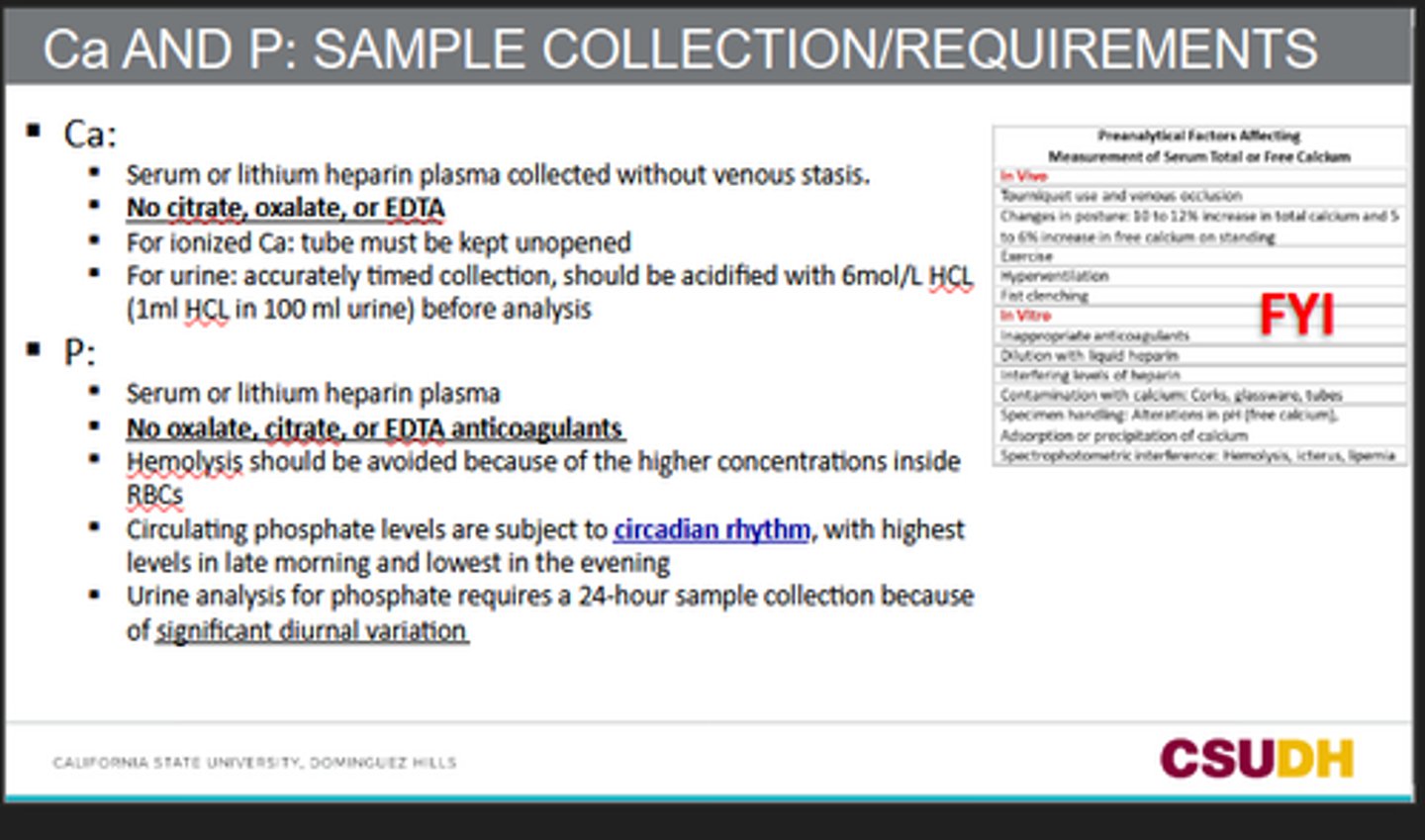
What specimen types are used for calcium testing?
Serum or lithium heparin plasma.
Why should venous stasis be avoided during calcium collection?
Venous stasis can falsely increase calcium levels.
Which anticoagulants should NOT be used for calcium testing?
Citrate, oxalate, and EDTA.
Why are citrate, oxalate, and EDTA not used for calcium testing?
They bind calcium and falsely decrease results.
What special handling is required for ionized calcium specimens?
The tube must be kept unopened.
Why must ionized calcium tubes remain unopened?
Exposure to air changes pH, which affects ionized calcium levels.
How should urine specimens for calcium testing be preserved?
They should be accurately timed and acidified with 6 mol/L HCl (1 mL HCL in 100 mL urine) before analysis.
What specimen types are used for phosphorus testing?
Serum or lithium heparin plasma.
Which anticoagulants should NOT be used for phosphorus testing?
Oxalate, citrate, and EDTA.
Why should hemolysis be avoided in phosphorus testing?
RBCs contain high amounts of phosphorus, which can falsely increase results.
What does circadian rhythm mean for phosphate levels?
Phosphate levels change throughout the day.
When are phosphate levels highest and lowest?
Highest in late morning and lowest in the evening.
Why is a 24-hour urine collection required for phosphate testing?
Because phosphate levels show significant diurnal variation.
What is diurnal variation?
Normal changes in levels throughout the day.
What are the two major types of metabolically produced acids?
Volatile acids and non-volatile acids.
What is the main volatile acid in the body?
Carbon dioxide (CO₂).
Approximately how much volatile acid (CO₂) is produced daily by normal metabolism?
Approximately how much volatile acid (CO₂) is produced daily by normal metabolism?
How is volatile acid removed from the body?
Through the lungs.
What are examples of non-volatile acids?
Uric acid, phosphoric acid, and sulfuric acid.
Approximately how much non-volatile acid is produced daily?
Around 100 mmol/day.
Can non-volatile acids be removed by the lungs?
No, they must be excreted by the kidneys instead.
In what form are non-volatile acids mainly present in the body?
As conjugated salts.
What is the main buffer system discussed in this slide?
The bicarbonate-carbonic acid buffer system.