ceutics 1 dosage form design
 Call Kai
 Learn
Learn Practice Test
 Spaced Repetition
 Match
Match Flashcards
 Knowt Play
1/52

There's no tags or description
Looks like no tags are added yet.
Name | Mastery | Learn | Test | Matching | Spaced | Call with Kai | Chat |
|---|
No analytics yet
Send a link to your students to track their progress
53 Terms
define pharmaceutics
The science of dosage form design
-> turning a NCE or API into safe and effective dosage form

NCE
'New chemical entity'. A newly discovered drug, in the early stages of testing
API
Active pharmaceutical ingredient (exerts pharmacological effect)
generally, while drugs are made with the disease in mind, pharmaceutics caters to?
patient needs
pre-formulation
involves the characterization of a drug's physical, chemical, and mechanical properties in order to choose what other ingredients (excipients) should be used in the preparation
ex: vaccine formulation-> under what temp will it survive? what ingredients will curb stress?
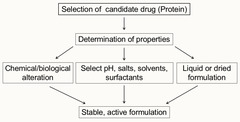
excipients
inactive substances used as a carrier for the active ingredients of a medication

describe what characteristics are considered during pre-formulation
1. particle size/distribution
2. polymorphism
3. solubility
4. dissolution rate
5. membrane permeability
6.pKa
7. stability
8. partition coefficient
why wouldn't you give a pure drug to a patient?
small doses, unstable, patient compliance
a dosage form relies on what 2 elements
1. formula
2. process
define dosage form
a preparation devised to make possible the administration of medication in measured amount
(API + excipients)
drug substance
Active Pharmaceutical Ingredient (API)
what makes a drug product
drug substance (API) and excipients
identify 8 benefits of dosage forms
1. correct dose
2. protect API during storage
3. protect APi from gastric acid
4. conceal bad taste/odor
5. rate-controlled drug action (extended release, etc)
6. optimal drug action topically
7. insertion into cavities
8. inhalation therapy
pharmacokinetics vs pharmacodynamics
Pharmacokinetics: What the BODY does to the drug (metabolism, excretion)
Pharmacodynamics: What the DRUG does on the body
(pharmacological effect)
biopharmaceutics
the study of the physical and chemical properties of drugs and their proper dosage as related to the onset, duration, and intensity of drug action
(release, dissolution, absorption)

passive vs facilitated diffusion
passive: passes through membrane from high to low
facilitated: passes through membrane from high to low through CARRIER PROTEIN
**no energy needed for both (unlike active)

active transport
requires both carrier protein and ENERGY

endocytosis
process by which a cell takes material into the cell by infolding of the cell membrane

where does most drug absorption take place
small intestine
what drives absorption in passive diffusion
concentration gradient
Fick's first law states what 2 things are proportional
The rate of drug diffusion is proportional to the concentration gradient.
What is Fick's first law of diffusion?
-dQ/dt = DAK /h (Ca-Cp)
dQ/dt= rate of drug diffusion
D= diffusion rate coefficient
A: surface area
K: partition coefficient (oil/water)
h= thickness of membrane
Ca-Cp: concentration gradient
*note: (DAK/h)=P or permeability coefficient
increase in D, A, K means increased diffusion
increase in h (thickness) means less
example of drug that uses active transport
5-fluoracil
anti-cancer drug that uses active transport to go from low to high concentrations using energy
example of drug that uses facilitated diffusion
cephalosporin
-> goes from high to low but uses carrier protein (no energy)
describe the necessary protonation state for a drug to pass through a membrane
only the NON ionized (no charge) form of a drug passes through a cell membrane
how can an acid pass through a membrane? a base?
HA: protonated acids can pass (no charge)
B: unprotonated bases can pass (no charge)
A- and HB+ cannot pass
what is pKa
the pH at which there are equal amounts of the unprotonated and protonated form of weak acid or base

Henderson-Hasselbalch equation
pH = pKa + log [A-]/[HA]
(base over acid)
![<p>pH = pKa + log [A-]/[HA]</p><p>(base over acid)</p>](https://assets.knowt.com/user-attachments/3efd4e52-b6aa-4d41-ad4c-1acb9a83a668.jpg)
EX:
A drug is a weak acid with pKa=3. At a pH of 2, will the drug be absorbed?
pH = pKa + log [A-]/[HA]
2 = 3 + log(x)
-1= log(x)
10^-1 = x
x= 1/10 so 1 A- for every 10 HA so more uncharged molecules= it is absorbed
EX:
A drug is a weak base with pKa=10. At a pH of 8, will the drug be absorbed?
8 = 10 + log [A-]/[HA]
-2 = log (B/BH+)
1/100 =x
so 1 base (uncharged) per 100 acid (charged)
more charged molecules so it will not be absorbed
*note for bases, it is not A- and HA. instead, it is B and BH+
ADME
Absorption (small intestine), Distribution (blood), Metabolism (liver), Excretion (urine/feces)
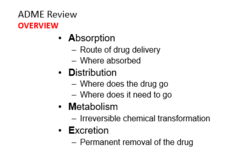
describe how the route of administration can affect time course of drug in body by giving examples
sublingual: quick to absorb but quick to be eliminated
intravenous: constant amount in body since continuously supplied

Bioavailability
how much of an oral dose reaches systemic circulation (ex: a metabolized drug is no longer bioavailable)

when is bioavailability 100%
never, unless through IV
why does bioavailability decrease when drugs are taken orally
1. incomplete absorption
2. first pass metabolism (liver)
what category of pharmacy is bioavailability crucial
pharmacokinetics
necessary to know how body responds to drug to calculate dose
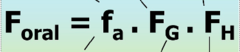
oral bioavailability equation
F= fa* Fg * FH
oral bioavailability= (fraction of dose released and passes through gut) (fraction not metabolized in intestine) (fraction escaped metabolism in liver)
Describe the 5 graph markers seen on a concentration vs time curve of a drug
Cmax= peak concentration
Tmax= time of peak concentration
AUC= area under curve= entire amount of drug in blood/plasma
MEC= minimum effective concentration
MTC= minimum toxic concentration
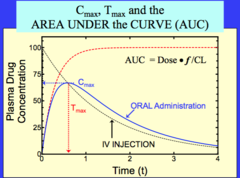
what does MEC on graph tell us
the minimum effective concentration
if drug does not surpass this, then t is not effective
what happens to Cmax and Tmax if the rate of drug absorption is increased
Cmax is increased and Tmax is decreased
what happens to Cmax and Tmax if the rate of drug absorption is decreased
Cmax is lowered and Tmax is longer/ later
Drug A has a later Tmax but more time spent above MEC. Drug B has an earlier Tmax but less time spent above MEC. What does this mean?
Drug A has a later onset but longer duration of action.
Drug B has rapid onset of action but shorter duration of time.
AUC
area under the curve
measure of the total amount of drug absorbed into circulation
Can 2 curves with different C max and Tmax have same AUC?
yes. AUC is measure of the total amount of drug absorbed into circulation. excipients may be different.
what does it mean 2 equivalent doses of the same drug are given but they provide different AUC values
there is a difference in how much of each drug is absorbed
absolute bioavailability
fraction of drug absorbed through non IV compared to IV (which is 100% bioavailable)

relative bioavailablity
fraction of certain drug absorbed when compared to another formulation of same drug
absolute vs relative bioavailability
Absolute = IV to not IV (one drug oral vs IV)
Relative = not IV to not IV (2 drugs given orally)
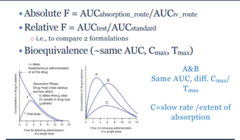
bioequivalence
AUC and Cmax are similar
drugs are similar in both rate and extent of bioavailability (superimposable concentration vs time graphs)

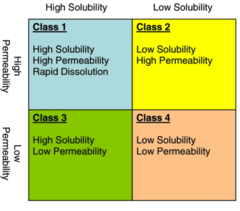
BCS
biopharmaceutics classification system
classifies drugs based on aqueous solubility and membrane permeability for ORALLY administered drugs
Which BCS class has best absorption
BCS1= high solubility, high permeability

Which BCS class is least likely to make it to market due to issues pertaining to bioavailability?
BCS 4= low solubility, low permeability
BCS 2=
low solubility, high permeability